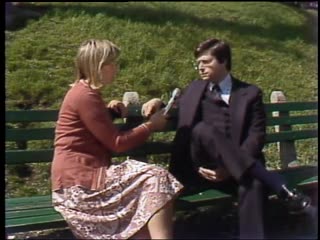
Description: Andrew Young (Mayor of Atlanta) endorses Mel King (candidate for Mayor of Boston) at a press conference at Northeastern University. Jim King (Senior Vice President, Northeastern University) introduces Young. Young talks about King's candidacy for mayor of Boston. King says that he and Young have discussed ideas for local job creation and for trade between local businesses and third world markets. In response to audience questions, Young talks about his recommendation that King set up a trade mission to export local manufactured goods. King discusses the value of his endorsement of King and the differences among the political situations in Boston, Chicago, and Philadelphia. Young says that he does not consider Boston to be a racist city. Young talks about the potential impact of the African American community on the election outcome. Young refuses to comment on the the presidential campaign of Jesse Jackson.
1:00:06: Visual: Andrew Young (Mayor of Atlanta) walks sits down at a table next to Mel King (candidate for Mayor of Boston). Mel King's campaign signs are visible on the walls of the room. Behind King and Young is a Northeastern University flag. A young African American woman announces that Young and "future mayor" Mel King will speak; that they will take questions after. Jim King (Senior Vice President, Northeastern University) introduces Young. He reviews Young's accomplishments. Shots of the audience. Young says that King's leadership will benefit Boston. Young talks about the importance of housing and neighborhood revitalization. Young says that King will work to reduce unemployment; that King will work with existing businesses and help to build new businesses. Young says that King is familiar with urban problems. Young commends King for his strong marriage, his family, and his values. 1:03:33: V: King calls Young "Mayor Class." King says that Young is one of the classiest politicians in the world; that Young has a world view which allows him make connections between his city and events in the greater world. King says that he and Young discussed how to create jobs in Boston; that Young has given him advice on how to unlock third world markets; that the city can help neighborhoods and businesses take advantages of these markets to create jobs. King thanks Young for coming to Boston. The audience applauds. 1:05:53: V: The audience asks questions. An audience member asks Young about his experiences as the Mayor of Atlanta. Young says that it is "fun" to solve local problems. Young says that he has recommended that King set up an export trading company to help export the city's manufactured goods. Young talks about trade missions that he has undertaken as Mayor of Atlanta. Young says that he has gone on trade missions to Trinidad and Jamaica, and is planning a trade mission to Nigeria. Young talks about how trade missions can benefit local businesses and industry. Young says that he and Henry Cisneros (Mayor of San Antonio) share the leadership of a task force for the National League of Cities; that mayors can create jobs by promoting international opportunities for local industry. Young says that Boston could export many products; that King is concerned about creating jobs through exports. Young says that he appointed a woman as Deputy Chief of Police in Atlanta; that her appointment heightened awareness of crimes against women in the city. Young says that it is important for a mayor to be responsive to problems of those who have been ignored; that King will be responsive. 1:09:59: V: An audience member asks Young about the value of his endorsement of King. Young says that Boston needs a good mayor; that he does not judge Boston to be a racist city on the basis of the actions of a few "hoodlums"; that there are voters who will elect King on the basis of his values and his positions on unemployment and crime; that skin color is not important. Young says that he is here as an urban mayor to remind people about important urban issues; that he is able to get television exposure for King. The audience applauds. An audience member asks Young about similarities in the political situations in Boston, Chicago and Philadelphia. Young says that there are few similarities; that there was a "revolution" against the mayor in Chicago; that there is more racial antagonism in Chicago than there is in Boston. Young says that Wilson Goode (candidate for Mayor of Philadelphia) will be elected because of his experience and broad support. Young says that he hopes King will emerge with broad support in Boston. Young refers to Boston's revolutionary history, saying that he hopes the city will rally around King. 1:14:11: V: An audience member points out that Boston has a small African American community with a record of low voter turnout. Young uses the example of Los Angeles as a city with a small minority population and a popularly elected African American mayor. An audience member asks Young to speculate on the chances of Jesse Jackson (African American political leader) being elected to the presidency. Young says that it is too soon to speculate on anyone's campaign for the presidency. 1:16:23: V: Young answers more questions from the audience. Shots of Young from behind the audience and media; of members of the audience. Audio cuts in and out during this segment. Young talks about the need for "open and honest" government and a good relationship with the press. King answers a question about his campaign. The moderator announces an end to the press conference. 1:18:45: V: Young and King greet members of the audience and the media.
Collection: Ten O'Clock News
Date Created: 09/22/1983
Description: "Leader: Your Place and Mine: "Secretaries", A Roll Women singing a protest song about more pay for women. Women leading the song in front of a small crowd in front on a van. Microphone used for protest doesn't have good sound. Woman speaks in front of the crowd, reading the "Bill of Rights for Women Office Workers". Shot of crowd. Interview with an older women, Florence Lascomb. She discusses being involved in the women's movement since her mother took her to the National Women's Suffrage Convention in 1892. She talks about a union that she started in the 1930's for working women in Boston. Interview with a young woman about being an office worker and her involvement in the 9 to 5 organization and the women's right movement. Cut to a women holding a sign that reads "Nat'l Secretaries Day: Raises not Roses. 9 to 5 Organization." Close up of the Bill of Rights for Women Office Workers. Shots of the crowd during the rally. Women holding signs. Note: Suffragette Florence Luscomb interviewed. Looks like the same protest from 2394.12379. National Secretaries Day in 1974 was on April 24th, so the 25th is the airdate. It was in the 4/8/1974 can, but 4/25/74 is most likely the correct airdate. Updated title to reflect the event. "
Collection: WCVB Collection
Date Created: 04/08/1974
Description: Man speaking from the Department of Youth Services on plans to install more intensive care units in their Rosindale facility. Answers question about their recidivism rate. Footage includes press conference, a hallway and cells, exterior of the Division of Youth Service building. Mix of sound and silent.
Collection: WCVB Collection
Date Created: 02/13/1973
Description: "Leader: "P2 Zayre - Natick #10760 12/16/74"; Interview with a detective about an attempted robbery at a Zayre store in Natick. Footage of police with guns outside and inside the store. More of the interview with Police Chief about the attempted robbery, hostages taken, and the capture of the suspect. More silent b-roll of the police around the store and the interview."
Collection: WCVB Collection
Date Created: 12/16/1974
Description: Tug Yourgrau interviews Zwelakhe Sisulu (South African journalist) about reactions in the South African townships to the play Woza Albert. Sisulu discusses censorship and the facilities in the townships where the play has been staged. Yourgrau and Sisulu talk about why the South African government has failed to ban Woza Albert; they talk about the government's attitude toward Bishop Desmond Tutu (South African anti-apartheid leader). Yourgrau and Sisulu discuss the effect of the Soweto uprising on black political consciousness in South Africa and the related politicization of black theater in South Africa. Yourgrau and Sisulu analyze the relationship of black theater to political rallies in South Africa and to black political culture. Sisulu talks about the multi-lingual, multi-ethnic nature of black South African society. Sisulu discusses the banning of theater groups or theatrical works by the South African government. Sisulu says that black theater portrays the situation in South Africa more accurately than the US media.
0:00:59: Visual: Tug Yourgrau interviews Zwelakhe Sisulu (South African journalist). The two are sitting among shelves of books. Yourgrau asks about the reaction to Woza Albert in the South African townships. Sisulu says that the play has had a good run in the townships; that the actors have enjoyed a good rapport with the audiences in the townships; that the audience becomes part of the play when it is run in the townships. Yourgrau asks where plays are staged in the townships. Sisulu says that the play is run in community halls or church halls in the townships; that there are no theaters in the townships. Sisulu notes that the play must have the approval of the township superintendent in order to be staged in the community hall. Sisulu says that the facilities in the township are inadequate. Sisulu says that the township supervisors are appointees of the South African government; that they are members of the white ruling party. Yourgrau notes that Woza Albert has never been banned. Sisulu notes that Woza Albert has never been staged in a community hall; that community halls were burnt down in 1976. Sisulu says that Woza Albert was staged in church halls or independently owned halls in the black community. Sisulu says that community halls were rebuilt as administrative offices for the government. Yourgrau asks if the government has shown tolerance by not banning the play. Sisulu says that the black community is beginning to exhibit some power in South Africa; that the black community is more militant. Sisulu notes that the government is aware that a ban of the play could provoke a crisis. Yourgrau asks about the government's attitude toward Bishop Desmond Tutu (South African anti-apartheid leader). Sisulu says that the government would like to jail Tutu; that the government cannot act against Tutu because of his standing in the international community. Sisulu says that the government cannot ban Woza Albert because of its international reputation. 1:05:22: V: Yourgrau asks again about the reaction to Woza Albert in the black townships. Sisulu talks about the good rapport between the actors and the audience in the townships. Sisulu says that the audience is seeing their own lives played out on stage. Yourgrau asks about the effect of the Soweto uprising on black consciousness in South Africa. Sisulu asks Yourgrau to define "black consciousness." Yourgrau asks about black political consciousness. Sisulu says that South African blacks began to assert their power in 1976. Sisulu talks about the origins of protest theater and protest poetry in 1969. Sisulu says that contemporary black theater in South African focuses on social issues and apartheid; that earlier black theater focused on entertaining people. Sisulu says that 1976 brought changes in black political consciousness and in black theater. Yourgrau asks how black theater has changed. Sisulu talks about the change in black theater since 1976. Sisulu says that theater has turned away from singing and dancing; that one-man and two-man plays are common since 1976. Sisulu says that contemporary black theater in South Africa is concerned with creating a dialogue about apartheid and South African society. 1:09:59: V: Yourgrau asks if black theater is present at political rallies in South Africa. Sisulu says that a typical political rally in Soweto includes speeches, poetry, and theater. Sisulu notes that speeches are often in English; that the plays are performed in native languages; that theater is used to get the message across to all people. Sisulu says that theater has become a part of black political culture. Yourgrau asks about the multiple languages used in Woza Albert. Sisulu says that black South African culture is multi-lingual. Sisulu says that black South Africans are not divided by language or ethnicity; that residents of Soweto can communicate in several different languages. Yourgrau asks if theater groups have been banned in South Africa. Sisulu says that a theater group was banned along with other organizations in October of 1977. Sisulu says that the government would ban a particular script instead of all works by a particular playwright. Sisulu adds that township managers would refuse to give permission for some plays to be staged. Yourgrau asks if the recent strike by black workers in the Transvaal area is an isolated event. Sisulu says that the US media does not present an accurate depiction of events in South Africa; that the US media portrays the situation in terms of riots and disturbances. Sisulu says that there is a "low-scale civil war" in South Africa. Sisulu says that South African black theater accurately reflects the situation.
Collection: Ten O'Clock News
Date Created: 11/08/1984
Description: Christopher Lydon reports that the Nieman Foundation has awarded Zwelakhe Sisulu (South African journalist) the Louis Lyons Award. Sisulu has been jailed by the South African government and has not been charged with a crime. Michael Pride (Concord Monitor of Concord, NH) and Al Max (Chairman, Lyons Committee) at a press conference. Pride talks about Sisulu's courage. Max says that Sisulu is the third South African journalist to win the award. Lydon notes that Zwelakhe Sisulu is the son of Walter Sisulu (founder of the African National Congress), who has been jailed since 1964 and is featured prominently in a new documentary film about the life of Nelson Mandela. Lydon's report includes photos of Zwelakhe Sisulu and footage from the HBO film Mandela. Fernando Lima (Mozambique News Agency) speaks about Zwelakhe Sisulu.
1:00:03: Visual: Footage of Mike Pride (Concord Monitor of Concord, NH) at a press conference. Pride talks about Zwelakhe Sisulu's great courage in the face of adversity. Shots of photos of Sisulu. Christopher Lydon reports that Sisulu's father was the founder of the African National Congress (ANC); that Walter Sisulu and Zwelakhe Sisulu are both in jail in South Africa. V: Footage from the Home Box Office (HBO) film Mandela. Lydon reports that Walter Sisulu is a major figure in the HBO film about the life of Nelson Mandela (ANC leader). Lydon notes that Mandela has been jailed since 1962; that Walter Sisulu has been jailed since 1964; that Oliver Tambo (ANC leader) has been exiled from South Africa. Shot of a black and white photo of Zwelakhe Sisulu. Lydon reports that Zwelakhe Sisulu has been jailed; that Zwelakhe Sisulu has not been charged with any crime. Lydon notes that Zwelakhe Sisulu will be honored by the Neiman Foundation. V: Footage of Al Max (Chairman, Lyons Committee) at a press conference. Max says that Sisulu is the third South African to have won the award. Max says that he hopes that Sisulu will be the last South African to win the award while in in prison. Footage of Fernando Lima (Mozambique News Agency). Lima speaks for Zwelakhe Sisulu, saying that apartheid is the cause of the trouble and disturbances in South Africa.
Collection: Ten O'Clock News
Date Created: 09/18/1987
Description: Carmen Fields interviews South African journalist Zwelakhe Sisulu about the situation in South Africa. Sisulu was jailed for two years without charges by the South African government. Footage of Sisulu celebrating with his family upon his release from jail. Sisulu discusses his confinement and the terms of his release. He talks about the government's censorship of the press, including his newspaper New Nation. Sisulu urges the US to impose sanctions on the South African government and talks about the effects of sanctions. Fields notes that F.W. de Klerk is expected to be elected the new leader of South Africa on September 6, 1989, and the black majority in South Africa is not allowed to vote. Fields's report includes footage of de Klerk giving a speech and footage of South African citizens. Sisulu says that does not believe that de Klerk will institute changes in the South African regime. Sisulu says that the black majority will not be content with negotiations. He says that the tension is great because the black majority wants a transfer of power.
1:00:07: Visual: Footage of Zwelakhe Sisulu (South African journalist) being interviewed by Carmen Fields. Sisulu says that he spent nine months in solitary confinement. Fields reports that Sisulu was in jail in South Africa last year; that Sisulu was detained for two years without charges being brought against him. V: Footage of Sisulu talking about the negative psychological effects of detention. Sisulu says that confinement can often strengthen the resolve of the prisoner. Footage from a news story from December 2, 1988. The news footage shows Sisulu celebrating with his family upon being released from jail. Shot of Sisulu sitting next to a woman who is speaking to the media at a press conference. Shot of the media at the press conference. Fields reports that Sisulu is forbidden from attending gatherings of more than ten people; that Sisulu is banned from speaking to or being quoted by the press; that Sisulu is banned from practicing his profession of journalist. Fields reports that Sisulu was the editor of the New Nation newspaper. V: Shot of the masthead of the New Nation newspaper. Fields reports that Sisulu now works in the circulation department of the newspaper. V: Footage of Sisulu talking about the difficult conditions in South Africa. Sisulu says that the New Nation newspaper was banned for three months last year. Shots of the offices of the New Nation newspaper; of employees in the offices of the New Nation newspaper. Sisulu says that the newspaper has a lawyer who advises them on the regulations of South African law. Sisulu says that it is no longer possible for lawyers to advise them on the law. Sisulu says that the emergency regulations imposed by the South African government are arbitrary; that police officers are the sole arbiters of the law. Shot of a poster with photographs of imprisoned South African leaders including Walter Sisulu and Nelson Mandela. Fields reports that Zwelakhe Sisulu's father, Walter Sisulu, is imprisoned; that there have been rumors of the impending release of Mandela and the elder Sisulu. V: Footage of Zwelakhe Sisulu saying that the South African regime is playing politics. Sisulu says that the South African government may be making conciliatory moves in order to convince Western governments to roll over their debts next year. Sisulu says that the South African governments always talk about releasing Mandela when they want to improve their relations with the outside world. Sisulu says that he does not believe these rumors. Fields reports that Sisulu believes that US business sanctions are effective. V: Footage of Sisulu saying that the flight of US capital from South Africa has had a sobering effect on the South African government. Sisulu says that the South African government has pulled out of Angola as a result of US sanctions. Sisulu says that the South African government is now trying to attract investment to the country; that the government is facing an economic crisis. Fields asks Sisulu about the effects of sanctions on black South Africans. Sisulu says that many black South Africans have lost their jobs as a result of sanctions; that black South Africans are prepared to suffer in order to bring down the South African regime. Sisulu says that the effects of sanctions are now visible. Footage of F.W. de Klerk (South African National Party leader) addressing an audience of white South Africans. De Klerk says that South Africa can be saved if there is hope in the hearts of all people. Shot of de Klerk and a woman walking on a street in South Africa. Fields reports that de Klerk is expected to succeed P.W. Botha as president of South Africa. V: Shot of white South African officials walking in a garden. Fields reports that South Africa's election day is September 6; that the country's black majority is not allowed to vote. Fields notes that some white South Africans do not support changes in the country's regime. V: Shot of a black South African and a white South African walking past a store. Shot of a white man and a white boy sitting on swings at a playground. A sign posted on the fence of the playground reads "Whites only." Footage of Sisulu saying that many believe that de Klerk will promote change within the South African military regime. Sisulu says that all nationalist prime ministers begin their terms on a conciliatory note. Sisulu refers to former South African leader John Foster and present leader Botha. Sisulu says that de Klerk's statement are aimed at improving South Africa's image abroad. Sisulu says that de Klerk's statements have no substance. Shot of de Klerk addressing an audience of white South Africans. Footage of Sisulu saying that the South African regime has made it known that it might be ready to negotiate with black liberation movements. Sisulu says that the black liberation movements do not want to negotiate with the South African regime; that the black liberation movements will only discuss a transfer of power. Sisulu says that the tensions within South Africa are very great; that the housing shortage is severe; that there is a shortage of schools. Sisulu says that the situation in South Africa is likely to become explosive once again.
Collection: Ten O'Clock News
Date Created: 05/08/1989
Description: Story on Russian author and activist Alexander Solzhenitsyn who was exiled from the Soviet Union and now lives in Cavendish Vermont. Footage of Solzhenistyn's home, Cavendish and the surrounding countryside, town meeting, interview with townfolk about Solzhenintsyn, and reporter standup. Reporter voice-over through reel. Sound.
Collection: WCVB Collection
Date Created: 03/1986
Description: Story about a football player from Harvard, Andrew Poupolo, who was stabbed in a fight over a wallet that was stolen by prostitutes. He went into a coma and died one month later. The police has cracked down on the Combat Zone since the murder. Footage of the alley where he was stabbed, the hospital he was brought to, the Combat Zone at night, and police patrolling the street. Interview with a man about why this homicide case is getting priority. Reporter voice-overs, and reporter standups. Poor image quality. Mix of sound and silent.
Collection: WCVB Collection
Date Created: 12/06/1976
Description: Written on tape: "Arch-Law Abortion." Story on the Catholic Church and abortion. Footage of a Pro-life rally, Arch Bishop O'Connor speaking about abortion, and Archbishop Bernard Law speaking to Harvard students. Interview with Law on O'Connor's statements on abortion, the Catholic Church's views of abortion, and how the topic should not be a partisan issue. Reporter voice-over throughout reel. Sound.
Collection: WCVB Collection
Date Created: 10/18/1984