Description:
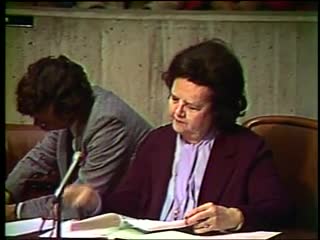
Thomas Saltonstall (Area Director, Equal Employment Opportunity Commission) speaks at a press conference to mark the opening of a Boston office of the Equal Employment Opportunity Commission (EEOC). Saltonstall introduces Robert Williams (regional attorney for the EEOC). Saltonstall discusses the EEOC's commitment to the elimination of race discrimination in employment and to equal opportunities for women, older workers and minorities; he announces the initiatives planned by the EEOC to enforce federal anti-discrimination laws. Saltonstall says that the EEOC will focus on voluntary compliance. Saltonstall discusses statistics illustrating the underrepresentation, or "opportunity gap," in the employment of women in management and of minorities in the city's overall work force. Saltonstall presents statistics illustrating the "opportunity gap" for minorities in the printing/publishing industry, the communications industry, investment companies, brokerage firms, and retail stores. Saltonstall talks about the concentration of Boston's minority workers in lower-paying jobs. Tape 1 of 2
1:00:05: Visual: A federal official from the Equal Employment Opportunity Commission (EEOC) and the US Department of Labor stands at a podium speaking to the media at a press conference on the opening of a Boston office of the EEOC. The official commends Thomas Saltonstall (Regional Director, EEOC) and the General Services Administration (GSA) for the design and effective use of space in the new EEOC office. Shot of the EEOC seal on the front of the podium. The official says that the EEOC is committed to equal treatment and access for all citizens; that minorities and women must be given an equal opportunity to advance themselves in the workplace. The official talks about the need for society to renew its commitment to civil rights. The official thanks the audience. Shot of audience members.
1:05:16: V: Saltonstall introduces Robert Williams (regional attorney for the EEOC). Saltonstall talks about the need to redress the employment opportunity gaps which exist for minorities in Boston. Saltonstall says that he will focus on race discrimination in employment; that the EEOC is also committed to equal opportunities for women, older workers and other minorities. Saltonstall announces the initiatives which will be taken by the EEOC to enforce federal anti-discrimination laws. Saltonstall says that the EEOC will promote a program of voluntary compliance with the statutes; that the EEOC will expand its services to the public; that the EEOC will focus on eliminating broad patterns and practices of employment discrimination; that the EEOC will focus on improving the quality and impact of the lawsuits filed. Saltonstall notes that he does not want to preach or embarass anyone.
1:08:23: V: Saltonstall defines the term "opportunity gap." Saltonstall refers to a chart illustrating the opportunity gap existing in 1980 for women as officials and managers in the Boston area. Saltonstall says that Boston rates among the lowest of six cities in a survey measuring the percentage of women in managerial positions. Saltonstall notes that minorities make up 29% of the labor force in the city of Boston; that minorities make up only 8% of the work force in the metropolitan area; that this disparity is greater in Boston than in any other major city. Saltonstall explains that the metropolitan figure of 8% has been used to calculate opportunity gaps; that the metropolitan figure is low when applied to businesses in the city. Saltonstall defines minorities. Saltonstall explains how the statistics were compiled.
1:13:58: V: Saltonstall refers to a chart illustrating the opportunity gap for minorities in the business of security/commodity brokerage. Saltonstall explains that individual companies will have performances which are better or worse than the average. Saltonstall notes that an unnamed private company in the Boston area has been targeted for enforcement action by the EEOC; that the unnamed company employs between 500 and 1000 employees; that all of the employees are white and only 3 employees are women.
1:15:28: Visual: Saltonstall refers to a chart illustrating the underrepresentation in the printing/publishing industry. Saltonstall notes that minorities are underrepresented as office workers and sales workers. Close-up shot of chart indicating statistical representation of minorities in jobs in the printing/publishing industry. Saltonstall says that many employers have claimed that they cannot find qualified minority employees to hire. Saltonstall says that there is not a shortage of qualified minority employees for low-paying clerical and sales positions. Saltonstall says that the opportunity gap widened for minority workers in the communications industry and other industries between 1970 and 1982. Close-up shot of the chart illustrating statistical representation of minority workers in the communications industry. Saltonstall notes that minorities are underrepresented in all white collar job categories in the communications industry except for office/clerical jobs. Saltonstall adds that many major companies in the communications industry failed to report statistics to the EEOC; that private employers are required by law to report statistics to the EEOC.
1:17:13: Saltonstall says that the opportunity gap widened for minority workers in food stores between 1970 and 1982. Saltonstall says that the statistics are "appalling"; that minority workers are underrepresented in all positions except as laborors and sales workers. Saltonstall refers to a chart illustrating representation of minority workers in investment companies. Saltonstall says that the opportunity gap for minorities in investment companies widened between 1970 and 1982; that hiring for managerial positions tripled, while the number of minority workers in those positions decreased. Saltonstall notes that minority workers are underrepresented in all white collar jobs except for clerical positions; that all of the laborors working for investment companies are white; that all of the companies represented by the statistics are located within the city of Boston. Saltonstall refers to a chart illustrating minority worker representation in general merchandise stores. Saltonstall says that the retail industry should be hiring more minority workers because a significant share of their income comes from minority shoppers. Saltonstall notes that the opportunity gap for minority workers in general merchandise stores widened between 1970 and 1982; that the minority participation rate in the industry has declined since 1970. Saltonstall talks about the concentration of minorities in lower-paying jobs.
Date Created:
01/19/1984