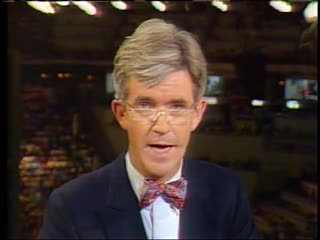
Description: Interview with Boston artist Conger Metcalf. Meltcalf teaches a master drawing class at the Boston Athenaeum. Discussion of his individual works, his life, his career, his influences, and his techniques. Tour of his apartment: living room, studio.
Collection: Ten O'Clock News
Date Created: 09/03/1990
Description: Christopher Lydon reports on a controversy over the distribution of contraception in schools. Lydon notes that the Adolescent Issues Task Force of the Boston School Department has recommended that birth control be distributed to students as part of a comprehensive adolescent health program in the city's middle schools and high schools. Lydon's report includes footage of an NAACP press conference with Jack E. Robinson (President, Boston chapter of the NAACP), Joseph Casper (member, Boston School Committee), and Grace Romero (NAACP board member). Robinson and Casper condemn the proposal as racist. Robinson says that the initiative targets African American students. Lydon's report includes footage from interviews with Hubie Jones (member, Adolescent Issues Task Force), Dr. Howard Spivak (member Adolescent Issues Task Force) and Dr. Deborah Prothrow-Stith (Chairwoman, Adolescent Issues Task Force). Jones, Spivak and Prothrow-Stith defend the proposal. Spivak and Prothrow-Stith discuss statistics relating to teen pregnancy. Lydon's report also features interviews with students about teen pregnancy and footage of students in schools.
1:00:11: Visual: Footage of an African American woman saying that she knows "what is going on" with teenagers from listening to them talk. Christopher Lydon reports that teenagers are starting to have sex at an early age. V: Footage of Dr. Howard Spivak (member, Adolescent Issues Task Force) saying that he is alarmed at the numbers of teenagers who are having sex. Spivack says that 25% of teenage girls are sexually active before the age of 15. Footage of Dr. Deborah Prothow-Stith (Chairwoman, Adolescent Issues Task Force) saying that one million girls under the age of nineteen become pregnant each year; that 600,000 of those girls give birth. Prothow-Stith says that teenage pregnancy has become an epidemic. Footage of Spivak quoting a statistic which predicts that 40% of fourteen-year olds will become pregnant before their twentieth birthday. Shot of teenage girls descending a staircase at a school. Lydon reports that the Boston School Department's Adolescent Issues Task Force is recommending the distribution of birth control as part of a comprehensive adolescent health program at Boston's middle schools and high schools. V: Shot of a collection of diaphragms in a health clinic. Shot of a clinic worker and a teenage girl at a school health clinic. Lydon reports that the proposal has been heavily criticized. V: Shot of the street outside of the Boston NAACP office. Footage of Jack E. Robinson (President, Boston chapter of the NAACP) at a press conference. Robinson says that the NAACP is opposed to the distribution of birth control in school health clinics. Joseph Casper (member, Boston School Committee) and Grace Romero (former member, Boston School Committee and NAACP board member) stand beside Robinson at the press conference. Lydon points out that Casper and Romero are unlikely allies for Robinson. V: Footage of Robinson saying that the plan introduces sexual devices into the schools under the guise of a health initiative. Robinson says that African American schools and school districts are the targets of these plans; that the plans are a form of "social engineering." Lydon notes that Robinson believes the proposal to be "insidiously racist." V: Footage of Hubie Jones (member, Adolescent Issues Task Force) saying that the proposal has nothing to do with race. Footage of Casper saying that the proposal targets inner city students; that there are no proposals to distribute birth control among white suburban students. Casper says that "something is afoot." Footage of Jones saying that it is genocidal to allow large numbers of African American teenage girls to become pregnant. Lydon reports that Jones sees the proposal as a "regrettable necessity," needed to combat the incidence of pregnancy in young girls. V: Shots of teenage students in a study hall. Footage of Prothow-Stith saying that the Task Force is concerned about the increase of pregnancies among girls aged ten to fourteen. Footage of a young African American male student saying that a lot of teenage girls are pregnant; of a young Hispanic male student saying that he knows a girl in ninth-grade with a child. Footage of another African American male student saying that he knows a thirteen-year old girl who became pregnant; that the girl has dropped out of school. Footage of a white female student saying that she knows eighth grade girls who are pregnant; that it is wrong for young girls to be pregnant. Shots of students outside of a school. Lydon says that everyone seems to agree that young girls should not be pregnant.
Collection: Ten O'Clock News
Date Created: 09/08/1986
Description: Lydon commentaries from the floor of the Democratic national convention in Atlanta.
Collection: Ten O'Clock News
Date Created: 07/31/1988
Description: Lydon commentaries from the floor of the Republican national convention in New Orleans.
Collection: Ten O'Clock News
Date Created: 08/17/1988
Description: Lydon commentaries from the floor of the Republican national convention in New Orleans.
Collection: Ten O'Clock News
Date Created: 08/18/1988
Description: Conversation in Old South Church with Benjamin Franklin as portrayed by Bill Meikle. Glass harmonica music.
Collection: Ten O'Clock News
Date Created: 07/03/1987
Description: Conversation with governor-elect Michael Dukakis on upcoming second (nonconsecutive) term. His top priority is improving the economy and employment. Also concerned about balancing municipal services and public education with the limitations of Proposition 2 1/2, and strengthening the state's reputation for integrity. Looks forward to constructive criticism from the press. Wants Massachusetts to be a model as a post-industrial knowledge-based economy, with high quality of life and excellent educational and medical resources.
Collection: Ten O'Clock News
Date Created: 11/26/1982
Description: REPS CRITICIZE MICHAEL DUKAKIS' SEARCH PROCESS FOR NEW CHANCELLOR. James Collins
Collection: Ten O'Clock News
Date Created: 07/02/1986
Description: Interview with the Crown Prince of Jordan at the Ritz-Carlton. He talks about his optimism for negotiations in the Middle East. He talks about relations between individual Middle Eastern countries, specifically Jordan, Israel, and Palestine. He adds his advice to the US administration in working with the Middle Eastern countries. They have an informal discussion while getting a wide shot. Lydon reasks questions for cutaways.
Collection: Ten O'Clock News
Date Created: 05/18/1982
Description: Christopher Lydon reports on the release of the film Cry Freedom, based on the life of Steve Biko (martyred black South African leader). Lydon notes that the film is told from the perspective of Donald Woods (white newspaper editor). Lydon interviews Woods about apartheid and his relationship with Biko. Woods says that the black opposition in South Africa was forced to become violent in response to the brutal tactics of the white regime. Woods talks about his early opposition to Biko and the black movement; he says that he changed his opinion when he realized that Biko's positive message of black self-reliance was not anti-white. Lydon notes that Biko was killed in prison while Woods was exiled from South Africa. Lydon's report is accompanied by footage from the film and from the trailer of the film Cry Freedom. Editor's note: Additional footage from the film and the trailer of the film Cry Freedom, were edited out of the end of the tape.
1:00:00: Visual: Footage from the trailer for the 1987 film, Cry Freedom starring Kevin Kline and Denzel Washington. Christopher Lydon reports that the film Cry Freedom is a the story of Steve Biko (martyred black South African leader) told through the eyes of a white newspaper editor. V: Footage from the film, Cry Freedom. Lydon notes that the film Cry Freedom takes up where the 1982 film Gandhi left off. Lydon notes that Mahatma Gandhi (Indian leader) was born in South Africa. V: Footage of Donald Woods (South African journalist) being interviewed. Woods says that he has always considered Gandhi more of a South African than an Indian. Woods says that Gandhi was involved in the first attempts at non-violent protest in South Africa. Woods says that non-violent protest does not work very well in South Africa because the government forces are not afraid to use their guns. Woods says that the African National Congress (ANC) was forced to take up arms after fifty years of non-violent struggle. Woods says that the South African government does not respond to non-violent protests; that the South African government has forced the opposition to become violent. Woods says that black South Africans are not allowed to vote; that black South Africans are not allowed to campaign against anything. Woods notes that the South African government refuses to allow free speech or passive protests. Lydon remarks that the irony of the film Cry Freedom is that a white editor tells the story of a black victim. Lydon notes the same irony exists in his interviews with Woods. Lydon reports that Woods never wanted to equate the price he paid with the price paid by Biko. Lydon reports that Woods was exiled and banned from South Africa; that Biko was killed in prison. V: Footage from the film, Cry Freedom. Shot of Woods being interviewed. Footage of Woods being interviewed by Lydon. Lydon asks if Woods was converted by Biko. Woods says that Biko did not set out to convert him; that Biko set out to neutralize the activities and writings of Woods. Woods says that he had been writing editorials condemning black consciousness. Woods says that he mistakenly considered black consciousness to be racism in reverse at the time. Woods says that he began to realize that Biko's message was a positive message of black self-reliance. Woods says that black racism is not and never has been a factor in black politics in South Africa. Woods notes that the ANC was formed in 1912; that no credible black leader or organization in South Africa has ever been anti-white. V: Footage from the film, Cry Freedom.
Collection: Ten O'Clock News
Date Created: 11/06/1987