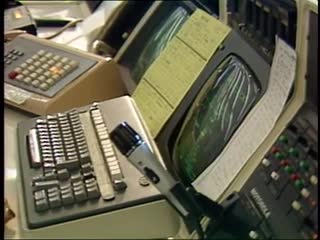
Description: CAMBRIDGE POLICE ANSWERING 911 EMERGENCY CALLS, ALSO BOSTON POLICE HEADQUARTERS
Collection: Ten O'Clock News
Date Created: 07/17/1985
Description: BOSTON COPS IN HALLS OF HEADQUARTERS, GOING TO CARS, IN UNIFORMS
Collection: Ten O'Clock News
Date Created: 03/14/1983
Description: Jan von Mehren reports that African American community leaders expressed their rage over the handling of the Carol Stuart murder case. Von Mehren notes that the leaders accused city officials, the Boston Police Department and the news media of racism in handling the case. Von Mehren's report includes angry speeches by Don Muhammad (Muhammad's Mosque), Rev. Graylan Hagler (Church of the United Community), and Bruce Bolling (Boston City Council). Von Mehren notes that the African American leaders have accused police of ignoring obvious clues during their investigation. Von Mehren adds that some leaders called for the resignation of Ray Flynn (Mayor of Boston) and Francis "Mickey" Roache (Commissioner, Boston Police Department). Von Mehren interviews Hagler. Hagler says that police officers ignored community residents who approached them with information about the case. Von Mehren concludes by saying that the African American community suffered a grave injustice in the aftermath of the murder.
1:00:04: Visual: Footage of Bill Owens (State Senator) speaking at a press conference. A group of African American community leaders stand behind him. The group includes Graylan Ellis-Hagler (Church of the United Community) and Don Muhammad (Muhammad's Mosque). Owens says that a great injustice has been done to the African-American community. Shots of the attendees at the press conference. Jan von Mehren reports that African American community leaders expressed rage and fury at a press conference today. V: Footage of Ellis-Hagler speaking at the press conference. Ellis-Hagler accuses Ray Flynn (Mayor of Boston) of placing blame too quickly on the African American community. Ellis-Hagler compares Flynn's actions to that of the Ku Klux Klan. The attendees at the press conference give vocal support to Ellis-Hagler's assertions. Footage of Muhammad at the press conference. Muhammad asks if white public officials will call Charles Stuart (murderer of Carol Stuart) "an animal." The crowd cheers. Von Mehren reports that African American leaders believe that Flynn, the Boston Police Department, and the media rushed to conclusions about the Stuart case. Von Mehren notes that the African American leaders say that racism played a huge role in the case. V: Shots of the press conference; of Charles Yancey (Boston City Council) addressing the press conference. Footage of Muhammad at the press conference. Muhammad says that police usually suspect the husband when a woman is killed. Muhammad says that police automatically suspect an African American man when a woman is killed in an African American neighborhood. Von Mehren stands outside of Muhammad's Mosque. Von Mehren reports that African American leaders have accused the police, the mayor, and the media of ignoring vital information about the case. Von Mehren notes that the African American leaders says that the vital information was circulating on the streets of Roxbury on the day after the shooting. V: Footage of Muhammad at the press conference. Muhammad says that there were rumours on the street that Charles Stuart was a drug addict. Muhammad says that police should have investigated those rumours. The crowd cheers. Von Mehren notes that Ellis-Hagler runs a recovery center for drug addicts out of his church in Roxbury. V: Footage of Ellis-Hagler being interviewed by von Mehren. Ellis-Hagler says that the workers in his recovery center told him that Charles Stuart was the murderer on the day after the murder occurred. Ellis-Hagler talks about a man from the community who went to police with information about the murder. Ellis-Hagler says that the man shared information with police which confirmed the alibi of William Bennett (suspect). Ellis-Hagler says that the police told the man that they had a suspect who suited their purposes. Footage of Muhammad at the press conference. Muhammad says that apologies are worthless; that the damage has already been done. Muhammad says that the city has stabbed the African American community in the back. Muhammad says that the African American community has been devastated. Shot of a sign at the press conference. The sign reads, "What does (sic) Boston and South Africa have in common? Stopping and detaining men because of the color of their skin." Von Mehren reports that some African American leaders called for the resignation of Flynn and Francis "Mickey" Roache (Police Commissioner, City of Boston); that some called for restitution to Mission Hill residents. V: Shots of Bruce Bolling (Boston City Council) speaking at the press conference; of attendees at the press conference. Shot of Muhammad at the press conference. Von Mehren adds that the African American community was dealt a grave injustice when police, public officials, and the media were taken in by Charles Stuart's hoax.
Collection: Ten O'Clock News
Date Created: 01/05/1990
Description: Robert Guiney, head of Boston Police Patrolman's Association, convenes his union to endorse candidacy of George Bush, who accepts in person. Dukakis & Cuomo hold State House PC to decry drug trafficking.
Collection: Ten O'Clock News
Date Created: 09/22/1988
Description: Community disorders unit of Boston Police to address racial violence incidents. Staff roster lists Sgt. Francis M. Roache as director. Map shows locations of stonings.
Collection: Ten O'Clock News
Date Created: 09/06/1979
Description: Deborah Wang reports that the Boston Police Department and the District Attorney's Office keep the money confiscated from drug arrests. Neighborhood groups want the money to go back into the community to fund drug education, drug treatment, and crime watch efforts. Interview with Bill Good of the Boston Police Department. Good says that the Police Department needs the money to keep its "operational edge" over drug traffickers. Interview with City Councilor Charles Yancey, who says that community residents are the most valuable asset in the war against drugs. Press conference at City Hall, where Yancey, Ben Haith (Roxbury Multi-Service Center) and Louis Elisa (NAACP) talk about the need to return confiscated drug money to the community. City Councilor Dapper O'Neil arrives at the press conference. O'Neil and State Rep. Byron Rushing confront each other on the issue. Wang reports that the city budget is tight and various groups are fighting over small amounts of money. Wang's report is accompanied by footage of police officers making a drug arrest.
1:00:01: Visual: Footage of a police cruiser stopped behind a red sports car. A white police officer searches an African American man. Shot of a plastic bag containing drugs. Deborah Wang reports that 7,500 people were arrested by police on drug-related charges last year; that police have confiscated weapons, drugs, and money from drug arrests. V: Footage of Bill Good (Boston Police Department) saying that approximately $990,000 has been forfeited to the Police Department through drug arrests. Shots of police officers searching the trunk of a red sports car. Shot of a police officer searching a handbag. Wang reports that the Boston Police Department has gone to court to obtain the money; that the Police Department has split the money with the District Attorney's office. Wang reports that the Police Department uses the money to pay informants, to buy drugs for deals, and to conduct police investigations. V: Footage of Good saying that the money is essential to the Police Department; that the money represents an "operational edge" for drug investigators. Good says that the money can be used at the discretion of drug investigators. Wang reports that some city officials see other uses for the money. V: Footage of Charles Yancey (Boston City Council) being interviewed by Wang. Yancey says that the city needs to fight an effective war against drugs. Yancey says that community residents are the city's most valuable allies in the war against drugs. Wang reports that neighborhood groups want the money to go back into the community; that the groups want the money to fund drug education, drug treatment, and crime watch efforts. V: Footage of Yancey at a press conference at City Hall. A group of neighborhood activists including Byron Rushing (State Representative) are with Yancey at the press conference. Shot of Ben Haith (Roxbury Multi-Service Center) speaking at the press conference. Footage of Louis Elisa (NAACP) speaking at the press conference. Elisa says that funding is needing to fight the war on drugs; that the confiscated money belongs to the community. Elisa says that the confiscated money comes from Charlestown, South Boston, Roxbury and Dorchester; that the confiscated money should go back to the communities to fund anti-drug initiatives. Footage of Good being interviewed by Wang. Good says that the neighborhood groups have good intentions. Good says that it is a mistake to take the money from the Police Department. Good says that the confiscated money funds the day-to-day operations of the Police Department's anti-drug effort. Shots of three police officers conferring near a police cruiser; of a police officer searching a handbag. Wang reports that the Boston City Council has the support to pass a bill requiring the confiscated money go back to the neighborhoods. Wang notes that Dapper O'Neil (Boston City Council) is opposed to the initiative; that O'Neil "crashed" the press conference at City Hall today. V: Footage of Rushing and O'Neil confronting one another over the issue. O'Neil says that Rushing is trying "to shake people down" for money. Rushing walks away from O'Neil. Yancey and David Scondras (Boston City Council) look on. O'Neil has an exchange with another neighborhood activist. Yancey addresses the media from a microphone. Wang reports that the dispute revolves around a relatively small amount of money; that the money represents less than one percent of the police budget. Wang notes that the city budget is tight; that money is hard to come by.
Collection: Ten O'Clock News
Date Created: 08/01/1989
Description: High school panel speaks out against causes of teenage violence. Blames media coverage for glorifying drug trafficking & street activity. Francis Roache on curbing family sources of violence.
Collection: Ten O'Clock News
Date Created: 10/04/1988
Description: Training expert says police more likely to shoot first because of increasing danger in drug raids. Francis Roache defends his force. Smashing door with sledgehammer. Sherman Griffiths funeral.
Collection: Ten O'Clock News
Date Created: 03/30/1989
Description: Robert DiGrazia resigns as Boston police commissioner to become police chief in Montgomery County, Maryland. Gives press conference on strengths and weaknesses in his department.
Collection: Ten O'Clock News
Date Created: 10/04/1976
Description: Ray Flynn holds press conference to express concern over performance of drug control unit of Boston police department.
Collection: Ten O'Clock News
Date Created: 04/13/1989