Description: Meg Vaillancourt reports on the tight race between candidates Michael Dukakis and Jesse Jackson for the Democratic nomination for the presidency. Vaillancourt notes that Jackson is still campaigning for the nomination; she adds that Dukakis needs to win 70% of the remaining delegates to win the nomination outright. Vaillancourt reports that Jackson has done well in the primary elections and has registered voters to vote in the Democratic primaries. Vaillancourt reports that some Democrats would like to see Jackson as Dukakis's running mate. Vaillancourt's report includes footage from an interview with Dukakis. Dukakis says that he must win the nomination before deciding on a running mate. Vaillancourt interviews Jack Beatty (Atlantic Monthly), Paul Tsongas (former US Senator), Byron Rushing (State Representative) and Robert Kuttner (author, "The Life of the Party) about Jackson's role in the Democratic Party and his role in a Dukakis administration. They discuss Jackson as a potential running mate or cabinet member. Kuttner suggests that Jackson could recruit Mario Cuomo (Governor of New York) as a candidate by offering to be his running mate. Vaillancourt reports that both candidates are focused on campaigning. She notes that the Democratic convention is three months away. Vaillancourt's report is accompanied by footage of Jackson campaigning and by footage of Dukakis campaigning.
1:00:16: Visual: Footage of Michael Dukakis (Democratic US Presidential candidate) saying that the "whole situation is getting kind of serious." Shot of Jesse Jackson (Democratic US Presidential candidate) at a campaign rally. Shot of Al Gore (Democratic US Presidential candidate). Meg Vaillancourt reports that Dukakis is ahead of Jackson by 50 delegates; that Gore might spoil Dukakis's chances of winning the New York primary. Vaillancourt notes that Gore will probably pull out of the race if Dukakis wins New York. V: Footage of Dukakis saying that his campaign will work hard to win like they did in Wisconsin. Footage of Jackson shaking hands with supporters. His supporters chant, "Win, Jesse, Win." Shot of Dukakis in a hard hat, shaking hands with workers. Shot of Jackson at a campaign rally. Vaillancourt reports that Jackson has won almost as many raw votes as Dukakis. Vaillancourt speculates as to whether Dukakis should ask Jackson to be his running mate. V: Footage of Dukakis saying that he has to win the nomination before he can decide on a running mate. Shot of Dukakis shaking hands with a supporter seated at a table. Vaillancourt reports that one poll shows that a Dukakis/Jackson ticket could beat George Bush (Republican US Presidential candidate). V: Footage of Jack Beatty (The Atlantic Monthly) saying that some studies have shown that more than half of the electorate have a negative image of Jackson. Footage of Paul Tsongas (former US Senator) chuckling at the prospect of a Dukakis/Jackson ticket. Tsongas says that Dukakis and Jackson would enjoy "fascinating plane rides" as they campaigned together. Footage of Byron Rushing (State Representative) saying that Dukakis would probably treat a vice president in the same way he has treated lieutenant governors; that Jackson would not want to be in that position. Footage of Beatty saying that Jackson has a "peculiar burden." Beatty says that the Democratic Party needs to do well with white ethnic voters and white southern voters; that the Democratic Party already does well with African American voters. Footage of Jackson at a campaign rally. Jackson raises linked arms with supporters. Vaillancourt reports that Jackson has done well in the primary elections; that Jackson has registered voters to vote; that Jackson has raised the profile of the race for the Democratic nomination. Vaillancourt says that the Democratic Party does not know what to do about Jackson. V: Footage of Rushing saying that Jackson should be able to suggest candidates for cabinet positions. Footage of Beatty being interviewed by Vaillancourt. Beatty says that Jackson would make an excellent cabinet member if appointed to the right position; that a good performance by Jackson in the cabinet would strengthen his next campaign for the presidency. Beatty says that it would not be condescending to appoint Jackson as the drug czar. Footage of Robert Kuttner (author of The Life of the Party) saying that the position of drug czar is the most difficult position in the cabinet; that the Democratic Party would be setting up Jackson for a defeat if he were appointed drug czar. Footage of Tsongas saying that Jackson needs to move to the center in order to attract voters and delegates. Shot of Jackson campaigning. Footage of Dukakis saying that the Democratic nominee needs to unite the party. Vaillancourt reports that Jackson is still campaigning for the nomination; that Dukakis needs to win 70% of the remaining delegates in order to win the nomination outright. V: Shot of Jackson giving a thumbs-up sign to the press. Footage of Kuttner saying that Dukakis must beat Jackson decisively in the remaining primary elections. Kuttner suggests that Jackson could try to recruit Mario Cuomo (Governor of New York) as a potential nominee by offering to be his running mate. Shot of Cuomo speaking. Vaillancourt reports that Dukakis has not yet received Cuomo's endorsement. V: Footage of Dukakis telling a reporter that he spoke to Jackson on Wednesday morning. Vaillancourt reports that the Democratic convention is three months away; that neither Jackson or Dukakis will make any private deals yet. Vaillancourt reports that the Dukakis campaign is concentrating on winning the primary elections.
Collection: Ten O'Clock News
Date Created: 04/07/1988
Description: Steve Nevas interviews George Wallace about his campaign for the Democratic presidential nomination. Nevas asks Wallace if he expects to do well with anti-busing voters in Massachusetts. Wallace comments on his chances in the Massachusetts primary, his relationship with the Democratic Party establishment and his role at the Democratic convention. He describes his feelings towards other Democratic perspective candidates Hubert Humphrey and Edward Kennedy. Wallace says that he has never campaigned much in Massachusetts; that he is happy to have the opportunity to present his ideas to the Massachusetts voters. Wallace denounces the "expansion" of the federal government, and calls busing a social experiment. Wallace gives his opinions on the political positions of Ralph Nader (consumer advocate) and Ronald Reagan (Governor of California). He talks about his previous campaigns for the presidential nomination.
15:33:22: Visual: Steve Nevas sets up an interview with George Wallace (Governor, State of Alabama) on his campaign for the presidency of the United States. Wallace is seated in a wheelchair. Nevas asks Wallace to comment on predictions that he will win the Massachusetts primary; that voters who are against busing will vote for him. Wallace says that he would be surprised if he won the Massachusetts primary. He says that too much time and money has been spent on busing in Boston; that busing is a "social experiment"; that the government needs to focus on unemployment and inflation. Wallace says that he did not campaign in Massachusetts in 1972; that he has not had a lot of contact with Massachusetts voters. Nevas again brings up the predictions that Wallace will win the state. Wallace says that his ideas have been distorted through propoganda; that many voters in Massachusetts have misunderstood his ideas. Wallace says that winning the Massachusetts primary would be a great victory for him. Nevas asks Wallace about the candidacy of Ronald Reagan (Governor, State of California). Wallace says that he is not familiar with the details of Reagan's plan to cut $90 billion from the federal budget; that he agrees with Reagan on increased state control over government spending; that the people of Massachusetts should have more control over how school money is spent. Nevas asks Wallace about Ralph Nader (consumer advocate) and his proposal that large corporations be chartered by the federal government. Wallace says that he does not support any idea giving the federal government more authority; that he believes in the enforcement of anti-trust laws. Wallace adds that the federal government already has too much authority; that the people of Massachusetts had no recourse when federal judges ordered forced busing; that state governments should have more authority in most matters. 15:38:25: V: Nevas remarks that a poll showed Wallace in second place after Sargent Shriver (presidential candidate) in Massachusetts. Wallace says again that he does not expect to do well in Massachusetts. Wallace adds that government attention has been focused on busing; that busing is a "social experiment"; that the voters of Massachusetts are concerned about other issues. Wallace says that he is campaigning in Massachusetts because it has an early primary election; that voters in the northeast have been unfamiliar with his ideas until now. Nevas asks Wallace if he would support Hubert Humphrey (US Senator) or Edward Kennedy (US Senator) as the Democratic nominee for president. Wallace says that Kennedy has never declared his candidacy; that Humphrey is not campaigning. Wallace notes that the national Democratic Party does not support his candidacy for president; that the Democratic Party is organizing a strategy to defeat his candidacy; that the Democratic Party is out of touch with working people. Wallace adds that there is a conspiracy against him in the Democratic Party. Nevas asks about the possibility of Wallace running for president as a third party candidate. Wallace says that many Democratic nominees are adopting his positions against busing and big government; that his positions are compatible with the platform of the national Democratic Party. Wallace says that he will work to ensure that his positions are represented at the Democratic convention in New York City over the summer. Wallace notes that many leaders are paying attention to his positions; that his ideas represent those of the working people of the nation. Wallace says that he is not at all interested in the vice-presidency. He adds that the other candidates have already stated that they will not offer him the vice-presidential nomination. 15:45:25: V: Nevas asks him if he would disclose his full medical report if the other candidates did so. Wallace responds that a medical writer for the New York Times has examined his medical report and given him a clean bill of health; that his confinement to a wheelchair does not affect his ability to be president. Nevas asks Wallace to comment on the movement for an uncommitted slate of delegates within the Democratic Party. Wallace says that some of the uncommitted delegates could pledge their votes to him. Nevas asks Wallace if he is in favor of streamlining the presidential campaign process. Wallace says that the state primaries could be consolidated into regional primaries. Nevas states that Wallace has run for president more than once. Wallace responds that he ran for president once in 1968; that he ran in three primaries in 1964 in order to make a statement against the left-wing politics of the other Democratic candidates; that he was shot in 1972 and did not finish the campaign. Nevas asks Wallace why he is seeking the presidency. Wallace says that he wants the working people of the nation to be represented in the government. Wallace notes that he has been warning people about the expanding reach of the federal government; that the people of Massachusetts experienced this kind of intrusive governmental intervention during the busing crisis. Nevas says that many people see him as a segregationist. Wallace says that he is not against people of color; that African Americans in Alabama have voted for him overwhelmingly; that he is against big government, not people. Wallace says that he grew up during a time when the segregation of races was accepted as the best solution; that segregation was sanctioned by the courts back then. Wallace adds that segregation is illegal now and it is no longer an issue. Nevas closes the interview. The camera crew takes cutaway shots of Nevas questioning Wallace. Wallace asks Nevas if he would be surprised if Wallace did well in the Massachusetts primary election. Nevas says that he would not be surprised if Wallace did well. Wallace says that he has not conducted any polls of Massachusetts voters. Wallace says that he expects to do well in Michigan and Pennsylvania; that it is hard to predict how voters will react to him. Wallace notes that people in Massachusetts made fun of his ideas years ago; that now Massachusetts voters take him seriously.
Collection: Ten O'Clock News
Date Created: 01/27/1976
Description: Gary Hart press conference at Democratic state convention in Springfield.
Collection: Ten O'Clock News
Date Created: 04/08/1983
Description: Deborah Wang reports that Boston supporters of Jesse Jackson are undecided about whether to campaign for Michael Dukakis. The supporters recently met to discuss their role in the upcoming campaign. Jackson delegates Mel King, Saundra Graham, Juanita Wade, and Byron Rushing are among the leaders of the meeting. The leaders say that the Dukakis campaign should not take the votes of Jackson supporters for granted. There are some Jackson supporters who will not support Dukakis under any circumstances. Interview with Philip Stanley of the Dukakis campaign about the role of Jackson supporters in the Dukakis campaign. Stanley says that the Dukakis campaign has been meeting with Jackson supporters and that the campaign is taking no votes for granted. Interviews with Jackson supporters Darryl Heller, Trent Pettus and Myra McAdoo. All three supporters criticize the Dukakis campaign. Wang's report includes footage of Dukakis and Jackson at the 1988 Democratic National Convention and footage of Jackson embarking on a voter registration campaign. This edition of the Ten O'Clock News also included the following item: Adult entertainment at the Highland Tap
1:00:02: Visual: Footage from July 21, 1988 of the Democratic National Convention. Michael Dukakis (Democratic US Presidential nominee) and Kitty Dukakis (wife of Michael Dukakis) are congratulated by Jesse Jackson (African American political leader) and Jacqueline Jackson (wife of Jesse Jackson). They are surrounded by Democratic Party notables. Deborah Wang reports that Jackson ended his presidential campaign by endorsing the nomination of his rival Dukakis; that Jackson pledged to campaign for Dukakis in the fall. V: Footage of Jackson speaking at the Democratic Convention on July 18, 1988. Jackson is flanked by Dukakis and Lloyd Bentsen (Democratic US vice-presidential nominee). Jackson says that he is not seeking a job or a salary; that he wants to serve the nation. Shot of Jackson standing at the entrance to a campaign bus. Jackson waves to supporters. Supporters hang a sign on the side of the bus. The sign reads, "Rainbow voter registration campaign." Wang reports that Jackson supporters are undecided about whether to campaign for Dukakis; that Jackson supporters met last night in Roxbury about their role in the upcoming campaign. V: Shots of the audience at the meeting. Campaign leaders including Mel King (community activist and Jackson delegate), Saundra Graham (Jackson delegate), Byron Rushing (State Representative and Jackson delegate), and Juanita Wade (Jackson delegate) sit at a table at the front of the room. Footage of Wade saying that Jackson supporters will use the Republican threat to convince others to vote for Dukakis. Wang reports that Jackson supporters are unhappy with the Dukakis campaign. V: Footage of King saying that the Dukakis campaign has not been listening to Jackson supporters. King says that the Dukakis campaign should have addressed the role of Jackson supporters before now. Footage of Graham saying that Dukakis should be pursuing the 7 million votes represented by Jackson supporters. Shot of a life-size cut-out of Dukakis in the window of the Dukakis volunteer headquarters. Footage of Philip Stanley (State Director for the 1988 Dukakis campaign) being interviewed by Wang. Stanley says that he has met twice this week with the Jackson leadership; that the discussions are progressing. Stanley says that the Dukakis campaign is not taking anyone's vote for granted. Shots of volunteers working at the Dukakis volunteer headquarters. Wang reports that some Jackson supporters says that they will not work for Dukakis under any circumstances. V: Shot of Rushing addressing the audience at the meeting of Jackson supporters. Footage of Darryl Heller (Jackson supporter) saying that Dukakis made a mistake by choosing Bentsen as his running mate. Heller says that Bentsen does not believe in any of the same things as Jackson; that Bentsen is closer to Ronald Reagan (US President) than he is to Jackson. Heller says that it would be a violation of his conscience to vote for the Dukakis ticket. Footage of Trent Pettus (Jackson supporter) saying that he will not vote for Dukakis. Pettus says that Dukakis does not believe that gays and lesbians are fit to be foster parents. Pettus says that Dukakis advocates a discriminatory policy against gays and lesbians. Pettus adds that he will not vote for Dukakis. Footage of Myra McAdoo (Jackson supporter) saying that Dukakis needs to be ready to deal realistically with minority groups; that Jackson needs to receive a message from minority groups. Wang reports that some Jackson supporters will work to revive the Rainbow Coalition; that the supporters will work to get Rainbow candidates elected to state and local offices. V: Shots of Jackson supporters at the meeting in Roxbury. Footage of Jackson at the Democratic National Convention. Shots of delegates on the floor waving signs reading, "Jesse!" Wang notes that Jackson supporters will try to gain concessions from the Democratic Party. V: Footage of Rushing saying that he wants his constituents to be represented fairly by the chosen leader of the Democratic Party. Rushing says that Jackson supporters must barter their votes for fair representation. Rushing says that Jackson supporters must not be taken for granted by Dukakis. Wang stands in front of the Dukakis volunteer headquarters. Wang reports that Dukakis may not need to make peace with local Jackson supporters; that Dukakis is expected to win Massachusetts easily. Wang reports that Jackson supporters hope that Dukakis includes them in his campaign. Wang adds that Jackson supporters want Dukakis to make it clear that he does not take Jackson voters for granted.
Collection: Ten O'Clock News
Date Created: 08/25/1988
Description: Meg Vaillancourt reports that Jesse Jackson has released position papers detailing his stance on domestic issues. Vaillancourt reviews Jackson's positions on the economy, trade, employment, social programs, defense spending, and taxes. Interview with labor union leader Domenic Bozzotto and Harvard professor Roger Porter about Jackson's positions on the issues. Bozzotto defends Jackson's platform while Porter criticizes it. Vaillancourt notes that Jackson would support his social programs through cuts in defense spending and increased taxes on wealthy Americans. Vaillancourt reports that Jackson's position as the frontrunner for the Democratic nomination challenges other candidates to defend their positions on the issues. This edition of the Ten O'Clock News also included the following item: James Farmer speaks at a ceremony in honor of Martin Luther King, Jr.
1:00:07: Visual: C-Span footage of Jesse Jackson (US Democratic Presidential Candidate) addressing the Democratic Convention in 1984. The audience cheers for Jackson. Footage of Jackson quoting poetry to a reporter. On-screen visuals list details about Jackson's position on the economy. On-screen text reads, "Invest pensions in America." Meg Vaillancourt reports that Jackson has a stack of position papers on economic issues. Vaillancourt notes that Jackson advocates the investment of pension funds in federally-guaranteed securities; that Jackson would use the capital to fund public housing, roads, and other public works projects; that the investment of 10% of US pensions would yield $60 billion for projects. V: Shot of Jackson talking about his positions at a forum; of Jackson addressing supporters at a campaign rally. Footage of Domenic Bozzotto (President, Hotel Workers Union) that he likes Jackson' s idea of putting pension money to work for social good; that Jackson's plan also gives a fair return on the investment. Footage of Roger Porter (Harvard University) being interviewed by Vaillancourt. Porter says that Jackson's plan calls for government guarantees on pension investments; that the government could end up paying the difference on a poor investment. Vaillancourt says that trade issues are another important issue in the election. V: On-screen visuals list details about Jackson's position on trade issues. On-screen text reads, "Adopt 'corporate code of conduct'." Footage of Jackson saying that General Electric is the number one exporter from Taiwan. Vaillancourt reports that Jackson believes that cheap overseas labor is the main cause of the US trade deficit. Vaillancourt reports that Jackson would abolish tax incentives for US companies abroad; that Jackson would insist that America's trading partners pay the same wages as those earned by US workers. V: Shots of Jackson marching with union workers. Footage of Bozzotto saying that "slave wages" paid to workers abroad will undercut organized labor in the US. Footage of Porter saying that the US cannot impose these policies on its trading partners. Vaillancourt reports that Jackson is a populist on employment issues. V: On-screen visuals and text detail Jackson's position on employment. Vaillancourt reports that Jackson supports an increase in the minimum wage; that Jackson supports the passage of a worker bill of rights; that Jackson supports the plant closing law; that Jackson supports comparable pay for jobs of comparable worth. V: Footage of Jackson addressing supporters. On-screen visuals detail Jackson's positions on social programs. Vaillancourt talks about Jackson's position on social programs. Vaillancourt reports that Jackson supports universal day care and national health care; that Jackson would double spending on education; that Jackson would focus on combatting drugs. V: Footage of Porter saying that the government cannot support the increase in spending required by Jackson's social programs. Footage of Bozzotto saying that Jackson's programs would get the average person involved in the economy. Vaillancourt reports that Jackson believes that social programs can be paid for through cuts in the defense budget. V: On-screen visuals and text detail Jackson's position on defense issues. Vaillancourt reports that Jackson would eliminate the MX, the Midgetman and the Trident missiles; that Jackson would eliminate the F-15 fighter plane, the stealth bomber, and the Strategic Defense Initiative. V: Footage of Bozzotto saying that there is "fat" to be cut out of the defense budget. Footage of Porter saying that Jackson is misguided in thinking that cuts in the defense budget will yield great savings. Vaillancourt reports that Jackson is the only current Democratic candidate who has talked about taxes. V: Footage of Jackson saying that "Reaganomics" exempted some people from paying taxes. On-screen visuals and text detail Jackson's position on taxes. Vaillancourt reports that Jackson would increase the corporate tax rate to 46%; that Jackson would raise the tax rate to 38.5% for residents with incomes above $100,000; that Jackson would impose an oil import fee. V: Footage of Porter saying that Jackson's tax policy would rob the private sector of money for productive investment. Footage of Bozzotto saying that Jackson is not afraid of the American people; that Jackson is not afraid to advocate change. Vaillancourt reports that the media and the public are now paying attention to Jackson's positions on the issues; that Jackson's position as a frontrunner challenges other candidates to defend their own positions.
Collection: Ten O'Clock News
Date Created: 04/04/1988
Description: Sam Fleming reports that Jesse Jackson is campaigning in New Hampshire. Some consider Jackson to be the frontrunner for the Democratic nomination, but many political observers doubt Jackson's chances of winning the nomination. Jackson addresses supporters at a campaign rally, including about his support for the gay and lesbian community. Interviews with enthusiastic Jackson supporters in New Hampshire. Jackson tells reporters that his race is not as important as his credentials. He addresses another rally on the need for national affordable health care. Interview with Joe Grandmaison the Chairman of the New Hampshire Democratic Party, who says that it would not be wise to underestimate Jackson and his campaign. This edition of the Ten O'Clock News also included the following item: Ray Flynn, Michael Dukakis, and Bruce Bolling discuss linkage between Chinatown development and Parcel 18 in Roxbury
1:00:54: Visual: Footage of Jesse Jackson (Democratic candidate for US President) getting his picture taken in front of the fall foliage in New Hampshire. Jackson walks into a rustic building. Sam Fleming reports that Jackson is trying to secure voter support in New Hampshire; that Jackson is considered to be the frontrunner for the Democratic nomination. V: Shots of Jackson shaking hands with New Hampshire voters. Shot of Jackson addressing the crowd. The crowd applauds. Fleming reports that many political observers doubt Jackson's chances of winning the nomination; that Jackson is not paying attention to the "conventional wisdom" of the political observers. V: Footage of Jackson addressing the crowd. Shots of members of the crowd. Jackson talks about speaking at last weekend's rally for gays and lesbians in Washingon D.C. Jackson says that the voices of gays and lesbians deserve to be heard. Fleming notes that Jackson is reaching out to the dispossesed. V: Footage of Jackson talking about his efforts to build a diverse coalition of supporters. Jackson says that his leadership will put the nation on a course for jobs, peace, and justice. The crowd applauds. Shots of individual audience members. Footage of an older white female voter saying that Jackson is "energizing"; of a white female voter saying that she hopes that Jackson has a chance at the nomination. Footage of an older white male voter saying that some critics are trying to create a negative image of Jackson; that Jackson is "electable." Footage of Jackson speaking to reporters. A reporter asks Jackson if an African American can win the Democratic nomination. Jackson says that the issue of his race should be left to "God"; that the issue of his credentials should be left up to the voters. Fleming notes that Jackson has been questioned about the state of his marriage. V: Footage of Jackson telling reporters that he will not speculate about rumors; that he is fighting to win the nomination. Fleming reports that Jackson opened his campaign office in Manchester, N.H. V: Footage of a crowd gathered in front of Jackson's campaign office. Shot of a white female voter holding a hand-made Jackson campaign sign. The crowd begins to chant, "We want Jesse." Jackson shakes hands with voters outside of the office. Shots of an older white man; of a young African American boy in the crowd. Jackson addresses the crowd. Jackson talks about the need for a national health care system. Jackson says that he will provide "bold leadership." Fleming notes that Jackson did well with white Democratic voters in New Hampshire in 1984. Fleming reports that one Jackson campaign supporter said that the Jackson campaign lacked an organized structure; that fundraising so far has been minimal. Fleming adds that some voters see Jackson as a candidate supported mainly by African Americans. V: Shots of Jackson addressing a crowd; of individual members of the crowd. Footage of Joe Grandmaison (Chairman, New Hampshire Democratic Party) saying that no one underestimates the strength of Jackson and his message. Footage of Jackson addressing the crowd about the need to save jobs, schools, farms, and the environment, and to "give peace a chance." The crowd chants along with Jackson and applauds for him. Shot of an elderly woman at the Jackson campaign rally.
Collection: Ten O'Clock News
Date Created: 10/12/1987
Description: A Ten O'Clock News special features an interview with Jesse Jackson (Democratic candidate for US President). Christopher Lydon (WGBH), Dennis Farney (Wall Street Journal), and Ken Bode (NBC News) interview Jackson. Lydon notes that the goal of the interview is to discover how Jackson's character would shape his presidency. Jackson jokes about the psychoanalytic nature of the interview. Jackson talks about growing up in a segregated society and participating in the civil rights movement. He answers questions about his childhood. He talks about his campaign and the support he has received so far. Jackson talks about the challenges faced by young African Americans, and says that young African Americans must work twice as hard as whites in order to succeed. Jackson says that some conservative African Americans may not support his candidacy; he adds that people of all races are finding common ground in his candidacy. Jackson reviews the accomplishments of his political organization and talks about his experiences in shaping political policy during the 1960s and the 1970s. He names the politicians whom he admires. He talks about his relationship to the Democratic Party leadership and about his efforts to open up the Democratic Party to minority voters. Jackson says that he would like to establish better relations between the African American community and the Jewish community. He names the people to whom he turns for advice. Jackson says that he regrets the splintering of the civil rights movement in the 1970s. He talks about the Rainbow Coalition as a means to reunite those groups. Tape 1 of 2.
1:00:37: Visual: WGBH logo. Christopher Lydon introduces an "extended conversation" with Jesse Jackson (candidate for US President). Lydon notes that the half hour show was planned in cooperation with the John F. Kennedy School of Government at Harvard University. Lydon adds that the goal of the interview is to discover how Jackson's character would shape his presidency. Lydon introduces in-studio guests Dennis Farney (Wall Street Journal) and Ken Bode (NBC News). Lydon reviews biographical facts about Jackson including date of birth, education, and his career in the civil rights movement. Lydon asks Jackson which actor he would choose to portray Jesse Jackson in a movie about his life, and what Jackson would tell the actor about his character. Jackson jokes about the psychoanalytic nature of this interview. Jackson talks about growing up in a segregated society. Jackson says that he is sensitive to the needs of the poor and the disenfranchised; that he participated in the civil rights movement and has seen great changes. Jackson says that he has not grown bitter about US society because he has seen such great changes. 1:04:28: V: Farney asks Jackson about his childhood and whether he felt rejected by his father. Jackson talks about feeling a sense of rejection as a child; that he was called a "bastard." Jackson says that his athletic and academic success were his way of fighting back against those who rejected him or laughed at him. Jackson says that he has grown accustomed to adversity and to the "double standard" which exists in society. Bode asks Jackson if the US is ready for an African American president. Bode mentions that Bill Lucy (African American union leader) has said that the US is not ready. Jackson notes that he has been received warmly in New Hampshire. Jackson says that no one will know if the US is ready for an African American president until the nation is given the chance to elect one. Jackson says that an African American candidate may get support from women, Hispanics and American Indians; that many groups in society can identify with his candidacy. Jackson mentions the Rainbow Coalition. Jackson notes that he is running second or third out of eight candidates in New Hampshire. Lydon asks Jackson about his success in life and about his belief in self-reliance. Jackson says that the "triangle" of family, church, and school allowed him to grow up with a sense of confidence; that he was insulated from some of the ill effects of segregation. Jackson mentions the closeness of his family to a particular white family, despite living in a segregated society. 1:11:19: V: Lydon asks Jackson how to foster good support networks for young African Americans growing up today. Jackson says that young African Americans need to work harder than whites to succeed; that their hard work will pay off in the end; that those who work hard to succeed develop an inner strength and character. Bode notes that the Alabama Democratic Conference endorsed Walter Mondale's candidacy for US President. Bode adds that Jackson's political organization said that their endorsement of Mondale was the equivalent of "putting another bullet into the body of Martin Luther King." Jackson denies characterizing the endorsement in that manner. Jackson talks about the reluctance of the African American community to upset the status quo. Jackson says that some of the resistance to the civil rights movement came from conservative African Americans. Bode asks Jackson what percentage of the vote he expects to receive in the Alabama primary. Jackson says that he will not speculate on percentages. Jackson talks about the endorsements and support he has received. Jackson says that he has received support from white voters in the south; that whites, African Americans, and other minorities are finding common ground in his candidacy. 1:15:38: V: Farney asks why Jackson sometimes refers to himself as a "prophet" instead of a "politician." Jackson explains that his role is prophetic in that he tries to change the structure of society. Farney notes that Jackson has been criticized for a lack of administrative experience. Jackson reviews the accomplishments of his political organization. Jackson notes the limited budget under which his campaign operates. Farney asks about Jackson's political legacy. Jackson says that his candidacy has forced the Democratic Party to open up; that his candidacy has forced both political parties to understand the importance of minority voters. Lydon asks about Jackson's spiritual life. Jackson says that he tries to seek common ground between people of different religions; that certain values are held in common by all religions. Jackson says that he is committed to the poor, the elderly and the young. Lydon asks Jackson why Ralph Abernathy (African American leader) said that Jackson could be his president but not his pastor. Jackson says that he does not know why Abernathy said that. Bode comments that Jackson has not held political office, but that he has had a lot of contact with politicians. Jackson notes that he was the first African American delegate to the Democratic Party in 1962. Jackson reviews his leadership experience and his role in shaping public policy in the 1960s and 1970s. 1:20:55: V: Bode asks Jackson which politicians he admires, aside from Martin Luther King. Jackson talks about Hubert Humphrey (US Senator), Ron Dellums (US Representative), and Adam Powell (US Representative). Bode notes that Jackson has criticized Tip O'Neill (Speaker, US House of Representatives) and Lane Kirkland (President, AFL-CIO). Bode asks how Jackson will deal with the Democratic leadership. Jackson says that he will conduct business with these leaders on the basis of "mutual respect." Jackson says that the Democratic Party needs a more articulate spokesman than O'Neill; that he respects O'Neill. Jackson notes that the labor movement needs to commit itself to providing equal access to jobs for African Americans, Hispanics, and women. Lydon asks Jackson about how his candidacy is viewed by American Jews. Jackson says that he would like to establish better relations between African American and Jewish leaders. Jackson says that he regrets the conflicts between African Americans and Jews in the past; that he supports the right of Israel to exist; that he also supports the rights of Palestinians. Jackson talks about his view of the Middle Eastern conflict. Farney notes that Jimmy Carter (former US President) was elected as an "outsider." Farney asks if Jackson would be more successful than Carter in operating in politics as an "outsider." Jackson says that Carter remained on the "outside" as president; that Carter did not use the power of the presidency to its full extent. Jackson says that he disagrees with the critics who call the Carter administration a "failure." Jackson criticizes the foreign policy of Ronald Reagan (US President). 1:26:29: V: Bode asks Jackson about his advisors. Jackson says that he consults with his wife and his children. Jackson names a list of people with whom he consults including Dellums, Marion Barry (mayor of Washington D.C.), Walter Fauntroy (US Congressman), Edward Bennett Williams (attorney), Dr. Al Pitcher (University of Chicago), and Dr. Jack Mendelsohn (minister). Lydon asks Jackson to disclose any major failures or flaws in his character. Jackson says that he does not dwell on his failures, but that he has learned a lot from them. Jackson says that he regrets how the civil rights movement broke up in the 1970s; that he is trying to bring back together the groups involved in the civil rights movement through his coalition. Jackson says that he is concerned with the conflict between African Americans and American Jews. Jackson talks about the importance of communication in resolving conflict. Lydon thanks Jackson, Farney and Bode. End credits roll.
Collection: Ten O'Clock News
Date Created: 02/03/1984
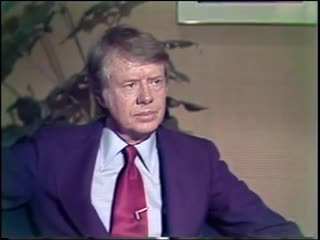
Description: Interview with Jimmy Carter as Democratic presidential candidate. He states with certainty that he will be the nominee on the first convention ballot.
Collection: Ten O'Clock News
Date Created: 02/25/1976
Description: Studio interview with Rep. John Flood as Democratic candidate for governor.
Collection: Ten O'Clock News
Date Created: 05/28/1990
Description: Interview with John Silber as maverick Democratic candidate for governor. He refuses to discuss his association with Kevin White.
Collection: Ten O'Clock News
Date Created: 05/30/1990