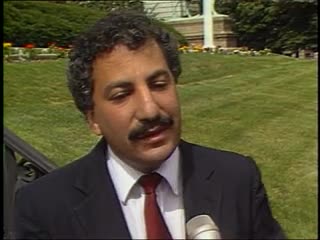
Description: B-roll of campaign workers holding campaign signs and handing out flyers for mayoral candidates Ray Flynn and Mel King, and other political candidates. Poll workers check in voters at polling stations. Voters stand in line to vote. A poll worker holds a stack of absentee ballots. Exteriors of the Mel King for Mayor headquarters. Campaign staff members work and make telephone calls at the campaign headquarters of Flynn and King. A Flynn worker telephones voters to remind them to vote for Flynn. Campaign workers for King and Flynn are gathered outside of a polling station in the evening. Some campaign workers approach voters. One campaign worker remarks on the cold weather. Voters stand in line and vote at a polling station. Shot of a voting booth.
1:00:00: Visual: Shot of a street corner posted with campaign signs for Mel King (candidate for mayor of Boston) and Craig Lankhorst (candidate for Boston School Committee). Footage of campaign workers holding signs for Mark Roosevelt (candidate for Boston City Council), King, Lankhorst, and Abby Browne (candidate for Boston School Committee). The workers give out flyers to people as they enter a building. Shot of poll workers sitting at a table. Voters are lined up in front of the table. 1:00:48: V: Shots of campaign workers in front of a building, holding signs for Roosevelt, King, Browne, Ray Flynn (candidate for mayor of Boston), and others. Shots of the interior of a a polling station. Poll workers are seated at a table. Two women confer on one side of the room. One of the women examines a stack of absentee ballots, which she holds in her hands. Shot of a voter list being examined by a poll worker. Shots of poll workers at the table with the voter lists. Shot of the stack of absentee ballots on the poll workers' table; of the cover of the "City of Boston List of Registered Voters" for 1983. 1:04:17: V: Shots of the headquarters for the King mayoral campaign. King campaign signs are posted in the window. A man is heard speaking into a bullhorn, urging voters to vote for King. Shots of the crowded interior of the King headquarters. Several campaign workers are present. One campaign worker is organizing a ride to the polls for a voter. Shot of a sign for the Rainbow Coalition. 1:05:57: V: Shots of the interior of the Flynn campaign headquarters. Campaign workers are telephoning voters to remind them to vote for Flynn. 1:06:47: V: Shot of two campaign workers standing in front of a building, holding Flynn campaign signs. In the background is a King supporter with a King campaign sign. People are gathered in front of the building. Shot of the white King supporter talking to an African American man. Shots of the people gathered in front of the building; of two men walking away from the building. 1:08:18: V: Footage of a woman entering a polling station in the evening. She refuses the flyers offered to her by campaign workers. The campaign workers joke about how cold it is outside. The campaign workers hand out more flyers to voters as they enter the polling station. Shot of campaign signs covering a pole on the sidewalk of a busy street. 1:09:48: V: Footage of the interior of a polling station. Poll workers sit behind a table as they check in voters. A white voter is shown to a polling booth. Poll workers continue to check in voters. 1:12:00: V: Footage of an African American male voter checking in with the poll workers. Voters stand in line to enter the polling booths. Shot of a ballot on a voting machine with levers. Shot of voters feet as they stand in the voting booths.
Collection: Ten O'Clock News
Date Created: 11/05/1983
Description: State Senator Jack Backman opens a press conference in support of Mel King (Boston mayoral candidate) in front of the State House. Other participants include Byron Rushing (State Representative from the South End), Mary Jane Gibson (State Representative from Belmont), Susan Schur (State Representative from Newton), Mary Goode (former State Representative from Roxbury), and Barney Frank (US Congressman). Frank voices his support for King's candidacy and discusses the reasons for his endorsement, specifically, Frank talks about King's views on economic development and about his leadership abilities. Frank says that King is a creative leader who will bring "enlightened policy" to the city. Various reporters point out that Frank endorsed Dennis Kearney (candidate for mayor of Boston) in the primary elections. King arrives, shakes hands with Frank, thanks endorsers, and asserts that his administration will focus on employment, education, and the youth of the city.
1:00:10: Visual: Shot of a Mel King campaign sign. Jack Backman (State Senator) opens a press conference in front of the State House. He notes that Mel King (candidate for mayor of Boston) has not yet arrived. He voices his support for King. He introduces Byron Rushing (State Representative from the South End), Mary Jane Gibson (State Representative from Belmont), Susan Schur (State Representative from Newton), Mary Goode (former State Representative from Roxbury). Bachman lists off some state representatives who are due to arrive shortly at the press conference. Shots of Schur; of Rushing. Bachman introduces Barney Frank (US Congressman). 1:02:33: V: Frank says that he will support King for mayor of Boston; that he served with King for eight years in the legislature. Frank says that King is an advocate for enlightened policy for the city of Boston. Frank talks about King's ideas for economic development programs; about the Community Development Corporation. Frank says that King's ideas for development are in tune with the needs of city residents; that King is sensitive to the problems of displacement and the needs of area residents. Frank says that King can speak effectively on behalf of a diverse group of people; that King was an effective and respected legislator. Frank says that King will make an excellent mayor. A reporter asks Frank about his previous endorsements for mayor. Frank says that he is not always good at picking the winning candidate; that he speaks out on behalf of candidates who have good ideas and programs. A reporter notes that Frank endorsed Dennis Kearney (State Representative) in the primary election. He asks Frank how Kearney would have been a better mayor than King. Frank says that he endorsed Kearney in the primary because he thought Kearney was a good candidate with a good chance of winning. Frank says that Kearney and King take similar positions on the issues. Shot of King supporters standing behind Frank. Shot of Christy George (WGBH reporter). Audio is muffled. 1:07:45: V: Frank says that the many of the candidates in the race had similar positions on the issues; that King has helped shape the debate on the issues; that King was one of the first people to talk about the adverse effects of development on the elderly and the poor. Frank says that King is responsible for focusing the attention of the city on the management of economic development in a compassionate and effective manner. Frank says that he respects Ray Flynn (candidate for mayor of Boston); that King is more creative, thoughtful and consistent candidate; that King has proven himself to be an effective leader. Frank refuses to speculate on who he would have endorsed if King were not in the race. Frank says that he is endorsing a candidate because he is an elected official with an opinion; that he does not know what effect his endorsement has on a candidate's chances. A reporter asks Frank about the differences between King and Flynn. Frank says that the differences between the candidates stem from their past records; that King has proven himself to be a consistent and effective leader on economic issues for many years; that King has the capacity to stay with these issues. Frank notes that he does not agree with King on a mayor's role in foreign policy. A reporter asks Frank if King needs to highlight the issues on which he differs from Flynn. Frank says that King has stuck with the same issues for ten years; that his leadership has brought attention to these issues. Frank says that this has been a good mayoral campaign; that it has focused on issues. 1:13:15: V: Frank jokes with the reporters about his endorsement bringing in the voters from Brookline and Newton. A reporter asks Frank how King can get white liberal voters to support him instead of Flynn. Frank says that King can win voter support by focusing on the issues; that his positions on economic development may win over voters from traditionally "conservative" neighborhoods. A reporter asks Frank about his campaign advice for King. Frank says that King is doing the right thing by focusing on the issues; that King has proven his ability to be a leader on the issues. 1:16:32: V: King's supporters clap as he arrives at the State House. King and Frank shake hands. King thanks Frank and the assembled state representatives for their endorsements and support. King says that his administration will make the city open and accessible; that his administration will focus on employment, education, and the youth of the city.
Collection: Ten O'Clock News
Date Created: 10/21/1983
Description: TOM GALLAGHER WITHDRAWS FROM EIGHTH DISTRICT RACE. COMMENTS FROM Mel King, Joe Kennedy, George Bachrach, James Roosevelt.
Collection: Ten O'Clock News
Date Created: 06/26/1986
Description: Deborah Wang reports that Boston supporters of Jesse Jackson are undecided about whether to campaign for Michael Dukakis. The supporters recently met to discuss their role in the upcoming campaign. Jackson delegates Mel King, Saundra Graham, Juanita Wade, and Byron Rushing are among the leaders of the meeting. The leaders say that the Dukakis campaign should not take the votes of Jackson supporters for granted. There are some Jackson supporters who will not support Dukakis under any circumstances. Interview with Philip Stanley of the Dukakis campaign about the role of Jackson supporters in the Dukakis campaign. Stanley says that the Dukakis campaign has been meeting with Jackson supporters and that the campaign is taking no votes for granted. Interviews with Jackson supporters Darryl Heller, Trent Pettus and Myra McAdoo. All three supporters criticize the Dukakis campaign. Wang's report includes footage of Dukakis and Jackson at the 1988 Democratic National Convention and footage of Jackson embarking on a voter registration campaign. This edition of the Ten O'Clock News also included the following item: Adult entertainment at the Highland Tap
1:00:02: Visual: Footage from July 21, 1988 of the Democratic National Convention. Michael Dukakis (Democratic US Presidential nominee) and Kitty Dukakis (wife of Michael Dukakis) are congratulated by Jesse Jackson (African American political leader) and Jacqueline Jackson (wife of Jesse Jackson). They are surrounded by Democratic Party notables. Deborah Wang reports that Jackson ended his presidential campaign by endorsing the nomination of his rival Dukakis; that Jackson pledged to campaign for Dukakis in the fall. V: Footage of Jackson speaking at the Democratic Convention on July 18, 1988. Jackson is flanked by Dukakis and Lloyd Bentsen (Democratic US vice-presidential nominee). Jackson says that he is not seeking a job or a salary; that he wants to serve the nation. Shot of Jackson standing at the entrance to a campaign bus. Jackson waves to supporters. Supporters hang a sign on the side of the bus. The sign reads, "Rainbow voter registration campaign." Wang reports that Jackson supporters are undecided about whether to campaign for Dukakis; that Jackson supporters met last night in Roxbury about their role in the upcoming campaign. V: Shots of the audience at the meeting. Campaign leaders including Mel King (community activist and Jackson delegate), Saundra Graham (Jackson delegate), Byron Rushing (State Representative and Jackson delegate), and Juanita Wade (Jackson delegate) sit at a table at the front of the room. Footage of Wade saying that Jackson supporters will use the Republican threat to convince others to vote for Dukakis. Wang reports that Jackson supporters are unhappy with the Dukakis campaign. V: Footage of King saying that the Dukakis campaign has not been listening to Jackson supporters. King says that the Dukakis campaign should have addressed the role of Jackson supporters before now. Footage of Graham saying that Dukakis should be pursuing the 7 million votes represented by Jackson supporters. Shot of a life-size cut-out of Dukakis in the window of the Dukakis volunteer headquarters. Footage of Philip Stanley (State Director for the 1988 Dukakis campaign) being interviewed by Wang. Stanley says that he has met twice this week with the Jackson leadership; that the discussions are progressing. Stanley says that the Dukakis campaign is not taking anyone's vote for granted. Shots of volunteers working at the Dukakis volunteer headquarters. Wang reports that some Jackson supporters says that they will not work for Dukakis under any circumstances. V: Shot of Rushing addressing the audience at the meeting of Jackson supporters. Footage of Darryl Heller (Jackson supporter) saying that Dukakis made a mistake by choosing Bentsen as his running mate. Heller says that Bentsen does not believe in any of the same things as Jackson; that Bentsen is closer to Ronald Reagan (US President) than he is to Jackson. Heller says that it would be a violation of his conscience to vote for the Dukakis ticket. Footage of Trent Pettus (Jackson supporter) saying that he will not vote for Dukakis. Pettus says that Dukakis does not believe that gays and lesbians are fit to be foster parents. Pettus says that Dukakis advocates a discriminatory policy against gays and lesbians. Pettus adds that he will not vote for Dukakis. Footage of Myra McAdoo (Jackson supporter) saying that Dukakis needs to be ready to deal realistically with minority groups; that Jackson needs to receive a message from minority groups. Wang reports that some Jackson supporters will work to revive the Rainbow Coalition; that the supporters will work to get Rainbow candidates elected to state and local offices. V: Shots of Jackson supporters at the meeting in Roxbury. Footage of Jackson at the Democratic National Convention. Shots of delegates on the floor waving signs reading, "Jesse!" Wang notes that Jackson supporters will try to gain concessions from the Democratic Party. V: Footage of Rushing saying that he wants his constituents to be represented fairly by the chosen leader of the Democratic Party. Rushing says that Jackson supporters must barter their votes for fair representation. Rushing says that Jackson supporters must not be taken for granted by Dukakis. Wang stands in front of the Dukakis volunteer headquarters. Wang reports that Dukakis may not need to make peace with local Jackson supporters; that Dukakis is expected to win Massachusetts easily. Wang reports that Jackson supporters hope that Dukakis includes them in his campaign. Wang adds that Jackson supporters want Dukakis to make it clear that he does not take Jackson voters for granted.
Collection: Ten O'Clock News
Date Created: 08/25/1988
Description: David Boeri reports that Jesse Jackson spoke at the Massachusetts State House about the importance of access to higher education. Boeri notes that some students cannot afford higher education because of the increasing costs of higher education and federal cuts in student aid. Many supporters turned out to listen to Jackson. Jackson talks to the audience about the importance of education. Jackson addresses the media after his speech.
1:00:10: Visual: Footage of Kevin Sheehan (State Student Association of Massachusetts) talking about college students who must work forty hours per week on top of taking classes. Footage of Mike Ferrigno (State Student Association of Massachusetts) addressing a crowd at the State House about the debt incurred by many students in college. David Boeri reports that many low- and middle-income college students are incurring heavy debt in colleges; that some students can not afford to go to college. V: Shot of students walking on a campus. Boeri reports that speakers at a State House rally attacked federal cuts in federal aid to students. Boeri notes that the cuts come at a time when tuition and the cost of living are increasing; that grants are less easy to obtain. V: Shot of speakers and the audience inside the State House. Footage of Jesse Jackson (African American political leader) speaking about the importance of access to education. Boeri reports that Jackson said that universities have let the enrollment numbers fall for African American, minority, and low-income students. V: Shots of the members of the audience, including Mel King (community activist), Bill Owens (former state senator) and Shirley Owens Hicks (state representative). Footage of Jackson urging students to protest cuts in student aid. Jackson condemns the priorities of Ronald Reagan (US President). Jackson says that Reagan is "embarking on a trillion dollar misadventure in space." Jackson tells students that they need to stay sober, fight the Star Wars program and to "vote with Red Sox fever." The audience applauds as members rise to their feet. Footage of Jackson speaking to the media after his speech. Jackson uses the parable of Jesus Christ to illustrate society's obligation to cater to the needs of the poor and needy. Jackson says that many children are "locked out and living in the manger." Bruce Bolling (Boston City Council) is visible behind Jackson. Boeri reports that the State Student Association has registered over 5,000 new student voters; that the students will vote for more affordable education in November.
Collection: Ten O'Clock News
Date Created: 10/17/1986
Description: Christopher Lydon reports that Mayor Ray Flynn is requesting the creation of a Boston Employment Commission in order to boost the number of Boston residents working in Boston jobs. The Flynn administration would like the Boston work force to be 10% female, 25% minority and 50% Boston residents. Interview with Flynn about employment in Boston. Interview with City Councilor James Kelly, who says that sanctions will be imposed unfairly on the construction industry. Interviews with Mel King and City Councilor Thomas Menino. Lydon notes that critics believe that compliance with the ordinance would cost jobs. Brief interviews with construction workers and white-collar workers about the proposed ordinance. This edition of the Ten O'Clock News also included the following item: Minister Don Mohammad speaks out against drug traffic in Roxbury
1:00:02: Visual: Footage of a white male construction worker being interviewed on the street. The man says that he is from Boston. Hope Kelly (WGBH reporter) asks him which neighborhood he is from. The man says that he is actually from Billerica. The man says that he avoids telling people that he is not from Boston. Christopher Lydon reports that Ray Flynn (Mayor of Boston) is requesting the creation of the Boston Employment Commission; that the Commission's goal would be to boost the number of Boston residents working on Boston jobs. V: Footage of Flynn being interviewed. Flynn says that Boston is experiencing a significant growth period; that there are plenty of opportunities for everyone. Flynn says that people are not fighting over crumbs. Footage of a white male construction worker being interviewed on the street. The man says that Flynn wants to put the "outsiders" out of work; that the "outsiders" are the true professionals who have been in the union for over ten years. Footage of another white male construction worker being interviewed. The man asks where he is supposed to go to work. The man says that the work is in the city of Boston; that he should be allowed to work there. Lydon reports that many construction workers fear displacement by the goals set by the Flynn administration. Lydon reports that the Flynn administration would like the Boston work force to be 10% female, 25% minority and 50% Boston residents. V: Shot of Boston City Hall. Lydon says that the present work force does not resemble Flynn's proposed work force. V: Footage of Hope Kelly interviewing construction workers at International Place. Two white male construction workers say that they are from North Attleborough. Another white male construction worker says that he is from Canton; that ninety percent of the workers on his job are not living in the city. Footage of Hope Kelly interviewing white-collar workers in Post Office Square. A white male says that he is a commuter. Another white male says that he is from Walpole. A white female says that she is from Newton. Another white female says that she is from Brookline. A third white female says that she is from Quincy. Lydon reports that Flynn's proposed ordinance would change the demographics of the work force in the public and private sectors. Lydon says that the greatest opposition so far comes from the unions; that the construction unions say that their field is being singled out. V: Shots of corporate workers crossing the street near Government Center; of a man carrying a brief case as he crosses the street. Shot of two white corporate workers conversing on the sidewalk. Shot of an African American construction worker talking to white colleagues. Shot of the State Street Bank building. Lydon reports that the unions have a political ally in James Kelly (Boston City Council and Sheet Metalworkers Union). V: Footage of James Kelly being interviewed. Kelly says that Flynn's ordinance talks about good faith efforts and voluntary agreements between the city and major corporations. Kelly says that sanctions will be imposed on construction companies. Lydon reports that the sanctions include potential fines against developers whose hiring practices do not meet the standards of the ordinance. Lydon notes that the mayor has issues two previous ordinances with similar goals. V: Shot of a backhoe excavating dirt at a construction site. Footage of Mel King (candidate for US Representative) being interviewed outside of his campaign offices. King says that the mayor has been unable to put "teeth" in the ordinance. Lydon reports that Flynn supporters point to progress. V: Footage of Thomas Menino (Boston City Council) being interviewed. Menino says that some trades are up to 20% and higher. Menino says that progress is being made. Menino says that the city has not yet imposed any sanctions on the construction trades. Lydon reports that King believes that sanctions are necessary. V: Footage of King being interviewed. King says that the ordinance needs "teeth." King says that there is no real monitoring process. Lydon reports that critics believe that compliance with the ordinance could cost jobs. Flynn disagrees with critics. Flynn says that at least six major public works projects are imminent. V: Shot of Flynn. Lydon reports that many workers do not believe Flynn. V: Footage of a white male construction worker being interviewed by Hope Kelly. The construction worker says that he does not believe Flynn. He asks Hope Kelly if she believes Flynn.
Collection: Ten O'Clock News
Date Created: 07/24/1986
Description: First seven minutes are shots of photographs of community activist Mel King throughout his life. Then Christopher Lydon interviews his wife Joyce King in the kitchen of their home. Joyce says that Mel's parents taught him the importance of sharing with others, and adds that he was very proud of his father, who was active in a union. Joyce talks about Mel's generosity. Lydon asks about the West Indian background of Mel's family, and about his formative years. She says that Mel's family was proud of their West Indian heritage and discusses his experiences while attending college in South Carolina. Joyce says that he learned about racism and oppression while living in South Carolina.
1:00:02: Visual: Shots of black and white photographs of Mel King throughout his life; of Mel King's high school yearbook photograph. 1:06:55: V: Christopher Lydon interviews Joyce King (wife of Mel King) in the kitchen of her home. Lydon asks Joyce King about Mel King's family. Joyce King says that Mel King's family always shared what they had with others; that Mel King's mother was able to make do with the few resources she had. Joyce King says that Mel King's father was active in a union; that Mel King is very proud of his father. Joyce King tells a story about the generosity of Mel King's father. Joyce King says that Mel King has an "open door policy"; that Mel King is not protective of his privacy. Joyce King says that Mel King often brings people to their home. Joyce King says that Mel King often gives clothing or money to those in need; that he does it in a quiet manner. 1:15:06: V: Lydon asks about the West Indian culture of Mel King's family. Joyce King says that Mel King's family is proud of their heritage; that his parents grew up in Barbados; that the family has strong connections to their heritage. Lydon asks about Mel King's formative years. Joyce King says that Mel King's membership in the Church of All Nations was important in his younger years; that Mel King attended a church-sponsored school in South Carolina; that the public school system discouraged African Americans from attending university. Joyce King says that Mel King learned a lot about race and oppression when he was at college in South Carolina; that Mel King traveled through the South as a member of the sports teams at his college. Joyce King says that Mel King returned from South Carolina with ideas about race and the fight against oppression.
Collection: Ten O'Clock News
Date Created: 11/06/1983
Description: Mayoral candidates Mel King and Ray Flynn participate in a forum on education sponsored by the Citywide Education Coalition (CWEC) at English High School. Flynn talks about his experience in government and his commitment to the public schools. He notes his familiarity with the city and school budgets, and he discusses the importance of public education and public housing. King stresses the importance of early childhood education programs and a "child-centered" school system. King speaks of the need for the mayor to work together with the Boston School Committee. King says that the city must continue to demonstrate its support of integrated schools. King and Flynn respond to a question about requiring students to pass a standardized test in order to graduate. Tape 1 of 2.
1:00:05: Visual: Four members of the Citywide Education Coalition (CWEC) sit at a table on stage at English High School. A member of the CWEC welcomes mayoral candidates Ray Flynn and Mel King to the annual meeting of the CWEC. Flynn and King are seated at a table at the center of the stage. Shots of Flynn and King. The CWEC member says that the candidates and the audience will discuss the future of public education in Boston. 1:01:55: V: Flynn thanks the moderator and the CWEC. Flynn mentions his experience as a state legislator and a member of the Boston City Council. He says that he was a student in the Boston Public Schools. Flynn congratulates the CWEC for their commitment ot public education. Flynn stresses the importance of public education and a good school system. Flynn says that he has a Master's Degree in education from Harvard; that he is committed to education. Flynn says that he would visit a few public schools and a few public housing projects on his first day as mayor; that education and public housing will be major concerns for his administration. Flynn says that the mayor should be involved in public education; that politicians in Boston have distanced themselves from the public schools since desegregation. Flynn says that the mayor should serve as an ex-officio member of the Boston School Committee; that the mayor needs to be aware of the situation in the schools. Flynn says that he is familiar with the city and school budgets. Flynn says that fiscal stability and predictable student placements are important for the schools. The audience applauds. 1:07:56: V: King thanks the audience and the CWEC. King says that the students in the school system must be served from birth to graduation; that early childhood education programs are important. King says that resources must be allocated to support Head Start programs and other early childhood education programs. King says that "child-centered" school system must guarantee education for all students; that the school system must believe that all children can be educated. King says that the mayor must work with the Boston School Committee; that the members of the School Committee will be newly elected; that the mayor and the Boston School Committee must determine the problems and the needs of the school system. King says that the newly elected School Committee must be unified in support of integrated schools. Jump cut in videotape. King says that he would provide leadership on the issue of education; that he would work to create a good climate and to end divisiveness on the issue of education. King says that the Boston Public School System must demonstrate its commitment to integrated education. The audience applauds. 1:14:52: V: An audience member asks if students should pass a standardized test in order to graduate from high school. King says that standards need to be established in the early grades as well as upon graduation. King says that the school administration must be held responsible for the education of the students; that diagnostic testing and evaluation is needed at every grade level, not just upon graduation.
Collection: Ten O'Clock News
Date Created: 10/13/1983
Description: Mayoral candidates Ray Flynn and Mel King participate in a forum on education sponsored by the Citywide Education Coalition (CWEC) at English High School. Flynn says that students graduating from Boston public schools must be prepared to compete in the workplace. He adds that there must be a working relationship between parents, teachers, administrators, and the community. King speaks about the workings of the school administration and advocates the inclusion of parents in the process. King and Flynn respond to questions about how they would have handled school desegregation if they had been mayor at the time. Both candidates answer questions about the role of the mayor upon the court's withdrawal from its supervisory role over the school system and about the school budget. Audience members include John O'Bryant of the Boston School Committee. Tape 2 of 2.
1:00:00: Visual: Ray Flynn (candidate for mayor of Boston) speaks at a forum on education sponsored by the Citywide Education Coalition (CWEC) at English High School. The candidates' forum is held in conjuction with their annual meeting. Flynn says that students graduating from Boston public schools must be able to compete in the workplace. Long shot of candidates on stage from the back of the auditorium. Flynn says that there must be a working relationship between parents, teachers, administrators and the community. The audience applauds. 1:00:56: V: King speaks about the workings of the school administration. Jump cut in the videotape. Shots of John O'Bryant (Boston School Committee); of members of the audience. King says that parents must be included in the workings of the school system. Shot of the candidates on stage. An audience member asks what each candidate would have done about school desegregation if he had been mayor at the time. The audience member also asks about the role of the mayor when the court pulls withdraws from its supervisory role over the school system. King says that community control over schools is important; that community accountablility is an important aspect of community control; that members of the community must be held accountable for the state of neighborhood schools. King says that he had suggested a community approach to schools which could have prevented the kind of sweeping court order imposed by the federal court to accomplish school desegregation. King says that he would have tried to bring people together in support of school desegregation if he had been mayor at the time; that there were many people acting in opposition to the court order at the time of school desegregation. King says that he would provide leadership on the issue of quality, integrated education upon the withdrawal of the court. 1:05:08: V: Flynn responds to the same question about school desegregation. Flynn notes that the State Department of Education will continue to oversee the Boston Public School System after the withdrawal of the court. Flynn says that he will work with the State Department of Education to protect the Constitutional rights of public schoolchildren in Boston. Flynn says that political and moral leadership was absent during school desegregation in Boston. Flynn says that he would have defended the rights and the safety of Boston schoolchildren as mayor, even if he disagreed with the court order. Flynn notes that he was a state legislator at the time of school desegregation; that he was criticized at the time for standing up for his beliefs; that he was criticized for living in a certain community; that he acted responsibly on behalf of all of Boston's schoolchildren at the time. 1:07:15: V: An audience member asks about the school budget. Flynn says that it is important to educate children; that it is more expensive to remedy social problems resulting from poor education. Flynn says that he supported funding for Boston schools even when it was politically unpopular to do so; that he is committed to providing the necessary funds to assure a good school system. Flynn says that accountability is as important as funding; that the school system has too many administrators. King responds to the same question. King says that he is aware of the lack of resources available to teachers and students in the Boston Public School System; that the lack of resources is embarrassing for a school system with a large budget; that the school administrators must make a commitment to provide resources for students and teachers.
Collection: Ten O'Clock News
Date Created: 10/13/1983
Description: B+W photos from The Boston Globe of Mel King and Ray Flynn through their respective political careers.
Collection: Ten O'Clock News
Date Created: 11/02/1983