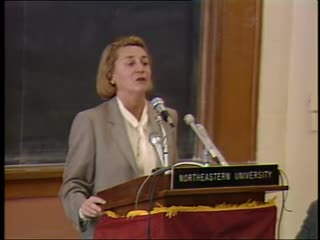
Description: THREE DEMOCRATIC US REPS VISIT NORTHEASTERN UNIVERSITY TO WOO STUDENTS FROM GOP. Chester Atkins, Barbara Kennelly, D. Edwards
Collection: Ten O'Clock News
Date Created: 10/21/1985
Description: Northeastern student James DeRosa was murdered in South End. University sponsors walk to benefit victims of violence. Office of NU police. Students lounge outside Ell Center in summer clothes.
Collection: Ten O'Clock News
Date Created: 05/15/1990
Description: Career planning directors at Boston University and Northeastern say graduating seniors have postponed job search this year and have been less successful.
Collection: Ten O'Clock News
Date Created: 05/08/1991
Description: Hope Kelly reports on the incidence of hate crimes in Boston. Kelly explains that hate crimes are defined as incidents of racial violence; she cites statistics that illustrate how hate crimes have affected various racial and ethnic groups. Kelly's report includes footage of Jack McDevitt (Center for Applied Research, Northeastern University) giving a seminar on hate crimes in Boston. The small audience includes uniformed police officers. McDevitt says that most hate crimes are not initially categorized as such by police officers. McDevitt talks about the seriousness of hate crimes. He notes that all racial and ethnic groups are affected. Kelly's report includes shots of Boston residents on the streets and shots from a moving car of downtown Boston in the evening.
1:00:13: Visual: Shots from a moving car of downtown Boston at night. Hope Kelly reports that hate crimes are defined as incidents of racial violence; that Boston has had 452 hate crimes over the past four years. Kelly notes that hate crimes are rarely recognized for what they are. V: Footage of Jack McDevitt (Center for Applied Research, Northeastern University) addressing a small audience. McDevitt says that his research looks at how Boston's 452 hate crimes were initially categorized by the responding officer. McDevitt says that 19 of the 452 incidents were initially categorized as racially motivated. Shots of the audience listening to McDevitt. Shots of police officers in uniform as they listen to McDevitt. Kelly reports that one of the goals of the study is to teach police officers and citizens to recognize these crimes for what they are. V: Footage of McDevitt saying that Boston's hate crimes were more serious than statistics show them to be. Kelly reports that half of Boston's 452 hate crimes involved assaults; that thirty percent of the assaults were serious enough to require hospitalization. Kelly reports that national statistics show only 7% of assaults as serious enough to require hospitalization. V: Shots from a moving car of residents on the streets of Boston at night. Audio of McDevitt saying that many of Boston's hate crimes involve multiple offenders attacking a single victim. Shots of Washington Street in Roxbury during the day. Elevated train tracks are visible. Shots of African American men gathered outside of Joe's sub shop on Washington Street. Kelly reports that McDevitt found turf issues to be the motivation of many hate crimes in Boston. V: Footage of McDevitt saying that members of every racial and ethnic group were victims of hate crimes. Kelly reports that the study found that Africans Americans and whites were equally apt to be victims of hate crimes; that the perpetrators were usually of another race than their victim. V: Shots of residents walking on the streets of Boston in the daylight. On-screen text and visuals detail hate crime statistics. Kelly reports that 118 African Americans were victims of hate crimes; that 92% of those victims were attacked by whites. Kelly reports that 111 whites were victims of hate crimes; that 78% of those victims were attacked by African Americans. Kelly reports that whites and African Americans accounted for 2/3 of all victims. Kelly reports that 6% of victims were Latino; that the rest of the victims were Asian. Kelly notes that Vietnamese residents were victimized at a rate far out of proportion to their population. V: Shot of a white business man walking and an African American business man walking in the financial district. Shots of Latino residents walking on a street; of two Asian men conversing on a sidewalk. Kelly reports that the perpetrators were unknown in 25% of Boston's hate crimes. V: Shots of a police car traveling slowly through a parking lot. On-screen text and visuals detail statistics about perpetrators of hate crimes. Kelly reports that 63% of known offenders are white; that 33 % of known offenders are African American; that 4% of known offenders are Latino and Asian. Kelly notes that victims are often reluctant to report hate crimes. V: Shots of McDevitt talking about his study; of police officers and officials in the audience, including Francis "Mickey" Roache (Commissioner, Boston Police Department). Shot from a car of a street in downtown Boston.
Collection: Ten O'Clock News
Date Created: 03/27/1989
Description: ELL CENTER AT NORTHEASTERN University, pubs, package store, liquor store ON HUNTINGTON AVENUE
Collection: Ten O'Clock News
Date Created: 02/22/1985
Description: Carmen Fields interviews three Northeastern journalism students on the coverage of the Persian Gulf war. Two students are impressed with the immediacy of the coverage provided by television (CNN and the networks), but the other thinks that it is "not as in-depth as it could get." Fields contrasts the commitment to "the people's right to know" of Watergate-era journalists with the students' views regarding the importance of censorship to protect national security and the lives of individual soldiers. The students also discuss the missing CBS news crew led by Bob Simon, and question the news team's decision to report in a war zone without a military escort.
Collection: Ten O'Clock News
Date Created: 02/18/1991
Description: INTERVIEWS ON STREET WITH NORTHEASTERN STUDENTS, DEAN AUSTIN ON COOP PROGRAMS
Collection: Ten O'Clock News
Date Created: 10/30/1984
Description: Exteriors of Northeastern Universtiy; MIT; Boston University.
Collection: Ten O'Clock News
Date Created: 02/10/1982
Description: Marcus Jones reports on Northeastern University's observation of the birthday of Martin Luther King Jr. Jones notes that a ceremony commemorating King's life was held at the university. Jones' report includes footage from the ceremony. Sonia Sanchez (poet and teacher) talks about King. Jones' report also includes footage of King. Susan Sullivan (Northeastern Law student) makes the announcement that the university is awarding an honorary law degree to Nelson Mandela. Interviews with Daniel Givelber (Dean, Northeastern University School of Law) and Sullivan about the decision to award a degree to Mandela. Jones notes that the university trustees overturned a policy which required recipients of degrees to pick them up in person. This edition of the Ten O'Clock News also included the following item: David Scondras, Charles Yancey and Ray Flynn: Boston City Council makes fair housing policy
1:00:10: Visual: Footage of an African American man performing a song at a ceremony commemorating the life of Martin Luther King (civil rights leader) at Northeastern University. Shots of the audience. Marcus Jones reports that hundreds of people gathered at Northeastern to commemorate the life of King; that King's 59th birthday is Friday. V: Shots of King addressing a crowd; of King marching at the head of a group of civil rights demonstrators. Footage of Sonia Sanchez (poet and teacher) talks about King's struggle to advance the cause of civil rights. Sanchez says that King's work is not finished. Shots of audience members applauding. Jones reports that Sanchez was the featured speaker at the ceremony; that the remarks of Susan Sullivan (Northeastern Law student) were the highlight of the event. V: Footage of Sullivan announcing that the Board of Trustees at Northeastern University has decided to award an honorary law degree to Nelson Mandela (jailed South African leader). The crowd applauds. Jones reports that Northeastern law students have petitioned the university for three years to grant a degree to Mandela. V: Shot of the entrance to the library at Northeastern Law School. Shot of a paper taped to the door of the library. A handwritten note on the paper reads, "Trustees grant Mandela Honorary Degree." Jones reports that the request had been previously denied due to a policy which required recipients of degrees to pick them up in person. Jones notes that Mandela has been jailed by the South African government because of his opposition to apartheid. V: Black and white footage of Mandela speaking; of a sign for Pollsmoor Prison, where Mandela is held. Jones notes that the university's decision to accede to the demands of students and faculty is unprecedented. V: Footage of Jones interviewing Daniel Givelber (Dean, Northeastern University School of Law). Givelbar says that Northeastern has an unusually diverse group of Trustees; that the Trustees felt like they were doing the right thing. Givelbar notes that the Board of Trustees made the decision to divest two years ago. Footage of Susan Sullivan saying that the degree should have been granted when the students first petitioned for it; that the law students should not have had to fight so hard for it. Sullivan says that international recognition could hasten Mandela's release from jail. Jones notes that the scheduled protest by the students turned into a celebration. Jones says that Northeastern students hope that other universities will follow Northeastern's example.
Collection: Ten O'Clock News
Date Created: 01/14/1988
Description: Widespread photocopying of published materials by students constitutes copyright infringement. Northeastern president John Curry will monitor this activity. Students doing library research.
Collection: Ten O'Clock News
Date Created: 10/18/1989