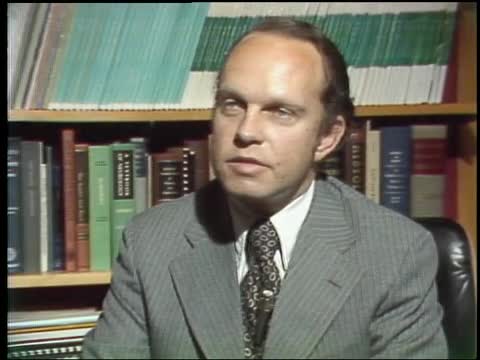
Description: Christopher Lydon interviews Mel King (candidate for mayor of Boston) in King's home. King talks about the benefits of growing up in a diverse neighborhood and about his own childhood in Boston. Lydon asks King about his philosophy of government. King says that the government must serve those who are most in need; he adds that the government should take an active role in issues of poverty, education, the environment, and women's issues. King talks about the interconnectedness of different issues and problems. Lydon asks whether there is an ideology behind King's politics. King says that he tries to take a realistic approach to government. King believes that love and change are the two fundamentals of life. Lydon asks how King rates himself as an administrator. King says that he is a good administrator who tries to identify problems and work together with people to find solutions. The tape includes shots of the exterior of King's home.
1:00:01: V: Shots of the exterior of the King home in the South End. 1:01:10: V: Christopher Lydon sets up an interview with Mel King (candidate for mayor of Boston) in King's home. Lydon asks King about his political formation on the streets where he grew up. King talks about growing up in the diverse "New York streets" neighborhood of Boston. King says that he grew up with an appreciation for other cultures. Lydon and the camera crew discuss the set-up of the shot. King continues to talk about his experiences growing up on Seneca Street. King says that diverse urban neighborhoods provide a model for cooperation among groups of different backgrounds. King talks about the benefits of growing up with people of different cultures and ethnicities. 1:05:41: V: Lydon asks King about his philosophy of government. King says that government must serve those who are most in need; that all of society benefits when the neediest are served. King says that government must serve society's needs in the areas of poverty, education, the environment, and women's issues. King says that government must serve the needs of all people. He uses the example of access for the disabled. King says that all of society is guaranteed access when access is granted to the disabled. King says that problems in Boston's neighborhoods cannot be ignored; that these problems must be solved before they spread to other areas. King says that problems in one neighborhood affect every resident of the city. King stresses the connections between people and problems. He gives an example of the local problems caused by the oil crisis in the 1970s. 1:11:46: V: Lydon asks if there is an ideology behind King's politics. King says that his approach to government is realistic; that there is no "pure" form of government. King says that he has tried to address the realities of his life as an African American man living in Boston; that he has tried to address the realities and needs of his community and his city. King says that there are essential needs which must be met; that he has tried to look at the forces impacting the needs of people and communities. King says that love and change are the two fundamentals of life. 1:15:35: V: Lydon asks King to rate himself as an administrator. King says that he tries to identify problems; that he gathers people together to find creative solutions; that he works with people to implement solutions; that he tries to evaluate the solution to find out if it works. King talks about using this approach as director of the Urban League of Boston. King says that he is using this approach to solve problems in his current job at MIT (Massachusetts Institute of Technology). King says that a city government must deliver services efficiently on a fixed budget. King notes that Joseph Jordan (Police Commissioner, City of Boston) has provided ineffective leadership for the Boston Police Department. King says that it is important to appoint good administrators for city programs. King notes that he has proven experience as a good administrator.
Collection: Ten O'Clock News
Date Created: 11/07/1983
Description: Christopher Lydon interviews Mel King (Boston mayoral candidate) in his home. Lydon asks King about his experiences and strengths as a social worker. King says that he believes in empowering people and encouraging them to solve their own problems. King answers questions about similarities between his background and the background of Ray Flynn (Boston mayoral candidate). King says that Flynn has adopted a "me, too" approach to politics. King emphasizes his own commitment to diversity and says that he has taken the lead on many issues. Lydon asks King whether Flynn has learned from him. Lydon also asks King about his silent nature. King says that there is thought and reflection behind his silences. Some sound interference at the end of the interview. Tape 2 of 2 Editor's note: Content given off the record was edited out of this footage.
1:00:30: Visual: Christopher Lydon interviews Mel King (candidate for mayor of Boston) in his home. Lydon asks King to describe his experiences and strengths as a social worker. King says that it is important to help people in need; that it is important to feel good about yourself in order to feel good about other people; that people feel good when they can solve their own problems. King talks about his work with the Symphony Tenants Organizing Project. King says that he encouraged the tenants to use their skills to solve problems. King says that it takes a lot of people to effect change. King says that he is inspired by the actions of Rosa Parks (African American civil rights activist); that the civil rights movement required the participation of many. King says that he believes in empowering people to solve their own problems. 1:04:57: V: Lydon asks King about similarities between his background and the background of Ray Flynn (candidate for mayor of Boston). King says that he has never remarked on similarities between him and Flynn; that Flynn has adopted a "me, too" approach to politics which leads people to see similarities between them. King says that their experiences and worldviews are vastly different; that Flynn's positions are narrower and more parochial. King notes that Flynn does not live in a diverse community; that his legislative achievements are different than Flynn's legislative achievements; that Flynn has not pushed for the same kind of programs. Lydon asks if Flynn has learned from King. King says that people are aware of his successes. King notes that he is usually out in front on the issues; that Flynn has not been out in front on the issues. King adds that he filed the first bills dealing with housing displacement and condominium conversion; that Flynn lagged behind him on this issue. King says that his politics have been informed by the issue of oppression. King says that he and Flynn come from different places in respect to the issue of oppression. 1:12:05: V: Lydon asks King what is behind King's silence. King says that there is thought and reflection behind his silence; that he expresses his anger at oppression through action. King says that he likes to think about the causes of problems and the solutions to problems. The crew takes cutaway shots of Lydon and King. Lydon says that King should consider Flynn as a student; that Flynn needs to learn from King, even if he wins the election. King and Lydon speak informally about the staffing of Flynn's administration in the event of a Flynn victory. Lydon asks King if he would consider working for a Flynn administration.
Collection: Ten O'Clock News
Date Created: 11/03/1983
Description: Persian Gulf veterans are among the marchers in the Memorial Day parade in Dorchester. Brigadier General Richard Neal addresses the crowd gathered at cemetery. "Taps"
Collection: Ten O'Clock News
Date Created: 05/27/1991
Description: Memorial service for Golda Meir at temple in Brookline. Elma Lewis and Kitty Dukakis are among the crowded congregation. Gov. Michael Dukakis, wearing yarmulke, on stage with dignitaries. Cantor sings. Dukakis gives tribute. Others, including former US ambassador to Israel Walworth Barbour, offer prayers, poems, remembrances.
Collection: Ten O'Clock News
Date Created: 12/12/1978
Description: Principal, teacher and secretary at Somerville High School recall the day JFK was assassinated 25 years ago.
Collection: Ten O'Clock News
Date Created: 11/21/1988
Description: "Memphis to Montgomery" B+W footage of the Montgomery bus boycott, Selma march, and other civil rights actions in the 1950s through 1968. Martin Luther King, Jr. and Ralph David Abernathy.
Collection: Ten O'Clock News
Description: Newly appointed mental health commissioner Henry Tomes addresses need for funding and proclaims his commitment to improving services. Lobbyists wary of budget priorities in legislature.
Collection: Ten O'Clock News
Date Created: 03/16/1989
Description: Mentally ill persons march to State House in rain to protest elimination of funds that support day treatment programs.
Collection: Ten O'Clock News
Date Created: 01/26/1990
Description: Mental health advocates try to regain crisis care funding which they say Dukakis administration has withdrawn. Frank Keefe defends budget "reversions" in mental health services.
Collection: Ten O'Clock News
Date Created: 06/02/1988
Description: Community mental health services are jeopardized by state budget cuts. Boston administrator Gerry Morrissey pleads for $$$ for the many patients who will suffer. Beds in night shelter for mentally ill.
Collection: Ten O'Clock News
Date Created: 09/22/1989