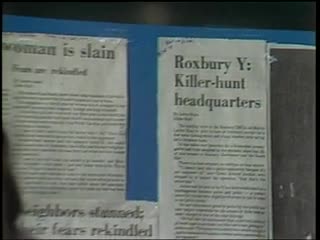
Description: Public defender Leslie Harris talks about confusion of getting cases through Roxbury District Court. This includes delays; missing defendants, witnesses and victims; making deals with prosecutors. Courtroom.
Collection: Ten O'Clock News
Date Created: 09/06/1990
Description: Footage of the exterior of Roxbury High School on Greenville Street and footage of students in an English class at Roxbury High School. Pam Bullard interviews Roxbury High School students Domingo Rivera, Ramon Alicea, Crystal Roach, Mark Benjamin, and Chiman Lee about their experiences at Roxbury High School. The students talk about academic programs at the school, their college plans, the atmosphere at the school, and extracurricular activities and sports programs at the school. All of the students speak highly of Charles Ray (Headmaster, Roxbury High School). Footage of Ray greeting students in the hall as they change classes.
1:00:07: Visual: Shots of the exterior of Roxbury High School on Greenville Street. Shots of the plaster statues at the entrance of the school. One of the statues has a cigarette stuck in its mouth. A male student enters the school. Shots of the houses on Greenville Street. 1:02:24: V: African American and white students sit in a classroom at Roxbury High School. A white female teacher talks to them about a book. She asks one of the students to read a paragraph. An African American male student reads from the book. The teacher asks the students questions about the passsage from the book. Shots of the students in the classroom. The students look at their books. The teacher and the students continue to discuss the book. Shots of the students seated at their desks. 1:06:50: V: Pam Bullard interviews a group of Roxbury High School students in a classroom. The students tell Bullard their names: Domingo Rivera, Ramon Alicea, Crystal Roach and Mark Benjamin. Bullard asks the students questions about Roxbury High School. Roach says that she is an the college program and has an internship at State Street Bank. Roach talks about her internship at the bank. Roach says that she would like to go to college and hopes for a scholarship. Alicea says that he is in the college program and is involved in the Upward Bound Program. Alicea talks about the Upward Bound Program; he says that the Upward Bound Program is helping him prepare his college applications. Alicea says that he plays for the football team. Rivera says that he is also in the college program and is involved in the Upward Bound Program. Rivera says that he has taken an English class through the Upward Bound Program. Rivera says that he does not know where he wants to go to college. Benjamin says that he is also in the college program. He says that he wants to major in sciences when he goes to college. Bullard asks Benjamin if he likes the school. Benjamin says that he likes the school. He adds that the majority of the students get along well at the school. 1:11:41: V: Bullard interviews Chiman Lee (Roxbury High School student); Lee has joined the group in the classroom. Lee says that he has recently moved to Boston and has been at Roxbury High School for six months. Lee says that he likes the teachers and students at the school. Lee adds that he is enrolled in the bilingual program. Bullard asks Roach what she likes about the school. Roach says that the teachers are helpful; that everyone gets along well. Roach says that she attended Charlestown High School for one week; that she transferred to Roxbury High School because she did not like Charlestown High School. Roach says that she likes Charles Ray (Headmaster, Roxbury High School) and the teachers at Roxbury High School. Roach says that Ray is helpful and friendly. Benjamin agrees that Ray is concerned about the students at the school. Benjamin talks about how much he likes going to school at Roxbury High School. He adds that the teachers are eager to help the students with their problems. Bullard asks about extracurricular activities at the school. Roach talks about the sports program and the annual Fall Festival at the school. Benjamin says that the sports teams would be better if all of the students participated. He talks about the football and basketball teams. Benjamin says that basketball is the most popular sport. Bullard asks Rivera about the baseball team. Rivera says that the baseball field is not very close to the school. He adds that it is inconvenient for some students to get to the field after school. Alicea says that the football team will be good this year. Bullard closes the interview. 1:17:38: V: The WGBH camera crew films Charles Ray as he greets students in the hallway of Roxbury High School. Ray greets most of the students by name. Some of the students wave and strike poses for the camera. Many students pass Ray in the hallway as they change classrooms. Some students stop to retrieve books from lockers in the hallway. Ray speaks to a teacher about the bilingual program at the school. Ray jokes with the students and urges them to go to their classrooms.
Collection: Ten O'Clock News
Date Created: 09/13/1978
Description: Roxbury High School. .
Collection: Ten O'Clock News
Date Created: 01/26/1981
Description: Charles Ray, the Headmaster of Roxbury High School, talking to students, parents and faculty members in the offices of Roxbury High School. Pam Bullard interviews Ray in the administrative offices of the school. Ray talks about how the school has changed since the beginning of school desegregation in 1974. He notes that white attendance is still low, but that it is improving. Ray describes the school's bilingual program, and the academic programs set up at the school in conjunction with Harvard University. He says that many students from Roxbury High School received college scholarships last year, and discusses their college opportunities. Ray talks about the atmosphere at the school, and the close relationships between the students and the faculty. He notes that very few students transfer out of the school. He adds that most students feel comfortable at Roxbury High School. Ray says that he tries to learn the names of every student in the school. Ray talks about the challenges of urban education. He says that he encourages pregnant students to remain in school as long as possible. Ray says that he would like to see a program set up to allow students to bring their children to school with them. Ray describes the school's building and facilities. Ray tells Bullard that it is important to treat each student with respect.
1:00:05: Visual: Charles Ray (Headmaster, Roxbury High School) speaks to an African American female student in the office of Roxbury High School. He tells the student what she needs to do in order to change school assignments. 1:01:37: V: Pam Bullard sets up an interview with Ray. Ray talks about some of the photographs in the school office. He notes that the photos were taken by students from the school. Ray talks to a student who has entered the office. The student asks Ray about the television crew in the school office. Bullard notes that the Boston Public Schools are beginning their fifth year of desegregation. Bullard asks Ray how things have changed in five years. Ray notes that Roxbury High School was paired with South Boston High School during the first year of desegregation. Ray notes that only a small percentage of students from South Boston attended Roxbury High School during the first year of school desegregation. Ray says that Roxbury High School was placed in the same district as Charlestown High School during the second year of school desegregation; that Roxbury High School has remained in that district. Bullard asks Ray about white attendance at Roxbury High School. Ray says that the school has more white students now than it had during the first year of school desegregation. He notes that sixty-three white students have been assigned to the school this year; that twenty-five white students are in attendance. Ray says that he would like the Boston School Department to assign more white students to the school. Ray says that Roxbury High School has a bilingual program for Asian and Spanish-speaking students. Bullard asks Ray about Roxbury High School's programs in conjuction with Harvard University. Ray explains that Roxbury High School has been paired with Harvard University by the federal court order governing school desegregation in Boston. Ray talks about a tutoring program in which Harvard students tutor Roxbury High School students. Ray talks about the Harvard Upward Bound Program. He adds that Harvard and Roxbury High School have set up programs for students in advanced math and sciences, reading, and art. Ray explains that teachers and advanced students can take courses at Harvard University. 1:06:46: V: Bullard notes that students who attend Roxbury High School tend to stay at the school and do not transfer out. Ray agrees that not many students transfer out of the school. He adds that most students like the school and the faculty. Bullard asks Ray if many students from Roxbury High School attend college. Ray says that 74 students graduated from Roxbury High School in 1978; that 37 of those students went on to college. He adds that many of the students received scholarships last year. Ray adds that the Girls High Alumni Association has contributed to a scholarship fund for the students. Ray notes that many Roxbury High School students have done well in their college careers. Bullard asks why Roxbury High School has been a successful school. Ray says that the teachers get to know the students and their families very well. Ray notes that the faculty know most of the students by name; that the students feel comfortable at the school. Ray adds that these close relationships are the key to the school's success. Bullard asks Ray if he knows the name of every student at the school. Ray says that he is learning the names of all of the incoming freshmen; that he makes an effort to talk to the students in the hallways. Ray adds that he knows the names of all of the returning students. Bullard notes that all of the students like Ray and speak highly of him. Ray talks about the importance of knowing the name of each student. He adds that the students know that the teachers and other faculty members care about them. 1:11:43: V: Bullard asks how urban education has changed in the past decade. Ray says that programs for special needs students have changed; that pregnant students now stay in school. Ray says that he encourages pregnant students to stay in school for as long as they can. He says that he encourages them to return to school as soon as possible. Ray adds that he would like to start a program that would allow students to bring their children to school with them. He says that it might be difficult for Roxbury High School to meet the safety requirements for such a program. Bullard asks Ray if he would have chosen to be assigned to Roxbury High School. Ray says that he likes Roxbury High School. He adds that the school is structurally sound and has good facilities; that he likes the layout of the building. Ray says that the faculty at the school have a good relationship with the community and with the parents. Ray adds that he likes the atmosphere at small high schools. He says that each student gets personal attention at Roxbury High School. Bullard asks Ray what he has learned over the course of his career. Ray says that he has learned the importance of treating each student with respect. He says that the students treat him respectfully in return. Bullard closes the interview. 1:16:38: V: Ray stands behind the counter of the office at Roxbury High School. He answers questions from a student about her school schedule. Ray confers with a teacher about two problem students. Ray tells the teacher that he will speak to the students. Ray talks to two more students about their school schedules. Ray confers with another teacher in the office.
Collection: Ten O'Clock News
Date Created: 09/13/1978
Description: Racially integrated, open classrooms at the Joseph Lee School in Dorchester. The teachers are primarily white. The classes are racially integrated; the majority of students are African American. Pam Bullard interviews Frances Kelley (Principal, Joseph Lee School) about school attendance, the faculty and the atmosphere at the school. Kelley is optimistic about the coming year. Bullard interviews two Roxbury High School students about their experiences at the school. Both are enthusiastic about the school, report little racial tension among students, and comment on how helpful headmaster Charles Ray is to the students.
0:59:58: Visual: Racially integrated classes enter the Joseph Lee School in Dorchester. The doors close. A few latecomers knock on the door to be let in. 1:02:01: V: Frances Kelley (Principal, Joseph Lee School) talks to a teacher about attendance. A white teacher helps students in an open classroom. The class is integrated, although a majority of the students are African American. The teacher helps the students learn how to print their names. The students color in pictures on their worksheets. Shot of a white student and an African American student sitting together at a table. 1:08:19: V: Shot of open classrooms at Lee School. Several classes are conducted at once. A teacher tells her students to stand up behind their chairs. The students stand and push their chairs in. Another white teacher teaches her class to read the names of colors. The class is racially integrated. 1:12:20: V: Pam Bullard sets up an interview with Frances Kelley (Principal, Joseph Lee School) in the open classrooms. Kelley admits that a certain percentage of students have not returned to the Lee School this year; that her staff will begin contacting their parents. Kelley says that parents are supportive of the programs at the Lee School; that some are upset because bus routes were consolidated this year; that there is some confusion over bus stops. Bullard comments that the Lee School lost some faculty this year. Kelley says that her faculty likes the school; that some are worried about losing their jobs due to the shrinking student population. Kelley says that morale tends to be low in June; that morale is higher in September when teachers return to school. Kelley says that the faculty at the Lee School is young, enthusiastic, and innovative; that the children like the school and its programs. 1:15:28: V: Bullard sets up an interview with a non-white female student (Betty) and a white male student (Paul) about their experiences at Roxbury High School. Both students opted to return to Roxbury High School after attending the previous year. Betty says that she likes the school because it is close to where she lives and it has good programs; that there are no problems. Paul says that he returned to Roxbury High School to play football; that he gets along well with the teachers and had no problems during the previous year; that he does not mind taking a bus to school. Betty says that there is no tension among the students at the school. Paul agrees that there are no racial problems. Betty says that it is a small school; that the teachers will give individual attention to the students. Paul says that everyone at the school seems to get along; that the teachers are willing to help the students with problems they might have; that Charles Ray (Headmaster, Roxbury High School) is a good principal. Bullard talks to the students informally while the crew takes cutaway shots. Betty says that she likes the programs at the high school; that there is a new chemistry lab; that students have access to photography equipment. Paul says that he moved to Boston from California last year; that people had told him not to attend Roxbury High School; that he liked the school after visiting it for the first time. Bullard comments that Roxbury High School does not deserve its bad reputation.
Collection: Ten O'Clock News
Date Created: 09/09/1976
Description: Buses pull up to Roxbury High School. The buses are not full. Asian students exit the buses and enter the school. African American and Asian students approach the high school on foot. Shots of housing in the surrounding area. Exteriors of Joseph Lee Elementary school, which school children walking towards school. Buses pull up to the Lee Elementary School. White and African American students exit buses and enter the school. African American students and parents approach the school on foot. Racially integrated classes line up in the recess yard and enter the Lee School. The students wave at the camera as they enter the school.
1:00:16: Visual: A nearly empty bus pulls up to Roxbury High School. Asian students exit the bus and enter the school. African American students approach the school on foot. Shots of Greenville Street, in front of Roxbury High School. A second bus pulls up to the school. More Asian students exit the bus and enter the school. Shot of plaque above entrance, reading "Roxbury High School." Two police officers are stationed in front of the school. Asian and African American students approach the school on foot. 1:07:20: V: A small school bus is parked in front of the Joseph Lee Elementary School. Young students of various races exit the bus. African American students and parents approach the school entrance. African American and white students exit another small school bus and approach the school entrance. Two of the white boys are identical twins. An African American boy asks the camera crew questions. He walks in front of the camera in order to be on television. More African American students and parents approach the school. Closeup shots of young African American students who have approached the camera crew. 1:12:57: V: A school bus pulls up in front of the school. Mostly white and a few African American students exit the bus and are greeted by an African American teacher. The students enter the school. Another school bus pulls up. The same African American teacher greets more African American and white students as they exit the bus. The students enter the school. 1:17:10: V: African American and white students line up for class in the recess yard. A young white female student stands alone, looking lost. The racially integrated classes enter the school building. Many students address the crew or wave at the camera as they pass by.
Collection: Ten O'Clock News
Date Created: 09/09/1976
Description: Touching reactions from friends and classmates of 11 year old Charles Copney, killed on a Saturday evening on Highland Avenue, Roxbury, in a shooting that also killed a teenager.
Collection: Ten O'Clock News
Date Created: 04/22/1991
Description: Carolyn Sawyer reports that a group of unemployed laborers are picketing the construction site of the new Post Office in Dudley Square in Roxbury. The picketers are demanding that fifty percent of the laborers on the site be residents of the Roxbury community. Press conference held by the picketers at the site. Rev. Graylan Hagler from the Church of the United Community says that the men will not go away with "crumbs." Picketers Ivan Singleton, James Gun, and Ron Nelson also speak out at the press conference. Interview with Stephen Coyle of the Boston Redevelopment Authority, who is trying to mediate the dispute. Coyle says that the community is legitimately concerned about the high rate of unemployment among residents. He adds that he expects similar protests during upcoming construction projects. Sawyer reviews the agreement concerning minority participation in the construction project.
1:00:37: Visual: Footage of Graylan Ellis-Hagler (Church of the United Community) speaking at a press conference held at the construction site of the new Post Office in Dudley Square. A group of African American men stand behind Ellis-Hagler. Ellis-Hagler says that he and the men will not go away with "crumbs." Ellis-Hagler says that if his men do not work, then nobody works. Shots of the Post Office construction site in Dudley Square. Carolyn Sawyer reports that no one has worked at the Post Office construction site since last Friday. Sawyer reports that picketers have refused to be moved. V: Footage of Ivan Singleton (unemployed laborer) speaking at the press conference. Singleton says that he lives in the community; that laborers on the construction site are coming in from outside of the community. Singleton says that he wants to work on the site. Footage of James Gun (unemployed laborer) speaking at the press conference. Gun says that unemployed laborers in the community are not working on any of the construction jobs in the community. Shot of the Post Office construction site. Sawyer reports that the workers want the fifty percent of the laborers on the site to be residents of the Roxbury community. Sawyer notes that federal law requires minority participation to be ten percent. Sawyer reports that the Post Office has agreed to hire 30% of the work force from the community. V: Shot of a Post Office building in the city. Footage of Stephen Coyle (Boston Redevelopment Authority) being interviewed in his office. Coyle says that the Post Office has satisfied the law and made an agreement with the community. Coyle says that the community is not satisfied. Coyle says that the Post Office and the community appear to be on a collision course. Sawyer reports that Coyle is charged with keeping the project on schedule; that the project is due to be completed next August. Sawyer notes that Coyle met separately today with Suffolk Construction (general contractor of the construction site), with Post Office officials and with Roxbury residents. V: Footage of Coyle being interviewed by Sawyer. Coyle says that the community has legitimate concerns; that unemployment rates are high. Sawyer reports that he expects more of these kinds of disputes in the future. V: Footage of Coyle being interviewed by Sawyer. Coyle says that there will be more tension surrounding upcoming construction projects; that there are not enough jobs and contracts for everyone. Coyle says that he hopes the public sector will engage in more capital projects in the future; that an increase in capital projects would ease the tension. Sawyer reports that government budgets are tight; that more capital projects appear unlikely. V: Shots of the Post Office construction site; of an African American man at the press conference. Footage of Ron Nelson (unemployed carpenter) at the press conference. Nelson says that laborers are coming in from outside to take food from the mouths of community residents. Nelson says that money from the construction is not circulating in the community. Nelson says that the unemployed laborers will continue to picket until they are allowed to work.
Collection: Ten O'Clock News
Date Created: 12/21/1990
Description: Meg Vaillancourt reports on the street violence that resulted in the accidental shooting of Darlene Tiffany Moore (eleven-year-old Roxbury resident). Vaillancourt interviews Maleka Few (Roxbury resident, age twelve) and Jessica Moore (Roxbury resident, age 10). The girls are afraid of the violence that resulted in Tiffany Moore's death. Vaillancourt reports that Roxbury residents went to City Hall to ask for more police protection in the neighborhood. Vaillancourt's report includes footage of Roxbury community leaders at a press conference. Amanda Houston (Roxbury resident), Bruce Bolling (Boston City Council), and Louis Elisa (Roxbury resident) talk about the need for more police on the streets. Vaillancourt reports the Ray Flynn (Mayor of Boston) has put more police on the streets and has pledged a full investigation of Moore's shooting. Vaillancourt's report includes footage of William Celester (Deputy Superintendent, Boston Police Department) and Flynn at a press conference. Vaillancourt reports that Roxbury is experiencing its worst violence in twenty years. She notes that city and state officials gathered at a press conference to discuss the problem. Vaillancourt's report includes footage of the press conference in Roxbury with Francis "Mickey" Roache (Police Commissioner, City of Boston), Royal Bolling, Sr. (former State Senator), and John Kerry (US Senator). Roache blames drug traffic for the violence. Kerry criticizes the ineffectual drug policy and social programs of the Reagan administration. Vaillancourt's report includes footage of police officers stopping African American men on the streets of Roxbury.
1:00:26: Visual: Footage of Maleka Few (Roxbury resident, age 12) saying that she thinks it might happen to her next. Shot of a Boston Herald newspaper article with a headline reading, "Police vow to capture girl's killers." A photo of Darlene Tiffany Moore (Roxbury resident, age 11) accompanies the article. Meg Vaillancourt reports that Moore was sitting outside on Humboldt Avenue in Roxbury when she was killed by a stray bullet; that Moore was the unintentional victim of a war between two rival gangs. V: Shot of a Humboldt Avenue in Roxbury. Footage of Few saying that the gang members were not shooting at Moore; that Moore was in the wrong place at the wrong time. Few says that she does not want to go out to the store with her mother anymore. Footage of Jessica Moore (Roxbury resident, age 10) saying that she used to sit in the same place on Humboldt Street. Shots of African American girls standing on a street in Roxbury. Vaillancourt reports that Roxbury parents went to City Hall today to ask for more police protection. V: Footage of Amanda Houston (Roxbury resident) saying that she is a "gutsy lady;" that she is starting to feel frightened. Footage of Bruce Bolling (Boston City Council) speaking to the press. Bolling says that there is open warfare going on in the city. Shot of media camera crews. Footage of Louis Elisa (Roxbury resident) saying that Roxbury residents pay their taxes; that Roxbury citizens are demanding equal protection under the law. Vaillancourt reports that forty extra police officers are patrolling Humboldt Avenue; that Ray Flynn (Mayor of Boston) has pledged a full investigation of the shooting. V: Shot of two police officers patrolling a street. Footage of William Celester (Deputy Superintendent, Boston Police Department) speaking to the press. Flynn stands beside him. Celester says that the community has been providing information about the shooting to police; that the police are investigating suspects. Footage of two white police officers stopping an African American man to search him. Vaillancourt reports that Roxbury is experiencing its worst violence in twenty years. V: Footage of Francis "Mickey" Roache (Police Commissioner, City of Boston) speaking at press conference in Roxbury. John Kerry (US Senator) and Royal Bolling Sr. (State Senator) are among the crowd standing with Roache. Roache says that drugs equal violence. Shots of the press at the press conference. Vaillancourt notes that Kerry visited Roxbury today to talk to residents about the drug problem. V: Footage of Kerry saying that the government cannot ask kids in Roxbury to say no to drugs if the Reagan administration cannot say no to General Manuel Noriega (leader of Panama). Kerry says that the drug policy of the Reagan administration is hypocritical and ineffective; that the administration's policy is contributing to the drug problem. Vaillancourt reports that Roxbury residents are calling for drastic measures to fight violence; that some curfews, night-court sessions, and the National Guard have all been suggested. V: Footage of Kerry saying that the presence of the National Guard will not solve the drug problem; that overcrowded prisons, an inadequate school system, and a lack of treatment centers are all contributing to the drug problem. Shot of two white police officers talking to an African American teenage boy on a street in Roxbury. Vaillancourt reports that Roxbury residents want increased aid on all levels. Vaillancourt notes that residents are worried that the situation will not improve after Moore's killer is found. V: Shot of a cameraman filming a man in a business suit on the street; of Humboldt Avenue in Roxbury.
Collection: Ten O'Clock News
Date Created: 08/22/1988
Description: Roxbury environs. Dudley Square, Warren Street, Orchard Park. Old homes, historic photos.Townhouses being renovated. Photo of architect Philip Johnson. Chadwick Lead Works building, Custom Tower. (1984)
Collection: Ten O'Clock News