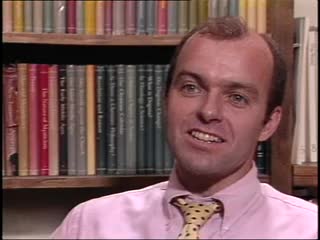
Description: David Boeri profiles Teko Manong, a South African exile, author and playwright, who has been living in the US for thirty years. Boeri notes that Manong was jailed in South Africa for anti-apartheid activities. Manong escaped from prison and fled to Ghana and then to the US. Interview with Manong, who talks about apartheid in South Africa and his participation in the defiance campaign and the potato boycott in South Africa in the 1950s. Manong talks about Nelson Mandela. Manong tells Boeri that his plays have received little critical recognition or success in the US. He says that his time in exile has been wasted. Manong says that he does not want to return to South Africa because he does not trust white South Africans. Boeri reports that black playwrights like Manong have found little success with US audiences. He notes that Manong has been supporting himself by working in the kitchen of a local restaurant. Boeri adds that Manong represents the thwarted hopes of many black South Africans. Boeri's report includes footage of Manong working in the kitchen of a restaurant.
1:00:08: Visual: Footage of Teko Manong (South African exile) walking across a parking lot and entering a building. Footage of Manong working in the kitchen of a restaurant. Boeri reports that Manong is one of the thousands of South Africans who are exiled from their homeland. Boeri reports that Manong has been in the US for thirty years; that Manong grew up in Soweto. V: Shot of a black and white photo of Manong as a boy in Soweto. He stands with two other boys. Footage of Manong working in the restaurant kitchen. Boeri reports that Manong joined the defiance campaign and the potato boycott in South Africa in the 1950s. V: Footage of Manong being interviewed by Boeri. Manong says that white South African potato farmers would bury the bodies of murdered black South Africans in their fields. Manong says that the potato farmers would brag about the size of their crops and the effectiveness of their "fertilizer." Close-up shot of Manong flipping through his South African passbook. Boeri reports that black South Africans were forced to carry their passbooks at all times. Boeri notes that Manong organized a pass burning campaign in the 1960s; that the campaign resulted in mass arrests. Boeri reports that Manong was jailed without trial; that his promising career as playwright and composer was brought to an end. V: Footage of Manong in the restaurant kitchen. Manong breaks eggs into a large metal pan. Manong pours the eggs into a large pot. Shot of Manong leaving a building and walking across a parking lot. Boeri reports that Manong escaped from prison and journied to Ghana. Boeri notes that Manong worked for the South African resistance movement while in Ghana; that Manong met Nelson Mandela (black South African leader). V: Shot of a framed drawing of Mandela. Footage of Manong being interviewed by Boeri. Manong says that Mandela was a great leader; that Mandela helped him personally. Manong says that Mandela would often defend people without money when he was a lawyer; that Mandela was a remarkable man. Shot of Manong's US documents identifying him as a refugee. Boeri reports that Mandela helped Manong get to England; that Manong had hoped to pursue his career in England. Boeri reports that Manong has been politically silenced in South Africa; that Manong has been commercially silenced in the US. V: Shot of a poster for the South African play Survival. Boeri reports that white South African playwrights have found producers and audiences in the US; that Manong has had little success because he is black and foreign. V: Footage of Manong being interviewed by Boeri. Manong says that his time in exile has been wasted. Boeri asks about the plays he has written while in exile. Manong says that he never should have escaped from prison; that he should have served time in jail for the cause like Mandela did. Boeri reports that Manong has not seen his wife or daughter for thirty years; that he was unable to return to South Africa for the funeral of his mother. V: Shot of a photo of a young black South African woman; of a black and white photo of Manong's parents; of a black and white photo of a gathering of black South Africans. Footage of Manong being interviewed by Boeri. Manong says that he does not want to return to South Africa; that he does not trust white people in South Africa. Footage of Manong working in the restaurant kitchen. Boeri reports that Manong has written a play titled Excuse Me While I Disappear. Boeri notes that Manong represents the blighted hopes of many talented South Africans.
Collection: Ten O'Clock News
Date Created: 06/21/1990
Description: Lee Nelson introduces The Ten O'Clock News broadcast. Nelson reads a news brief about US Army testing of live bacteria on civilians in simulated germ warfare attacks. Art Cohen reports on racial controversy during jury selection in the Andrew Puopolo murder trial. Cohen reports that the defense attorneys have accused the prosecution of excluding African Americans from the jury. Gary Griffith reports on Mayor Kevin White's proposed fiscal legislation. The report includes footage of Jim Young (Treasurer, City of Boston) explaining the fiscal package. Steve Curwood reports on George Bush's address to the Middlesex Club of Republicans. The report includes footage of Bush answering questions about his tenure as CIA Director, biological warfare, and the overthrow of foreign governments. Mike Kolowich reports on Thomas Widmer (Vice President, Thermo Electron), who advocates energy efficiency and conservation through the application of technology. Footage of Widmer talking about technology and energy policy. Christopher Lydon comments on the early days of the Carter presidency and Carter's outspoken position on human rights. Footage from another Ten O'Clock News broadcast. Steve Nevas hosts the Ten O'Clock News. Nevas reports on the possibility of peace talks in the Middle East. Lydon interviews Richard Reeves (political writer) on Jimmy Carter's character and his public image. Nevas editorializes on US policy regarding marine resources. Footage from another Ten O'Clock News broadcast. Nevas closes the show. David Ives (President, WGBH) sings a fundraising song for on-air fundraising promotion
0:00:10: Volunteers in studio for on-air fundraising. WGBH station identification. 0:01:12: The Ten O'Clock News opening credits. Lee Nelson introduces the show. Nelson reports that the US Army has tested live germs on civilians in simulated germ warfare attacks from 1949 to 1969; that the Pennsylvania Turnpike, the City of San Francisco and Washington's national airport were targets over a twenty-year period; that over 500 project employees suffered infections. Nelson reports that four jurors were chosen in the trial of three men connected with the death of Harvard football player Andrew Puopolo. 0:02:16: Art Cohen reports on the Puopolo murder trial at Suffolk Superior Court. Visual: Artist's drawing of courtroom. Cohen reports that Puopolo had been in the Combat Zone with fellow Harvard football players Thomas Lincoln and Steve Saxon; that Lincoln and Saxon suffered only minor injuries; that Puopolo died of stab wounds. Cohen reports that Richard Allen, Edward Soares and Leon Easterling are charged with Puopulo's murder; that the three defendents are African American. V: Artist's drawing of defendants. Cohen reports that Judge James Roy asked each prospective juror if the racial profiles of the defendents and plaintiffs would affect their judgment; that Roy dismissed several jurors who were unsure. V: Artist drawing of Roy by Sonja Benson. Cohen reports that there were only four African Americans out of 70 prospective jurors; that the defense lawyers accused the prosecution of excluding African Americans from the jury; that Thomas Mundy (Assistant District Attorney, Suffolk County) challenged three of the African American jurors without cause; that the fourth African American juror was dismissed by Roy. V: Artists drawings of lawyers at table; of Mundy. Cohen reports that three women and one man have been chosen for the jury so far; that these four jurors are an electronics engineer, a manager with a local insurance company, a school monitor, and a housewife from South Boston. Cohen reports that jury selection is expected to go on until Thursday. 0:03:48: Nelson reads the national headlines: the US House of Representatives voted to pass a major segment of President Jimmy Carter's economic stimulus program, including $50 tax rebates for many taxpayers; Carter will travel to London in May for his first summit with leaders from Canada, West Germany, France, Italy, Japan, and Great Britain; France threatened economic reprisals unless the SST (Concorde) is allowed to land in New York; Carter favors granting temporary landing rights for the Concorde, but the decision is up to the states of New York and New Jersey. 0:04:39: Nelson reports that the White Administration is concentrating on the passage of its fiscal legislation; that Kevin White (Mayor, City of Boston) is on vacation on an unnamed Caribbean island. V: Footage of James Young (Treasurer, City of Boston) saying that the mayor's fiscal legislation addresses the management problems in the city; that it attempts to redress imbalances in the fiscal relationship between the state and the city; that it enables the city to improve its financial situation by allowing it to impose modest taxes. Gary Griffith reports that the fiscal package includes 28 bills broken into three major categories; that there are 11 bills in a revenue sharing package which increases city fines and parking fees, and denies registration to vehicles with unpaid fines and taxes; that there are 10 bills in a state share package which mandates the state to assume the costs of county government, of school desegregation and of veteran benefits; that there are 7 bills in a new tax package which includes a payroll excise tax and new excise taxes on hotels, motels and college dorms. Griffith reports that some of the bills in the state share package and the new tax package are not expected to pass; that the city's property tax is expected to rise next year. V: Shots of downtown Boston; of a meter maid giving a parking ticket. Footage of Young saying that the city will not go bankrupt; that the city will be forced to reduce the services it provides to residents; that the city will see a decline in its character and standard of living. Griffith reports that legislative hearings on the bills will be held on March 23; that votes will take place by May. V: Shots of reporters at Young's press conference. 0:07:23: Stock report: Dow Jones Industrials at 952.04; New York Stock Exchange volume was 19,520,000 shares; American Exchange volume was 3,110,000 shares. 0:07:48: Nelson reports that Brady Tyson (US Deputy Delegate to the UN Human Rights Commission) expressed regrets to the government of Chili for CIA involvement in the 1973 overthrow of the government of Salvador Allende; that the State Department said later that Tyson's remarks at the meeting of the UN Human Rights Commission were personal and not approved by the State Department. Nelson reports that Idi Amin (military ruler of Uganda) claims he is on a CIA death list; that Amin met with leaders at the Afro-Arab summit in Cairo; that Amin refused to allow a probe into human rights violations in Uganda. 0:08:37: Nelson reports that George Bush (former CIA Director) visited Cambridge to address the Middlesex Club of Republicans; that there is speculation about Bush running for president in 1980. Steve Curwood reports that Bush became CIA Director in 1976. V: Footage of Bush saying that he was often asked about the Allende affair as CIA Director; that he would not have apologized for the Allende affair. Bush says that he would support action to destabilize or overthrow certain governments, or "a Hitler." Curwood asks Bush about allegations concerning CIA use of the African Swine Fever Virus in Cuba to destabilize the Castro government. Bush responds that the allegations are false; that he never authorized the use of any chemical or biological warfare agents as CIA Director; that he will not comment on the use of those agents by other countries. Bush says that he does not believe that the CIA will be hurt by going along with rules and regulations not followed by other countries; that he worries about narrow guidelines concerning counterintelligence strategy. Curwood says that Bush does not deny the possibility of his running for the presidency in 1980. 0:11:47: Sports scores: Bruins beat Atlanta, 3 - 2. 0:12:00: Nelson reads headlines: Joseph Califano (HEW Secretary) announced a major reorganization of HEW; a law professor from the University of Chicago warned the House of Representatives not to let Carter reorganize the federal government. 0:12:19: Nelson reports that Carter will present a comprehensive energy program on April 20; that Carter's planners are soliciting input from citizens; that conservation and "personal sacrifice" will be at the heart of the program. Mike Kolowich reports that the US is the largest consumer of energy in the world; that the US wastes some of its most valuable energy resources. V: Shots of steam rising from smokestacks, chimneys and sewers. Kolowich reports that Thomas Widmer (vice president, Thermo Electron) advocates a more efficient use of energy; that Thermo Electron is a thermodynamic research and manufacturing firm in Waltham. V: Footage of Widmer saying that there is no energy crisis; that the US is not using energy effectively; that there is a "surplus of entropy." Kolowich reports that Widmer endorses conservation in a report he prepared for the Carter administration; that Widmer believes conservation is not enough. V: Shots of Widmer's report. Footage of Widmer saying that he does not endorse conservation through curtailment of energy use; that he endorses conservation through technology; that energy must be used more efficiently. Kolowich reports that "technological fixes" have been used in West Germany; that West Germany uses energy more efficiently than the US. V: Shots of smokestacks; of cars and trucks on highway; of factories; of houses with chimneys. Kolowich reports that US cars and trucks are too large; that the US steel making industry is not using energy as efficiently as it could; that new technology could help US industries use energy more efficiently. Kolowich reports that the federal government would need to provide incentives for industry to become more energy efficient; that the government would need to impose controls on the consumer level. V: Audio of Widmer saying that there should be mandatory controls on the efficiency of air conditioners, lighting, new home construction and commercial buildings; that it is possible to set mandatory efficiency standards for industry. Footage of Widmer saying that energy taxes could be imposed on industry; that tax credits could be given to energy efficient industries. Kolowich reports that Widmer thinks this policy would result in economic growth without an increase in energy use; that Widmer's ideas were once considered revolutionary; that Carter's energy program may rely on some of Widmer's ideas. 0:16:56: Weather report and area ski conditions. 0:17:45: Nelson reports that Henry Gonzales (Democratic Representative from Texas) resigned as chairman of the House Assassinations Committee; that Lewis Stokes (Democratic Representative from Ohio) will be the new chairman. Nelson reports that Governor Michael Dukakis is looking for quick legislative approval of his proposed Industrial Development Authority, an agency to encourage business development in Massachusetts. Nelson reports that state officials will not comment on a listening device found in the telephone of Owen Clarke (State Tax Commissioner); that tax records were recently seized in an investigation of his agency. Nelson reports that Leo Nolan is appealing his conviction for the murder of a Haverhill grocer fifty years ago. 0:18:30: Nelson introduces commentary by Christopher Lydon on the first few months of the Carter presidency. Lydon says that critics have doubts about Carter's performance; that critics doubt his understanding of foreign policy issues. Lydon says that Carter knows what he is doing when he speaks out on human rights; that Carter's outspoken support of human rights can lead to inconsistencies in foreign policy; that Carter wrote a letter in support of Soviet dissident Andrei Sakharov, but told the Soviet ambassador that human rights should not get in the way of relations between the two countries. Lydon points out other contradictions in the intersection of human rights and foreign policy in the Carter administration. Lydon says that Carter speaks out on human rights to remind Americans of the importance of human liberties and the values represented by the US. 0:20:38: Nelson closes the show with a joke. Credits roll. 0:21:19: Footage from another Ten O'Clock News broadcast. Steve Nevas reports that Secretary of State Cyrus Vance says that there is a chance for Middle East peace talks during the second half of the year; that Arab states might allow Israel to keep some of the West Bank; that the Arab states will insist on the return of the Gaza Strip, the Golan Heights and the Sinai Desert; that Vance asked Congress not to try to enlist other nations in measures against the Arab boycott of Israel. 0:21:57: Sports scores: Golden State beats the Celtics, 101 - 94; the Bruins beat Detroit, 8 - 3. 0:22:20: Nevas reports that Carter spoke to employees at the Pentagon today; that Carter says he does not want to revive the draft, but will not rule it out completely. 0:22:36: Nevas introduces Christopher Lydon's interview with Richard Reeves (political writer). Lydon asks Reeves about Carter's public persona. Reeves says that Carter's ruthlessness and toughness is not visible in his public image; that Carter had to be calculating and tough to get to the top; that Carter has picked up campaign tips and tricks from political novels. Lydon comments on Reeves' theory that Carter's early success in the campaign was played up in the media; that the media ignored later setbacks because they had already created an image of him as a winning candidate. Reeves says that Carter planned a good campaign; that the media chose to give extensive coverage to the primary election; that the media created a momentum around Carter and it worked in his favor. Lydon asks Reeves' opinion on Carter and his success. Reeves says that Carter's public image will be destroyed if he gets caught lying. 0:25:55: Weather report and ski conditions. 0:26:55: Nevas reports that the US has taken control of the fishing grounds along the east coast. He gives a brief history of fishing in the western Atlantic. Nevas reports that the US now controls nearly 1/5 of the world's marine fish resources; that the US took control of east coast fishing grounds in the name of conservation; that taking control of the fishing grounds should not become a jingoistic exercise. Nevas closes the show. Credits roll. 0:28:23: Footage from another Ten O'Clock News broadcast. Christopher Lydon comments on Carter's energy policy. He speculates on Carter's relations with the natural gas industry. Nevas closes the show. Credits roll. 0:29:50: Footage from the end credits of another Ten O'Clock News broadcast. Fundraising promotion featuring David Ives (President, WGBH) singing a fundraising song accompanied by guitar.
Collection: Ten O'Clock News
Date Created: 03/08/1977
Description: Christopher Lydon and Gail Harris host a Ten O'Clock News broadcast. Christy George reports on a campaign debate between Republican US Senate candidates Elliot Richardson and Ray Shamie. The report includes footage of their debate at Faneuil Hall. Charles Bennett reports on the race between Democratic US Senate candidates Jim Shannon and John Kerry. Bennett reports that Shannon held a press conference to announce the endorsement of his candidacy by several leaders of Vietnam Veterans' groups. The report includes footage from the press conference featuring Shannon and Vietnam veterans Charles Harris and Sam Mullen. Bennett reviews Kerry's history as a Vietnam veteran and talks about Kerry's relations with veterans' groups. Bennett's report also includes footage from a campaign advertisement for Kerry. Lydon and Harris read headlines about Greg Bemis (arsonist) and a hepatitis outbreak in Worcester. Lydon reports on addresses to the B'Nai Brith convention by Ronald Reagan (US president) and Walter Mondale (Democratic candidate for US president). The report includes footage of both candidates addressing the convention. Harris reports on a power-sharing agreement between Israeli leaders Shimon Peres and Yitzhak Shamir. Harris's report features footage of Peres and Shamir at a press conference. Loretta Roach talks about school desegregation ten years later Christopher Lydon interviews in-studio guests Kim Marshall (Director for Curriculum, Boston Public Schools) and Loretta Roach (parent activist) about the state of Boston Public Schools ten years after the beginning of school desegregation. Marshall talks about the educational agenda for the schools; he says that the schools are beginning to improve. Roach says that she is more concerned about quality education than she is about integrated schools. Roach and Marshall say that the schools must concentrate on serving the present student population, which is poor and minority. Harris reads a news brief about school bus safety standards in the aftermath of a school bus accident in Rehoboth, Mass. Donna Hodge reports on Congressional efforts to protect the striped bass population in the Northeast. Hodge notes that there are disagreements between those who support a moratorium on striped bass fishing and those who are opposed to any quotas on striped bass fishing. Hodge's report includes footage from interviews with Kenny Baker (fisherman), Philip Coates (Director, Massachusetts Marine Fisheries) and Owen DeLong (Emergency Striped Bass Council).
1:00:02: Christopher Lydon and Gail Harris introduce the newscast. The logos of The Ten O'Clock News underwriters Shawmut Bank, New England Telephone, and The Nimrod Press are displayed. 1:00:54: Christopher Lydon reports on the debate at Faneuil Hall between Republican candidates for the Senate seat of Paul Tsongas (US Senator). Christy George reports on the debate. George says that the candidates disagreed on most of the issues. Visual: Footage of Elliot Richardson (candidate for US Senate) and Ray Shamie (candidate for US Senate) debating tax increases and the ERA (Equal Rights Amendment). 1:04:15: Harris reports that Jim Shannon (candidate for US Senate) won the personal endorsement of a number of the leaders of Massachusetts' Vietnam Veterans groups; that opponent John Kerry (candidate for US Senate) is a Vietnam veteran. Charles Bennett reports that Shannon choreographed a "large-scale stunt;" that the media was invited to a press conference where the endorsement was announced. V: Footage from Vietnam- A Television History, of Kerry in Vietnam; of Vietnam protesters in Washington D.C.; of Kerry testifying about Vietnam before the US Congress; of a sign reading "Vietnam Vets against the war." Bennett reviews Kerry's history as a Vietnam veteran and as an activist protesting against the war. V: Footage of Charles Harris (Vietnam veteran) endorsing Shannon at the press conference with other leaders from Vietnam Veterans of Massachusetts Incorporated. Harris wears a pin reading "Vietnam Vets for Shannon." Harris talks about Shannon's sponsorship of a bill declaring a national POW-MIA recognition day. Footage of Shannon talking about the need to provide compensation to the victims of Agent Orange; about the need to improve treatment for veterans who suffer from post-traumatic stress disorder. Bennett reports that Shannon made no mention of Kerry; that Sam Mullen (Vietnam veteran) seemed to represent the sentiment of some anti-Kerry veterans. V: Footage of Mullen saying that Kerry had an outstanding record of service; that he finds Kerry's political commercials offensive; that Kerry's performance was not "above and beyond the call" of duty. Footage of Kerry saying that he has a lot of support from veterans; that different veterans have different beliefs. Bennett reports that the veterans' endorsement of Shannon was intended as a rejection of Kerry. V: Footage of Shannon saying that he did not serve in the military. Bennett stands in front of the South Boston Vietnam Memorial. Bennett reports that some veterans may not support Kerry because he was a fierce opponent of the Vietnam War, as well as a war hero. V: Footage of a Kerry political advertisement focusing on the Vietnam War. Bennett reports that some veterans think that Kerry is denouncing the soldiers as well as the war in this political advertisement. V: Footage of Kerry saying that the soldiers were the victims of the Vietnam War; that he has fought to gain recognition for the contribution of the Vietnam veterans. Bennett reports that many veterans are conflicted by Kerry's dual roles as a war hero and an upper-middle class, well-educated war protester. V: Shot of the South Boston Vietnam Memorial. 1:08:39: Lydon and Harris read the news headlines. Harris reports that Kerry won the endorsement of the Black Political Task Force in Roxbury. Lydon reports that Greg Bemis (arsonist) pleaded guilty to 68 counts of arson; that Bemis admitted to setting more than 100 fires in the Boston area as a member of an arson ring in 1982 and 1983; that the arson ring included former Boston area police officers and fire fighters who were protesting the cutbacks resulting from Proposition 2 1/2. Harris reports that the outbreak of hepatitis in Worcester is being complicated by a rare Delta Virus; that this form of hepatitis is very serious; that city officials are trying to institute a program to vaccinate drug abusers who use needles. 1:10:08: Harris gives the weather report. WGBH promotions for the The Ten O'Clock News and Live From Lincoln Center. 1:11:34: Lydon reads the national news headlines. Lydon reports that Walter Mondale (candidate for US President) accused Ronald Reagan (US President) of "moral McCarthyism" and religious zealotry; that Mondale asked for respect of his religion, family values, and patriotism. V: Footage of Mondale and Reagan addressing the B'nai Brith convention in Washington DC. Lydon reports that Reagan talked about the importance of the separation of church and state. Lydon reports that Gerald Ford (former US President) said that Mondale never complained when Jimmy Carter (former US President) mixed religion and politics. Lydon reports on a humorous exchange between Geraldine Ferraro (Mondale's running mate) and a high school student in Independence, Missouri. 1:12:51: Harris reads the international headlines. Harris reports that Shimon Peres (leader, Israeli Labour Party) and Yitzhak Shamir (leader, Israeli Likud Party) have agreed on the details of a power-sharing agreement. V: Footage of Peres and Shamir at a press conference. Harris reports that the Labour Party will handle defense issues and the Likud Party will handle economic issues; that the parties are optimistic that the agreement will work. Harris reports that the US vetoed a resolution by the United Nations Security Council; that the resolution would have demanded that Israel lift restrictions on the movement of people in Southern Lebanon. Harris reports that the US representative rejected the resolution because it did not address the activities of Syrian and Palestinian forces in other parts of Lebanon. 1:14:13: Report on the winning lottery numbers in Massachusetts, New Hampshire, and Rhode Island. 1:14:34: Christopher Lydon reports on the opening of Boston Public Schools. Lydon notes that it has been ten years since the beginning of busing and school desegregation. Lydon introduces in-studio guests Kim Marshall (Director for Curriculum, Boston Public Schools) and Loretta Roach (parent activist). Lydon notes that Marshall called the 1974 court order a "disaster" because it did not integrate the city with the suburbs. Marshall says that he thought few educational advancements could be made without integrating students of diverse social classes as well as students of different races. Marshall says that integration with the suburbs will never happen; that he is more realistic now. Marshall says that he is now concentrating on addressing the important issues on the educational agenda of the Boston Public Schools. Marshall talks about the need for good school principals, for high expectations for all students, for clear curriculum objectives, for test data about student performance, and for a safe climate in the schools. Marshall says that he was not focused enough on the realities of urban classrooms and schools in 1974. Lydon asks Roach what she has learned as a parent since the beginning of school desegregation in 1974. Roach says that the school system has improved; that there are some administrators in place who are concerned with accountability in education and high expectations for students. Roach says that the schools still have a poor record in dealing with racism. Roach says that the integration of social classes is not possible in Boston Public Schools; that the majority of students are African American, Hispanic, and poor. Lydon asks Roach if the court order has tried to address the needs of white students who have left the school system. Roach and Lydon agree that no one knows the whereabouts of the white students who are assigned to integrated public schools and do not show up. Marshall mentions the Jeremiah Burke School as an example of a school which has shown great improvements since desegregation. Marshall says that school administrators are focused on serving the students who are attending the schools. Lydon quotes Hubie Jones (Dean, Boston University) as saying that the Boston Public Schools are a "disaster." Marshall says that the system has just begun to make improvements; that the system has a very long way to go. Marshall notes that a new policy requires students to have an attendance rate of 85% in order to be promoted to the next grade level. Lydon quotes Robert Spillane (Superintendent, Boston Public Schools) as saying that Robert Dentler (Dean of Education at Boston University and advisor to the federal court) is a "social engineer." Lydon quotes Spillane's predictions that the Boston Public School System will continue to lose white students until it is once again a segregated system. Marshall says that the Boston Public School System has moved beyond school desegregation; that the school system needs to improve in order to attract new students. Roach says that urban schools across the country are in trouble; that African American parents are very concerned with the quality of education in the schools. Roach says that she is more concerned about quality education than she is about integrated schools. Roach says that she has invested a lot of time and effort in the Boston Public Schools; that she feels good about the kind of education her children are receiving. Lydon thanks Marshall and Roach. 1:22:43: Stock report: the Dow Jones average is listed at 1218.86; the volume of the New York Exchange is listed at 91,920,000. 1:23:03: Harris reports reports on school bus safety standards. Harris says that a school bus crash in January in Rehoboth, Massachusetts, could have been much worse without the safety standards adopted in 1977; that the National Transportation Safety Board has determined that Mary Jane Noons (Rehoboth bus driver) could not have avoided the crash; that the board is looking into further safety measures to protect children riding on school buses. 1:23:46: Harris reports that a Congressional committee will force Atlantic states to reduce their catches of striped bass or face a ban on striped bass fishing; that Maryland and Virginia lawmakers oppose quotas on striped bass; that Gary Studds (US Congressman from Massachusetts) and others support the quotas. Donna Hodge reports that Kenny Baker (fisherman) once fished primarily for striped bass. V: Footage of Baker preparing to go out on his boat in Woods Hole, Massachusetts; of Baker piloting his boat out of the harbor. Footage of Baker talking about the challenges involved in fishing for striped bass. Baker says that he feels fortunate to have been able to make a living from fishing for striped bass. Footage of Baker fishing off of his boat. Hodge says that the striped bass population has declined precipitously in Massachusetts. V: Footage of Philip Coates (Director, Massachusetts Marine Fisheries) talking about the decline of the striped bass population due to a combination of overfishing and environmental phenomena. Footage of Baker fishing from his boat. Shots of the coastline and the ocean. Hodge reports that striped bass migrate from the Chesapeake Bay to the North Atlantic every year; that an eleven-state coastal commission has been formed to protect the fish. Hodge reports that regulations on striped bass fishing are very tough in Massachusetts; that some fisherman believe the regulations are excessive. V: Shots of a man fishing off of a boat. Footage of Baker saying that regulations should be equally tough in every state; that a moratorium on fishing for striped bass should be imposed in all of the states along the coast. Shots of a bass being caught on a fisherman's line. Hodge reports that fishermen on Martha's Vineyard are preparing for the annual Striped Bass Derby. V: Footage of Owen DeLong (Emergency Striped Bass Council) saying that an immediate moratorium on striped bass fishing should be imposed along the whole east coast; that the Striped Bass Derby is inappropriate and morally wrong at this time. Footage of workers at a fish processing plant. Hodge reports on the need for uniform regulations among all states involved in striped bass fishing. Hodge reports that Claudine Schneider (US Congresswoman from Rhode Island) has proposed a three-year moratorium on striped bass fishing. V: Footage of DeLong saying that Studds, Edward Kennedy (US Senator) and John Chafee (US Senator) have all filed bills to regulate striped bass fishing; that strict regulations must be imposed in the next few months in order to save the species. Shots of an aquarium exhibit of striped bass. Harris reports that Studds has defended his plan as a compromise between those pushing for a moratorium on fishing and those who want no regulation at all. Harris notes that the organizers of the Striped Bass Derby on Martha's Vineyard have said that the competition will proceed as planned. 1:29:05: Harris and Lydon close the newscast. End credits roll.
Collection: Ten O'Clock News
Date Created: 09/06/1984
Description: Review of the first few years of court ordered desgregation, including explosion of racism and violence, and the heavy police patrol required to keep things under control. Garrity is still in charge of the Boston schools. Although things are more quiet, and certain programs are working , like magnet schools, a high percentage of Boston students are still significantly under the national average. The Boston school system is also still overwhelmingly made up of minority students. Black parents propose ‘freedom of choice’ plan. Interviews with Robert Peterkin, Robert Spillane, and other officials. Classroom scenes of the current school system,highlighting Mildred Reed and her daughter Kim. They are Jamaica Plain residents, and Kim is bused to Brighton High School. Interview with Kim, where she talks about the benefits of being bused. Scenes of Kim getting on the bus, the bus ride, and in school.
Collection: Ten O'Clock News
Date Created: 01/11/1984
Description: Operatic tenor Carlo Bergonzi gives master class at BU. Student sings.
Collection: Ten O'Clock News
Date Created: 04/18/1989
Description: Several takes of reporter standup. Report on the "domino effect" created by the swearing in of ex-auditor Thaddues Buczko as a judge. John Finnegan will most likely replace him, and then someone else will have to replace Finnegan. B-roll of Speaker of the House Thomas McGee, President of the Senate William Bulger, and other state legislators in the State House Chambers. Buczko's swearing in ceremony. Bulger, McGee, and Governor King preside over the ceremony. McGee makes a heartfelt speech about his admiration for Buczko. King swears in Buczko. Buczko addresses the audience. A judge also addresses the audience.
Collection: Ten O'Clock News
Date Created: 02/11/1981
Description: Profile of The Pilot, newspaper of the Boston archdiocese. Changed its format from broadsheet to tabloid. Who is its readership? Editor Philip Lawler.
Collection: Ten O'Clock News
Date Created: 09/11/1987
Description: Wheelchair users gather on City Hall plaza to protest The Ride van service with lift because it is ill-equipped and unreliable. James O'Leary, MBTA general manager. Handicapped. Discrimination.
Collection: Ten O'Clock News
Date Created: 07/27/1988
Description: "The Simpsons" animated family is featured on Fox tv. Samples from animation festival. Karen Aqua teaches animation class at Boston College. Channel 25 logo.
Collection: Ten O'Clock News
Date Created: 04/06/1990
Description: History of Thomas Finnerty's career and association with William Bulger. Harold Brown misquotes Shakespeare. 75 State Street. Moving aerial of downtown. Various senators enter Senate chamber.
Collection: Ten O'Clock News
Date Created: 02/16/1989