Description: Harvard University radicals from the 1960s reunite for a rally in the Yard and speak from the steps of Widener Library, proclaiming their current causes.
Collection: Ten O'Clock News
Date Created: 04/07/1989
Description: AFSCME affiliated union attempts to organize Harvard University clerical and technical workers. Supporters rally at OCBC.
Collection: Ten O'Clock News
Date Created: 05/12/1988
Description: AIDS activist organization, ACT-UP Boston, protests outside Harvard Medical School, alleging unethical practices in limiting availability of experimental drug treatments.
Collection: Ten O'Clock News
Date Created: 09/07/1988
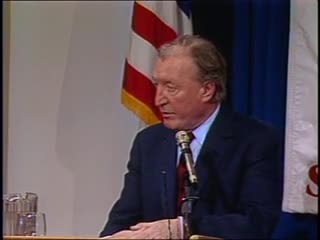
Description: Charles Haughey, prime minister of Ireland, visits Boston and speaks at Kennedy School. Protesters outside Ritz-Carlton.
Collection: Ten O'Clock News
Date Created: 04/22/1988
Description: Secretary of Defense Caspar Weinberger speaks at Harvard Law Forum at Sanders Theater on SALT arms limitation. Audience yells and chants in protest. Roger Fisher tries to quiet disruption. Upside down American flag suspended from balcony. Banner says “Weinberger = War Criminal.” Students asks questions about Middle East and Central America.
Collection: Ten O'Clock News
Date Created: 11/17/1983
Description: Meg Vaillancourt reports that Derrick Bell (Professor, Harvard Law School) has announced that he will take a voluntary leave of absence from Harvard Law School until an African American female is granted tenure. Vaillancourt notes that Harvard Law School has only five tenured female professors and three tenured African American male professors on staff. She adds that the student body is 25% minority and 40% female. Vaillancourt's report includes footage of Bell speaking at a student demonstration. Bell makes his announcement. Bell adds that it is necessary to make sacrifices to advance one's beliefs. Students applaud Bell. Many students hold protest signs. Three students address the demonstrators. They talk about the lack of minority faculty. Vaillancourt's report also includes footage of Louis Kaplow (Associate Dean, Harvard Law School) speaking at a press conference. Kaplow defends the school's record of minority hiring. Vaillancourt notes that Bell does not know if his act of conscience will have any effect on the school administration. Vaillancourt's report includes footage from May 1988, of Harvard Law School students occupying the dean's office to protest the lack of minority faculty. Following the edited story is additional footage of the demonstration, including law student Barack Obama introducing Derrick Bell.
1:00:09: Visual: Footage of Harvard Law School students at a demonstration outside of Harvard Law School. Meg Vaillancourt reports that Harvard Law School counts fifteen Supreme Court Justices among its alumni; that tenure is granted only to the academic elite. Vaillancourt reports that Derrick Bell (Professor, Harvard Law School) is a tenured professor who has announced his departure. V: Shot of a student at the demonstration. Footage of Bell at the demonstration. Bell says that he will remove himself from the Harvard payroll as a "sacrificial financial fast." Bell says that he is not trying to coerce his colleagues; that he is trying to honor a commitment to those responsible for his presence at Harvard. The students applaud. Shots of the media and students at the demonstration. Vaillancourt reports that Bell was the first African American to be granted tenure at Harvard; that he was granted tenure in 1969. Vaillancourt reports that Bell has decided to take a leave of absence until an African American female is granted tenure. V: Footage of Bell saying that students have already enrolled in his classes; that he can ill afford to live for a year without his salary. Bell says that he he has urged students to take risks to further their beliefs; that he must do the same. Shots of students holding a sign reading, "Where are our tenured black women professors?" Shots of students applauding for Bell; of female students holding signs reading, "Come out of the ivory tower" and "No education without representation." Vaillancourt reports that approximately 500 students are supporting Bell's decision; that student are urging alumni to boycott Harvard's current fundraising drive. V: Footage of an African American female student addressing the crowd of demonstrators. She says that Robert Clark (Dean of Harvard Law School) has plans to improve the school by building a new library; that he should instead improve the school by making the faculty more diverse. The students applaud. A white male student holds a sign reading, "reflect reality." Footage of a Latina female student saying that Bell has set an example for all of the students. The student says that she has not role model at the school; that there are no Latino or Latina professors on the faculty. Footage of an African American female student addressing the demonstrators. The student says that people must make sacrifices to advance their cause. Shot of Bell outside of a Harvard Law School building, with chanting demonstrators. Vaillancourt reports that Bell is giving up a salary of more than $100,000 per year. Vaillancourt notes that students have staged sit-ins to protest the lack of minority faculty; that the issue has been contested for nearly twenty years. V: Footage from May, 1988 of a student sit-in at the dean's office in the administration building of Harvard Law School. Students study textbooks as they occupy the office. Vaillancourt stands on the campus of Harvard Law School. Vaillancourt reports that there are 1600 students at Harvard Law School; that nearly 25% are minority students; that nearly 40% are women. Vaillancourt notes that the Harvard Law School faculty has 5 tenured female professors and three tenured African American male professors. V: Footage of Louis Kaplow (Associate Dean, Harvard Law School) speaking at a press conference. Kaplow says that Harvard Law School only hires a few people each year; that some years they do not hire anyone. Kaplow says that positions at Harvard Law School are often permanent; that hiring decisions are made carefully and cautiously. Vaillancourt reports that Kaplow spoke at a press conference after Bell's announcement. Vaillancourt notes that Kaplow does not believe that Harvard Law School will make any significant changes to its hiring practices. V: Shots of student demonstrators in the audience of the press conference. The demonstrators stand together, raising linked arms. Some demonstrators hold protest signs. Footage of Kaplow saying that Harvard's hiring has been fully 50% minority and women over the past eight to ten years; that Harvard's job offers have been fully 50% minority and women over the past eight to ten years. Kaplow says that Harvard is making an effort; that Harvard has kept some positions empty in an effort to locate minority and women candidates. Shots of the students at the press conference. Shots of student demonstrators marching outside a Harvard Law School building. Vaillancourt reports that Bell does not know if his act of conscience will have any effect on the school's hiring record; that Harvard will have only two tenured African American professors if Bell leaves. V: Shots of student demonstrators with linked arms upraised. Footage of Bell addressing the demonstrators. Bell says that he hopes that student persistence will prevail for those minority candidates who deserve to be on the faculty. Bell says that hopes to be able to remain on staff if the students succeed.
Collection: Ten O'Clock News
Date Created: 04/24/1990
Description: Meg Vaillancourt reports that Jesse Jackson visited Harvard Law School to join student protests over the school's minority hiring practices. Vaillancourt notes that Jackson supports Derrick Bell (Professor, Harvard Law School), who has announced that he will leave his post to protest the school's poor affirmative action record. Derrick Bell is Harvard's first African-American tenured professor. Vaillancourt reports that there are only five tenured female professors and three tenured African American male professors out of sixty-one tenured professors at the school. Vaillancourt's report includes footage of Jackson addressing students at the school. Barack Obama is seen among students in the background. Jackson shakes hands with Bell and condemns the school's affirmative action record. Vaillancourt notes that the school administration has refused Jackson's offer to act as a mediator on the issue. Vaillancourt reports that Jackson accused Harvard Law School of institutional racism and sexism. She adds that Robert Clark (Dean, Harvard Law School) issued a statement defending the school's hiring practices. Vaillancourt's report features footage of Bell at a student demonstration at Harvard Law School in April 1990 and footage of Jackson at a student demonstration. This tape includes additional footage of Jackson addressing demonstrators at Harvard Law School.
1:00:05: Visual: Footage of Jesse Jackson (African American political leader) speaking at Harvard Law School. Jackson says that affirmative action is a response to years of denial by law. Shots of the audience listening to Jackson in a lecture hall at the school. Meg Vaillancourt reports that Jackson's visit to Harvard Law School attracted national attention to the controversy over the school's minority hiring practices. V: Footage of Jackson addressing the audience. Jackson says that it is an error and an insult to say that there is no African American woman qualified to be a tenured professor at Harvard Law School. Shots of the audience. Vaillancourt reports that Jackson visited the school to support Derrick Bell (Professor, Harvard Law School). Vaillancourt notes that Bell was the first African American to be granted tenure at Harvard Law School. Vaillancourt reports that Bell has announced that he will leave his post to protest the school's poor affirmative action record. V: Shot of Jackson and Bell shaking hands in the conference hall. Footage from April 24, 1990 of Bell at a demonstration on the campus of Harvard Law School. Bell addresses student demonstrators. Bell says that he he has urged students to take risks to further their beliefs; that he must now do the same. Shot of demonstrators holding a sign reading, "Where are our tenured black women professors?" Vaillancourt reports that Bell will take a leave of absence until the school adds a woman of color to the faculty. Vaillancourt notes that there are 61 tenured professors at the school; that three of those professors are African American; that the African American professors are all male. Vaillancourt reports that half of the students at Harvard Law School are women; that there are only five tenured female professors; that there are no Latino or Asian law professors at the school. V: Shots of Bell and Jackson entering the lecture hall; of students standing and applauding for Bell and Jackson. Shots of white and African American female students in the audience. Shot of Jackson, Bell and a white woman raising linked arms at the front of the lecture hall. The students applaud. Vaillancourt reports that the school seems ready to accept Bell's departure; that Robert Clark (Dean of Harvard Law School) declined to speak on camera about the school's hiring practices. Vaillancourt reports that Clark issued a statement in which he defended the slow pace of change at Harvard Law School. Vaillancourt reports that Jackson has accused Harvard of institutional racism and sexism. V: Shot of students demonstrators on the Harvard Law School campus on April 24, 1990. Footage of Jackson addressing student demonstrators outside on the campus of Harvard Law School. Student supporters stand behind him. Jackson says that Harvard should negotiate with Bell and the student demonstrators. The demonstrators applaud Jackson. Vaillancourt stands outside of a building on the Harvard Law School campus. Vaillancourt reports that Jackson met briefly with Clark today; that the school has refused Jackson's offer to act as a mediator on the issue of faculty diversity. Vaillancourt reports that Jackson called for a reexamination of race relations in the US during his speech at Harvard Law School. V: Footage of Jackson addressing an audience in a lecture hall at Harvard Law School. Jackson says that most people in the world are not white nor are they males. Jackson says that these people cannot wait for some archaic standard to allow them to be appraised as worthy by white males. Shots of students in the audience. Shot of Jackson entering a room. Jackson shakes hands and embraces Bell. Jackson shakes hands with other Harvard Law School professors and officials. Vaillancourt reports that Jackson has called for a new Kerner Commission; that the Kerner Commission issued a study twenty years ago which concluded that white America and black America were separate and unequal. Vaillancourt reports that Jackson praised Bell for his courage; that Jackson called on Harvard Law School faculty to support Bell. V: Footage of Jackson addressing an audience in the lecture hall. Jackson talks about the sacrifices made by Rosa Parks (civil rights activist) and Martin Luther King (civil rights leader). Jackson says that Bell is taking a principled stand; that Bell is drawing attention to the problem of racism and sexism at Harvard. Shots of Bell at a demonstration on the Harvard Law School campus on April 24, 1990. Shots of Bell addressing a demonstration outside of a building on the Harvard Law School campus today. Jackson stands beside Bell. Student demonstrators stand behind them. The demonstrators raise their linked arms. A demonstrator holds a sign reading, "diversity now." Vaillancourt reports that faculty were scheduled to vote today on a resolution encouraging diversity. Vaillancourt notes that Harvard officials say that a personal matter forced the dean to end the meeting before the resolution came to a vote. Vaillancourt notes that the vote was not rescheduled.
Collection: Ten O'Clock News
Date Created: 05/09/1990
Description: David Boeri reports on protests against US foreign policy during a visit by Secretaries of State George Shultz and Defense Casper Weinberger to the Fogg Art Museum at Harvard University. Boeri notes that demonstrators protested against apartheid and US policies in South Africa, Nicaragua and El Salvador. Boeri's report includes footage of protesters and footage of Shultz and Weinberger entering the museum. Boeri notes that some of the demonstrators were Harvard alumni advocating Harvard's divestment from South Africa. Boeri interviews Boone Schirmer (Harvard alumnus) about Harvard's refusal to divest from South Africa. Boeri reports that security has been tightened all over campus. This protest takes place during the celebration of Harvard's 350th anniversary. This edition of the Ten O'Clock News also included the following item: Mario Valdes reports on the book Blood Royal, which covers the ancestry of the British Royal Family
1:00:10: Visual: Shots of a large police contingent outside of the Fogg Art Museum at Harvard University; of police officers marching in formation in front of the museum; of police officers stationed on the roof of a Harvard building. Shots of individual police officers. Shots of officials entering the museum. Footage of apartheid protesters marching with signs and banners outside of Harvard Yard. The protesters carry signs and a banner reading, "Harvard must divest." Shot of George Shultz (US Secretary of State) exiting a car and being escorted toward the museum. Shots of protesters demonstrating behind a cordon of police officers. The protesters chant, "Shultz go home". Shots of signs reading, "Harvard honors destructive engagement and Shultz" and "Biko lives." Boeri reports that Schultz visited Harvard University today; that demonstrators gathered to protest his presence at Harvard. Boeri notes that protesters began to gather outside Harvard Yard in the morning; that demonstrators were protesting several issues. V: Footage of protesters marching as they chant, "George Shultz end the war. Stop the killing in El Salvador." Shot of a protester wearing a white death mask. Another protester carries a sign and wears a bloodied shirt. Footage of protesters chanting, "No Contra aid." Footage of protesters demonstrating against apartheid in South Africa. Shots of a sign reading, "End Harvard support for apartheid" and "Divest now." Boeri reports that some of the demonstrators were alumni and alumnae pushing for Harvard to divest from South Africa. V: Footage of Boone Schirmer (Harvard alumnus) saying that Harvard's refusal to divest is disgraceful; that Harvard's slogan is "Veritas," which means truth; that Harvard is supporting a South African government which is based on the lie of white supremacy. Shot of a quotation written in stone above an entrance to Harvard Yard. The quotation reads, "Open ye the gates. . . ." Boeri reports that the gates to Harvard Yard were locked today to keep out the protesters. V: Shot of a security officer locking the gates. Shot of a protester standing outside the gates with a sign reading, "End support of apartheid." A small child stands at the gates, looking into Harvard Yard. Boeri reports that alumni and alumnae were turned away from the gates. V: Shot of a Harvard alumnus turning away from a locked gate. Boeri reports that Shultz had lunch at the Fogg Art Museum after giving a speech; that Schultz had no comment on today's hijacking of a Panam jet in Pakistan; that Shultz only caught a brief glimpse of the protesters. V: Shots of Shultz entering the museum. Boeri notes that Casper Weinberger (US Secretary of Defense) also attended the lunch at the museum; that Weinberger had no comments for the media. V: Footage of Weinberger exiting his car and being escorted into the museum with other officials. Boeri reports that the protests outside of Harvard Yard were uneventful.
Collection: Ten O'Clock News
Date Created: 09/05/1986
Description: Marcus Jones reports that anti-war activists protested across the nation to rally public opinion against the use of force in the Persian Gulf, including in downtown Boston. Jesse Jackson visited MIT to speak out against going to war in the Middle East on the birthday of Martin Luther King, Jr. Jones notes that the MIT Initiative for Peace in the Middle East brought Jackson to the campus. Jackson says that the US must not rush to war on January 15. Interviews with MIT graduate students Corrie Lathan and Steve Penn, who oppose the war. Interview with Jesse Jackson, who says that the US and Iraq should negotiate because war is inevitable if talking is impossible. Jones' report includes footage from Inside Edition of Jackson in Iraq. Following the edited story is additional b-roll of anti-war demonstrations and of Jackson at MIT talking about Martin Luther King, Jr.
1:00:36: Visual: Footage of anti-war protesters on Winter Street in downtown Boston. The protesters carry signs protesting the Gulf War. They chant together, "We remember Vietnam. We won't go." Shot of two police officers standing in front of a building. Marcus Jones reports that a group of anti-war protesters demonstrated outside of the Army recruiting headquarters in Boston. V: Shot of a protesters carrying a sign reading, "U.S. Troops out of the Gulf." The protesters chant, "We won't fight for Texaco." Shot of a protester handing out leaflets. Jones reports that anti-war activists took to the streets across the country today; that the protesters are trying to rally public opinion against the use of force in the Persian Gulf. V: Shot of an older white woman wearing a sign around her neck. The sign reads, "Bring our troops home." Shot of two white children standing among the protesters. Jones reports that Jesse Jackson (African American political leader) visited MIT (Massachusetts Institute of Technology) tonight; that the members of the MIT Initiative for Peace in the Middle East brought Jackson to the campus. Jones reports that Jackson spoke out against going to war in the Middle East on the birthday of Martin Luther King Jr. (civil rights activist). V: Shots of Jackson greeting an MIT student; of Jackson greeting students as he walks to the podium. Shots of students in the audience. Footage of Jackson addressing the students. Jackson says that the US must not rush to war on January 15. Jackson says that efforts toward peace must be made on King's birthday. Footage of Corrie Lathan (MIT graduate student) being interviewed. Lathan says that she is opposed to the war; that the situation should be resolved in a non-violent manner. Footage of Steve Penn (MIT graduate student) being interviewed by Jones. Penn says that decision-makers in the US understand pressure; that the voice of the people must speak out against the war. Jones reports that Jackson's call for restraint may reflect a change in his thinking. Jones notes that Jackson met with Saddam Hussein (Iraqi leader) last year. Jones reports that Jackson said last year that war would be inevitable if talking proved impossible. V: Footage from Inside Edition of Jackson entering a building in Iraq; of Jackson speaking to Hussein. Jones questions whether Jackson has changed his position. V: Footage of Jackson speaking at MIT. Jones asks Jackson if he has changed his position. Jackson says that he has kept the same position. Jackson says that war is inevitable if talking is impossible. Jackson says that the US and Iraq should "talk"; that the two countries must choose negotiation over confrontation. The audience applauds for Jackson as he walks away from the podium.
Collection: Ten O'Clock News
Date Created: 01/14/1991
Description: Meg Vaillancourt reports on a protest by Cambridge activists against plans proposed by MIT to develop a parcel of land near Central Square. Protesters accuse MIT and the developer of misleading the public by underestimating the size and scope of the project planned for the Simplex site. Bill Cavellini from the Simplex Steering Committee and Ken Campbell of MIT discuss the plans for the site. Vaillancourt reviews the plans for the site. The protesters differ with MIT over the amount of low-income housing to be built on the site and on the definition of low-income housing. Bill Noble from the Simplex Steering Committee criticizes MIT's definition of low-income housing. Cambridge activists and the homeless community are at odds with one another over the most effective form of protest against the development. At a protest, a scuffle breaks out between one of the activists and a homeless man. Community activist Mel King tries to make peace between the two sides. The Cambridge City Council will soon vote on the planned development. Following the edited story is additional b-roll footage of students on the campus of MIT in warm weather.
1:00:05: Visual: Footage of a group of protesters marching through a snowy lot near Central Square in Cambridge, chanting "We say no to MIT." Meg Vaillancourt reports that a small band of Cambridge activists are protesting the development of 27 acres of land owned by MIT (Massachusetts Institute of Technology); that MIT is working with Forest City Developers to build a multi-million dollar research and development complex; that the proposed site is known as the Simplex site. V: Shots of protesters standing near a sign for University Park at MIT; of the sign for University Park. Footage of a protest leader addressing the crowd of demonstrators. The protesters carry signs. Vaillancourt reports that the activists claim that developers deliberately misled the public; that the developers underestimated the size and scope of the project. V: Footage of Bill Cavellini (Simplex Steering Committee) saying that the developers told the public that they would build a $250 million development; that the developers will build a $500 million development. Cavellini tells Vaillancourt that the activists received documentation about the development from a confidential source. Cavellini says that Forest City Developers have been deceptive and have breached the public's trust. Footage of Ken Campbell (MIT) saying that the activists got hold of documents from October of 1987; that the Cambridge City Council approved the plan for the site in December of 1987; that the plan approved by the Council includes 400,000 square feet of housing. Shot of documents and information distributed by the opponents of the plan. Vaillancourt reports that the University Park Development Plan includes housing, a hotel and a 12-screen cinema; that a four- to six-screen theater had been discussed by the developer in public. V: Shot of a vacant lot in Cambridge, covered with snow; of a group of people standing outside of a house in Cambridge. Vaillancourt reports that opponents say that numerous zoning changes will be required to build the project, including the widening of streets and the removal of the city fire station in Central Square. V: Shot of a group of protesters; of a sign reading, "Cambridgeport has decided to stop MIT expansion." Vaillancourt says that MIT and the Simplex Steering Committee differ on how much low-income housing will be built on the site. V: Footage of Campbell saying that MIT has doubled the amount of affordable housing in the original proposal; that MIT is proposing 100 low-income units and 50 moderate-income units. Footage of Bill Noble (Simplex Steering Committee) saying that MIT's definition of low- and moderate-income is not accurate; that MIT is really proposing moderate- and middle-income units. Vaillancourt reports that there are many homeless people in the area; that activists and the homeless do not always agree on how to oppose the development. Vaillancourt says that the homeless do not think that the protesters are representing the interests of the homeless. V: Footage of a female protest leader addressing the demonstrators and the press. A scuffle breaks out between Cavellini and Carlos (homeless man). Footage of Carlos addressing the demonstrators. Carlos says that affordable housing is not the same thing as housing for the homeless. A female protester yells that Carlos does not represent the views of the community. A shouting match ensues. Vaillancourt reports that Mel King (community activist) tried to bring the two sides together. V: Footage of King addressing the crowd. King says that the two sides must unite to fight against the greed of MIT. Members of the crowd cheer. Vaillancourt reports that the Cambridge City Council will vote on MIT's proposal on Monday.
Collection: Ten O'Clock News
Date Created: 01/07/1988