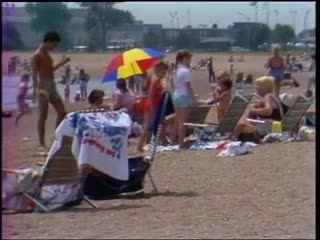
Description: MAN FROM ENVIRONMENTAL RESEARCH GROUP TESTS WATER AT CARSON BEACH. pollution
Collection: Ten O'Clock News
Date Created: 07/03/1985
Description: B-roll of people on Carson Beach in South Boston.
Collection: Ten O'Clock News
Date Created: 07/08/1982
Description: African American beachgoers are escorted onto Carson Beach in South Boston by Metropolitan District Commission (MDC) police officers. Officers are posted on the beach, forming a ring around the African American beachgoers. Police officers station themselves at the edge of the water as children play. Police officers line up near the recreation building, observing the action on the beach. Three MDC police boats patrol the water. Three white males are escorted from the beach. White beachgoers stand around, observing the scene.
0:00:26: Visual: Four Metropolitan District Commission (MDC) police officers escort a small group of African American youth on to Carson Beach in South Boston. There are white swimmers and sunbathers on the beach. The Boston skyline is visible in the distance. A group of older white men sit under a shelter near the road. Cars pass by slowly on the road. Groups of white people sit under the shelters or sunbathe on the sand. 0:01:50: V: A larger group of African Americans walk on to the beach, accompanied by police officers. The group of African Americans ranges in age from young kids to adults. The group walks along the beach, heading toward the recreation building. Young African American children play in the water along the shore. Police officers stand casually on the beach as the African American beachgoers get settled . An older white man greets some of the African American youth. White beachgoers are seated near the African American beachgoers. Many whites stare at the African Americans. MDC police officers are lined up near the recreation building, observing the scene on the beach. 0:06:25: V: White residents and beachgoers are standing up, watching the African American beachgoers and the police on the beach. Police officers walk among the crowd. A police officer escorts a white man from the beach. A large line of MDC police officers circles approaches the recreation building to join the other group of officers. Approximately 50 police officers stand in front of the recreation building. Two helmeted police officers escort another white man from the beach. Another group of police officers walks toward the beach. A group of 20 more African Americans are escorted onto the beach by a police officer. 0:09:31: V: An older white man with a walkie talkie walks down the beach toward the crowd. Police officers stand at the edge of the water while African American children play. A few white beachgoers mill about near the police officers. Most white beachgoers sit separately from the African American beachgoers. Other white beachgoers observe the scene from further up the beach. A group of police officers stands in front of the recreation building. A group of five African American adults walk down the beach toward the African American beachgoers. They are followed by a police officer. 0:12:05: V: African American beachgoers are seated in small groups on the beach. A line of police officers forms a ring around them. A group of white beachgoers stands nearby. Shot of a young white boy sitting by himself on the beach. African American children play in the water. MDC police officers stand at the edge of the water. White beachgoers stand near the police officers, watching the African American children. The African American beachgoers enjoy themselves. Police stand by. The media record the scene. White beachgoers stand around in groups. Two MDC Police boats patrol the water. 0:15:33: V: A line of MDC police officers with riot helmets stands in front of the recreation building. MDC police officers observe the action on the beach from the MDC boats in the water. A line of police cordons off the African American beachgoers from the white beachgoers. Members of the media and white bystanders stand near the African American beachgoers. White beachgoers sit and stand apart from the African American beachgoers. Two police officers escort a young white man from the beach. A group of African American beachgoers heads toward the recreation building.
Collection: Ten O'Clock News
Date Created: 08/03/1977
Description: Chinatown environs with reporter voice over. Reporter talks about the apolitical nature of Chinatown. She reports that although there aren't many active residents, those who do care about politics are outraged at the redistricting which groups Chinatown with South Boston. Interview with Chinatown resident, Mr. Chang, on the divergent interests and concerns of Chinatown and South Boston. City Council chambers.
Collection: Ten O'Clock News
Date Created: 02/25/1982
Description: David Boeri reports that Ray Flynn (Mayor of Boston) and the Boston City Council will work together to create a public housing policy that ensures equal access while providing some element of choice. Boeri notes that the city must comply with the policy of the Department of Housing and Urban Development (HUD) if they wish to continue receiving federal funds. Boeri's report includes footage of Flynn, Charles Yancey (Boston City Council), and Bruce Bolling (Boston City Council) at a press conference about fair housing policy. Boeri's report also features footage from an interview with James Kelly (Boston City Council). Kelly says that free choice is more important than racial diversity. Boeri reviews the current housing policy and the policy requirements of HUD. Boeri's report also includes footage of white and African American tenants of public housing and by footage of Dapper O'Neil (Boston City Council). This edition of the Ten O'Clock News also included the following item: Sonia Sanchez
1:00:10: Visual: Footage of Ray Flynn (Mayor of Boston) speaking to the press. Charles Yancey (Boston City Council) stands beside him. Flynn says that Boston's housing policy will guarantee equal access to housing for all. David Boeri reports that Flynn met with the Boston City Council about public housing issues; that Yancey said that the meeting was productive. Boeri reports that Flynn and the Council agreed that equal access to public housing must be guaranteed. V: Footage of Bruce Bolling (Boston City Council) saying that no families will be displaced from public housing in order to achieve integration. Boeri reports that Flynn and the Council agreed to work together constructively on the issue. Boeri notes that Dapper O'Neil (Boston City Council) was not present at the meeting; that James Kelly (Boston City Council) did not join Flynn and the other councillors for the press conference after the meeting. V: Shot of O'Neil at a meeting in the City Council chambers. Footage of Kelly in his office. Kelly says that people should be able to choose where they want to live; that the new policy will create "forced housing" instead of "fair housing." Boeri notes that the current housing selection process allows each applicant to select choose three public housing projects where he or she would like to live. Boeri reports that South Boston residents usually list the three housing projects in South Boston; that the three housing projects are all white. V: Shots of Flynn and the councillors speaking to the press; of a white woman looking out of a window of an apartment in a project building; of a white woman and white children in front of a project building; of a sign for the Old Colony Housing Project in South Boston. Shot of a housing project in South Boston. Shots from a moving vehicle of a housing project in Mission Hill. Shot of an African American boy near a dumpster outside of a public housing project. Boeri notes that the Department of Housing and Urban Development (HUD) has called Boston's housing policy discriminatory; that the three-choice system has been rejected in other cities. Boeri reports that HUD has recommended a city-wide list, where applicants take the first available apartment. V: Shots of white residents outside of a public housing project in South Boston. Footage of Kelly saying that there is nothing wrong with giving tenants a choice about where they want to live. Kelly says that free choice may result in housing developments which are not racially diverse; that free choice is more important than racial diversity. Shot of Bolling. Boeri reports that Bolling would also like to protect the three-choice system. Boeri notes that HUD provides 70% of Boston's public housing funds; that Boston stands to lose $75 million if they do not comply with HUD policy. V: Shot from a moving vehicle of a manicured lawn in front of a public housing development; of a public housing project on Fidelis Way. Footage of Bolling saying that the city will try to negotiate with HUD to develop an application process with some degree of choice for tenants. Boeri notes that the HUD policy will make tenants choose between living in public housing and living in the neighborhood of choice. Boeri notes that there are 14,500 families on the waiting list for public housing in Boston. V: Shots of public housing projects in Boston; of a racially diverse group of children playing outside of a project building.
Collection: Ten O'Clock News
Date Created: 01/14/1988
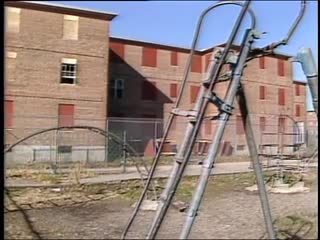
Description: D Street public housing exteriors in South Boston. Boarded up windows, graffiti on brick, bare trees, barren playground.
Collection: Ten O'Clock News
Date Created: 11/23/1983
Description: Veterinarian John DeJong runs against Bulger for state senate. Paul Gannon, candidate for representative from South Boston, shares DeJong's theme of "time for a change." DeJong shaking hands.
Collection: Ten O'Clock News
Date Created: 10/05/1990
Description: Boston Police Department press conference with Police Commissioner Robert DiGrazia, Superintendent Joseph Jordan, Deputy Superintendent Lawrence Quinlan, Captain Morris Allen, and Captain Fred Conley. Steve Dunleavy (spokesperson for DiGrazia) is the moderator. The speakers are seated at a table featuring an array of street weapons used against police in a riot in South Boston on the previous day. Press conference includes police department videotapes of a riot in South Boston on the previous day and of an unruly crowd at a Citywide Coordinating Council (CCC) meeting at English High School. DiGrazia announces that violence and disruptions of public order will no longer be tolerated by police.
0:00:16: Visual: Shot of bottles, baseball bats, pipes, bricks and other weapons lying on table. Some have exhibit tags attached to them. Microphones are also set up on the table for a press conference. Shot of a police map of the city of Boston. 0:03:31: V: Robert DiGrazia (Police Commissioner, City of Boston) and others sit down at the table displaying the weapons. Steve Dunleavy (spokesperson for DiGrazia) introduces the police officials on the panel: Captain Morris Allen, Superintendent Joseph Jordan, DiGrazia, Deputy Superintendent Lawrence Quinlan, Captain Fred Conley. Dunleavy announces that a short videotape will be shown. 0:05:02: V: A videotape plays on a television screen. The videotape shows a large crowd on a city street. Police officers in riot gear are stationed on the street. Dunleavy points out the weapons used by the crowd, and that the crowd has thrown tear gas at the police. The videotape shows a cloud of tear gas in the police ranks. Rioting crowd charges police, throwing bricks and other objects. Dunleavy says that the street on the videotape is East 6th Street in South Boston. V: The videotape shows crowd throwing rocks and other objects. The crowd retreats, still throwing objects, as police advance. Dunleavy announces that the next videotape was shot at English High School last Thursday at a meeting of the Citywide Coordinating Council (CCC). V: The videotape shows a noisy crowd seated in an auditorium. Members of the CCC are seated on stage. The crowd chants and claps its hands, disrupting the meeting. Arthur Gartland (CCC) threatens to call in the police to establish order. Shot of members of press watching videotape on the television. 0:14:03: V: Shot of DiGrazia. Dunleavy shows photos of the aftermath of violence yesterday in South Boston, including photo of a police cruiser with rear window missing. He says that the weapons on the table were used against police in South Boston yesterday. DiGrazia says that a demonstration in South Boston turned violent yesterday; that citizens of Boston have a legitimate right to stage demonstrations against busing; that the actions of some are denying the rights of others; that the governor's wife was denied her right to speak at Faneuil Hall; that a US Senator has been harassed and threatened; that a presidential candidate was denied the right to speak out last week; that parents are prevented from holding meetings. DiGrazia says that there is a conspiracy against public order in Boston; that the police will no longer be tolerant of those disrupting the rights of others. DiGrazia says that the police will protect the rights of anti-busers and pro-busers alike; that arrests will be made and violators of the law will be prosecuted. 0:18:44: V: Reporters ask questions to DiGrazia and other police officers. DiGrazia says that a small number of people in the city are using the busing issue as an excuse to pursue vandalism and mayhem. DiGrazia says that the police department took a low visibility approach to busing in 1974; that they acted more forcefully in 1975; that they have been attempting to let people demonstrate against the law; that they will be more forceful from now on. A reporter asks if there is evidence of a conspiracy against the police. DiGrazia replies that the weapons on the table are evidence of a conspiracy; that police were letting the demonstration proceed until they were attacked by the crowd.
Collection: Ten O'Clock News
Date Created: 02/16/1976
Description: Boston Police Department press conference with Police Commissioner Robert DiGrazia, Superintendent Joseph Jordan, Deputy Superintendent Lawrence Quinlan, Captain Morris Allen, and Captain Fred Conley. Steve Dunleavy (spokesperson for DiGrazia) is the moderator. The speakers are seated at a table featuring an array of street weapons used against police in a riot in South Boston on the previous day. DiGrazia says that violence and disruptions of public order will no longer be tolerated. He says that the police department is actively investigating participants in the violence at the previous day's demonstration in South Boston. DiGrazia says that the police are gathering evidence against the South Boston Marshals and others for engaging in violent actions. DiGrazia notes that the demonstrators in South Boston knowingly violated the restrictions of their parade permit. Some drop out in the middle of the video. Reel 2 of 2.
1:00:03: Visual: Press conference with Robert DiGrazia (Police Commissioner, City of Boston), Captain Morris Allen, Superintendent Joseph Jordan, Deputy Superintendent Lawrence Quinlan, and Captain Fred Conley. Steve Dunleavy (spokesperson for DiGrazia) is the moderator. DiGrazia and the police officers sit at a table displaying bottles, rocks, pipes and bricks which were used against police in a demonstration in South Boston the day before. DiGrazia takes questions from reporters. A reporter comments that one anti-busing organization has decided to take to the streets. DiGrazia replied that statements like that will be considered conspiratorial and could be used against the organization in court. DiGrazia says that the police will use whatever force is necessary to keep order. DiGrazia says that the police department has been working with the state police and the MDC police since 1974; that the Boston police will continue to rely on those police forces for support. DiGrazia says that he is compiling facts and evidence to be presented before a grand jury; that the police will arrest those who participate in violence or who violate the civil rights of others. DiGrazia says that a parade permit was granted to demonstrators in South Boston yesterday; that the demonstrators knowingly violated the permit when they marched up to the high school to confront police. 1:02:52: V: A reporter asks DiGrazia if the police department has the support of the mayor. DiGrazia says that the mayor supports police efforts to enforce the law and protect the community. DiGrazia says that he is concerned with the lack of prosecutions of those violating the court order; that he was pleased when the US Justice Department began investigating cases in 1975; that he is particularly dismayed at the lack of prosecutions in the South Boston District Court. DiGrazia says that he does not know where the demonstrators in South Boston procured tear gas. DiGrazia says that the police is now taking a more forceful approach against disruptors of public order. A reporter asks if past policies of tolerance were a mistake. DiGrazia says that they began with a low visibility policy in September of 1974; that the policy worked in all areas of the city except South Boston; that in 1975, they changed tactics and were more forceful; that the police have been tolerant of demonstrations up until now; that they will no longer tolerate violence during demonstrations. DiGrazia says that expenses are not an issue when city residents are injured and property is damaged; that the money will be made available to the police to deal with these problems. 1:06:02: V: A reporter asks DiGrazia about how the police handled demonstrators at the Citywide Coordinating Council (CCC) meeting. Shot of weapons on table. DiGrazia says that police tried to take their cues from Arthur Gartland (CCC), who ran the meeting; that from now on, police will act when they think it is necessary. DiGrazia says that he has not been in contact with Judge Garrity about the change in police deparment tactics. Dunleavy adds that a list will be made available of the 80 police officers injured in yesterday's demonstration in South Boston; that 13 arrests were made at the demonstration. DiGrazia says that the police department's new policy on demonstrations will not affect the way police handle their duties in and around the schools. DiGrazia says that he will not station more police in South Boston permanently; that he will send more officers there if it is necessary. A reporter comments that demonstrators were using radios to monitor police activity. A reporter asks if police department will change radio frequencies to avoid being monitored. DiGrazia says that police department may explore other means of communications in order to avoid radios altogether. 1:09:24: V: DiGrazia invites the reporters to question the other officers who were all present at the demonstration in South Boston on the previous day. A reporter asks if it is a small group of people who are actively participating in violence. DiGrazia replies that he has seen demonstrations with as few as 150 people; that 1,000 people were present at yesterday's demonstration; that there is a group of 300-400 "hoods" who are leading the violence; that the police department is gathering evidence on the participation of the South Boston Marshals in violent acts. DiGrazia says that the police department is actively investigating actions connected to yesterday's demonstration; that he will not put a time limit on the investigation. DiGrazia thanks the media and leaves. 1:10:41: V: DiGrazia exits. Members of the media talk among themselves. Jordan talks to members of the press informally. 1:12:07: V: Judy Stoia stands next to map of South Boston. Allen refers to the map as he charts out the course of the previous day's demonstration. Allen says that one group of marchers began at the Broadway MBTA station and proceeded up West Broadway to Perkins square; that the other group of marchers began at the Andrews MBTA station and marched up Dorchester Avenue to Perkins Square;that the marchers were supposed to proceed to the Dorchester Heights Monument. Allen says that the marchers chose to march up East Broadway to G Street, heading toward the front of the high school; that there were over 2,000 marchers gathered in Perkins Square. Stoia and crew prepare to leave.
Collection: Ten O'Clock News
Date Created: 02/16/1976
Description: Carmen Fields interviews Dr. Kenneth Clark (psychologist). Fields reports that Clark and his Mamie Phipps Clark (psychologist) performed studies using dolls to gauge ego and self-esteem in young African American children. Fields notes that the Clarks' research influenced the Supreme Court's 1953 landmark decision on school desegregation. Clark talks about his research, saying that African American children rejected the brown dolls because they had internalized society's negative stereotypes of African Americans. Clark discusses the use of the study by NAACP lawyers in the 1953 school desegregation case. Clark talks about the importance of school desegregation and the need for white and African American children to grow up with self-respect and respect for others. He says that children must be taught to act humanely toward others. Fields' report includes footage from the 1959 film Imitation of Life and footage from Eyes on the Prize. Fields' report also includes footage of school desegregation in South Boston and shots of dolls. Sound cuts out at the very end of the video.
1:00:10: Visual: Shot of a display of dolls and toys. Carmen Fields reports that Dr. Kenneth Clark (psychologist) and the late Mamie Phipps Clark (psychologist) used dolls in a 1939 psychological experiment; that the Clarks used dolls to gauge ego and self esteem in young African American children. Fields notes that the results of the experiments shocked the nation. V: Shots of Kenneth Clark being interviewed by Fields. Shots of a white doll; of an African American doll. Footage of Clark talking about how African American children internalize society's negative stereotypes of African Americans. Clark says that two out of three African American children rejected the brown dolls. Footage from the 1959 film, Imitation of Life. Footage of Clark saying that the children were forced to identify with the brown dolls they had rejected. Fields reports that the Supreme Court's 1953 decision on school desegregation was influenced by the Clarks' research. V: Shot of the exterior of the Supreme Court Building in Washington D.C. Footage of Clark saying that NAACP lawyers were interested in the study; that NAACP found parallels between the results of the study and the effects of segregated schools on African American chiildren. Fields reports that school desegregation has been accomplished in both southern and northern cities. V: Black and white footage from Eyes On the Prize. Shots of an African American girl being accompanied into a school; of the National Guard running in formation; of African American students entering a school; of an African American female student in a classroom; of an African American man walking with two white men. Shots of school buses pulling up to the front of South Boston High School in 1974; of South Boston residents jeering at the buses. Shots of police officers lined up on a streeet outside of a Charlestown Housing Project. Fields notes that Clark blames low self-esteem for many of today's educational problems including high drop-out rates and violence. V: Footage of Clark being interviewed by Fields. Clark says that society's problems cannot be solved by laws and court cases; that churches have not influenced people to act more humanely toward others. Clark says that children must be educated to act in a humane manner. Fields asks Clark how he responds to people who believe that desegregation did not work. Clark says that desegregation has never really been tried; that schools are still organized along racial lines. Clark says that schools are not set up to teach children to respect others. Fields asks if the doll study is still relevant today. Clark says that both white African American children need help in developing positive self-images in today's society. Shots of students in an integrated classroom; of white students in the classroom. Footage of Clark saying that racism is indicative of a lack of self-respect. Clark says that dolls can be used to communicate a sense of humanity and decency. Shots of white and African American dolls. Footage of Clark saying that some African American children in his doll study had good role models; that those children did not reject the brown dolls. Clark says that children can be taught to respect themselves and others.
Collection: Ten O'Clock News
Date Created: 10/18/1988