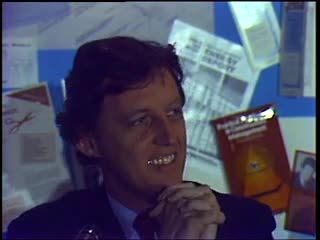
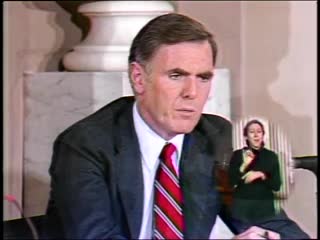
Description: Interview with Andrew Young, Mayor of Atlanta at the Parker House. Young talks about his efforts to facilitate international trade between Atlanta businesses and third-world nations. He says that urban mayors can help local businesses by leading trade delegations and encouraging local businesses to get involved in emerging markets. Young criticizes the federal government's reliance on the military in conducting foreign policy. He says that the US must act with intelligence and rely on diplomacy to solve world problems. He talks about US involvement in Vietnam, Lebanon, and El Salvador. Young and Christy George discuss African Americans in politics. Young does not believe that a candidate should not represent one single constituency. Young says that more African Americans need to be elected as senators, mayors and governors before an African American is elected as president. George reasks questions for cutaways. Young attends a cocktail party at the Parker House. Other guests include Bruce Bolling, Boston City Councilor, and Hubie Jones, Dean of the School of Social Work at Boston University.
1:00:04: Visual: Andrew Young (Mayor of Atlanta) is interviewed by Christy George in the Parker House. George asks about urban mayors taking on international roles. George notes that Mel King (candidate for mayor of Boston) is interested in Young's work in Atlanta with third-world nations; that Kevin White (Mayor of Boston) calls Boston a "world-class city." Young says that most governments help businesses; that the federal government has done little to help businesses. Young says that mayors can help local businesses. Young talks about leading trade delegations of Atlanta businessmen to other parts of the world. Young says that businessmen can gain access to government officials through the mayor. Young says that he took businesspeople, educators and a YMCA soccer team on a trip to Jamaica and Trinidad. Young says that the businesspeople did $150 million of business during a one-week trade mission. Young says that business people were allowed to see the decision-makers in foreign governments. Young says that white mayors can do the same thing. Young says that the mayors of Seattle and Indianapolis have done the same thing. Young says that there are large concentrations of Dutch and Japanese businesses in Georgia; that he is trying to build on that. George notes that African-American mayors are now dealing with third-world countries. Young says that the emerging markets are in the third world. Young says that he will visit Nigeria next week. Young says that Nigeria is buying products from Atlanta; that Nigeria is developing at a rapid rate. Young notes that Japanese and German businesses have been doing business with the third world for a long time. Young says that US businesses never needed to do business abroad until 1975. George notes that Young had been talking about doing business with the third world when he worked for Jimmy Carter (former US President). George remarks that the Democratic Party has not advocated more trade with the third world. Young says that Ronald Reagan (US President) sees everything in terms of an East-West conflict. Young says that the US needs to look beyond the East-West conflict. Young talks about US involvement in Egypt and Panama in the 1970s. Young says that diplomatic treaties can undercut communist influence. Young says that military solutions seem popular, easy and "macho." Young says that military solutions have seldom succeeded for the US or for the Soviet Union. 1:05:15: V: George asks what the Democratic Party should be doing to prepare for the 1984 elections. Young says that the Democratic Party must approach world problems with "reason and sanity." Young talks about how the US was drawn into the Vietnam War. Young says that US ships are present off the coasts of Central America and Lebanon; that the US could easily become trapped in a military situation in one of these regions. Young says that there is no military solution in Lebanon; that the US has no business there. Young says that there is no military solution in El Salvador. Young says that the US needs to show its strength through intelligence; that the US should not show its strength through destructiveness. Young says that the Democratic Party must offer clear a alternative to Reagan. Young says that the US is living on the brink of war; that this policy is insane. George asks how the Democratic Party should deal with political unrest and revolutions in the third world. Young says that the US needs to understand the impulses behind revolutions in third world country. Young says that Harry Truman (former US President) probably did not know that Ho Chi Min (former Vietnamese leader) worked as a chef at the Parker House while he was a student in Boston. Young talks about the influence of American ideas of freedom on Ho Chi Min in the 1940s. Young says that third world leaders should not be discounted as Marxists. Jump cut in videotape. George asks if African Americans need an African American candidate for president in 1984 in order to gain political influence. Young says that he disagrees; that politicians should not represent only one segment of the population. Young says that the present Democratic candidates have strong records on civil rights and minority issues. Young says that African Americans need to be involved in the campaign of a winning candidate. Young says that candidates never live up to promises made at the convention. George asks if it is time for an African American presidential candidate. Young says that there need to be more African American mayors, governors and senators before there is an African American president. George closes the interview. 1:09:57: V: The crew takes cutaway shots of George. 1:14:40: V: Footage of a cocktail reception at the Parker House. Attendees eat, drink, and socialize. Attendees include Hubie Jones (Dean of the School of Social Work, Boston University), Bruce Bolling (Boston City Council), Carol Bolling (wife of Bruce Bolling), Young, and others. Shot of Young socializing.
Collection: Ten O'Clock News
Date Created: 09/22/1983
Description: State Senator Jack Backman opens a press conference in support of Mel King (Boston mayoral candidate) in front of the State House. Other participants include Byron Rushing (State Representative from the South End), Mary Jane Gibson (State Representative from Belmont), Susan Schur (State Representative from Newton), Mary Goode (former State Representative from Roxbury), and Barney Frank (US Congressman). Frank voices his support for King's candidacy and discusses the reasons for his endorsement, specifically, Frank talks about King's views on economic development and about his leadership abilities. Frank says that King is a creative leader who will bring "enlightened policy" to the city. Various reporters point out that Frank endorsed Dennis Kearney (candidate for mayor of Boston) in the primary elections. King arrives, shakes hands with Frank, thanks endorsers, and asserts that his administration will focus on employment, education, and the youth of the city.
1:00:10: Visual: Shot of a Mel King campaign sign. Jack Backman (State Senator) opens a press conference in front of the State House. He notes that Mel King (candidate for mayor of Boston) has not yet arrived. He voices his support for King. He introduces Byron Rushing (State Representative from the South End), Mary Jane Gibson (State Representative from Belmont), Susan Schur (State Representative from Newton), Mary Goode (former State Representative from Roxbury). Bachman lists off some state representatives who are due to arrive shortly at the press conference. Shots of Schur; of Rushing. Bachman introduces Barney Frank (US Congressman). 1:02:33: V: Frank says that he will support King for mayor of Boston; that he served with King for eight years in the legislature. Frank says that King is an advocate for enlightened policy for the city of Boston. Frank talks about King's ideas for economic development programs; about the Community Development Corporation. Frank says that King's ideas for development are in tune with the needs of city residents; that King is sensitive to the problems of displacement and the needs of area residents. Frank says that King can speak effectively on behalf of a diverse group of people; that King was an effective and respected legislator. Frank says that King will make an excellent mayor. A reporter asks Frank about his previous endorsements for mayor. Frank says that he is not always good at picking the winning candidate; that he speaks out on behalf of candidates who have good ideas and programs. A reporter notes that Frank endorsed Dennis Kearney (State Representative) in the primary election. He asks Frank how Kearney would have been a better mayor than King. Frank says that he endorsed Kearney in the primary because he thought Kearney was a good candidate with a good chance of winning. Frank says that Kearney and King take similar positions on the issues. Shot of King supporters standing behind Frank. Shot of Christy George (WGBH reporter). Audio is muffled. 1:07:45: V: Frank says that the many of the candidates in the race had similar positions on the issues; that King has helped shape the debate on the issues; that King was one of the first people to talk about the adverse effects of development on the elderly and the poor. Frank says that King is responsible for focusing the attention of the city on the management of economic development in a compassionate and effective manner. Frank says that he respects Ray Flynn (candidate for mayor of Boston); that King is more creative, thoughtful and consistent candidate; that King has proven himself to be an effective leader. Frank refuses to speculate on who he would have endorsed if King were not in the race. Frank says that he is endorsing a candidate because he is an elected official with an opinion; that he does not know what effect his endorsement has on a candidate's chances. A reporter asks Frank about the differences between King and Flynn. Frank says that the differences between the candidates stem from their past records; that King has proven himself to be a consistent and effective leader on economic issues for many years; that King has the capacity to stay with these issues. Frank notes that he does not agree with King on a mayor's role in foreign policy. A reporter asks Frank if King needs to highlight the issues on which he differs from Flynn. Frank says that King has stuck with the same issues for ten years; that his leadership has brought attention to these issues. Frank says that this has been a good mayoral campaign; that it has focused on issues. 1:13:15: V: Frank jokes with the reporters about his endorsement bringing in the voters from Brookline and Newton. A reporter asks Frank how King can get white liberal voters to support him instead of Flynn. Frank says that King can win voter support by focusing on the issues; that his positions on economic development may win over voters from traditionally "conservative" neighborhoods. A reporter asks Frank about his campaign advice for King. Frank says that King is doing the right thing by focusing on the issues; that King has proven his ability to be a leader on the issues. 1:16:32: V: King's supporters clap as he arrives at the State House. King and Frank shake hands. King thanks Frank and the assembled state representatives for their endorsements and support. King says that his administration will make the city open and accessible; that his administration will focus on employment, education, and the youth of the city.
Collection: Ten O'Clock News
Date Created: 10/21/1983
Description: First seven minutes are shots of photographs of community activist Mel King throughout his life. Then Christopher Lydon interviews his wife Joyce King in the kitchen of their home. Joyce says that Mel's parents taught him the importance of sharing with others, and adds that he was very proud of his father, who was active in a union. Joyce talks about Mel's generosity. Lydon asks about the West Indian background of Mel's family, and about his formative years. She says that Mel's family was proud of their West Indian heritage and discusses his experiences while attending college in South Carolina. Joyce says that he learned about racism and oppression while living in South Carolina.
1:00:02: Visual: Shots of black and white photographs of Mel King throughout his life; of Mel King's high school yearbook photograph. 1:06:55: V: Christopher Lydon interviews Joyce King (wife of Mel King) in the kitchen of her home. Lydon asks Joyce King about Mel King's family. Joyce King says that Mel King's family always shared what they had with others; that Mel King's mother was able to make do with the few resources she had. Joyce King says that Mel King's father was active in a union; that Mel King is very proud of his father. Joyce King tells a story about the generosity of Mel King's father. Joyce King says that Mel King has an "open door policy"; that Mel King is not protective of his privacy. Joyce King says that Mel King often brings people to their home. Joyce King says that Mel King often gives clothing or money to those in need; that he does it in a quiet manner. 1:15:06: V: Lydon asks about the West Indian culture of Mel King's family. Joyce King says that Mel King's family is proud of their heritage; that his parents grew up in Barbados; that the family has strong connections to their heritage. Lydon asks about Mel King's formative years. Joyce King says that Mel King's membership in the Church of All Nations was important in his younger years; that Mel King attended a church-sponsored school in South Carolina; that the public school system discouraged African Americans from attending university. Joyce King says that Mel King learned a lot about race and oppression when he was at college in South Carolina; that Mel King traveled through the South as a member of the sports teams at his college. Joyce King says that Mel King returned from South Carolina with ideas about race and the fight against oppression.
Collection: Ten O'Clock News
Date Created: 11/06/1983
Description: Mayoral candidates Mel King and Ray Flynn participate in a forum on education sponsored by the Citywide Education Coalition (CWEC) at English High School. Flynn talks about his experience in government and his commitment to the public schools. He notes his familiarity with the city and school budgets, and he discusses the importance of public education and public housing. King stresses the importance of early childhood education programs and a "child-centered" school system. King speaks of the need for the mayor to work together with the Boston School Committee. King says that the city must continue to demonstrate its support of integrated schools. King and Flynn respond to a question about requiring students to pass a standardized test in order to graduate. Tape 1 of 2.
1:00:05: Visual: Four members of the Citywide Education Coalition (CWEC) sit at a table on stage at English High School. A member of the CWEC welcomes mayoral candidates Ray Flynn and Mel King to the annual meeting of the CWEC. Flynn and King are seated at a table at the center of the stage. Shots of Flynn and King. The CWEC member says that the candidates and the audience will discuss the future of public education in Boston. 1:01:55: V: Flynn thanks the moderator and the CWEC. Flynn mentions his experience as a state legislator and a member of the Boston City Council. He says that he was a student in the Boston Public Schools. Flynn congratulates the CWEC for their commitment ot public education. Flynn stresses the importance of public education and a good school system. Flynn says that he has a Master's Degree in education from Harvard; that he is committed to education. Flynn says that he would visit a few public schools and a few public housing projects on his first day as mayor; that education and public housing will be major concerns for his administration. Flynn says that the mayor should be involved in public education; that politicians in Boston have distanced themselves from the public schools since desegregation. Flynn says that the mayor should serve as an ex-officio member of the Boston School Committee; that the mayor needs to be aware of the situation in the schools. Flynn says that he is familiar with the city and school budgets. Flynn says that fiscal stability and predictable student placements are important for the schools. The audience applauds. 1:07:56: V: King thanks the audience and the CWEC. King says that the students in the school system must be served from birth to graduation; that early childhood education programs are important. King says that resources must be allocated to support Head Start programs and other early childhood education programs. King says that "child-centered" school system must guarantee education for all students; that the school system must believe that all children can be educated. King says that the mayor must work with the Boston School Committee; that the members of the School Committee will be newly elected; that the mayor and the Boston School Committee must determine the problems and the needs of the school system. King says that the newly elected School Committee must be unified in support of integrated schools. Jump cut in videotape. King says that he would provide leadership on the issue of education; that he would work to create a good climate and to end divisiveness on the issue of education. King says that the Boston Public School System must demonstrate its commitment to integrated education. The audience applauds. 1:14:52: V: An audience member asks if students should pass a standardized test in order to graduate from high school. King says that standards need to be established in the early grades as well as upon graduation. King says that the school administration must be held responsible for the education of the students; that diagnostic testing and evaluation is needed at every grade level, not just upon graduation.
Collection: Ten O'Clock News
Date Created: 10/13/1983
Description: Mayoral candidates Ray Flynn and Mel King participate in a forum on education sponsored by the Citywide Education Coalition (CWEC) at English High School. Flynn says that students graduating from Boston public schools must be prepared to compete in the workplace. He adds that there must be a working relationship between parents, teachers, administrators, and the community. King speaks about the workings of the school administration and advocates the inclusion of parents in the process. King and Flynn respond to questions about how they would have handled school desegregation if they had been mayor at the time. Both candidates answer questions about the role of the mayor upon the court's withdrawal from its supervisory role over the school system and about the school budget. Audience members include John O'Bryant of the Boston School Committee. Tape 2 of 2.
1:00:00: Visual: Ray Flynn (candidate for mayor of Boston) speaks at a forum on education sponsored by the Citywide Education Coalition (CWEC) at English High School. The candidates' forum is held in conjuction with their annual meeting. Flynn says that students graduating from Boston public schools must be able to compete in the workplace. Long shot of candidates on stage from the back of the auditorium. Flynn says that there must be a working relationship between parents, teachers, administrators and the community. The audience applauds. 1:00:56: V: King speaks about the workings of the school administration. Jump cut in the videotape. Shots of John O'Bryant (Boston School Committee); of members of the audience. King says that parents must be included in the workings of the school system. Shot of the candidates on stage. An audience member asks what each candidate would have done about school desegregation if he had been mayor at the time. The audience member also asks about the role of the mayor when the court pulls withdraws from its supervisory role over the school system. King says that community control over schools is important; that community accountablility is an important aspect of community control; that members of the community must be held accountable for the state of neighborhood schools. King says that he had suggested a community approach to schools which could have prevented the kind of sweeping court order imposed by the federal court to accomplish school desegregation. King says that he would have tried to bring people together in support of school desegregation if he had been mayor at the time; that there were many people acting in opposition to the court order at the time of school desegregation. King says that he would provide leadership on the issue of quality, integrated education upon the withdrawal of the court. 1:05:08: V: Flynn responds to the same question about school desegregation. Flynn notes that the State Department of Education will continue to oversee the Boston Public School System after the withdrawal of the court. Flynn says that he will work with the State Department of Education to protect the Constitutional rights of public schoolchildren in Boston. Flynn says that political and moral leadership was absent during school desegregation in Boston. Flynn says that he would have defended the rights and the safety of Boston schoolchildren as mayor, even if he disagreed with the court order. Flynn notes that he was a state legislator at the time of school desegregation; that he was criticized at the time for standing up for his beliefs; that he was criticized for living in a certain community; that he acted responsibly on behalf of all of Boston's schoolchildren at the time. 1:07:15: V: An audience member asks about the school budget. Flynn says that it is important to educate children; that it is more expensive to remedy social problems resulting from poor education. Flynn says that he supported funding for Boston schools even when it was politically unpopular to do so; that he is committed to providing the necessary funds to assure a good school system. Flynn says that accountability is as important as funding; that the school system has too many administrators. King responds to the same question. King says that he is aware of the lack of resources available to teachers and students in the Boston Public School System; that the lack of resources is embarrassing for a school system with a large budget; that the school administrators must make a commitment to provide resources for students and teachers.
Collection: Ten O'Clock News
Date Created: 10/13/1983
Description: In this story on linkage, Christy George gives history of Boston development boom and affordable housing decline. She describes proposed linkage between the two in the form of taxes on new development, the proceeds of which would go toward affordable housing. Kevin White press conference. Interview with Bruce Bolling on his proposed linkage law. Interview with housing advocate Robert McKay, who is also on the committee reviewing the linkage law. There is a discussion of how exactly linkage will work. Kevin White, Ray Flynn, Larry DiCara, and Dave Finnegan all weigh in on linkage as a mayoral campaign issue.
Collection: Ten O'Clock News
Date Created: 08/16/1983
Description: MAYORAL DEBATE ON ARCHITECTURE AND DEVELOPMENT. Dennis Kearney, Ray Flynn, David Finnegan, Larry DiCara, Mel King, Robert Kiley. reel 2
Collection: Ten O'Clock News
Date Created: 05/18/1983
Description: MAYORAL DEBATE AT SIMMONS College, REEL 3. Ray FLYNN, David FINNEGAN, Eloise Linger, Fred Langone, Robert Kiley, Dennis Kearney. CUTAWAYS, WIDE SHOT of candidates.
Collection: Ten O'Clock News
Date Created: 04/25/1983
Description: MAYORAL DEBATE ON ARCHITECTURE AND DEVELOPMENT. Dennis Kearney, Ray Flynn, David Finnegan, Larry DiCara, Mel King, Robert Kiley. reel 3
Collection: Ten O'Clock News
Date Created: 05/18/1983
Description: RAY FLYNN AND MEL KING IN FINAL MAYORAL DEBATE BEFORE ELECTION
Collection: Ten O'Clock News
Date Created: 11/01/1983