Description: Rhode Island bank failures disadvantage small business owners. Brown University president Vartan Gregorian blames politics. RI state house. Power tool store. Pan of Providence. RISDIC bldg. Credit unions.
Collection: Ten O'Clock News
Date Created: 03/15/1991
Description: Carmen Fields reports that Richard Taylor, the Massachusetts Secretary of Transportation and Construction, will preside over the Central Artery/Third Harbor Tunnel Construction Project in Boston. Taylor is one of the few African American Republicans in Massachusetts. Interview with Taylor, who talks about his reasons for being a Republican and his career in business. Taylor talks about his commitment to affirmative action and his plans to encourage participation by women and minorities in the Central Artery/Third Harbor Tunnel Project. Taylor says that he has always pushed for fair and equitable opportunities for minority businesses. Fields notes that Taylor says that his appointment signals a commitment to affirmative action on the part of Governor William Weld. Fields' report is accompanied by footage of Rev. Graylan Hagler and unemployed construction workers at a press conference at a construction site in Roxbury. This edition of the Ten O'Clock News also included the following item: Alexandra Marks interviews businessmen Derek Jeter and William Singleton on the challenges faced by minority businesses in Boston
1:00:03: Visual: Footage of Richard Taylor (Secretary of Transportation and Construction) being interviewed. Taylor says that he supports limited taxes, limited regulation, more research, and development and more private sector involvement. Carmen Fields reports that Taylor is a wealthy, well educated entrepreneur; that Taylor is a Republican; that Taylor is also African American. Fields reports that Taylor is part of a small but growing band of African American Republicans. V: Shot of Taylor in his office. Footage of Taylor being interviewed. Taylor says that some have argued that all African Americans should be Republicans; that Abraham Lincoln (former US president) was a Republican. Taylor says that he believes in limited taxation and limited government involvement. Taylor says that the Republican Party encourages people to pursue economic independence; that the Republican Party discourages people from looking to the government for sustainment. Fields reports that Taylor is the State Transportation Secretary; that he presides over the Central Artery-Third Harbor Tunnel Construction Project. V: Shot of Taylor greeting an African American man and a white man as they enter his office. Footage of Taylor at a meeting with the two men and another woman. Taylor talks about the risk of delays in the project. Fields reports that Massachusetts has a high unemployment rate; that the construction project will provide jobs. Fields notes that the Republican Party is often viewed as being anti-minority, anti-women, and anti-civil rights. V: Shots of Taylor at the meeting. Footage of Taylor being interviewed by Fields. Fields asks Taylor if he is against affirmative action. Taylor says that affirmative action is necessary. Taylor says that minority businesses should participate in the project if it strengthens their skills; that minority businesses should be paid for a job well done. Taylor says that affirmative action helps minority businesses be competitive; that affirmative action is part of the remedial process. Taylor says that some affirmative action models are troublesome. Taylor says that he does not support quotas. Taylor says that some affirmative action models do not give minority businesses enough significant responsibility. Fields asks if he will be a reluctant or an enthusiastic supporter of affirmative action. Taylor says that he is inclined to have active and strong participation by women and minorities. Taylor says that he has always pushed for fair and equitable opportunities for minority businesses. Taylor talks about his career in business before entering government.Taylor says that he will do a good job in this area. Fields reports that Roxbury residents halted construction on a new Post Office facility in Dudley Square recently. Fields notes that residents wanted more jobs for community workers on the project. V: Footage of Graylan Ellis-Hagler (Church of the United Community) speaking at a press conference held at the construction site of the new Post Office in Dudley Square. A group of African American men stand behind Hagler. Hagler says that he and the men will not go away with "crumbs." Shots of the construction site. Fields notes that Taylor says that he has learned from the experience in Roxbury. V: Footage of Taylor being interviewed by Fields. Taylor says that the MBTA recently began a $9 million project to renovate Dudley Station. Taylor says that he incorporated some recent provisions from the Post Office project into the MBTA project. Turner says that it is important for the major contractor to be in agreement with the provisions of the contract. Turner says that he hopes that these provisions will be used in the Central Artery Project. Fields reports that Taylor says that his appointment signals the commitment of William Weld (governor of Massachusetts) to affirmative action. Fields notes that Turner believes that there are many opportunities for qualified people of color. V: Shots of Taylor in his office. Footage of Taylor being interviewed by Fields. Taylor talks about a recent business seminar at the Boston World Trade Center. Taylor says that the seminar focused on how minority businesses could participate in the Central Artery Project. Taylor says that he will soon meet with major contractors for the Central Artery Project. Taylor says that he hopes to link minority businesses with the major contractors in order to provide work for minorities.
Collection: Ten O'Clock News
Date Created: 03/29/1991
Description: Profile of Robert Spillane, superintendent of Boston Public Schools as he prepares to leave Boston for a post in Virginia. Vaillancourt reports on Spillane's accomplishments in improving the Boston Public School System and cutting the school budget deficit. Interview with Spillane where he compliments the teaching staff in the Boston Public Schools and talks about his opinion of Arthur Garrity. He says that Garrity's stewardship of the school system was a disaster. Interview with Peter McCormick, the President of the Bank of New England, about Spillane's good relationship with the business community. Vaillancourt speculates about whether Spillane will one day pursue a career in politics.
1:00:21: Visual: Footage of Robert Spillane (Superintendent, Boston Public Schools) speaking to an audience. Spillane says that the quality of every school must be improved in order for school desegregation to be considered a success. Meg Vaillancourt reports that Spillane took over as Superintendent of the Boston Public Schools four years ago; that Boston was undergoing school desegregation. V: Shot of a young African American boy watching an anti-busing march. White protesters chant, "Here we go, Southie." Shot of a police officer pushing an angry white man against a car. Vaillancourt reports that the quality of education was very low. Vaillancourt notes that school officials admitted that more than one-third of the graduates from Boston Public Schools could not read. V: Shots of students descending an elevator at English High School. Shot of an African American male student reading at a his desk; of two white male students sitting together in a classroom; of students in a classroom. Shots of a group of students sitting together in a study hall; of a teacher in the study hall. Vaillancourt reports that there were six superintendents during the first seven years of school desegregation in Boston. Vaillancourt reports that Spillane was committed to changing the schools in Boston. V: Shot of Spillane seating himself as he prepares to speak to an audience. The audience applauds. Vaillancourt reports that Spillane instituted the first changes to the school curriculum in fifteen years; that promotion standards were established; that students' test scores began to improve. V: Shot of two elementary school students seated in front of computers. A teacher looks over the shoulder of one of the students. Vaillancourt reports that Spillane shares credit for success with his staff. V: Footage of Spillane being interviewed. Spillane says that there is an excellent teaching staff in the Boston Public Schools. Spillane says that the rising levels of student achievement reflect the dedication of the teaching staff. Spillane says that he provided help and direction. Spillane says that he challenged the teachers by publishing the test scores of each school. Shots of Spillane in his office. Vaillancourt reports that Spillane is known as the "velvet hammer." V: Shot of a hammer with a velvet grip on display in Spillane's office. Vaillancourt reports that Spillane is credited with pushing Arthur Garrity (federal judge) aside; that Spillane allowed the Boston School Department to take charge of the schools once again. Vaillancourt notes that Garrity is slowly handing over his control of the Boston Public Schools. V: Shot of Garrity at a community meeting in January of 1976. Vaillancourt reports that Spillane has few kind words for Garrity. V: Footage of Spillane being interviewed by Vaillancourt. Spillane says that Garrity was a "disaster"; that Garrity was not a good manager of the schools. Spillane says that Garrity did what was necessary to desegregate the schools; that Garrity tried to manage the schools as well. Spillane says that a federal judge has no qualifications to manage a school system. Vaillancourt reports that Spillane considers his ability to manage the school system as his strength. Vaillancourt reports that the school budget had tripled in the decade before Spillane's arrival. Vaillancourt reports that Spillane cut the school deficit from $30 million to $3 million within one year. Vaillancourt notes that Spillane got Boston businesses involved in the schools; that Boston businesses have given over $5 million in additional funds to the schools. Vaillancourt adds that the Boston Public Schools have the largest private endowment in the nation. V: Footage of a woman introducing Spillane to an audience. Spillane rises from his seat, shakes the woman's hand and prepares to address the audience. The audience applauds. Shots of audience members. Footage of Spillane receiving an award in front of an audience. Footage of Peter McCormick (President, Bank of New England) being interviewed. McCormick says that Spillane is highly respected by the business community. McCormick says that Spillane understands the problems of the business community; that Spillane has been willing to be flexible. McCormick says that the business community responded in kind to Spillane. Vaillancourt reports that Spillane is leaving Boston for Virginia; that Spillane will make an additional $30,000 per year in his new job. Vaillancourt reports that Spillane made $70,000 per year in Boston; that his salary is considered low. V: Footage of Spillane talking with a small group of people. Spillane shakes hands with an Asian American woman. Footage of Spillane being interviewed by Vaillancourt. Spillane says that superintendents are like athletes in that they have a short span of time in which to perform well and make money. Spillane says that there is a good market for superintendents. Vaillancourt reports that some are speculating that Spillane is looking for a political appointment in Washington DC. in the future. Vaillancourt notes that Spillane is a former Deputy Commissioner of Education in New York. V: Shot of Spillane socializing with a group of people at a gathering. Footage of Spillane being interviewed by Vaillancourt. Spillane says that public service is a great opportunity; that he loves public service. Spillane says that he may enter politics in the future; that he might like to be a city councillor or school committee member someday.
Collection: Ten O'Clock News
Date Created: 06/28/1985
Description: Frantic pace of food ordering and preparation in S&M Deli on Beacon Street, Boston. Fleet of line cooks make variety of sandwiches and salads in rapid succession. Orders called out by restaurant staff in lunchtime rush. Bins of ingredients - iceberg lettuce, sliced meats and cheeses, tomatoes, pickles. Assorted breads and rolls, condiments, sauces. Sodas, packaged snack cakes, potato chips, crushed ice. Customers crowd near counter awaiting takeout orders. Staff in perpetual motion. Close-up as price is rung into cash register. Storefront.
Collection: Ten O'Clock News
Date Created: 11/07/1978
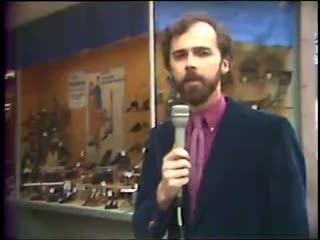
Description: SHOE STORE FRONT WINDOWS
Collection: Ten O'Clock News
Date Created: 10/13/1982
Description: Broadened sales tax on services loses support from Democrats. Rep. Steven Pierce gloats. Jim Braude defends service tax, saying it is not harmful to business.
Collection: Ten O'Clock News
Date Created: 06/19/1990
Description: Speaking at Biogen, John Silber says service cuts not the solution to state budget; wants to streamline workforce instead, and change corporate and capital gains taxes to encourage business.
Collection: Ten O'Clock News
Date Created: 10/05/1990
Description: Small business classification under Subchapter S of state revenue code is revoked. Advantage is lost by many start-up entrepreneurs who had changed status to qualify for 5% tax rate. Stephen Kidder.
Collection: Ten O'Clock News
Date Created: 08/26/1988
Description: MassPort plans to raise landing fees at Logan, posing a burden on small aircraft. Business lobbyists fight proposal. Ray Flynn & area residents happy about improved safety.
Collection: Ten O'Clock News
Date Created: 02/22/1988
Description: Interview with Solar Power Corp. president John Wurmser about Exxon owned local solar power company. As startup business in new industry, not yet profitable or cost-effective, but investment in future. Solar array, volt meter, silicon disk, propeller. Photovoltaics.
Collection: Ten O'Clock News
Date Created: 08/03/1979