Description: In Brockton, drug crime is rampant, police short- staffed. Night scenes shot from cruiser. Man with knife arrested. Drugs exchanged from cars. Officers lined up. Man holding bottle in bag. Former chief Richard Sproules.
Collection: Ten O'Clock News
Date Created: 10/16/1990
Description: Carl Taylor talks about multibillion $ heroin trade of Detroit gang which operates underground without showing colors. Chez Vous roller rink. Castlegate graffiti. Black youth wearing baseball caps.
Collection: Ten O'Clock News
Date Created: 05/15/1990
Description: Phoenix reporter says Darryl Whiting wants to be boss of Boston gangs, and that his Dorchester recreation club is a center for drug dealing. Whiting denies it.
Collection: Ten O'Clock News
Date Created: 05/16/1990
Description: Darryl Whiting, who runs Dorchester social club, video and sneaker store, barber shop, and other businesses in New York, is suspected of involvement in drug and gang activity. He denies allegations.
Collection: Ten O'Clock News
Date Created: 05/25/1990
Description: Marcus Jones compares the differing opinions on law enforcement of Deputy Superintendent of Boston Police William Celester and Reverend Graylan Hagler of the Church of the United Community. Interview with Celester, who says that the police are at war with drug addicts and gang members in the neighborhood, and that some of these individuals need to be scared of police. Celester says that police officers are not well equipped to serve as mentors. Jones reports that Hagler and others believe that a new approach is necessary. Hagler recommends that police academy graduates serve as mentors to community youth. Jones' report includes footage of Hagler talking about his plan from December 15, 1989. Hagler and his supporters see prevention as an effective weapon against drugs and violence. Following the edited story is b-roll of Celester and police officers at police headquarters.
1:00:05: Visual: Footage of William Celester (Deputy Superintendent, Boston Police Department) talking to a group of Roxbury residents at Boston Police Department Area B Headquarters on August 21, 1989. Marcus Jones reports that Celester believes that the police officers in his division are at war with drug addicts and gang members in Roxbury, Dorchester, and Mattapan. V: Shot of two plain-clothes police officers arresting an African American man on the street. The man struggles with the police officers. Footage of Celester being interviewed by Jones. Celester says that there is a war over who will run the community. Celester says that either the "thugs" or the residents can run the community. Shot of a white police officer putting handcuffs on an African American man. The man stands beside a red sports car. Shots of police officers standing near a police cruiser with flashing lights. Shots of police officers at police headquarters; of a police officer sitting on a police motorcycle; of two white police officers searching a young African American man. Jones reports that Celester and the officers in his division were criticized last year; that some critics did not think the officers did enough to fight crime. Jones notes that others criticized the officers for going too far; that many opposed the police department's stop-and-search policy. V: Footage of Celester being interviewed by Jones. Celester says that some people need to be scared; that some people only understand fear. Footage of Graylan Ellis-Hagler (Church of the United Community) from December 15, 1989. Hagler says that police need to find some new tactics because the old tactics do not work. Shots of Ellis-Hagler walking with two African American men toward the Church of the United Community building. Shots of a sign for the Church of the United Community. Shots of Ellis-Hagler talking with a group of African American men at the Church of the United Community. Shots of the individual men in the group. Jones reports that Ellis-Hagler and other community activists are urging the police department to consider ways to prevent young people from getting involved with drugs and gangs. Jones notes that Ellis-Hagler recommends that rookie police officers serve as mentors for the community youth. V: Footage of Ellis-Hagler from December 15, 1989. Hagler says that most police officers are concerned about the community. Hagler says that many police officers are frustrated because they realize that an more innovative approach is necessary. Jones reports that Celester does not think that police officers should serve as social workers. V: Footage of Celester being interviewed by Jones. Celester says that police officers are not well equipped to serve as mentors. Celester says that the police must care about the community; that the police cannot do everything. Shot of an African American man and an African American woman walking past a fire truck in Los Angeles; of police officers arresting a suspect. Jones reports that police officers in Los Angeles and Washington are taking the call for prevention seriously. V: Shot of English High School students walking on a street. Jones notes that the effectiveness of prevention measures cannot be easily measured; that many see prevention as an effective weapon in the war against drugs and violence. V: Shots of a white police officer guiding a group of African Americans away from a crime scene; of medics putting a wounded person on a stretcher into an ambulance.
Collection: Ten O'Clock News
Date Created: 01/02/1990
Description: City inspectors visit trashed apartments in Dorchester building commandeered by crack dealers. Tenants show decrepit conditions.
Collection: Ten O'Clock News
Date Created: 05/17/1990
Description: Marcus Jones reports on the competion of renovations at the Renaissance Building in the Grove Hall district of Roxbury. The project was funded with money from the city's only minority-owned bank and was overseen by minority architects and contractors. Jones adds that the building is a cornerstone of the Grove Hall revitalization effort. People hold a celebration for the completion of the restorations. A crowd stands outside of the building. Virginia Morrison (Neighborhood Development Corporation of Grove Hall) and Don Muhammad (Muhammad's Mosque) address the crowd. Muhammad says that gang activity will decline as more renovation takes place in the neighborhood. Interview with Trevor Blake (TTB Construction Inc.) and Ernest Scott, a businessman, about the renovations. Blake talks about the challenges faced by minority businesses and contractors. Scott says that renovations and increased foot traffic will force the drug trade out of the area. Jones reports that the city of Boston has committed an additional $50,000 to the Grove Hall revitalization effort.
1:00:01: Visual: Footage of a gathering to celebrate the restoration of the Renaissance Building in the Grove Hall district of Roxbury. Virginia Morrison (Neighborhood Development Corporation of Grove Hall) addresses the gathering. Morrison says that the building makes a statement on behalf of Muhammad's Mosque, of the Grove Hall Board of Trade, of the Prince Hall Masonic Lodge, of the residents of the area. Morrison says that the building represents the way that the residents of the area intend to live. Shot of a man tearing off paper above the door to reveal the street number. Marcus Jones reports the newly renovated Renaissance Building is located at 483 - 487 Blue Hill Avenue. Jones says that the building was "an eyesore" for more than a decade; that the building is now the cornerstone of the Grove Hall revitalization effort. V: Footage of Morrison addressing the gathered crowd. Supporters stand behind her, including Don Muhammad (Muhammad's Mosque). Morrison says that the building cost $1,276,000 to renovate; that the building was renovated by qualified African American workers from the community. Shot from an upper window of the Renaissance building, of the intersection of Blue Hill Avenue and Cheney Street. Shots of people looking at the interior of the newly-renovated building. Shot of the newly renovated kitchen. Jones reports that the project was funded with money from the city's only minority-owned bank; that the project was overseen by minority architects and contractors. Jones reports that the building includes twelve apartments on the upper floors of the building; that there is retail space on the bottom level. V: Shot of a man exiting the Ernest Scott Insurance Agency. Footage of Trevor Blake (TTB Construction Inc.) standing in one of the apartments. Blake talks about the challenges faced by African American businesses and contractors. Footage of Ernest Scott (businessman) saying that the whole neighborhood is improving. Jones reports that Scott's Insurance Agency has operated on Blue Hill Avenue for over thirty years. Jones notes that Scott's business is one of the new tenants in the Renaissance Building; that Scott believes that businesses and residents need to fight the gangs and drug dealers in the neighborhood. V: Shot of the exterior of the Ernest Scott Insurance Agency. Shot of a man fixing lettering to the interior of a window of the Insurance Agency; of an employee and customer at the Insurance Agency. Footage of Scott saying that foot traffic and business activity puts a damper on the drug trade. Scott says that participants in the drug trade will be forced out of the area. Shots of traffic on the street in the Grove Hall area; of the crowd gathered in front of the Renaissance Area. Jones reports that community organizers hope to refurbish the entire Grove Hall district within five years; that Ray Flynn (Mayor of Boston) has committed an addtional $50,000 to the effort. V: Footage of Muhammad addressing the crowd outside of the Renaissance Building. Muhammad says that the Grove Hall community deserves the same respect and resources as any other neighborhood. Muhammad says that gang activity will dwindle as more renovation takes place in the neighborhood. The crowd claps for Muhammad. Morrison approaches the microphone.
Collection: Ten O'Clock News
Date Created: 03/12/1990
Description: Marcus Jones interviews Brian Wright O'Connor, the Managing Editor of The Bay State Banner, about the negative media portrayal of the Roxbury, Dorchester and Mattapan area. Jones notes that O'Connor believes that the media focus only on images of violence, drugs, and murder. O'Connor talks about the effects of the negative media coverage. Footage from an interview with Boston Police Deputy Superintendent William Celester about negative media coverage of the community. Jones notes that gubernatorial candidate John Silber was recently criticized for making negative comments about the Roxbury community. Silber has accused columnist Mike Barnacle of giving a biased representation of life in many neighborhoods. Jones' report is accompanied by footage from a news story with Barnacle, by footage from Justice on Trial (WCVB-TV) and by footage from Street Cop (WGBH/Frontline documentary). Jones notes that politicians and community leaders have spoken out against media bias in the wake of the Carol Stuart murder case. Michael Dukakis talks about media bias at a press conference. Following the edited story is additional footage of Jones's interview with O'Connor. This edition of the Ten O'Clock News also included the following item: John Silber speaks to the media and Roxbury residents
1:00:25: Visual: Footage of news reports from local TV stations. John Henning (WBZ news anchor) reports on the murder of a woman in the city. Natalie Jacobson (WCVB news anchor) reports on a police search for suspects in two Roxbury shootings. Shot of police searching two suspects who are lying face down on a sidewalk. R.D. Sahl (WHDH news anchor) reports on growing outrage in Roxbury. Shot of a woman being taken from a home on a stretcher. Shots of police cruisers on the streets of Roxbury at night. Shot of an injured person in an ambulance; of police at a crime scene cordoned off by yellow tape. Shot of an African American man leaving a police station. Marcus Jones reports that media coverage of the Roxbury, Dorchester, and Mattapan neighborhoods focus on images of violence, drugs, and murder. Jones reports that Brian Wright O'Connor (Managing Editor, The Bay State Banner) believes that the media does not provide an accurate portrayal of life in Roxbury. Jones notes that O'Connor lives in a quiet section of the Roxbury neighborhood. V: Shot of Jones and O'Connor walking through a quiet park. Footage of O'Connor saying that criminal activity should be covered by the media; that the media uses questionable tactics in covering crime. O'Connor says that the media often stretches its definition of the term "news." O'Connor questions if there is balanced news coverage of the greater Roxbury area. O'Connor says that the media come to Roxbury to cover crime; that the media comes to Roxbury to cover reactions of local residents to comments by white politicians. Footage of William Celester (Deputy Superintendent, Boston Police Department) saying that media coverage creates the wrong perceptions about the community. Celester says that negative perceptions did not begin with the comments of John Silber (Democratic candidate for governor of Massachusetts). Celester says that the negative perceptions need to be changed. Footage from WCVB of Justice on Trial. The footage shows Joe Lally (Boston Police Department) walking toward a city courthouse. The narrator says that Lally is "the only symbol of civilization left on many city streets." Marcus Jones reports that Silber has accused the media of twisting his words; that Silber says that the media has skewed perceptions of reality in Area B neighborhoods. Jones notes that Silber accused Mike Barnacle (columnist) of giving a skewed portrayal of life in many neighborhoods. V: Shot of Mike Barnacle interviewing a white man outside of a building. Footage of Barnacle walking along a sidewalk. Barnacle compares the neighborhood to a "shooting gallery." Jones reports that he interviewed Barnacle by telephone. Jones reports that Barnacle says that he feels no obligation to balance negative coverage of a neighborhood with positive coverage. Jones notes that Barnacle could not recall the number of columns he has written this summer with positive coverage of the neighborhoods in Area B. V: Footage from a WGBH/Frontline documentary called Street Cop. A plain-clothes police officer rides through a housing development. The officer says that the neighborhood is a tough place. The officer says that he would probably end up selling drugs if he were a poor, African American teenager in this neighborhood. Footage from Street Cop of white, plain-clothes police officers breaking down the door of an apartment with sledgehammers. A police officer reaches down the shirt of an old woman to look for drugs. Jones notes that WGBH/Frontline produced a documentary called Street Cop three years ago; that the documentary was accused of using negative stereotypes of crime in Roxbury. Jones reports that politicians and community leaders have spoken out against media bias in the wake of the Carol Stuart murder. V: Shots of newspaper articles with headlines about the suspect in the Stuart case. Footage of Michael Dukakis (Governor of Massachusetts) speaking at a press conference on April 11, 1990. Dukakis says that there are thousands of good kids in the community; that the media gives all of the news coverage to the 500 bad kids. Bernard Cardinal Law (Archidiocese of Boston) is seated behind Dukakis. Footage of O'Connor being interviewed by Jones. Jones asks if the media focus on crime leads to a reduction in crime. O'Connor says that the community has been stereotyped by the media; that negative stereotypes reduce the political will to address the underlying socio-economic problems. O'Connor says that these negative stereotypes imply that the citizens of the community are morally defective or undeserving of aid. O'Connor says that the biased media coverage is "pernicious." O'Connor says that the negative media coverage allows people with resources to turn away from the community. O'Connor notes that two large companies scrapped their plans to build facilities in Roxbury in the wake of the Stuart murder. O'Connor says that the two companies could have provided jobs for at-risk teenagers in the community.
Collection: Ten O'Clock News
Date Created: 09/12/1990
Description: Wayne Budd announces federal indictments in South Boston based cocaine trade. Defendants walk in courthouse corridor. Martin Healey, Mickey Roache. D Street Deli. Photos of Whitey Bulger.
Collection: Ten O'Clock News
Date Created: 08/10/1990
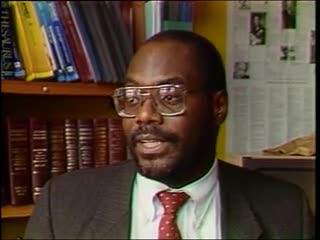
Description: Leslie Harris, an attorney with Roxbury Defenders Committee, describes his work seeking justice for those accused, sometimes unfairly, by police in the street drug war. Lawyers in conference room.
Collection: Ten O'Clock News
Date Created: 09/04/1990