Description: Explainer on where state funds go: human services, corrections, education, highway construction, job training, health care, etc. Per capita spending and increase therein rank above national average.
Collection: Ten O'Clock News
Date Created: 01/12/1989
Description: Meg Vaillancourt interviews Robert Peterkin (Superintendent, Cambridge Public Schools) about school desegregation in Boston. Peterkin reviews desegregation in Boston, both the positive and negative outcomes. He talks about the challenges that lie ahead for desegregation. Peterkin discusses his belief in the potential for educational innovation and quality in a minority school system, stating that quality education will desegregate schools more effectively than a court order. He discusses the difficulties in moving from a "numerical desegregation" plan to a "freedom of choice" plan and notes that the Cambridge Public School System desegregated its schools through a "freedom of choice" plan. Peterkin says that busing was necessary to desegregate the Boston school system; notes that the city had been given opportunities to explore other desegregation models; that the resistance to busing was very strong. Peterkin discusses the magnet school concept and the need to institute valuable educational programs at every school. Peterkin talks about the problems with the court-ordered desegregation plan in Boston, but says that the positive result of equal access to the schools far outweighs the negative results. Peterkin discusses the prospect of more students returning to Boston schools in the future. Peterkin says that Arthur Garrity (federal judge) should end his supervision of Boston's schools; that the Boston School Department is able to assume the responsibility of continued desegregation of the schools, but that safeguards are required to prevent a return to discriminatory practices. Peterkin discusses his perceptions of what Martin Luther King would have thought about school desegregation in Boston.
1:00:02: Visual: Meg Vaillancourt interviews Robert Peterkin (Superintendent, Cambridge Public Schools) about school desegregation in Boston. Vaillancourt asks Peterkin to review desegregation in Boston. Peterkin says that school desegregation has given minority students access to better school programs; that school desegregation opened up the Boston Public School System. Peterkin talks about partnerships between the school system and businesses and universities in the community. Peterkin mentions the cooperation between the school system and human services agencies. Peterkin says that school desegregation exposed the educational shortcomings of the system. Peterkin says that school desegregation is still a difficult issue in Boston; that white and middle-class students have abandoned the school system; that the population of the Boston schools is overwhelmingly minority. Peterkin says that the desegregation effort needs to focus on educational programs; that Robert Spillane (Superintendent, Boston Public Schools) is focusing more on educational reform; that parents support the renewed focus on educational programs. Vaillancourt asks Peterkin if improvements in education are possible with a minority student population and an overwhelmingly white city government. Peterkin says that he resents the implication that educational innovation and quality are not possible in a minority school system. Peterkin notes that the school system must spend their resources wisely; that the quality of education will determine whether or not students will attend; that quality education will desegregate schools more effectively than a court order. 1:05:00: V: Vaillancourt asks Peterkin's opinion on the "freedom of choice" proposal. Peterkin says that the "freedom of choice" plan will not work until the quality of education improves in all schools across the city; that there is varying quality among the schools in Boston; that each neighborhood school needs to offer strong educational programs. Peterkin says that it will be difficult to switch from a "numerical desegregation" plan to a "freedom of choice" plan; that the "freedom of choice" plan will require an enormous leap of faith for the minority community and the court. Peterkin mentions that the Cambridge Public School System desegregated its schools through a "freedom of choice" plan. Vaillancourt asks Peterkin if busing was necessary for desegregation in Boston. Peterkin says that busing was necessary at the time; that the city had been given opportunities to explore other desegregation models; that the resistance to busing was very strong. Peterkin says that Arthur Garrity (federal judge) made efforts to improve the schools through magnet programs and partnerships with businesses; that parents are more willing to bus their children to a school with strong educational programs. Vaillancourt asks Peterkin if all schools should be follow the magnet school model. Peterkin says that there must be an effort to institute valuable educational programs in every school; that parents will send there children to schools with sound educational programs; that it is not necessary to make every school a magnet school. Vaillancourt asks about the problems with the court-ordered desegregation plan in Boston. Peterkin says that the schools were ignored recently by city officials and the community in the late 1970s and early 1980s; that many residents and city officials did not pay attention to the schools because of a fiscal crisis and low attendance; that a declining school system can adversely affect the whole city. Peterkin says that a reduced student population was a negative result of school desegregation; that the positive result of equal access to the schools far outweighs the negative result. 1:11:24: V: Vaillancourt asks Peterkin if students will return to the schools. Peterkin says that there has been a renewed commitment to the schools in the past few years; that improvements in the educational programs will prompt younger parents to consider sending their children to the Boston Public Schools. Peterkin notes that the decline in attendance has leveled off. Vaillancourt asks Peterkin if Garrity should end his supervision of the schools. Peterkin says that Garrity should end his supervision; that the Boston School Department is able to assume the responsibility of continued desegregation of the schools. Peterkin says that there need to be some safeguards in the system to prevent a return to discriminatory practices. Peterkin says that flexible guidelines must be established to guarantee the percentages of children in neighborhood schools; that educational standards must be guaranteed. Vaillancourt asks Peterkin what Martin Luther King would have thought about school desegregation in Boston. Peterkin says that King would have been disheartened by the violence and turmoil resulting from school desegregation; that King would have been encouraged by the positive changes in the system and in the city. The crew takes cutaway shots of Vaillancourt and Peterkin. Peterkin and Vaillancourt speak informally about the state of schools in Boston.
Collection: Ten O'Clock News
Date Created: 03/17/1983
Description: Marcus Jones reports on efforts to provide positive male role models for young African American boys through the Paul Robeson Institute for Positive Self-Development. Third and fourth grade boys attend the Institute every Saturday, and 25 men from diverse backgrounds assist the boys in developing their understanding of math, science and history. Interviews with Pamela Brodie and Delores Wilson, who are both teachers at the Holland Community School. Both teachers praise the program. Brodie talks about the need for positive male role models. Interview with Keith Motley, a member of the Paul Robeson Institute, about the program. Motley says that programs like this one can help to end the violence on the streets. Interviews with two African American boys who attend the Institute. Following the edited story is additional footage of Brodie and her students in class at the Holland School.
1:00:14: Visual: Footage of students in a classroom at the Holland Community School in Dorchester. Shot of students are getting out their textbooks. The students are seated at their desks. Pamela Brodie (teacher, Holland Community School) stands at the front of the room. Shot of students raising their hands to be called on. Most of the students are non-white. Marcus Jones reports that the majority of students in public elementary schools in Boston are non-white. Jones reports that most of the teachers are female. Jones notes that male authority figures are limited; that African American male authority figures are virtually absent. V: Footage of Brodie being interviewed. Brodie says that most school systems have a lot of female teachers. Brodie says that it is important to have positive male role models for students; that some students do not have a male role model at home. Brodie says that schools need more male role models. Jones reports that elementary school students are in their formative years. Jones reports that a group called Concerned Black Men of Massachusetts visit the Holland School to help students make the right choices. V: Shots of students eating lunch at their desks. Shots of an African American boys walking around the classroom. Footage of Keith Motley (Paul Robeson Institute) being interviewed. Motley says that the group wants to fight against violence; that education is necessary to end violence. Footage from the Paul Robeson Institute. An African American man addresses a group of African American boys. The man speaks from a podium, while the boys sit in seats. The man encourages the boys to be the best people they can be. The man says that the future depends on them. Jones reports that the organized effort to provide positive role models is called The Paul Robeson Institute for Positive Self-Development. Jones reports that African American boys from the third and fourth grades in the Holland and Fifield Schools are involved in the program; that the boys visit the African American Institute at Northeastern University on Saturdays. Jones reports that 25 men from diverse backgrounds assist the boys in developing their understanding of math, science, and history. Jones says that the Institute focuses on African American history. V: Shot of an African American man speaking to a group of African American boys in a classroom. The boys are seated at desks. Shot of a sign for the African American Institute on the exterior of a building. Shot of an African American man standing at the front of a classroom. African American boys are seated at desks. A second African American man leans on a chalkboard as the other man teaches. Shot of a group of African American boys in orange T-shirts standing in a circle. The boys hold hands. An African American man stands in the center of the circle. African American men stand in a circle surrounding the boys. Footage of an African American boy being interviewed by Jones. Jones asks if the teachers at the institute are teaching him to be proud of himself. The boy says yes. Footage of another African American boy being interviewed by Jones. The boy says that the program has taught him that he can do something else besides sell drugs on the street. Shots of Brodie standing in her classroom; of an African American boy flipping through a textbook. Jones reports that the Robeson Institute has been operating for a year; that the Robeson Institute has earned praise from parents and teachers. V: Footage of Delores Wilson (teacher, Holland Community School) being interviewed. Wilson talks about one of her students who has behavior problems. Wilson says that the student's behavior has improved since attending the Robeson Institute. Wilson says that the student now helps other kids. Footage of Motley being interviewed. Motley says that programs like the Robeson Institute should be promoted and encouraged; that men and women should get involved. Shot of the African American boys at the Institute standing in a circle while holding hands. African American men form a circle around the boys. An African American man stands in the center.
Collection: Ten O'Clock News
Date Created: 12/13/1990
Description: Rollins School is example of overburdened educational system in Lawrence. Interview with the principal of the school on all of the repairs that need to be made. The student population has dramatically increased without any changes to the building. Interview with mayor Kevin Sullivan on the dilemma of serving growing population. He talks about local aid provided by the state. Special needs classroom scenes. Following the edited story is b-roll of classrooms and school building, including Mayor Sullivan in front of the class talking to students.
Collection: Ten O'Clock News
Date Created: 03/08/1990
Description: Charles Ray, the Headmaster of Roxbury High School, talking to students, parents and faculty members in the offices of Roxbury High School. Pam Bullard interviews Ray in the administrative offices of the school. Ray talks about how the school has changed since the beginning of school desegregation in 1974. He notes that white attendance is still low, but that it is improving. Ray describes the school's bilingual program, and the academic programs set up at the school in conjunction with Harvard University. He says that many students from Roxbury High School received college scholarships last year, and discusses their college opportunities. Ray talks about the atmosphere at the school, and the close relationships between the students and the faculty. He notes that very few students transfer out of the school. He adds that most students feel comfortable at Roxbury High School. Ray says that he tries to learn the names of every student in the school. Ray talks about the challenges of urban education. He says that he encourages pregnant students to remain in school as long as possible. Ray says that he would like to see a program set up to allow students to bring their children to school with them. Ray describes the school's building and facilities. Ray tells Bullard that it is important to treat each student with respect.
1:00:05: Visual: Charles Ray (Headmaster, Roxbury High School) speaks to an African American female student in the office of Roxbury High School. He tells the student what she needs to do in order to change school assignments. 1:01:37: V: Pam Bullard sets up an interview with Ray. Ray talks about some of the photographs in the school office. He notes that the photos were taken by students from the school. Ray talks to a student who has entered the office. The student asks Ray about the television crew in the school office. Bullard notes that the Boston Public Schools are beginning their fifth year of desegregation. Bullard asks Ray how things have changed in five years. Ray notes that Roxbury High School was paired with South Boston High School during the first year of desegregation. Ray notes that only a small percentage of students from South Boston attended Roxbury High School during the first year of school desegregation. Ray says that Roxbury High School was placed in the same district as Charlestown High School during the second year of school desegregation; that Roxbury High School has remained in that district. Bullard asks Ray about white attendance at Roxbury High School. Ray says that the school has more white students now than it had during the first year of school desegregation. He notes that sixty-three white students have been assigned to the school this year; that twenty-five white students are in attendance. Ray says that he would like the Boston School Department to assign more white students to the school. Ray says that Roxbury High School has a bilingual program for Asian and Spanish-speaking students. Bullard asks Ray about Roxbury High School's programs in conjuction with Harvard University. Ray explains that Roxbury High School has been paired with Harvard University by the federal court order governing school desegregation in Boston. Ray talks about a tutoring program in which Harvard students tutor Roxbury High School students. Ray talks about the Harvard Upward Bound Program. He adds that Harvard and Roxbury High School have set up programs for students in advanced math and sciences, reading, and art. Ray explains that teachers and advanced students can take courses at Harvard University. 1:06:46: V: Bullard notes that students who attend Roxbury High School tend to stay at the school and do not transfer out. Ray agrees that not many students transfer out of the school. He adds that most students like the school and the faculty. Bullard asks Ray if many students from Roxbury High School attend college. Ray says that 74 students graduated from Roxbury High School in 1978; that 37 of those students went on to college. He adds that many of the students received scholarships last year. Ray adds that the Girls High Alumni Association has contributed to a scholarship fund for the students. Ray notes that many Roxbury High School students have done well in their college careers. Bullard asks why Roxbury High School has been a successful school. Ray says that the teachers get to know the students and their families very well. Ray notes that the faculty know most of the students by name; that the students feel comfortable at the school. Ray adds that these close relationships are the key to the school's success. Bullard asks Ray if he knows the name of every student at the school. Ray says that he is learning the names of all of the incoming freshmen; that he makes an effort to talk to the students in the hallways. Ray adds that he knows the names of all of the returning students. Bullard notes that all of the students like Ray and speak highly of him. Ray talks about the importance of knowing the name of each student. He adds that the students know that the teachers and other faculty members care about them. 1:11:43: V: Bullard asks how urban education has changed in the past decade. Ray says that programs for special needs students have changed; that pregnant students now stay in school. Ray says that he encourages pregnant students to stay in school for as long as they can. He says that he encourages them to return to school as soon as possible. Ray adds that he would like to start a program that would allow students to bring their children to school with them. He says that it might be difficult for Roxbury High School to meet the safety requirements for such a program. Bullard asks Ray if he would have chosen to be assigned to Roxbury High School. Ray says that he likes Roxbury High School. He adds that the school is structurally sound and has good facilities; that he likes the layout of the building. Ray says that the faculty at the school have a good relationship with the community and with the parents. Ray adds that he likes the atmosphere at small high schools. He says that each student gets personal attention at Roxbury High School. Bullard asks Ray what he has learned over the course of his career. Ray says that he has learned the importance of treating each student with respect. He says that the students treat him respectfully in return. Bullard closes the interview. 1:16:38: V: Ray stands behind the counter of the office at Roxbury High School. He answers questions from a student about her school schedule. Ray confers with a teacher about two problem students. Ray tells the teacher that he will speak to the students. Ray talks to two more students about their school schedules. Ray confers with another teacher in the office.
Collection: Ten O'Clock News
Date Created: 09/13/1978
Description: OFFICIALS SUGGEST RESTRUCTURING OF SCHOOL COMMITTEE FOR BETTER EDUCATION. RAY FLYNN, EDWARD DOHERTY.
Collection: Ten O'Clock News
Date Created: 04/21/1987
Description: INTRO OF ROBERT SCHWARTZ, GOVERNOR'S NEW ADVISOR ON EDUCATION
Collection: Ten O'Clock News
Date Created: 07/15/1986
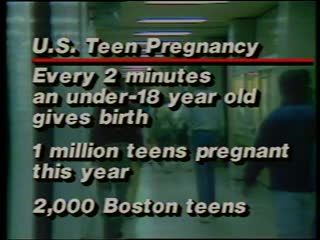
Description: FORUM ON URGENT NEED FOR SEX EDUCATION BECAUSE OF TEEN IGNORANCE. HIGH SCHOOL STUDENTS IN CORRIDORS AND ON STAIRWELLS. LAVAL WILSON. TEEN PREGNANCY. HEALTH CLINIC.
Collection: Ten O'Clock News
Date Created: 04/22/1987
Description: COMPARISON OF SEX EDUCATION AND ABORTION IN US AND BRITAIN. DOCTOR PERFORMING ABORTION. BILL BAIRD. Visuals of contraceptives: condoms in packets, diaphragm, birth control pills, vaginal suppositories.
Collection: Ten O'Clock News
Date Created: 04/27/1987
Description: SEX EDUCATION DISCUSSION IN A CATHOLIC HIGH SCHOOL CLASSROOM, PAROCHIAL STUDENTS
Collection: Ten O'Clock News
Date Created: 04/21/1985