Description: Mayor Ray Flynn holds a press conference in Roxbury to unveil plans for a new housing and commercial development to be built on a vacant lot in Douglass Square. The Boston Redevelopment Authority (BRA) cleared the land in the 1960s and never rebuilt on the lot. The owners and developers of the new project are African American. Flynn and City Councilor Bruce Bolling talk about the new development. Flynn says that all neighborhoods and all residents must share in the growth of the city. Bolling says that the proposal for the creation of Mandela, Massachusetts is a no longer an issue. Bolling and other Mandela opponents believe that the new development signifies a renewed commitment to the Roxbury neighborhood by the city of Boston.
1:00:10: Visual: Footage of Ray Flynn (Mayor of Boston) at an outdoor gathering in Roxbury. Flynn stands under a tent, addressing a crowd. Flynn talks about the vote against the proposal for the creation of Mandela, Massachusetts. Flynn says that the vote shows that the racial polarization of the city is in the past. Shot of the gathering from the back of the tent; of an architectural model. David Boeri reports that Flynn is advocating affordable housing and economic opportunity in every neighborhood. Boeri notes that Flynn unveiled a plan for a project in Douglass Square; that the Boston Redevelopment Authority (BRA) cleared a two-acre plot of land in Douglass Square in the 1960s; that the lot has been abandoned since then. V: Shot of a mural on the wall of a building in Douglass Square in Roxbury; of buildings in Douglass Square; of a vacant lot in Douglass Square; of architectural plans and an architectural model. Boeri reports that a housing and commercial complex is slated to be built on the vacant lot; that one-quarter of the units will be set aside for low-income housing. V: Footage of Bruce Bolling (Boston City Council) saying that the project addresses the need for economic re-investment in Roxbury. Boeri reports that the developers and owners of the project will be African American; that Bolling noted that Roxbury is becoming a full and equal partner in the city of Boston. V: Shots of African American crowd members; of an African American man standing beside an architectural drawing of the project. Footage of Bolling saying that the incorporation of minority neighborhoods into a new city is a dead issue. Boeri reports that Flynn had a unity breakfast with Roxbury leaders this morning; that Flynn pledged to make the city of opportunity for all. V: Shots of the crowd at the gathering. Footage of Flynn saying that all residents need to share in the city's growth and prosperity; that development of the downtown must be accompanied by development of the neighborhoods. Boeri stands in the vacant lot in Douglass Square. Boeri says that the lot has represented an empty promise by the city of Boston to the people of Roxbury. Boeri says that Bolling and other leaders fought the idea of secession from the city. Boeri adds that these leaders say that the plans for the new project are a signal that "their time has come."
Collection: Ten O'Clock News
Date Created: 11/05/1986
Description: State Senator Jack Backman opens a press conference in support of Mel King (Boston mayoral candidate) in front of the State House. Other participants include Byron Rushing (State Representative from the South End), Mary Jane Gibson (State Representative from Belmont), Susan Schur (State Representative from Newton), Mary Goode (former State Representative from Roxbury), and Barney Frank (US Congressman). Frank voices his support for King's candidacy and discusses the reasons for his endorsement, specifically, Frank talks about King's views on economic development and about his leadership abilities. Frank says that King is a creative leader who will bring "enlightened policy" to the city. Various reporters point out that Frank endorsed Dennis Kearney (candidate for mayor of Boston) in the primary elections. King arrives, shakes hands with Frank, thanks endorsers, and asserts that his administration will focus on employment, education, and the youth of the city.
1:00:10: Visual: Shot of a Mel King campaign sign. Jack Backman (State Senator) opens a press conference in front of the State House. He notes that Mel King (candidate for mayor of Boston) has not yet arrived. He voices his support for King. He introduces Byron Rushing (State Representative from the South End), Mary Jane Gibson (State Representative from Belmont), Susan Schur (State Representative from Newton), Mary Goode (former State Representative from Roxbury). Bachman lists off some state representatives who are due to arrive shortly at the press conference. Shots of Schur; of Rushing. Bachman introduces Barney Frank (US Congressman). 1:02:33: V: Frank says that he will support King for mayor of Boston; that he served with King for eight years in the legislature. Frank says that King is an advocate for enlightened policy for the city of Boston. Frank talks about King's ideas for economic development programs; about the Community Development Corporation. Frank says that King's ideas for development are in tune with the needs of city residents; that King is sensitive to the problems of displacement and the needs of area residents. Frank says that King can speak effectively on behalf of a diverse group of people; that King was an effective and respected legislator. Frank says that King will make an excellent mayor. A reporter asks Frank about his previous endorsements for mayor. Frank says that he is not always good at picking the winning candidate; that he speaks out on behalf of candidates who have good ideas and programs. A reporter notes that Frank endorsed Dennis Kearney (State Representative) in the primary election. He asks Frank how Kearney would have been a better mayor than King. Frank says that he endorsed Kearney in the primary because he thought Kearney was a good candidate with a good chance of winning. Frank says that Kearney and King take similar positions on the issues. Shot of King supporters standing behind Frank. Shot of Christy George (WGBH reporter). Audio is muffled. 1:07:45: V: Frank says that the many of the candidates in the race had similar positions on the issues; that King has helped shape the debate on the issues; that King was one of the first people to talk about the adverse effects of development on the elderly and the poor. Frank says that King is responsible for focusing the attention of the city on the management of economic development in a compassionate and effective manner. Frank says that he respects Ray Flynn (candidate for mayor of Boston); that King is more creative, thoughtful and consistent candidate; that King has proven himself to be an effective leader. Frank refuses to speculate on who he would have endorsed if King were not in the race. Frank says that he is endorsing a candidate because he is an elected official with an opinion; that he does not know what effect his endorsement has on a candidate's chances. A reporter asks Frank about the differences between King and Flynn. Frank says that the differences between the candidates stem from their past records; that King has proven himself to be a consistent and effective leader on economic issues for many years; that King has the capacity to stay with these issues. Frank notes that he does not agree with King on a mayor's role in foreign policy. A reporter asks Frank if King needs to highlight the issues on which he differs from Flynn. Frank says that King has stuck with the same issues for ten years; that his leadership has brought attention to these issues. Frank says that this has been a good mayoral campaign; that it has focused on issues. 1:13:15: V: Frank jokes with the reporters about his endorsement bringing in the voters from Brookline and Newton. A reporter asks Frank how King can get white liberal voters to support him instead of Flynn. Frank says that King can win voter support by focusing on the issues; that his positions on economic development may win over voters from traditionally "conservative" neighborhoods. A reporter asks Frank about his campaign advice for King. Frank says that King is doing the right thing by focusing on the issues; that King has proven his ability to be a leader on the issues. 1:16:32: V: King's supporters clap as he arrives at the State House. King and Frank shake hands. King thanks Frank and the assembled state representatives for their endorsements and support. King says that his administration will make the city open and accessible; that his administration will focus on employment, education, and the youth of the city.
Collection: Ten O'Clock News
Date Created: 10/21/1983
Description: GRACE ROMERO IN COURTROOM AND FOOTAGE FROM GRAVEYARD PRESS CONFERENCE
Collection: Ten O'Clock News
Date Created: 08/07/1985
Description: PRESS CONFERENCE ON GUN CONTROL
Collection: Ten O'Clock News
Date Created: 11/14/1985
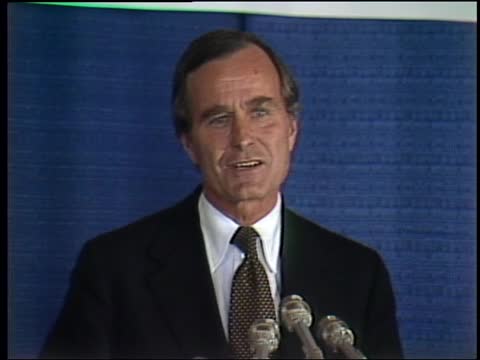
Description: George Bush as prospective presidential candidate at Logan Airport press conference. Introduced by William Saltonstall.
Collection: Ten O'Clock News
Date Created: 05/01/1979
Description: Marcus Jones reports that state and local officials have come through with funding for a multi-million dollar program to revitalize Grove Hall, which is Roxbury's business district. The area has experienced hard times since the late 1960s. Press conference to announce the revitalization program. City Councilor Charles Yancey and Mayor Ray Flynn talk about the program to revitalize the district. Jones walks through district while conducting an interview with Walter Little, the Executive Director of the Neighborhood Development Association of Grove Hall. Little talks about the revitalization program and the development of the area. Little notes that there is a high concentration of subsidized housing in the area. Little talks about the history of the area, noting that the district once had a large Jewish population. Jones notes that the revitalization program will benefit current and future residents of the area. Following the edited is additional footage from the press conference and Jones' interview with Little while walking through the Grove Hall District.
1:00:23: Visual: Footage of Charles Yancey (Boston City Council) at a ceremony to mark the revitalization of Grove Hall. Yancey says that the revitalized Grove Hall will develop into the best community in the city of Boston. Footage of Ray Flynn (Mayor of Boston) at the ceremony. Flynn says that the concerns of the Grove Hall community will no longer be ignored. Shots of the neighborhood; of signs for the Grove Hall Cafe and the Boston Legal Assistance Project. Marcus Jones reports that state and local officials have finally come through with a multi-million dollar program aimed at revitalizing Roxbury's business district. Jones notes that the area has experienced hard times ever since the riots which followed the assassination of Martin Luther King, Jr. (civil rights leader) in 1968. V: Shot of Jones in the Grove Hall district with Walter Little (Executive Director, Neighborhood Development Association of Grove Hall). Jones asks about a boarded up building on the street. Shot of a woman crossing the Street. Footage of Little standing with Jones. Little says that three tenants of one building have now become owners of the properties on the block. Little says that local residents must have the opportunity to participate in the ownership and development of a property. Shot of the streets in the area. Jones remarks that Little has lived in this area for forty years. V: Shot of a "No Trespassing" sign on a boarded-up building; of another boarded-up building. Footage of Little saying that the area has the largest concentration of subsidized housing of any area in the city; that there are 2800 subsidized units within the Grove Hall boundaries. Little says that economic balance is important to the survival of a commercial district. Little says that the small shops currently in the Grove Hall area are not enough to support a thriving commercial district. Little notes that many of the current businesses are fairly new to the area. Jones reports that Little remembers when there was a large Jewish population in the area; that Siegel's cafeteria was a popular restaurant in those days. V: Shot of Jones and Little walking on in the Grove Hall District, near a liquor store which once was Siegel's Cafeteria. Footage of Little saying that Siegel's Cafeteria closed in the early 1970s; that they were one of the last businesses to leave the area. Shot of the front of the liquor store; of two women walking on the street. Shot of a boarded-up apartment building. Jones reports that the revitalization plan aims to benefit the current and future residents of the Grove Hall area. V: Footage of Little saying that the money is available for the project; that buildings in the area will no longer be boarded up after the revitalization. Shot of Jones and Little on the street.
Collection: Ten O'Clock News
Date Created: 09/20/1988
Description: REFLECTIONS ON GARY HART'S COMPOSURE UNDER INTENSE, HOSTILE SCRUTINY. SOUND EFFECTS OF MANY CAMERA SHUTTERS CLICKING AT PC
Collection: Ten O'Clock News
Date Created: 05/07/1987
Description: GARY HART PRE-CANDIDACY PC AT HYATT ON KENNEDY, MONDALE, FUTURE, LIBERAL STANCE
Collection: Ten O'Clock News
Date Created: 12/02/1982
Description: RUPERT MURDOCH PC: HERALD PURCHASE & UNION NEGOTIATION AT LONG WHARF MARRIOTT
Collection: Ten O'Clock News
Date Created: 12/03/1982
Description: Hope Kelly reports that Reverend Graylan Hagler of the Church of the United Community has announced his candidacy for mayor of Boston. He says that it is time for a change in the city of Boston. His supporters cheer. Kelly reviews Hagler's credentials and career. She notes that Hagler has a confrontational style and is experienced in the art of political theater. Kelly reviews Hagler's recent political activities. Kelly's report includes footage of Hagler addressing striking hotel and restaurant workers in November of 1988 and footage of Hagler with unemployed construction workers at a press conference at a Roxbury construction site in December of 1990. Kelly's report also includes footage of Hagler denouncing racism on the part of city officials at a press conference in the wake of the Carol Stuart murder case. Kelly's report includes footage from an interview with Hagler in March of 1991. He says that he is seeking justice and equity in the city.
1:00:11: Visual: Footage of the Reverend Graylan Ellis-Hagler (Church of the United Community) announcing his candidacy for mayor of Boston. Ellis-Hagler says that it is time for change. The audience applauds. Shots of Ellis-Hagler supporters cheering. Hope Kelly reports that Ellis-Hagler's announcement was a rousing reminder that many residents of the city are ready for a change. V: Footage of Ellis-Hagler speaking to supporters. Ellis-Hagler says, "no more business as usual" and "no more disrespect." Kelly reports that Ellis-Hagler is a minister; that Ellis-Hagler was born in Baltimore and graduated from Oberlin College. Kelly reports that Ellis-Hagler listed many reasons why Ray Flynn (Mayor of Boston) should not be re-elected. V: Shots of Ellis-Hagler as he addresses the crowd. Shots of the audience. Footage of Ellis-Hagler addressing supporters. Ellis-Hagler says that streets in some neighborhoods have more trash-filled lots than houses. Ellis-Hagler says that the city is ready for a change. The audience applauds. Kelly reports that Ellis-Hagler says that his constituents are the ones who live on streets with vacant lots. Kelly reports that Ellis-Hagler believes that the city needs to hire more of its own residents instead of bringing in workers from outside. V: Footage of Ellis-Hagler addressing supporters. Ellis-Hagler says that many workers in the city come from towns outside of the city. Ellis-Hagler says that the city is ready for change. The audience applauds. Shot of Chuck Turner (teacher) holding up Ellis-Hagler's arm as he sits down after his speech. Kelly reports that Ellis-Hagler is experienced in the art of political theater; that Ellis-Hagler does not give in or give up quickly. V: Footage of Ellis-Hagler speaking to striking hotel and restaurant workers in November of 1988. Ellis-Hagler embraces Domenic Bozzotto (union leader). Footage of Ellis-Hagler at a press conference at a construction site in Dudley Square in December of 1990. Unemployed African-American construction workers stand behind him. Ellis-Hagler says that the workers will not "go away with crumbs." Shots of the construction site. Kelly reports that Ellis-Hagler was arrested twice last winter at the construction site of a new Post Office facility in Dudley Square. Kelly reports that Ellis-Hagler was supporting the cause of unemployed construction workers in his community. V: Footage of Ellis-Hagler being interviewed on March 13, 1991. Ellis-Hagler says that people must buck the system in order to stand up for their dignity and rights. Footage of Ellis-Hagler at a press conference about the Carol Stuart murder case in January of 1990. Ellis-Hagler compares the actions of city officials and the media to the actions of the Ku Klux Klan. Ellis-Hagler says that the African American and Latino communities have been "raped" by the police and the media. Shot of an audience member at the press conference holding a sign reading, "What do Boston and South Africa have in common? Stopping and detaining men because of the color of their skin." Kelly reports that Ellis-Hagler excoriated the police, the media, and the mayor after the murder of Carol Stuart (Reading resident). Kelly notes that Ellis-Hagler's style is confrontational. V: Footage of Ellis-Hagler being interviewed on March 13, 1991. Ellis-Hagler says that he has a desire to seek justice and equity in the city. Ellis-Hagler says that he wants the voices of all of the people to be heard. Kelly stands outside of a church. Kelly reports that Flynn' s campaign is following the actions of Ellis-Hagler; that Ellis-Hagler is short on money, but long on mission. V: Footage of Ellis-Hagler addressing his supporters. Ellis-Hagler says that he and his supporters will win. The audience applauds. Ellis-Hagler steps back from the microphone and greets Elizabeth Ellis-Hagler (wife of Graylan Ellis-Hagler). Another man speaks into the microphone.
Collection: Ten O'Clock News
Date Created: 05/01/1991