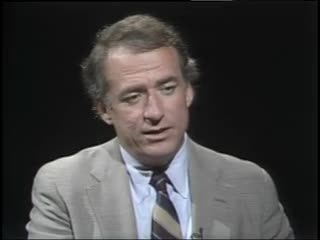
Description: CITY COUNCIL HEARING ON ARSON, RACISM. John White, George Paul, Fred Langone, Christopher Iannella, Michael McCormack, Ray Flynn, Joseph Tierney
Collection: Ten O'Clock News
Date Created: 10/26/1983
Description: MICHAEL DUKAKIS SPEAKS TO BOSTON COMMITTEE ON RACISM ABOUT ARSON AND RACISM
Collection: Ten O'Clock News
Date Created: 10/25/1983
Description: Gail Harris interviews Mel King (candidate for mayor). King discusses his reasons for running for mayor and talks about the issues he considers most important to the city's residents. King answers questions about how he would deal with the city's leaders, the city's power brokers and "the Vault." King talks about the importance of education and training. Harris and King discuss the changes in King's image and manner of dress. King notes the diversity within the African American community; he dismisses the idea of any one candidate receiving 100% of the vote in the African American community. King gives his opinion of Mel Miller (publisher of the The Bay State Banner), who is opposed to King's candidacy. King says that there is no Boston neighborhood in which he feels uncomfortable. King and Harris discuss how to keep racial issues out of the campaign; Harris and King discuss his boycott of an earlier campaign debate because it excluded some candidates. King talks about his goals for the city as mayor. After the interview, while shooting cutaways, King tells Harris about his book, Chain of Change. King talks about his hobbies and about the importance of organizing and empowering people. King gives his opinion of Kevin White (Mayor, City of Boston).
0:59:57: Visual: Gail Harris interviews Mel King (candidate for mayor). Harris asks King why he is running for mayor. King says that he has lived his whole life in Boston; that he understands the importance of public service; that it is important for the city to take care of its neediest citizens. King says that affordable housing, employment, health care, and education are important issues to many in the city. King says that some residents of Boston are living in unacceptable conditions; that families are living in overcrowded apartments; that some residents are isolated from the mainstream; that homelessness is a problem in the city. Harris asks King how he would deal with the city's leaders and power brokers and "The Vault." King says that he has worked with a cross-section of people in the city over the course of his career; that he worked with the Chamber of Commerce and the Chandler School to develop a training and placement program for women. King says that people are resources; that training can provide skilled workers for big corporations. King says that training is important; that school failure leads to street crime and juvenile delinquency; that lack of education and unemployment are at the root of most social problems. 1:06:20: V: Harris comments that King has changed his look; that he no longer wears a dashiki. King says that he has not changed his position on the issues; that his clothing is not relevant to his ideas. Harris asks if it is possible to get 100% of the vote in the African American community. She notes that the African American community is very diverse. King agrees that the African American community is very diverse. He says that he resents those who say that he needs to get 100% of the African American vote; that no white candidate is assumed to need 100% of the white vote. King says that a racism leads voters to look at the color of his skin instead of his record and his position on the issues. Harris asks what King thinks of Mel Miller (publisher of the The Bay State Banner), who says that the African American community should offer their support to a strong candidate who can support them after becoming mayor. King says that no one pays a lot of attention to Miller; that Miller is opposed to the ERA. King says that African Americans need to fight for what they want and support one another; that Miller has a negative view of white people; that Miller's influence is destructive to the African American community. Harris asks King if there are any parts of the city in which he feels uncomfortable. King says that there is no part of the city in which he is uncomfortable; that he wants to bring the city together; that he wants to reach out to people who disagree with him on the issues. King says that people must be brought together around common issues like employment and improvements to the schools and the city. Harris asks how King would prevent racial issues from entering the campaign, especially if he found himself in a runoff with David Finnegan (candidate for mayor) or Ray Flynn (candidate for mayor). King says that his previous campaigns for public office have always focused on issues; that the diversity of his campaign workers has earned his campaign the nickname of "the rainbow campaign." 1:14:21: V: Harris asks King if he regrets boycotting an earlier campaign debate because two other candidates were not invited to participate. King says that he has no regrets; that candidates must practice the "politics of inclusion." King notes that it is hypocritical for a candidate to promote equal access for all, and then to take part in a public forum which excludes the voices of some. Harris asks him about what he could accomplish as mayor. King says that he could affect real change in the city; that he would concentrate on reducing crime and fighting drugs; that he would appoint a new police commissioner to work with the community and to root out problems in the police force. King says that Joseph Jordan (Police Commissioner, City of Boston) learned about the problems on Sonoma Street by watching television; that the city needs a commissioner who can mobilize the force to fight crime; that Jordan allowed the mayor to use the police force as a political tool in the debates on Proposition 2 1/2 and the Tregor Bill. King says that he would investigate corruption through an audit of the city's programs; that the government needs to make sure that good services are being provided. King notes that the city government must spend the citizen's tax dollars wisely. King says that new resources must be spent for improvements at Boston City Hospital; that some employees at the hospital qualify for public assistance because their salaries are so low. Harris asks King if he would campaign for mayor even if he knew there was no chance of victory. King says that he has many forums through which to promote his ideas; that he has published a book recently. King says that he would not run if he didn't think he could win; that he would not want to waste his own time and valuable time and money of others; that he thinks he can win and effect real change in the city. 1:20:55: V: Harris thanks King and closes the interview. The crew takes cutaway shots of Harris and King. King tells Harris about his book, Chain of Change. King talks about his hobbies. King talks about the importance of organizing and empowering people. He talks about organizing tenants through the Symphony Tenants Organizing Project. Harris tells King about her impressions of Boston politics. She mentions Kevin White (Mayor of Boston) and Clarence Jones (former Deputy Mayor of Boston). King says that he did not support White in 1975 or 1979; that White has taken the African American vote for granted; that White has not delivered services to the African American community.
Collection: Ten O'Clock News
Date Created: 09/19/1983
Description: Interview with Robert Kiley as Boston mayoral candidate. Formerly deputy mayor, MBTA manager, CIA bureaucrat. Makes fighting racism a priority.
Collection: Ten O'Clock News
Date Created: 09/16/1983
Description: Christopher Lydon and Gail Harris host The Ten O'Clock News Election Night Special with in-studio guests Dennis Kearney (Suffolk County Sheriff), Dr. Alvin Poussaint (Harvard Medical School), Kirk Scharfenberg (The Boston Globe) and Michael Rezendes (The Boston Phoenix). Lydon, Harris and the guests analyze the voting results. Lydon calls the Flynn victory a "landslide." Poussaint talks about "ethnic voting" in the white precincts. Lydon and Harris read the news headlines. Harris reports on an agreement between WGBH and the Massachusetts House of Representatives, which allows WGBH to broadcast live coverage of House proceedings. A panel discusses Ray Flynn's victory over Mel King in Boston's mayoral elections Lydon, Harris and the in-studio guests talk about Flynn's victory. The guests discuss how Flynn will reach out to the African American community and how Flynn will deal with the business community. Scharfenberg notes that Flynn will need to appoint non-whites to some high-level positions in his administration. Rezendes criticizes the King campaign for not spending enough money on media advertising. The guests debate the role of race in the campaign. Poussaint believes that many white voters were frightened of King's appearance. The guests talk about whether the media downplayed racial issues during the campaign. They speculate about whether another African American candidate would have fared better than King.
0:59:59: The logo of The Ten O'Clock News underwriter New England Telephone is displayed. Gail Harris announces that Ray Flynn (candidate for mayor of Boston) has won the mayoral election. Visual: Shots of Flynn with his family; of campaign workers holding signs for Flynn and Mel King (candidate for mayor of Boston). The Ten O'Clock News logo. Christopher Lydon reports that Flynn received overwhelming support from the more conservative precincts of the city. Gail Harris talks about an upcoming report on the King campaign. Lydon asks in-studio guest Dennis Kearney (Suffolk County Sheriff) about the Flynn "landslide." Kearney says that the Flynn margin of victory was higher than expected. Kearney analyzes the Flynn victory. Kearney says that Flynn has been successful in cutting into King's base of support. Harris asks Dr. Alvin Poussaint (Harvard Medical School) if a more charismatic African American politician could have won the election. Poussaint cites the "ethnic voting" in some of Boston's white precincts. Poussaint says that any African American politician would have had difficulty overcoming the barrier of "ethnic voting"; that King ran a good campaign. Lydon asks Kirk Scharfenberg (The Boston Globe) how the Flynn administration will differ from the administration of Kevin White (Mayor of Boston). Scharfenberg says that Flynn will proceed slowly; that Flynn will put emphasis on the neighborhoods, on schools and on public housing. Harris asks Michael Rezendes (The Boston Phoenix) about complaints by the King campaign that the media focused too much on the similarities between the candidates. Rezendes says that the complaints are unjustified; that King chose not to use the media in his campaign; that there are indeed similarities between King and Flynn. 1:05:21: Report on the winning lottery numbers in Massachusetts, New Hampshire, and Rhode Island. WGBH promotion for the Sesame Street special, Don't Eat the Pictures. 1:06:23: Lydon and Harris read the news headlines. Lydon reports on protests in Great Britain against the shipment of nuclear missiles from the US into Great Britain. V: Shot of a US transport plane; of student protesters throwing red paint at Michael Heseltine (British defense minister). Shots of protesters outside of the British Parliament building. Lydon reports that the Geneva talks on the deployment of cruise missiles broke up when the Soviet delegation walked out. Harris reports on the murder of George Tsantes (US naval attache) by a terrorist in Athens, Greece. V: Shots of the car in which Tsantes was driving at the time of the murder. Harris reports on an escalation of tension between Greece and Turkey stemming from a declaration of independence by Turkish northern Cyprus. Harris reports on fierce fighting around a refugee camp in northern Lebanon between Yasser Arafat's supporters and PLO (Palestine Liberation Organization) dissidents. V: Shots of troops under fire at the Lebanese refugee camp. Lydon and Harris read the national news headlines. Lydon reports that on the death of a renewed ERA (Equal Rights Amendment) bill in Congress; that the debate centered on abortion rights and women in military combat. Lydon reports on the end of a strike by Greyhound bus drivers. Harris reports on an agreement between the Massachusetts House of Representatives and WGBH-TV to broadcast live, "gavel to gavel" coverage of floor debate in the House of Representatives. V: Footage of the signing of the agreement by David Ives (President, WGBH) and Thomas McGee (Speaker, Massachusetts House of Representatives). Footage of McGee talking about the benefits of the live coverage to Massachusetts residents. 1:09:59: Lydon gives the weather report. WGBH promotion for An Evening of Championship Skating. 1:11:13: Lydon opens a general discussion on the future Flynn administration with the in-studio guests. Scharfenberg talks about Flynn's progression from conservative candidate to liberal candidate. Kearney talks about the diverse coalition supporting his candidacy. Kearney questions how Flynn will deal with those competing interests as mayor. Lydon comments that Flynn is a progressive candidate with a fairly conservative constituency. Poussaint asks how Flynn will deal with racial issues. Kearney says that Flynn will be able to reach out to the African American community because he is a populist. Rezendes says that it is crucial for the next mayor to reach out to the African American community. Poussaint notes that Flynn won the election with little African American support; that Flynn might not feel as if he has to reach out to African Americans. Scharfenberg comments that Flynn will be tested by the imminent desegregation of housing projects in Charlestown. Lydon asks if there is a position for King in the Flynn administration. Scharfenberg says that he sees King in a volunteer position, but not as a paid employee. Poussaint asks how Flynn will involve the larger African American community in his administration. Kearney says that Flynn will reach out to African Americans. Harris asks how Flynn will deal with the downtown business community. Rezendes says that Flynn will face a great challenge in dealing with the city's economic crisis. Lydon asks if Flynn bears comparison to Dennis Kucinich (former mayor of Cleveland). Scharfenberg says that Flynn bears no comparison to Kucinich. Rezendes says that Flynn will bend to the pressure of the business community; that he may disappoint his liberal supporters. Kearney says that Flynn will have to balance the needs of competing interests in the city. 1:20:33: Stock report: the Dow Jones average is shown at 1,247.97; the volume of the New York Exchange is shown at 77,840,000. 1:20:54: Lydon asks about desegregation of public housing in Charlestown and other racial issues. Scharfenberg talks about the need for Flynn to appoint non-whites to high-level positions in his administration. Lydon asks how the King campaign could have been more successful. Rezendes says that the King campaign made a mistake in imposing a spending cap of $150,000; that King was not able to get his message out through television ads. Kearney says that King has done most of his work in the South End; that Flynn has come into contact with voters city-wide through his election to the Boston City Council. Poussaint notes that white voters see King as a "radical;" that many voters are frightened by his appearance as a tall, bald, bearded African American man. Kearney notes that there were "anti-Semitic" comments from King before the election. Poussaint says that the media have been playing down racial issues in the campaign; that some white voters would not vote for Mel King because he is African American. Harris asks if the race question was played down by the media because of the lack of racial tension between the two candidates. Harris asks if the city has not been given "too much credit" in overlooking the race of King. Kearney says that voters were not afraid of King's appearance at a debate in South Boston before the primary election. Lydon notes that many white voters were not given a chance to see beyond the stereotype of King as a "radical." Rezendes says that there is no denying the role played by race in the election. Rezendes adds that King's "radical" statements about Fidel Castro (leader of Cuba) and Yasser Arafat (PLO leader) prevented him from reaching conservative white voters. Scharfenberg says that another African American candidate may have fared better than King. Scharfenberg notes the John O'Bryant (Boston School Committee) is running first in the race for seats on the Boston School Committee. Poussaint wonders if King's defeat will affect the outcome of other city electoral races involving African American candidates. Lydon notes that King received more than 20% of the white vote. Lydon asks if the results will affect Boston's national reputation as a racist city. Kearney says that there was an air of conciliation rather than confrontation during the campaign; that the city has moved forward. 1:28:54: Lydon and Harris thank the in-studio guests and close the show. End credits roll. The logos of The Ten O'Clock News underwriters New England Telephone and Shawmut Brokerage Services are displayed.
Collection: Ten O'Clock News
Date Created: 11/15/1983
Description: Andrew Young (Mayor of Atlanta) endorses Mel King (candidate for Mayor of Boston) at a press conference at Northeastern University. Jim King (Senior Vice President, Northeastern University) introduces Young. Young talks about King's candidacy for mayor of Boston. King says that he and Young have discussed ideas for local job creation and for trade between local businesses and third world markets. In response to audience questions, Young talks about his recommendation that King set up a trade mission to export local manufactured goods. King discusses the value of his endorsement of King and the differences among the political situations in Boston, Chicago, and Philadelphia. Young says that he does not consider Boston to be a racist city. Young talks about the potential impact of the African American community on the election outcome. Young refuses to comment on the the presidential campaign of Jesse Jackson.
1:00:06: Visual: Andrew Young (Mayor of Atlanta) walks sits down at a table next to Mel King (candidate for Mayor of Boston). Mel King's campaign signs are visible on the walls of the room. Behind King and Young is a Northeastern University flag. A young African American woman announces that Young and "future mayor" Mel King will speak; that they will take questions after. Jim King (Senior Vice President, Northeastern University) introduces Young. He reviews Young's accomplishments. Shots of the audience. Young says that King's leadership will benefit Boston. Young talks about the importance of housing and neighborhood revitalization. Young says that King will work to reduce unemployment; that King will work with existing businesses and help to build new businesses. Young says that King is familiar with urban problems. Young commends King for his strong marriage, his family, and his values. 1:03:33: V: King calls Young "Mayor Class." King says that Young is one of the classiest politicians in the world; that Young has a world view which allows him make connections between his city and events in the greater world. King says that he and Young discussed how to create jobs in Boston; that Young has given him advice on how to unlock third world markets; that the city can help neighborhoods and businesses take advantages of these markets to create jobs. King thanks Young for coming to Boston. The audience applauds. 1:05:53: V: The audience asks questions. An audience member asks Young about his experiences as the Mayor of Atlanta. Young says that it is "fun" to solve local problems. Young says that he has recommended that King set up an export trading company to help export the city's manufactured goods. Young talks about trade missions that he has undertaken as Mayor of Atlanta. Young says that he has gone on trade missions to Trinidad and Jamaica, and is planning a trade mission to Nigeria. Young talks about how trade missions can benefit local businesses and industry. Young says that he and Henry Cisneros (Mayor of San Antonio) share the leadership of a task force for the National League of Cities; that mayors can create jobs by promoting international opportunities for local industry. Young says that Boston could export many products; that King is concerned about creating jobs through exports. Young says that he appointed a woman as Deputy Chief of Police in Atlanta; that her appointment heightened awareness of crimes against women in the city. Young says that it is important for a mayor to be responsive to problems of those who have been ignored; that King will be responsive. 1:09:59: V: An audience member asks Young about the value of his endorsement of King. Young says that Boston needs a good mayor; that he does not judge Boston to be a racist city on the basis of the actions of a few "hoodlums"; that there are voters who will elect King on the basis of his values and his positions on unemployment and crime; that skin color is not important. Young says that he is here as an urban mayor to remind people about important urban issues; that he is able to get television exposure for King. The audience applauds. An audience member asks Young about similarities in the political situations in Boston, Chicago and Philadelphia. Young says that there are few similarities; that there was a "revolution" against the mayor in Chicago; that there is more racial antagonism in Chicago than there is in Boston. Young says that Wilson Goode (candidate for Mayor of Philadelphia) will be elected because of his experience and broad support. Young says that he hopes King will emerge with broad support in Boston. Young refers to Boston's revolutionary history, saying that he hopes the city will rally around King. 1:14:11: V: An audience member points out that Boston has a small African American community with a record of low voter turnout. Young uses the example of Los Angeles as a city with a small minority population and a popularly elected African American mayor. An audience member asks Young to speculate on the chances of Jesse Jackson (African American political leader) being elected to the presidency. Young says that it is too soon to speculate on anyone's campaign for the presidency. 1:16:23: V: Young answers more questions from the audience. Shots of Young from behind the audience and media; of members of the audience. Audio cuts in and out during this segment. Young talks about the need for "open and honest" government and a good relationship with the press. King answers a question about his campaign. The moderator announces an end to the press conference. 1:18:45: V: Young and King greet members of the audience and the media.
Collection: Ten O'Clock News
Date Created: 09/22/1983