Description: B-roll footage of African American and white students at work in the pottery studio at English High School. Footage of an African American teacher teaching a history class at English High School. The class discusses social unrest in the 1960s and government efforts to fight poverty. Footage of students passing through a hallway and using escalators at English High School. Exteriors of English High School. Several takes of reporter standup on a new code of discipline that Judge Arthur Garrity has called for in the Boston City Schools. School suspension guidelines have been called into question because minority students are given suspensions more frequently than white students.
1:00:01: Visual: African American and white students work in the pottery studio at English High School. Students mold clay, work on the pottery wheel and paint their finished projects. Students work on a large art project on a table. Shots of projects, including ceramic block letters. 1:04:16: V: An African American teacher teaches a history class at English High School. The students are seated at small tables, facing the blackboard. The class discusses social unrest in the 1960s and government efforts to fight poverty. Shots of African American and white students in the class. 1:09:09: V: African American and white students pass through a hallway at English High School. Students use the escalators to move in between floors. Shots of students and teachers riding escalator. Students move through the hallway. 1:11:39: V: Shots of the exterior of English High School on Avenue Louis Pasteur; of the courtyard outside of the school; of the multi-story building. Sharon Stevens reports on a new code of discipline for Boston Public School students, called for by Judge Arthur Garrity (federal court judge). Stevens reports that school suspension guidelines have been called into question; that minority students were given suspensions more frequently than white students. Stevens reports that the Boston School Committee is scheduled to vote next week on the new code of discipline. Stevens does several takes of the introduction and ending to her report. Shots of the exterior of English High School; of student baseball players standing in the courtyard of the school; of a group of African American students exiting the school.
Collection: Ten O'Clock News
Date Created: 05/18/1980
Description: BOSTON LATIN SCHOOL HEADMASTER MICHAEL CONTOMPASIS TAKES LEAVE OF ABSENCE
Collection: Ten O'Clock News
Date Created: 07/21/1986
Description: Hope Kelly reports that Superintendent Laval Wilson proposed a set of reforms to improve the Boston Public Schools in the beginning of his tenure as superintendent. Kelly reviews Wilson's proposals for school reforms and notes that the programs were backed by the Boston School Committee. Kelly's report includes footage of Wilson in 1985 and footage of Wilson announcing his school reform package. The Boston School Committee has recently cut Wilson's budget by $8.5 million. Kelly reviews the budget cuts. Interviews with John Nucci (Boston School Committee), Sam Tyler (Boston Municipal Research Bureau), and Ellen Guiney (Educational Advisor to Mayor Flynn) about the budget cuts. Kelly reviews the budget figures for municipal spending on education from 1984 to 1989 and budget figures for overall city spending from 1986 to 1988. Kelly notes that the city's spending on education has greatly increased from 1984. She notes that critics believe that the School Department is not spending its money wisely. Kelly reports that the city will need to curb its spending in the next few years due to the absence of budget surpluses. Kelly's report is accompanied by footage of students in the Boston Public Schools.
1:00:19: Visual: Footage of Dr. Laval Wilson (Superintendent, Boston Public Schools) being interviewed by the Boston School Committee for the position of superintendent of schools on July 19, 1985. Wilson says that his goal is to convince the members of the Boston School Committee that he is the best candidate for the position. Hope Kelly reports that Wilson took over the Boston Public School System at a time when the average graduating senior reads at a seventh-grade level. Kelly notes that the average drop-out rate is 43%. V: Shots of high school students outside of a high school; of students descending a stairs in a school building. Kelly notes that Wilson approached the job with determination. V: Footage of Wilson saying that his goal is to lift the educational level of the students coming out of the Boston public school system. On-screen text and visuals detail the specifics of Wilson's proposed educational programs. Kelly reports that Wilson proposed a set of reforms called the Boston Education Plan. Kelly notes that Wilson proposed a $3.1 million dollar program for after-school remedial reading; that Wilson proposed a $1.3 million program to standardize remedial reading programs city-wide. Kelly notes that the School Committee backed Wilson's programs when he arrived. Kelly reports that the School Committee cut Wilson's budget by $8.5 million on Wednesday. V: On-screen text detail the specifics of the budget cuts. Kelly reports that Wilson proposed a budget of $364.6 million; that the School Committee cut his budget to $355.9 million; that Ray Flynn (Mayor of Boston) has refused to spend more than $350.0 million on the school budget. V: Shot of Flynn talking to reporters. Footage of John Nucci (President, Boston School Committee) saying that the city administration does not understand the impact of its cuts to the school budget. Kelly reports that Sam Tyler (Boston Municipal Research Bureau) runs an agency which monitors city spending. V: Footage of Tyler being interviewed by Kelly. Tyler says that city officials were thinking about the future when they asked the School Department to keep its spending to within $350 million. Tyler says that the superintendent cannot introduce new programs and expect them all to be funded. Footage of Ellen Guiney (Flynn's Education Advisor) being interviewed by Kelly. Guiney says that $350 million is what the city can afford to spend on education. On-screen text and visuals detail the city of Boston's spending on education from 1984 to 1989. Kelly reports that the city has increased its spending on schools from $245 million in 1984 to $341.1 million in 1989. V: Footage of Guiney says that some city officials in other departments think that the School Department already receives too much money. Kelly reports that some critics wonder if the School Department is spending its money wisely. V: Shot of two elementary-school students in front of a computer terminal. Footage of Tyler saying that the school system has improved. Kelly reports that Nucci points to a 1% decrease in the drop-out rate. Kelly notes that Guiney points to improved teacher salaries and more teachers; that Guiney admits that there have been few actual performance gains by students. V: Shot of Nucci; of Guiney; of a white male teacher in a classroom. Footage of Guiney saying that she would have liked to have seen greater improvements in the last five years. Shot of an African American girl coloring a picture in a classroom. Kelly reports that spending by the city has risen overall in the past five years. V: On-screen text compares the rise in city spending to the rise in school spending from 1986 to 1988. Kelly reports that city spending has risen 34% since 1986; that school spending has risen 23% since 1986. Kelly stands in front of the offices of the Boston School Committee. Kelly reports that the city had surpluses from 1986 to 1988; that it is less certain that surpluses will exist in future city budgets. V: Footage of Tyler saying that the city needs to put a brake on its spending. Shot of elementary school students entering a classroom.
Collection: Ten O'Clock News
Date Created: 05/06/1988
Description: Marcus Jones reports that a shrinking school budget may force teacher layoffs in the Boston Public School System, and a final federal court order may require layoffs to be based on affirmative action quotas instead of union seniority. White teachers with seniority are at odds with newer minority teachers. Members of the Boston Teachers Union picketing outside of the Boston School Department. The president of Concerned Black Teachers of Boston, Robert Marshall, speaks at a press conference. Marshall says that seniority is a biased and discriminatory criterion for determining layoffs. Interview with Boston Teachers Union President Edward Doherty, who says that more minority teachers must be hired. He adds that affirmative action quotas should not force white teachers out of their jobs. At a Boston School Committee meeting Antonieta Gimeno, a parent, tells the School Committee that Haitian, Asian, Cape Verdean, and African students find no reflection of their heritages in the school curriculum or in the school faculty. The federal court withdrew from supervision over the Boston Public schools last month, but deep-seated racial problems still plague the system.
1:00:10: Visual: Footage of teachers picketing in front of the headquarters of the Boston School Department at 26 Court Street. Teachers hold signs reading, "No layoffs." Shots of individual teachers in the picket lines. Marcus Jones reports that the federal court no longer oversees the operation of the Boston Public School System; that the teachers have a new contract which includes a salary increase and more input into decisions affecting the schools. Jones notes that Dr. Laval Wilson (former Superintendent, Boston Public Schools) has left the school system. Jones reports that the Boston Public School System is still underfunded and racially divided. V: Shot of Joseph McDonough (Interim Superintendent, Boston Public Schools) walking to his seat at the front of the Boston School Committee chambers. Footage of Edward Doherty (President, Boston Teachers Union) standing in front of the School Department headquarters. Doherty says that next year will be difficult unless teacher lay-offs can be avoided. Shots of teachers picketing the School Department headquarters. Jones reports that more than 150 teachers may be laid off this summer; that the city of Boston has refused to grant McDonough's $409 million budget request. Jones notes that Ray Flynn (Mayor of Boston) has said that the schools must make do with a budget request of $400 million. Jones reports that the final federal court orders require lay-offs to be based on affirmative action quotas instead of union seniority. Jones notes that white teachers with seniority are at odds with newer minority teachers. V: Shot of Robert Marshall (President, Concerned Black Teachers of Boston) holding a press conference. Supporters stand behind him. Shot of teachers unfurling a union banner in front of the School Department headquarters. Footage of Marshall speaking at the press conference. Marshall says that minority teachers and progressive white teachers have urged the Boston Teachers Union not to appeal the federal court orders. Marshall accuses the Boston Teachers Union of racism. Marshall says that the Boston Teachers Union continues to defend seniority; that seniority has been ruled to be a biased and discriminatory criterion. Footage of Doherty being interviewed by Jones outside of the School Department headquarters. Doherty says that more minority teachers must be hired; that white teachers should not be forced out of their jobs by affirmative action quotas. Doherty says that minority teachers should look at the unfairness of the situation. Footage of Antonieta Gimeno (parent) standing with other parents at the front of the Boston School Committee chambers. Members of the Boston School Committee are seated in their seats at the front of the chambers. Gimeno says that the parents have come to protest the School Committee meeting. Gimeno holds up a sign reading, "We demand excellence for all children." The audience applauds Gimeno. Gimeno says that School Committee meetings are a "mockery" and an "insult" to the intelligence of community members. Shots of one of the parents at the front of the chambers with Gimeno. Jones reports that disgruntled parents aired their grievances before today's School Committee meeting. V: Footage of Gimeno saying that Haitian, Asian, Cape Verdean, and African students find no reflection of their heritages in the school curriculum or in the school faculty. Jones stands outside the chambers of the Boston School Committee. Jones reports that the federal court closed the books on school desegregation in Boston last month; that there remain deep-seated racial problems in the system. Jones reports that there may be a court battle concerning faculty desegregation in Boston Public Schools.
Collection: Ten O'Clock News
Date Created: 06/19/1990
Description: CLASSROOMS, STUDENTS, INTERVIEW WITH CHELSEA PRINCIPAL
Collection: Ten O'Clock News
Date Created: 04/30/1985
Description: Meg Vaillancourt reports that the Boston City Council has delayed voting on the school reform package proposed by Mayor Ray Flynn, which includes a home rule petition that transfers decision-making power from the Boston School Committee to the superintendent of schools. Reverend Bruce Wall of the Twelfth Baptist Church delivers an invocation before a City Council meeting, presided over by President Bruce Bolling. Some councilors, including Dapper O'Neil, are opposed to the plan. O'Neil criticizes the plan because it gives too much power to the superintendent. Jim Kelly and Joseph Tierney also speak at the meeting. Critics accuse the Boston City Council of delaying their vote on the proposal in order to garner media attention. Interview with Boston School Committee member John Nucci. Vaillancourt notes that school reform is an important issue for voters. Shots of a newspaper article criticizing the City Council. Interview with City Councilor Christopher Ianella, who says that the councilors are practicing "the art of politics" and that they will eventually vote in favor of the proposal. This edition of the Ten O'Clock News also included the following item: Callie Crossley reports on a proposal to allow for AIDS testing by insurance companies
1:00:01: Visual: Footage of Reverend Bruce Wall (Twelfth Baptist Church) delivering an invocation before a meeting of the Boston City Council in the City Council Chambers. City Councillors Charles Yancey and Bruce Bolling stand behind him. Shots of the City Councillors in the Chambers. Bruce Bolling presides over the meeting. The other councillors sit behind desks. Meg Vaillancourt reports that the Boston City Council met to consider the school reform package proposed by Ray Flynn (Mayor of Boston). Vaillancourt notes that the package includes the home rule petition, which is the "cornerstone" of school reform in Boston. V: Footage of Dapper O'Neil (Boston City Council) saying that the Boston School Commitee is "crucifying the teachers"; that the School Committee is giving too much power to the superintendent. O'Neill compares Wilson's power to that of Adolph Hitler. O'Neil says that he will never vote for the school reform package. Vaillancourt reports that O'Neil was the only City Councillor to say that he would vote against the package; that consensus is never easy in an election year. V: Shot of the stenographer in the center of the Chambers. Footage of James Kelly (Boston City Council) saying that there is no rush to vote on the home rule petition; that the state legislature will not meet to approve the petition until September. Vaillancourt reports that most City Councillors agree with the petition; that the petition transfers power from the School Committee to the superintendent. V: Shots of a School Committee meeting in session. Vaillancourt reports that the School Committee has agreed to share power; that the proposal to allow Wilson to make personnel decisions has strong backing in the business community. Vaillancourt notes that Flynn's proposal includes changes suggested by councillors; that Boston newspapers called the councillors' suggested changes "absurd." V: Shots of the City Council meeting; of a newspaper editorial with a headline reading, "Games Councillors Play." Vaillancourt reports from outside of the City Council Chambers. Vaillancourt reports that the City Council delayed voting on the package; that the Council referred the school reform package to its Education Committee for review. Vaillancourt notes that the Council objected to the package last week. Vaillancourt speculates that the Council did not want to appear to back down from their objections by approving the package; that the Council did not want to open themselves up to criticism by rejecting the package. V: Footage of Bolling preciding over a vote in the Coucil Chambers. Shot of Joseph Tierney (Boston City Council) addressing the Council. Vaillancourt reports that politics may be behind the City Council's delay. Vaillancourt adds that school reform is the focus of Tierney's mayoral campaign. V: Footage of Tierney saying that he will not vote in favor of the package until he has the opportunity to make an "intelligent, informed vote." Footage of John Nucci (President, Boston School Committee) saying that the City Council is delaying on the issue in order to garner attention from the media. Vaillancourt speculates that Nucci is correct; that school reform is a major issue for voters; that most City Councillors will probably endorse the plan. V: Shot of students playing ring-around-the rosey at the Jackson Mann Elementary School. Footage of Christopher Ianella (Boston City Council) being interviewed by Vaillancourt. Ianella says that Councillors are practicing the "art of politics"; that the vote will eventually come out in favor of the package.
Collection: Ten O'Clock News
Date Created: 08/03/1987
Description: Christopher Lydon reports on a controversy over the distribution of contraception in schools. Lydon notes that the Adolescent Issues Task Force of the Boston School Department has recommended that birth control be distributed to students as part of a comprehensive adolescent health program in the city's middle schools and high schools. Lydon's report includes footage of an NAACP press conference with Jack E. Robinson (President, Boston chapter of the NAACP), Joseph Casper (member, Boston School Committee), and Grace Romero (NAACP board member). Robinson and Casper condemn the proposal as racist. Robinson says that the initiative targets African American students. Lydon's report includes footage from interviews with Hubie Jones (member, Adolescent Issues Task Force), Dr. Howard Spivak (member Adolescent Issues Task Force) and Dr. Deborah Prothrow-Stith (Chairwoman, Adolescent Issues Task Force). Jones, Spivak and Prothrow-Stith defend the proposal. Spivak and Prothrow-Stith discuss statistics relating to teen pregnancy. Lydon's report also features interviews with students about teen pregnancy and footage of students in schools.
1:00:11: Visual: Footage of an African American woman saying that she knows "what is going on" with teenagers from listening to them talk. Christopher Lydon reports that teenagers are starting to have sex at an early age. V: Footage of Dr. Howard Spivak (member, Adolescent Issues Task Force) saying that he is alarmed at the numbers of teenagers who are having sex. Spivack says that 25% of teenage girls are sexually active before the age of 15. Footage of Dr. Deborah Prothow-Stith (Chairwoman, Adolescent Issues Task Force) saying that one million girls under the age of nineteen become pregnant each year; that 600,000 of those girls give birth. Prothow-Stith says that teenage pregnancy has become an epidemic. Footage of Spivak quoting a statistic which predicts that 40% of fourteen-year olds will become pregnant before their twentieth birthday. Shot of teenage girls descending a staircase at a school. Lydon reports that the Boston School Department's Adolescent Issues Task Force is recommending the distribution of birth control as part of a comprehensive adolescent health program at Boston's middle schools and high schools. V: Shot of a collection of diaphragms in a health clinic. Shot of a clinic worker and a teenage girl at a school health clinic. Lydon reports that the proposal has been heavily criticized. V: Shot of the street outside of the Boston NAACP office. Footage of Jack E. Robinson (President, Boston chapter of the NAACP) at a press conference. Robinson says that the NAACP is opposed to the distribution of birth control in school health clinics. Joseph Casper (member, Boston School Committee) and Grace Romero (former member, Boston School Committee and NAACP board member) stand beside Robinson at the press conference. Lydon points out that Casper and Romero are unlikely allies for Robinson. V: Footage of Robinson saying that the plan introduces sexual devices into the schools under the guise of a health initiative. Robinson says that African American schools and school districts are the targets of these plans; that the plans are a form of "social engineering." Lydon notes that Robinson believes the proposal to be "insidiously racist." V: Footage of Hubie Jones (member, Adolescent Issues Task Force) saying that the proposal has nothing to do with race. Footage of Casper saying that the proposal targets inner city students; that there are no proposals to distribute birth control among white suburban students. Casper says that "something is afoot." Footage of Jones saying that it is genocidal to allow large numbers of African American teenage girls to become pregnant. Lydon reports that Jones sees the proposal as a "regrettable necessity," needed to combat the incidence of pregnancy in young girls. V: Shots of teenage students in a study hall. Footage of Prothow-Stith saying that the Task Force is concerned about the increase of pregnancies among girls aged ten to fourteen. Footage of a young African American male student saying that a lot of teenage girls are pregnant; of a young Hispanic male student saying that he knows a girl in ninth-grade with a child. Footage of another African American male student saying that he knows a thirteen-year old girl who became pregnant; that the girl has dropped out of school. Footage of a white female student saying that she knows eighth grade girls who are pregnant; that it is wrong for young girls to be pregnant. Shots of students outside of a school. Lydon says that everyone seems to agree that young girls should not be pregnant.
Collection: Ten O'Clock News
Date Created: 09/08/1986
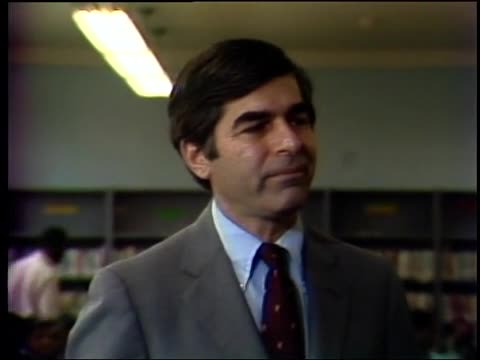
Description: MICHAEL DUKAKIS AT TIMILTY SCHOOL, WITH TEACHERS, PRINCIPAL, SCHOOL COMMITTEE MEMBERS, press conference
Collection: Ten O'Clock News
Date Created: 10/21/1982
Description: Laval Wilson & Robert Schwartz announce reduced superintendent's staff and shift to school-based management. Decentralization. John O'Bryant, Peggy Davis-Mullen.School Committee hq 26 Court Street.
Collection: Ten O'Clock News
Date Created: 05/25/1989
Description: The Boston School Committee holds a meeting in the School Committee chambers. Members of the School Committee discuss school business. John O'Bryant (Boston School Committee) reports on the need for school repairs; Robert Spillane (Superintendent, Boston Public Schools) reports on staffing issues. Sharon Stevens (WGBH reporter) interviews Kathleen Kelly (President, Boston Teachers Union) about a proposed school choice plan. Kelly says that many parents support a school choice plan because the current system allows little flexibility. Kelly says that the school choice plan must be considered carefully to prevent a return to segregated schools. Stevens interviews O'Bryant about the proposed school choice plan. O'Bryant says that the plan promotes greater access to schools across the city; that the current system is archaic and inflexible. Stevens interviews Barbara Gray (parent) about the proposed school choice plan. Gray says that parents should be allowed to choose a school with programs suited to the needs of their children. Gray says that the schools need to be improved; that the Boston Public Schools are not truly integrated because there are few white students. Stevens has extended conversations with interviewees while cutaways are shot. Takes of Stevens doing standup about supporters of the school choice plan working on an official proposal for the end of the month. The audio quality on this tape is uneven.
1:00:12: Visual: A Boston School Committee meeting is held in the chambers of the Boston School Committee. School committee members Jean McGuire, John O'Bryant, Jean Sullivan McKeigue, Kevin McCluskey, and Rita Walsh Tomasini are seated at the front of the room. Robert Spillane (Superintendent, Boston Public Schools) sits at the front with the members of the School Committee. Community members and the press are seated in the audience. O'Bryant talks about the need for $40 million to make school repairs. He says that the mayor, the Boston City Council, and the community must be made aware of the money needed for repairs. Shots of the various committee members. McKeigue agrees that school repairs are needed. A vote is taken on approving a draft of a letter to the mayor and the Boston City Council. O'Bryant thanks Spillane for his report. O'Bryant asks Spillane a question about staffing. Spillane says that more staff is needed before instituting a certain program. Audio is muffled. Shots of Sharon Stevens (WGBH reporter); of members of the audience; of the stenographer; of the committee; of the audience. The committee members discuss school business. Audio remains muffled. Shot of the committee members from the perspective of the audience. 1:05:10: Visual: Spillane talks about setting objectives for the school Social Studies programs. Shots of the committee members; of the audience. Audio is muffled. The committee members take a vote. Committee members discuss school contract issues. Shot of Stevens; of Kathleen Kelly (President, Boston Teachers Union) speaking to another audience member; of audience members. 1:08:15: V: Stevens sets up an interview with Kelly. Stevens asks Kelly about a "freedom of choice" proposal supported by some African American parents. Kelly says that she has not yet seen the proposal; that many African American and white parents support a "freedom of choice" plan because the geocode system allows little flexibility; that parents are more interested in good education than racial statistics. Kelly says that a control mechanism must be put in place to prevent a return to segregated schools; that the plan must be given careful thought. Kelly says that the choice of educational programs is more important than the choice of school location. Stevens asks Kelly if busing is "almost dead." Kelly says that busing is no longer the only remedy for Boston schools; that busing can serve as a tool to further the goals of desegregation and educational quality. The crew takes cutaway shots of Stevens and Kelly. Stevens and Kelly speak informally. 1:12:36: V: Stevens sets up an interview with O'Bryant. Stevens asks for O'Bryant's opinion of the "freedom of choice" proposal. O'Bryant says that parents are trying to reform the rigid geocode system; that students have been denied access to schools because of the geocode system. O'Bryant mentions students who have been denied access to the Trotter School. O'Bryant says that the parents are asking for more accessibility to the schools; that the "freedom of choice" proposal has been made into a bigger issue than it should be. O'Bryant says that the geocode system assigns students to schools based upon their residence; that the geocode system is archaic and inflexible; that the geocode system must be addressed in the consent decrees put forth by the court; that leaving the geocode system in place would have "disastrous" consequences. Stevens asks O'Bryant about NAACP intervention in the court case, and NAACP opposition to the "freedom of choice" plan. O'Bryant says that there is a lack of communication between the NAACP and supporters of the plan; that supporters of the plan want greater access to the schools. Stevens asks if the "freedom of choice" plan could result in a return to segregated schools. O'Bryant says that schools in Boston are already segregated because white parents refuse to send their children to most schools located in African American communities; that African American parents want greater access to quality schools all over the city. The crew takes cutaway shots of Stevens and O'Bryant. O'Bryant says again that the "freedom of choice" plan does not represent a return to segregated schools. 1:16:13: V: Stevens sets up an interview with Barbara Gray (parent), who supports the "freedom of choice" plan. Gray says that the supporters of the plan want greater access to all of the schools; that supporters of the plan want an end to the rigid geocode system. Gray explains that the geocode system assigns children to schools according to address and race. Gray says that all of Boston schools need to have high standards; that the each of the schools should have different programs designed to suit specific needs; that students should be able to choose a school whose programs suit their needs. Gray says that education needs to be improved so that all of the schools are equally competitive and able to provide a good education. Stevens asks if the "freedom of choice" plan could result in a return to segregated schools. Gray says that she does not want to go back to segregated schools; that true integration does not exist in Boston because there are not enough white students in the school system; that white students might return to the system if the schools are reformed. The crew takes cutaway shots of Stevens and Gray. Gray says that parents want more control over the education of their children. 1:19:59: V: Stevens records the closing segment of the story from outside of the headquarters of the Boston School Committee. She reports that the supporters of the "freedom of choice" plan are working on an official proposal for the end of the month; that the Massachusetts State Board of Education will propose an end to court intervention in the Boston School System. Stevens does two more takes of the closing segment.
Collection: Ten O'Clock News
Date Created: 03/08/1982