Description:
A group of school bus drivers stand in the lobby of a building. They protest as police officers tell them to leave the building. One of the bus drivers demands to be let into a press conference to be given by Laval Wilson (Superintendent, Boston Public Schools). The bus driver negotiates with school officials, who decide to let him attend the press conference. The bus driver promises not to be disruptive. Wilson speaks at the press conference. Wilson says that school attendance was low because of a strike by school bus drivers. Wilson refers to a chart with school attendance figures. Wilson talks about the bus drivers' strike. He says that an agreement cannot be reached until the drivers rescind their outrageous economic demands. Wilson describes these economic demands. Wilson adds that the union members do not support the strike. He demands the union leaders to let the membership vote on the proposed contract by secret ballot. Wilson answers questions from the media about the strike. Wilson says that the Boston School Department will not hire substitutes to drive the buses. Wilson notes that the School Department cannot afford the economic demands of the bus drivers. He reviews the estimated costs of the bus drivers' demands. Wilson says that he is willing to negotiate with the drivers, but that he will not give into their economic demands. Wilson accuses the union leadership of introducing the demands after negotiations were already in progress. Wilson notes that school attendance may be down because it is the first day back after winter vacation
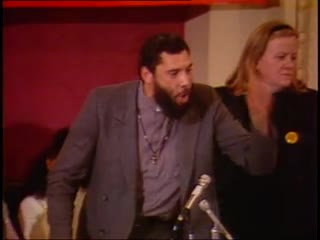
0:59:58: Visual: A group of school bus drivers stand in the lobby one of the school buildings. The drivers are asked to leave the building by uniformed police officers. The drivers contend that they have a right to be in a public building. A police officer tells them that the building is controlled by the superintendent of schools; that the superintendent has asked the police to escort the drivers from the building. One of the drivers demands to see either Dr. Laval Wilson (Superintendent, Boston Public Schools) or a representative of Wilson. Another police officer tells the drivers to pick a representative; that someone will meet with the representative. The officer tells the drivers to wait outside of the building. Members of the media watch the confrontation between the police officers and the bus drivers. One of the bus drivers is designated as the representative. The representative demands that he be able to attend Wilson's press conference. The representative asks why bus drivers are "second class citizens." A school official approaches the representative. He says that the bus drivers may choose one person to attend the press conference to represent the union's newspaper. The representative asks permission to have three bus drivers wait outside of the press conference room. The representative wants those bus drivers to talk to the media after the press conference. The school official denies his request. The representative negotiates permission to bring another bus driver into the press conference as his photographer. The representative promises not to disrupt the press conference. The school official confers with another official. The second official speaks to the representative of the school bus drivers. The representative tells the official that he has no intention of disrupting the press conference. He asks permission to speak to the media afterwards.
1:05:03: V: Wilson stands behind a table set up for the press conference. He is joined for a moment by the second official. Wilson comments on the "ruckus" outside of the room. Wilson sits down and begins to speak. Wilson reports that there was a strike by school bus drivers in the morning; that he visited several schools this morning; that attendance was low. Wilson indicates a chart detailing school attendance figures. Wilson says that attendance at the high schools was at 67%; that attendance was at 48.8% for the middle schools; that attendance was at 54% at the elementary schools. Wilson notes that district-wide attendance was down 24% from last year. Wilson says that he hopes that attendance will increase; that a settlement is reached with the bus drivers to end the strike. Wilson says that the bus drivers must rescind their three "outrageous economic demands" before a settlement can be reached; that these economic demands were not made until November; that their only demand before November was to resolve the issue of terminated drivers. Wilson says that the drivers have demanded a pension benefit, full coverage of medical benefits and an extra mid-day break; that a settlement can be easily reached outside of those three economic demands. Wilson says that the leaders of the union are supporting the strike; that the majority of bus drivers do not support the strike. Wilson urges the leadership to call a meeting of the union membership. Wilson says that the leadership should let the membership vote on a new contract by secret ballot; that the membership would support the contract put forth by the Boston School Department. Wilson notes that there have been no major disruptions in the schools.
1:10:58: V: A reporter asks Wilson about contingency plans to hire more drivers. Wilson says that the school department will not try to substitute other drivers for those on strike. Shot of the press conference from the side of the room. Members of the media are visible. Wilson sits in the center of a long table. A reporter asks if parents support the strike. Wilson says that parents would like to have their children in school. Shot of Meg Vaillancourt (WGBH reporter). Wilson adds that the school department cannot afford the economic demands of the bus drivers. A reporter asks if the timing of the strike has worked in favor of the school department. Wilson says that he does not know. Shots of members of the media; of the representatives of the school bus drivers. A reporter asks Wilson about his belief that the membership of the union does not support the strike. Wilson repeats his challenge to the union leadership to let the membership vote on a contract by secret ballot. Vaillancourt asks Wilson to comment statements by the union. She says that the union has noted that their economic demands are affordable and that Wilson is trying to negate benefits which are already in their contract. Wilson says that the union has never had pension benefits, full coverage of medical benefits, or an extended mid-day break. Wilson reviews the breaks to which the bus drivers are entitled according to the last contract. Wilson says that the new economic demands are not in the contract. Wilson adds that the school department has estimated costs to be $800,000 for medical insurance, $450,000 for pension benefits and $450,000 for the additional break time. A reporter asks if Wilson will tolerate a lengthy strike. Wilson says that he would like to resolve the issues; that the school department is willing to negotiate on all of the issues except the economic demands. Wilson says that he was shocked when the three economic demands were added at the last minute. Wilson says that he has not set a deadline for resolving the strike; that he wants to negotiate with the bus drivers. Wilson notes that negotiations were in their fifth month before the bus drivers added the economic demands. Wilson says that progress had been made on all of the issues before the economic demands were introduced.
1:17:34: V: A reporter comments that the union added the demands because the school department was trying to introduce "giveback issues." Wilson says that the "giveback issues" would have been resolved. A reporter asks why the leadership would want a strike. Shot of the attendance chart. Wilson says that the union leadership has a "credibility gap" because they introduced the economic demands after negotiations were in progress. Wilson accuses the union leadership of being "unreasonable." Wilson explains that the school department picks up costs in the contract which are not covered by the bus companies. A reporter asks how much money the school department is saving due to the strike. Wilson says that he does not know. A reporter asks about the costs of 11,000 MBTA passes handed out to students. Wilson says that it depends on how many MBTA passes are used. A reporter asks if he knows why some students did not attend school. Wilson says that he does not know. Wilson notes that it is the first day back after winter vacation.
Date Created:
01/02/1986