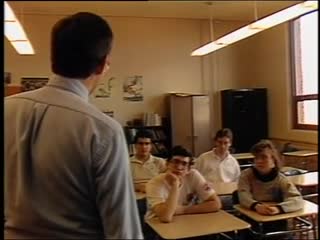
Description: Teachers attend convention to promote humor in the classroom to make learning more enjoyable.
Collection: Ten O'Clock News
Date Created: 03/24/1988
Description: Audio goes in and out. Hyde Park environs. Uniformed police are stationed outside of Hyde Park High School, including horse mounted officers. Students exit the school. African American students board buses. Buses depart with police motorcycle escort. Pam Bullard interviews Hyde Park High School teachers Terry Gaskill and Hugh Mullen discuss racial tension inside the school. The students have returned to school after a recent racial disturbance. Mullen says that the school was quiet; that the students segregated themselves along racial lines. Mullen says that a small group of students is responsible for the trouble at the school. Both teachers agree that the students do not act up when the police are present in the school. Tape 1 of 2.
0:58:01: Visual: Shots of a black dog on the porch of a house on Westminster Street, near Hyde Park High School; of a police horse standing on the grass while a police officer talks to a resident; of the exterior of Hyde Park High School. Police are stationed outside of Hyde Park High School. A police bus is parked in front of the school. Three police officers stand on the steps of the school, while one police officer directs traffic on the street. A police officer pulls up on a motorcycle. 1:00:44: V: A line of school buses pulls up Central Street and stops beside Hyde Park High School. Two mounted police officers survey the scene from the intersection. Several officers are stationed on the steps of the school. Cars pass by slowly. Another police officer arrives on a motorcycle. 1:05:19: V: Shot of the exterior of Hyde Park High School. African American and white students exit the school. African American students walk toward the school buses and board them. Police and the media survey the scene. 1:09:56: V: Groups of police officers appear in the front entrances of the school. Three of the buses pull away, escorted by police on motorcycles. The buses travel up Metropolitan Avenue. Three more buses follow, accompanied by a police officer on a motorcycle. Groups of students, school officials, and police remain on the steps of the school. The last bus pulls away, with a police motorcycle escort. Police officers exit the school and walk down the steps. Groups of people remain on the steps. Close up shot of a white woman police officer on a horse. A few police officers walk away from the school. 1:13:27: V: Pam Bullard sets up an interview with two Hyde Park teachers in front of the school. Terry Gaskill is African American and Hugh Mullen is white. Vehicle noise makes their voices inaudible at beginning of interview. Gaskill advocates an after school program or gathering place for both white and African American youth in Boston. He notes that African American and white students gather on the streets after school; that a group of angry white youth kicked his car last year as he drove to Hyde Park High School. Mullen says that the day went smoothly; that the school staff had to break up groups of students in order to get them into homeroom in the morning; that the strong police presence made a difference; that the police did not interfere with school activities. Gaskill says that the students were tense at the beginning of the day; that the atmosphere was quiet. Bullard asks about racial tension among the students. Mullen says that the students segregated themselves along racial lines today; that students of different races had been mixing somewhat before Friday's racial disturbance. Gaskill says that the first day of school was calm; that racial tension began to build up among the students as the week progressed. Mullen agrees that the first few days of school were quiet. He says that there is a small group of students who make trouble; that the situation at the school will not get better unless they can get rid of the small group of troublemakers. Mullen adds that the school has a large freshman class this year; that he had thought the presence of the younger students would help to ease the tensions of the previous year; that teachers will not be able to assess the situation until the police pull out of the school; that the students do not dare act out while the police are present. Gaskill agrees that students will not act out while police are in the building.
Collection: Ten O'Clock News
Date Created: 09/15/1976
Description: Pam Bullard interviews teachers Hugh Mullen and Terry Gaskill about racial tension and disturbances at Hyde Park High School. The teachers say that incidents occur in the hallways, bathrooms and cafeteria, but not in the classrooms. They discuss requests made by Hyde Park High School faculty to the school administration upon the reopening of the school after a racial disturbance. Mullen says that the school faculty has requested that outside community groups stay out of the schools until the situation is under control. Tape 2 of 2.
0:00:14: Visual: Pam Bullard interviews a white teacher, Hugh Mullen, and an African American teacher, Terry Gaskill, about racial tension at Hyde Park High School. Gaskill says that every student has grown up with racial prejudice; that most students do not want to get into trouble; that emotions run high when trouble begins and students are drawn in to the situation. Mullen says that most of the trouble happens in the hallways and bathrooms; that the atmosphere is calm in the classrooms and the gym. Gaskill adds that two fights have occurred this year in the gym; that neither stemmed from racial tensions. Mullen says that the Hyde Park High School Faculty Senate has asked for a stronger police presence and for more aides in the school building; that the school administration has granted their requests; that he hopes the school can be peaceful without police officers on duty. Pam Bullard talks informally to the teachers while the crew takes cutaway shots. Mullen says that there has been little interference from parents; that African American parents have had meetings since last week's racial disturbance; that he does not know what has come out of the school administration's meetings with parents. Mullen says that the faculty has requested outside community groups to stay out of the school until the situation is under control.
Collection: Ten O'Clock News
Date Created: 09/13/1976
Description: Somerville High School students learn of legacy of JFK through their parents' memories and their history teacher's lessons. Students in corridors, classroom. High shot of Somerville skyline.
Collection: Ten O'Clock News
Date Created: 11/21/1988
Description: South Boston High School exterior. Background comments of pedestrians talking to camera operator and reporter. Pam Bullard interviews headmaster Jerome Wynegar on what programs his school will offer, including core curriculum and vocational education. Wynegar says racial problems have been aggravated by outside agitators. He adds that the school is enrolled to capacity, and cannot accommodate students who wish to return after dropping out. He says that the school should make sure to listen to the suggestions of the students, and those students who dropped out, to try to improve the school. He commends the faculty. Additional comments from Wynegar as they shoot cutaways. Shots of graffiti painted on pavement, which reads “Stop Forced Busing.” Several takes of reporter voice over and standup.
Collection: Ten O'Clock News
Date Created: 08/17/1976
Description: ENVIRONS OF FAIRMOUNT SCHOOL. KINDERGARTEN, KIDS, TEACHERS, DRAWING, DANCING. CLASSROOM.
Collection: Ten O'Clock News
Date Created: 01/13/1981
Description: Lowell teachers vote to strike (illegally) because of unsatisfactory contract raise. Teachers picket. Lowell street scenes. Boys on skateboards.
Collection: Ten O'Clock News
Date Created: 09/06/1988
Description: PAUL A. DEVER SCHOOL FOR MENTALLY RETARDED, ACTIVITIES, TEACHERS
Collection: Ten O'Clock News
Date Created: 04/05/1984
Description: Carmen Fields reports that Dr. James Williams, a professor at the Massachusetts Institute of Technology, will fast each Wednesday in April outside of the office of the president of MIT. Williams is protesting the lack of diversity among the faculty at MIT. There are fourteen African Americans in a faculty of 900 professors. Interview with Williams, who talks about the role of professors as role models and the need for a diverse faculty. He says that he is trying to encourage minority students to fight for change. Interview with MIT spokesperson Ken Campbell, who talks about the university administration's efforts to hire more minority faculty. This edition of the Ten O'Clock News also included the following item: Meg Vaillancourt reports on the annual Black/Jewish Seder supper
0:59:01: Visual: Footage of Dr. James Williams (professor, Massachusetts Institute of Technology) being interviewed. Williams says that his mother inspired his current protest actions. Williams talks about his mother as a sensitive and caring person. Carmen Fields reports that Williams will fast and work outside of the office of the president of MIT. V: Shots of the door of the president's office; of Williams working at a table near the door. Footage of Williams being interviewed. Williams says that minority students must act; that minority students must not be discouraged by institutional intransigence. Williams says that minority students must act decisively to effect change. Shot of Williams working at the table outside of the president's office. Fields reports that Williams is an MIT graduate; that Williams is dissatisfied with the lack of African American faculty at the school. Fields notes that there are fourteen African American faculty members in a faculty of 900 professors. V: Shot of a building on the MIT campus. Shot of Williams speaking to a group of students of color. Fields reports that Williams believes that African American students and all students need African American role models. V: Footage of Williams being interviewed. Williams says that he is trying to be a role model for minority students through his protest. Williams says that professors are role models even if they do not want to be. Williams says that professor can choose what kinds of role models to be. Fields reports that MIT believes that Williams has reason to protest. V: Footage of Ken Campbell (MIT spokesperson) being interviewed. Campbell says that the university agrees with Williams; that there are too few minority faculty members. Campbell says that two more African American faculty members have been hired since Dr. Charles Vest (president, MIT) became president of the university. Campbell says that the school needs to make more progress. Fields reports that Williams believes that protest is still necessary. V: Footage of Williams being interviewed. Williams says that people must still act in the face of slow-moving institutions. Williams says that people must not give up in defeat.
Collection: Ten O'Clock News
Date Created: 04/03/1991
Description: Marion Fahey (Superintendent, Boston Public Schools) holds a press conference on the closing of Hyde Park High after a disturbance. She says that the her staff is investigating the situation and will respond to a list of complaints drawn up by the faculty of the high school. Fahey says that the school faculty is concerned about disruptive students and renovations to the building. She will not comment on whether the disturbance was caused by racial tension. Fahey says that Elvira "Pixie" Palladino (Boston School Committee) had a right to visit the school. Fahey will not comment on the effect of Palladino's presence on the disturbance. Ann Foley (administrative assistant to Fahey) and Associate Superintendents Charles Leftwich and Paul Kennedy are also present at the press conference.
0:00:45: Visual: Media are gathered at Boston Schools Information Center as Marion Fahey (Superintendent, Boston Public Schools), Charles Leftwich (Associate Superintendent, Boston Public Schools), Ann Foley (administrative assistant to Fahey), and Paul Kennedy (Associate Superintendent, Boston Public Schools) seat themselves. Foley says that Fahey will speak about the situation at Hyde Park High School. She requests the media to confine their questions to that situation. 0:01:26: V: Fahey announces that classes at Hyde Park High School will be suspended on the following day; that a group of officials and administrators will be convened to plan for the reopening of the school. Reporters ask questions about the school closing. Fahey says that Kennedy and Leftwich visited Hyde Park High School to confer with faculty, administrators, members of the biracial counsel and members of the Home and School Association. Fahey says that she made the decision to close the school based on information from that visit. Fahey says that Hyde Park faculty is preparing a list of concerns and problems which need to be addressed. Fahey says that the following day will be spent planning and addressing concerns about the school. Fahey says that she has not decided whether to request a larger police presence at Hyde Park High School. 0:03:32: V: Fahey says that she will not comment on the situation at the school until she has all of the information. Fahey says that she will determine tomorrow evening if the school will reopen on Friday. Fahey says that the school will reopen when the safety of the students can be guaranteed. Fahey says that damage to the building will be repaired before the school reopens. Fahey says that the incidents at Hyde Park were deplorable and that the situation at the school will be addressed. Fahey says that she does not know how many arrests were made; that her staff is investigating the situation in order to make a full report to her. 0:05:52: V: A reporter asks Fahey to comment on overcrowded classes and the closing of the top floor of the school. Leftwich says that some classrooms on the top floor are being refurbished; that the superintendent's staff is investigating the situation; that these complaints may have contributed to the situation at Hyde Park. Fahey says that she will not speculate on whether racial issues were the cause of the disturbance; that she will investigate the causes of the disturbance. Fahey says that her staff will assess the situation tomorrow and make plans to prevent such incidents in the future. Fahey says that she had not known about the concerns about Hyde Park faculty members before today; that faculty are concerned about disruptive students and renovations to the school building. Fahey says that students had been dismissed from school when she arrived there. Fahey says that she would address the students by saying that the faculty at Hyde Park is concerned about their well-being and education; that the biracial counsel will work hard to resolve problems at the school; that her administration is dedicated to resolving the situation at the school. 0:10:18: V: A reporter asks Fahey if Elvira "Pixie" Palladino played a destructive role in the situation at Hyde Park. Fahey says that Palladino had a right to be at the school as a member of the school committee; that she has not spoken to Palladino about the situation. A reporter asks Fahey if she is concerned that the concerns of Hyde Park faculty have not been addressed. Fahey says that she will investigate the situation. Fahey declines to answer a question unrelated to the situation at Hyde Park. She thanks the media and leaves the room with Leftwich, Kennedy, and Foley. Reporters talk among themselves as they clear the room. Shot of Fahey heading down a hallway toward the exit.
Collection: Ten O'Clock News
Date Created: 01/21/1976