Description: Marcus Jones interviews Eugene Rivers of the African Peoples Pentecostal Church about his community work in the greater Roxbury neighborhood. Jones notes that Rivers is an outspoken critic of the religious establishment. He adds that Rivers spends a lot of time counseling troubled youth and acting as a legal advocate for them. Rivers talks about his work with neighborhood youth. Rivers says that many troubled teenagers come from disadvantaged socioeconomic backgrounds. Rivers talks about the need for churches to do more to reach out to young people. Rivers says that churches must provide alternatives for young people. Rivers talks about violence in the community and about his commitment to young people in the neighborhood. Jones notes that violence is a problem in the neighborhood. He adds that Rivers is committed to fighting the problem. Jones' report is accompanied by footage of Rivers talking to young people on the street and footage of Rivers' church van, damaged from gunfire.
1:00:06: Visual: Footage of Eugene Rivers (Pastor, African Peoples Pentecostal Church) talking to two young African American men in front of a courthouse. Marcus Jones reports that Rivers is not a social worker; that Rivers spends a lot of time counseling troubled youth. Jones reports that Rivers is the pastor of the African Peoples Pentecostal Church; that Rivers' church holds its meetings at the Freedom House in Roxbury. V: Footage of Rivers being interviewed by Jones. Jones asks how much of Rivers' time is taken up by troubled youth. Rivers says that his wife thinks that he spends too much time. Jones asks Rivers how often he is in the courthouse. Rivers says that he is in the courthouse three or four days per week. Rivers says that a large number of teenagers end up getting into trouble for legitimate reasons; that many these teenagers get into trouble stemming from their socio-economic backgrounds. Rivers says that he tries to make himself available to help these people. Shot of Rivers walking on a sidewalk with a young African American man. Jones reports that Rivers is an outspoken critic of the religious establishment. Jones reports that Rivers believes that religious leaders have failed the young people of Roxbury, Dorchester, and Mattapan. Jones notes that Rivers believes that religious organizations need to provide alternatives to drugs, gangs, and violence. V: Shot of a group of African American teenage boys standing in front of a house. Another group of African American teenage boys rides by on bicycles. Footage of Rivers being interviewed by Jones. Rivers says that churches are the premier institutions in the African American community. Rivers says that churches, including his own, are not doing enough to reach out to young people. Rivers says that the absence of the churches on the street is more conspicuous than the presence of drugs. Shot of Rivers walking on the street with another African American man. Rivers stops an African American teenage boy. Rivers starts talking to the boy. Footage of Rivers being interviewed by Jones. Rivers says that many young men are involved in illegal activities because no other form of activity was available to them. Rivers says that many young drug dealers never had adult role models; that many young drug dealers never had access to any kind of significant alternative. Shot of Rivers walking down the courthouse steps with another man. Jones reports that Rivers speaks from experience when he talks about role models. Jones reports that Rivers was a gang member and drug dealer in Philadelphia before he enrolled at Harvard University. Jones notes that Rivers is trying to make a difference on the streets of a neighborhood where gang violence is commonplace. V: Shot of bullet holes in the windshield of Rivers's van. Footage of Rivers counting the bullet holes on his van. Rivers points out the damage done to his van. Close-up shot of a bullet hole on the side of the van. Jones reports that gang members fired dozens of bullets into the home of Rivers's next-door nieghbor last month. Jones reports that many of the bullets hit Rivers's church van; that two bullets pierced the wall of his home. V: Shot of Rivers and Jones outside of Rivers's home. Shot of a bullet hole in the window of a home. Shots of the broken windows of the church van; of broken glass inside of the van. Shot of a bullet hole in the wall of Rivers's home. Footage of Rivers being interviewed by Jones outside of his home. Jones comments that Rivers's neighbors have moved out of their home. Rivers says that he feels a commitment toward the community; that he wants to make something happen here. Shot of Rivers and Jones framed by the broken window of the van. Jones reports that Rivers, his family and his congregation want to make the African American community aware of its responsibility to change things. Jones reports that Rivers wants the community to work at making improvements instead of blaming outsiders. V: Footage of Rivers being interviewed by Jones. Rivers says that kids will participate in legitimate acitivities if those activities are provided. Jones asks who will provide the activities. Rivers says that African American churches need to come up with alternatives for youth; that the churches should close shop if they fail to provide alternatives. Rivers says that African American churches should become employers, educators, advocates; that the churches should be in the courts and in the jails. Rivers says that the churches have failed to understand the meaning of the gospel if they fail to take up this challenge.
Collection: Ten O'Clock News
Date Created: 08/15/1990
Description: Carolyn Sawyer reports on Reverend John Borders of the Morningstar Baptist Church, and his efforts to reach out to his community. Borders has conducted at least 15 funerals for teenagers who have died as a result of street violence. Interview with Borders, who talks about the problem of violence in the community. He expresses sadness at the number of young people caught up in the violence. Borders says that adults need to spend more time with young people; he adds that teenagers need to know that someone cares about them. Borders talks about his hopes for positive changes in the community. Sawyer's report includes footage of Borders at his church and footage of Borders at his children's school. Sawyer's report also includes footage from the funeral of Charles Hardison and footage of victims of street violence. Following the edited story is b-roll of the Blue Hill Avenue environs near the Morningstar Baptist Church.
1:00:01: Visual: Footage from the funeral of Charles Hardison (Milton teenager) at Ebenezer Baptist Church in Milton. Pall bearers bring the coffin out of the church. Mourners stand outside the church. Shots of African American and white teenagers standing outside of the church; of teenagers consoling each other with hugs. Shot of two white girls hugging an African American boy. Audio of Reverend John Borders (Morningstar Baptist Church) talks about the heartbreak caused by the violent deaths of teenagers. Borders says that he wants peoples' hearts to break when they hear about these tragedies. Footage of Borders and a young African American man praying in a church. Carolyn Sawyer reports that Borders prays for peace in a community afflicted by crime. Sawyer reports that Borders has conducted at least 15 funerals for teenagers who have died. V: Shot of Border's clasped hands as he prays. Footage of Borders being interviewed. Borders recalls some of the funerals of local teenagers. Shot of Borders walking to his car; of Blue Hill Avenue near the Morningstar Baptist Church. Sawyer reports that Borders grew up not far from the church; that Borders had a career in music before entering the ministry. V: Shots of residential homes in Mattapan. Footage of Borders being interviewed. Borders says that there has been a growth of evil in the neighborhood and a decline in values. Borders says that there is a lack of respect for human life. Footage of Borders at a local school. He speaks to a teacher. Borders speaks to a child standing with other children. Sawyer reports that Borders is 32 years old; that Borders has three children of his own. V: Footage of Borders saying that adults need to turn off the radio and the television; that adults need to spend time with young people. Borders says that parents needs to question where kids are getting money if the kids do not have jobs. Borders says that parents need to ban drug money from their homes. Shots of an African American man pulling a shopping cart along a street; of two African American men standing on a sidewalk. Shot of Borders speaking on the telephone. Sawyer reports that Borders preaches for people to return to the community. V: Footage of Borders being interviewed. Borders says that young people need people who care. Borders says that gang members care about other gang members; that some teenagers do not think that anyone else cares. Shot of Borders hand as he speaks on the telephone. Footage of Borders speaking on the phone. Sawyer reports that Borders puts his faith in change; that Borders wants the church to play a role in future changes. V: Shot of Borders in the church. Borders in on his knees as he prays. Footage of Borders being interviewed. Borders says that people will tire of the murder and violence; that people will turn to God. Borders says that the church will play a prominent role in the community. Shots of a body on a stretcher as it is wheeled toward an ambulance; of paramedics tending to an African American woman. Shots of paramedics putting an African American man on a stretcher; of a police cruiser turning a corner.
Collection: Ten O'Clock News
Date Created: 12/17/1990
Description: Robert Spillane (Superintendent, Boston Public Schools) speaks to an audience in the chambers of the Boston School Committee. He is introduced by Jean Sullivan McKeigue (President, Boston School Committee), who notes that the School Committee will vote on March 5 about whether to keep Spillane in the post of Superintendent. Spillane addresses the issues of school desegregation and school violence. Spillane says past students in Boston Public Schools had been denied a good education due to segregated schools and cynicism among educators. Spillane talks about the continued involvement of Arthur Garrity (federal judge) in the supervision of the Boston Public Schools. Spillane says that the Boston School Department must begin to take responsibility for school desegregation. Spillane reminds the audience that racial discrimination will not be tolerated in the Boston Public School system; that the climate in the schools must be improved. Spillane stresses the importance of faculty integration. Spillane talks about school discipline and the fair implementation of the disciplinary code. Spillane says that a monitoring process will assure that minority students are no longer singled out for disciplinary action. Spillane promises to establish a task force to investigate school violence. Spillane says that school desegregation will have been a failure if quality education cannot be assured. Spillane also talks about additional programs for students, teacher training, teacher evaluation and community involvement in the schools. John O'Bryant (Boston School Committee) is interviewed by the media after the speech. O'Bryant says that Spillane has addressed school desegregation in a courageous manner; that he will vote for Spillane on March 5.
1:00:04: Press and members of the community are gathered in the Boston School Committee chambers. Jean Sullivan McKeigue (President, Boston School Committee) enters the room and announces that the vote on the office of school superintendent will take place on March 5. McKeigue introduces Robert Spillane (Superintendent, Boston Public Schools). Spillane enters the room and sits down. Spillane thanks McKeigue. He acknowledges the fact that the School Committee will be voting on whether to continue his superintendency. Spillane addresses the need for community involvement in Boston schools. Spillane says that he started as superintendent seven months ago; that he was aware of the social, fiscal and educational problems faced by Boston schools; that he has tried to provide constructive leadership. Spillane says that the schools are working with reduced resources; that he is trying to address the educational and social needs of nearly 60,000 students. Spillane refers to school desegregation across the nation. He says that Boston public school students had been denied a good education due to segregated schools and a cynicism among educators. Spillane says that he would like to address two problems today: school desegregation and school violence. Spillane talks about Judge Arthur Garrity's efforts to produce agreement among the parties in the Boston school desegregation case (Morgan v. Hennigan). He says that these agreements aim to secure the advances made by eight years of school desegregation; that these agreements would form the basis of a final set of court orders; that Garrity would cease to supervise the schools after these consent decrees were put in place. Spillane says that the consent decrees provide an opportunity to assess the progress made in school desegregation. Spillane reviews the state of the Boston Public School System before desegregation. Spillane says that he would like to eliminate racial inequality while improving educational quality. Spillane says that he would like to institute a long-range plan for the schools; that the plan would be presented to Garrity through the consent decree process. Spillane says that Boston schools must take responsibility for school desegregation; that equal educational opportunities must exist for all students; that the staff must be integrated as well as the students. Spillane says that the schools require strong leadership, a clear curriculum, conscientious teaching and a safe school climate. Spillane says that students must be prepared for higher education or the job market; that schools must work with parents to improve education. Spillane says that racial discrimination cannot be tolerated in and out of school; that he will not tolerate those who say that some children cannot learn. Spillane says that teachers must work hard to educate all children. Spillane says that he supports the integration of school faculty; that school staff must represent a cross-section of American society; that minority staff have been denied access to jobs in the past. Spillane says that African Americans and other minorities will be represented in key positions in the school administration. 1:10:44: Spillane says that youth violence is a problem in Boston's schools and neighborhoods. Spillane says that order must be kept in the schools; that alternative programs must be provided for all students in need of them. Spillane says that violence can stem from a lack of success in school; that school staff must help students to learn and achieve as best they can. Spillane says that fair and equitable disciplinary action must be assured; that minority students may have been singled out for disciplinary action in the past. Spillane says that he will set up a process to monitor disciplinary action and insure fair implementation of the disciplinary code. Spillane says that he will establish a task force to investigate school violence; that the task force can make recommendations on how to counter school violence. Spillane notes that students who are not taught to read and write are victims of another kind of violence; that some students are not encouraged to learn; that all students must be prepared to function as active and contributing members of society. Spillane says that desegregation will be rendered ineffective if quality education is not assured; that urban schools can make a difference in the lives of their students. Visual: Shot of a young African American boy who is fidgeting in the back of the room. Spillane says that teacher training is important. V: Jump cut in videotape. Spillane talks about alternative programs for students with special needs. V: Jump cut in videotape. Shots of audience from Spillane's perspective. Spillane says that a fair process of teacher evaluation will be implemented; that assistance and training must be given to teachers; that superior performance should be recognized and inferior performance should be addressed. V: Shot from the back of the room of Spillane addressing the audience. Spillane talks about the need for high academic standards. V: Jump cut in videotape. Spillane says that he will continue to work with the business community on employment and training programs for students. V: Jump cut in videotape. Spillane talks about the need for good vocational education programs. V: Jump cut in videotape. Spillane addresses the need for strong bilingual education programs. Spillane says that the programs must be assessed to assure that they are meeting the needs of the students. V: Jump cut in videotape. Spillane says that education must be a priority in the city; that civic leaders, parents and school administrators must work together to improve the schools; that all groups concerned about the schools must be listened to. V: Jump cut in videotape. The audience claps for Spillane. V: Jump cut in videotape. John O'Bryant (Boston School Committee) is interviewed by the media. He says that he is impressed with Spillane's growth since his stormy meeting with the school committee on February 8; that he will vote for Spillane. O'Bryant says that Spillane addressed school desegregation in a courageous manner; that very few high-profile officials talk about the beneficial effects of school desegregation in Boston; that few people give Garrity credit for instituting desegregation in Boston schools. O'Bryant says that he is optimistic about Spillane's ability to do the job. The media continues to question O'Bryant.
Collection: Ten O'Clock News
Date Created: 03/02/1982
Description: Touching reactions from friends and classmates of 11 year old Charles Copney, killed on a Saturday evening on Highland Avenue, Roxbury, in a shooting that also killed a teenager.
Collection: Ten O'Clock News
Date Created: 04/22/1991
Description: Meg Vaillancourt reports on the street violence that resulted in the accidental shooting of Darlene Tiffany Moore (eleven-year-old Roxbury resident). Vaillancourt interviews Maleka Few (Roxbury resident, age twelve) and Jessica Moore (Roxbury resident, age 10). The girls are afraid of the violence that resulted in Tiffany Moore's death. Vaillancourt reports that Roxbury residents went to City Hall to ask for more police protection in the neighborhood. Vaillancourt's report includes footage of Roxbury community leaders at a press conference. Amanda Houston (Roxbury resident), Bruce Bolling (Boston City Council), and Louis Elisa (Roxbury resident) talk about the need for more police on the streets. Vaillancourt reports the Ray Flynn (Mayor of Boston) has put more police on the streets and has pledged a full investigation of Moore's shooting. Vaillancourt's report includes footage of William Celester (Deputy Superintendent, Boston Police Department) and Flynn at a press conference. Vaillancourt reports that Roxbury is experiencing its worst violence in twenty years. She notes that city and state officials gathered at a press conference to discuss the problem. Vaillancourt's report includes footage of the press conference in Roxbury with Francis "Mickey" Roache (Police Commissioner, City of Boston), Royal Bolling, Sr. (former State Senator), and John Kerry (US Senator). Roache blames drug traffic for the violence. Kerry criticizes the ineffectual drug policy and social programs of the Reagan administration. Vaillancourt's report includes footage of police officers stopping African American men on the streets of Roxbury.
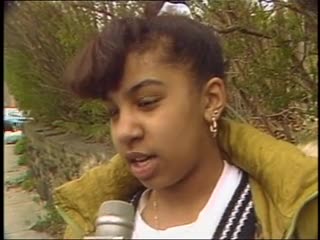
1:00:26: Visual: Footage of Maleka Few (Roxbury resident, age 12) saying that she thinks it might happen to her next. Shot of a Boston Herald newspaper article with a headline reading, "Police vow to capture girl's killers." A photo of Darlene Tiffany Moore (Roxbury resident, age 11) accompanies the article. Meg Vaillancourt reports that Moore was sitting outside on Humboldt Avenue in Roxbury when she was killed by a stray bullet; that Moore was the unintentional victim of a war between two rival gangs. V: Shot of a Humboldt Avenue in Roxbury. Footage of Few saying that the gang members were not shooting at Moore; that Moore was in the wrong place at the wrong time. Few says that she does not want to go out to the store with her mother anymore. Footage of Jessica Moore (Roxbury resident, age 10) saying that she used to sit in the same place on Humboldt Street. Shots of African American girls standing on a street in Roxbury. Vaillancourt reports that Roxbury parents went to City Hall today to ask for more police protection. V: Footage of Amanda Houston (Roxbury resident) saying that she is a "gutsy lady;" that she is starting to feel frightened. Footage of Bruce Bolling (Boston City Council) speaking to the press. Bolling says that there is open warfare going on in the city. Shot of media camera crews. Footage of Louis Elisa (Roxbury resident) saying that Roxbury residents pay their taxes; that Roxbury citizens are demanding equal protection under the law. Vaillancourt reports that forty extra police officers are patrolling Humboldt Avenue; that Ray Flynn (Mayor of Boston) has pledged a full investigation of the shooting. V: Shot of two police officers patrolling a street. Footage of William Celester (Deputy Superintendent, Boston Police Department) speaking to the press. Flynn stands beside him. Celester says that the community has been providing information about the shooting to police; that the police are investigating suspects. Footage of two white police officers stopping an African American man to search him. Vaillancourt reports that Roxbury is experiencing its worst violence in twenty years. V: Footage of Francis "Mickey" Roache (Police Commissioner, City of Boston) speaking at press conference in Roxbury. John Kerry (US Senator) and Royal Bolling Sr. (State Senator) are among the crowd standing with Roache. Roache says that drugs equal violence. Shots of the press at the press conference. Vaillancourt notes that Kerry visited Roxbury today to talk to residents about the drug problem. V: Footage of Kerry saying that the government cannot ask kids in Roxbury to say no to drugs if the Reagan administration cannot say no to General Manuel Noriega (leader of Panama). Kerry says that the drug policy of the Reagan administration is hypocritical and ineffective; that the administration's policy is contributing to the drug problem. Vaillancourt reports that Roxbury residents are calling for drastic measures to fight violence; that some curfews, night-court sessions, and the National Guard have all been suggested. V: Footage of Kerry saying that the presence of the National Guard will not solve the drug problem; that overcrowded prisons, an inadequate school system, and a lack of treatment centers are all contributing to the drug problem. Shot of two white police officers talking to an African American teenage boy on a street in Roxbury. Vaillancourt reports that Roxbury residents want increased aid on all levels. Vaillancourt notes that residents are worried that the situation will not improve after Moore's killer is found. V: Shot of a cameraman filming a man in a business suit on the street; of Humboldt Avenue in Roxbury.
Collection: Ten O'Clock News
Date Created: 08/22/1988
Description: On Good Friday, parishioners and clergy march through Roxbury past sites of violence in a pilgrimage of hope for the community. Stations of the cross.
Collection: Ten O'Clock News
Date Created: 03/29/1991
Description: Marcus Jones reports that Roxbury community leaders met behind closed doors to draw up a plan to deal with the growing problem of gang violence in the community. Jones reports on the recent deaths of Roxbury residents Darlene Tiffany Moore and Richard Bailey. Jones' report includes photos of Bailey and Moore. Four suspects in the Bailey murder, including Shango Dilday, Demetrius Dunston, and Emmett Snow, were arraigned today in Roxbury District Court. Interview with Barry Snow (uncle of Emmett Snow) about the arraignment. Police have arrested Roxbury resident Shawn Drumgold and another suspect in connection with Moore's death. Information from the community led to Drumgold's arrest. Press conference with Police Commissioner Francis "Mickey" Roache, who says that police are working with members of the community to solve crimes. Interview with Roxbury resident Terrence Kelley about the increase in violence. City Councilor Bruce Bolling speaks to the press.
1:00:05: Visual: Footage of Bruce Bolling (Boston City Council) and Gloria Fox (State Representative) entering a building. Members of the press remain outside. Marcus Jones reports that Roxbury leaders met behind closed doors to draw up a plan to deal with the growing problem of gang violence. V: Shot of a Boston Herald newspaper article a headline reading, "Police vow to capture girl's killers." The article features a photo of Darlene Tiffany Moore (Roxbury resident and shooting victim). Jones reports that two Roxbury youngsters have been killed in less than two weeks; that Moore was killed in the crossfire of two warring drug gangs on August 19. V: Shot of the Humboldt Street location where Moore was killed. Jones reports that Richard Bailey (Roxbury resident, age 14) was stabbed to death by a rival gang member over the past weekend. V: Shot of a color photo of Bailey. Jones stands on the corner of Copeland Street in Roxbury. Jones reports that Bailey was one of several gang members being chased by a rival gang; that Bailey was caught and stabbed by the rival gang member. Jones reports that four suspects in the Bailey murder were arraigned today in Roxbury District Court. V: Shot of Francis "Mickey" Roache (Police Commissioner, City of Boston) approaching the podium at a press conference. William Celester (Deputy Superintendent, Boston Police Department) and another man stand stand behind him. Footage of a lawyer at the arraignment of the suspect. The lawyer addresses the judge, saying that the government does not have a case against his client. Shots of Clarence Dilday (father of Shango Dilday) in the audience of the courtroom; of Barry Snow (uncle of Emmett Snow) in the audience of the courtroom; of other audience members. Jones reports that a 14-year-old juvenile was arraigned in court today; that Shango Dilday (Roxbury resident), Demetrius Dunston (Roxbury resident) and Emmett Snow (Roxbury resident) were also arraigned. V: Footage of Barry Snow saying that he brought Emmett Snow to court today so that the situation could be straightened out. Shot of Shawn Drumgold (Roxbury resident) in Roxbury District Court. Jones reports that police have arrested Drumgold and another suspect in connection with the Moore shooting; that police arrested Drumgold in court where he was being arraigned on a heroin charge. [Shot of Drumgold in Roxbury District Court. Jones reports that the information from the community aided police in making Drumgold's arrest. V: Footage of Roache at a press conference. Roache says that he has spoken to members of the Roxbury community; that members of the community are willing to do whatever they can to help police. Footage of Jones interviewing Terrence Kelley (Roxbury resident) on the street. Jones asks Kelley if there will be an end to the violence. Kelley says that the violence may only be at its beginning. Shot of Jones stands with other members of the media outside of the building in which Roxbury community leaders are meeting. Jones reports that today's meeting is a signal that Roxbury leaders are serious about ending the violence. V: Footage of Bolling speaking to the press outside of the building. Bolling says that community leaders are going to work together to get rid of the negative elements in the community. Shot of Copeland Street.
Collection: Ten O'Clock News
Date Created: 08/29/1988
Description: SCHOOL COMMITTEE DISCUSSES PROBLEM OF STUDENT VIOLENCE
Collection: Ten O'Clock News
Date Created: 03/04/1987
Description: Human rights activist Dr. Jonathan Fine tells about Iraqi president Saddam Hussein's use of chemical weapons, and brutality to children.
Collection: Ten O'Clock News
Date Created: 08/03/1990
Description: Alexander Dawoody, Kurdish political refugee from Iraq, wants Saddam Hussein eliminated. Middle East expert Feroz Ahmad explains Saddam's staying power through paradox of brutality and welfare.
Collection: Ten O'Clock News
Date Created: 02/19/1991