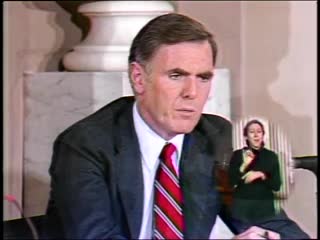
Description: Andrew Young (Mayor of Atlanta) endorses Mel King (candidate for Mayor of Boston) at a press conference at Northeastern University. Jim King (Senior Vice President, Northeastern University) introduces Young. Young talks about King's candidacy for mayor of Boston. King says that he and Young have discussed ideas for local job creation and for trade between local businesses and third world markets. In response to audience questions, Young talks about his recommendation that King set up a trade mission to export local manufactured goods. King discusses the value of his endorsement of King and the differences among the political situations in Boston, Chicago, and Philadelphia. Young says that he does not consider Boston to be a racist city. Young talks about the potential impact of the African American community on the election outcome. Young refuses to comment on the the presidential campaign of Jesse Jackson.
1:00:06: Visual: Andrew Young (Mayor of Atlanta) walks sits down at a table next to Mel King (candidate for Mayor of Boston). Mel King's campaign signs are visible on the walls of the room. Behind King and Young is a Northeastern University flag. A young African American woman announces that Young and "future mayor" Mel King will speak; that they will take questions after. Jim King (Senior Vice President, Northeastern University) introduces Young. He reviews Young's accomplishments. Shots of the audience. Young says that King's leadership will benefit Boston. Young talks about the importance of housing and neighborhood revitalization. Young says that King will work to reduce unemployment; that King will work with existing businesses and help to build new businesses. Young says that King is familiar with urban problems. Young commends King for his strong marriage, his family, and his values. 1:03:33: V: King calls Young "Mayor Class." King says that Young is one of the classiest politicians in the world; that Young has a world view which allows him make connections between his city and events in the greater world. King says that he and Young discussed how to create jobs in Boston; that Young has given him advice on how to unlock third world markets; that the city can help neighborhoods and businesses take advantages of these markets to create jobs. King thanks Young for coming to Boston. The audience applauds. 1:05:53: V: The audience asks questions. An audience member asks Young about his experiences as the Mayor of Atlanta. Young says that it is "fun" to solve local problems. Young says that he has recommended that King set up an export trading company to help export the city's manufactured goods. Young talks about trade missions that he has undertaken as Mayor of Atlanta. Young says that he has gone on trade missions to Trinidad and Jamaica, and is planning a trade mission to Nigeria. Young talks about how trade missions can benefit local businesses and industry. Young says that he and Henry Cisneros (Mayor of San Antonio) share the leadership of a task force for the National League of Cities; that mayors can create jobs by promoting international opportunities for local industry. Young says that Boston could export many products; that King is concerned about creating jobs through exports. Young says that he appointed a woman as Deputy Chief of Police in Atlanta; that her appointment heightened awareness of crimes against women in the city. Young says that it is important for a mayor to be responsive to problems of those who have been ignored; that King will be responsive. 1:09:59: V: An audience member asks Young about the value of his endorsement of King. Young says that Boston needs a good mayor; that he does not judge Boston to be a racist city on the basis of the actions of a few "hoodlums"; that there are voters who will elect King on the basis of his values and his positions on unemployment and crime; that skin color is not important. Young says that he is here as an urban mayor to remind people about important urban issues; that he is able to get television exposure for King. The audience applauds. An audience member asks Young about similarities in the political situations in Boston, Chicago and Philadelphia. Young says that there are few similarities; that there was a "revolution" against the mayor in Chicago; that there is more racial antagonism in Chicago than there is in Boston. Young says that Wilson Goode (candidate for Mayor of Philadelphia) will be elected because of his experience and broad support. Young says that he hopes King will emerge with broad support in Boston. Young refers to Boston's revolutionary history, saying that he hopes the city will rally around King. 1:14:11: V: An audience member points out that Boston has a small African American community with a record of low voter turnout. Young uses the example of Los Angeles as a city with a small minority population and a popularly elected African American mayor. An audience member asks Young to speculate on the chances of Jesse Jackson (African American political leader) being elected to the presidency. Young says that it is too soon to speculate on anyone's campaign for the presidency. 1:16:23: V: Young answers more questions from the audience. Shots of Young from behind the audience and media; of members of the audience. Audio cuts in and out during this segment. Young talks about the need for "open and honest" government and a good relationship with the press. King answers a question about his campaign. The moderator announces an end to the press conference. 1:18:45: V: Young and King greet members of the audience and the media.
Collection: Ten O'Clock News
Date Created: 09/22/1983
Description: State Senator Jack Backman opens a press conference in support of Mel King (Boston mayoral candidate) in front of the State House. Other participants include Byron Rushing (State Representative from the South End), Mary Jane Gibson (State Representative from Belmont), Susan Schur (State Representative from Newton), Mary Goode (former State Representative from Roxbury), and Barney Frank (US Congressman). Frank voices his support for King's candidacy and discusses the reasons for his endorsement, specifically, Frank talks about King's views on economic development and about his leadership abilities. Frank says that King is a creative leader who will bring "enlightened policy" to the city. Various reporters point out that Frank endorsed Dennis Kearney (candidate for mayor of Boston) in the primary elections. King arrives, shakes hands with Frank, thanks endorsers, and asserts that his administration will focus on employment, education, and the youth of the city.
1:00:10: Visual: Shot of a Mel King campaign sign. Jack Backman (State Senator) opens a press conference in front of the State House. He notes that Mel King (candidate for mayor of Boston) has not yet arrived. He voices his support for King. He introduces Byron Rushing (State Representative from the South End), Mary Jane Gibson (State Representative from Belmont), Susan Schur (State Representative from Newton), Mary Goode (former State Representative from Roxbury). Bachman lists off some state representatives who are due to arrive shortly at the press conference. Shots of Schur; of Rushing. Bachman introduces Barney Frank (US Congressman). 1:02:33: V: Frank says that he will support King for mayor of Boston; that he served with King for eight years in the legislature. Frank says that King is an advocate for enlightened policy for the city of Boston. Frank talks about King's ideas for economic development programs; about the Community Development Corporation. Frank says that King's ideas for development are in tune with the needs of city residents; that King is sensitive to the problems of displacement and the needs of area residents. Frank says that King can speak effectively on behalf of a diverse group of people; that King was an effective and respected legislator. Frank says that King will make an excellent mayor. A reporter asks Frank about his previous endorsements for mayor. Frank says that he is not always good at picking the winning candidate; that he speaks out on behalf of candidates who have good ideas and programs. A reporter notes that Frank endorsed Dennis Kearney (State Representative) in the primary election. He asks Frank how Kearney would have been a better mayor than King. Frank says that he endorsed Kearney in the primary because he thought Kearney was a good candidate with a good chance of winning. Frank says that Kearney and King take similar positions on the issues. Shot of King supporters standing behind Frank. Shot of Christy George (WGBH reporter). Audio is muffled. 1:07:45: V: Frank says that the many of the candidates in the race had similar positions on the issues; that King has helped shape the debate on the issues; that King was one of the first people to talk about the adverse effects of development on the elderly and the poor. Frank says that King is responsible for focusing the attention of the city on the management of economic development in a compassionate and effective manner. Frank says that he respects Ray Flynn (candidate for mayor of Boston); that King is more creative, thoughtful and consistent candidate; that King has proven himself to be an effective leader. Frank refuses to speculate on who he would have endorsed if King were not in the race. Frank says that he is endorsing a candidate because he is an elected official with an opinion; that he does not know what effect his endorsement has on a candidate's chances. A reporter asks Frank about the differences between King and Flynn. Frank says that the differences between the candidates stem from their past records; that King has proven himself to be a consistent and effective leader on economic issues for many years; that King has the capacity to stay with these issues. Frank notes that he does not agree with King on a mayor's role in foreign policy. A reporter asks Frank if King needs to highlight the issues on which he differs from Flynn. Frank says that King has stuck with the same issues for ten years; that his leadership has brought attention to these issues. Frank says that this has been a good mayoral campaign; that it has focused on issues. 1:13:15: V: Frank jokes with the reporters about his endorsement bringing in the voters from Brookline and Newton. A reporter asks Frank how King can get white liberal voters to support him instead of Flynn. Frank says that King can win voter support by focusing on the issues; that his positions on economic development may win over voters from traditionally "conservative" neighborhoods. A reporter asks Frank about his campaign advice for King. Frank says that King is doing the right thing by focusing on the issues; that King has proven his ability to be a leader on the issues. 1:16:32: V: King's supporters clap as he arrives at the State House. King and Frank shake hands. King thanks Frank and the assembled state representatives for their endorsements and support. King says that his administration will make the city open and accessible; that his administration will focus on employment, education, and the youth of the city.
Collection: Ten O'Clock News
Date Created: 10/21/1983
Description: Mayoral candidates Mel King and Ray Flynn participate in a forum on education sponsored by the Citywide Education Coalition (CWEC) at English High School. Flynn talks about his experience in government and his commitment to the public schools. He notes his familiarity with the city and school budgets, and he discusses the importance of public education and public housing. King stresses the importance of early childhood education programs and a "child-centered" school system. King speaks of the need for the mayor to work together with the Boston School Committee. King says that the city must continue to demonstrate its support of integrated schools. King and Flynn respond to a question about requiring students to pass a standardized test in order to graduate. Tape 1 of 2.
1:00:05: Visual: Four members of the Citywide Education Coalition (CWEC) sit at a table on stage at English High School. A member of the CWEC welcomes mayoral candidates Ray Flynn and Mel King to the annual meeting of the CWEC. Flynn and King are seated at a table at the center of the stage. Shots of Flynn and King. The CWEC member says that the candidates and the audience will discuss the future of public education in Boston. 1:01:55: V: Flynn thanks the moderator and the CWEC. Flynn mentions his experience as a state legislator and a member of the Boston City Council. He says that he was a student in the Boston Public Schools. Flynn congratulates the CWEC for their commitment ot public education. Flynn stresses the importance of public education and a good school system. Flynn says that he has a Master's Degree in education from Harvard; that he is committed to education. Flynn says that he would visit a few public schools and a few public housing projects on his first day as mayor; that education and public housing will be major concerns for his administration. Flynn says that the mayor should be involved in public education; that politicians in Boston have distanced themselves from the public schools since desegregation. Flynn says that the mayor should serve as an ex-officio member of the Boston School Committee; that the mayor needs to be aware of the situation in the schools. Flynn says that he is familiar with the city and school budgets. Flynn says that fiscal stability and predictable student placements are important for the schools. The audience applauds. 1:07:56: V: King thanks the audience and the CWEC. King says that the students in the school system must be served from birth to graduation; that early childhood education programs are important. King says that resources must be allocated to support Head Start programs and other early childhood education programs. King says that "child-centered" school system must guarantee education for all students; that the school system must believe that all children can be educated. King says that the mayor must work with the Boston School Committee; that the members of the School Committee will be newly elected; that the mayor and the Boston School Committee must determine the problems and the needs of the school system. King says that the newly elected School Committee must be unified in support of integrated schools. Jump cut in videotape. King says that he would provide leadership on the issue of education; that he would work to create a good climate and to end divisiveness on the issue of education. King says that the Boston Public School System must demonstrate its commitment to integrated education. The audience applauds. 1:14:52: V: An audience member asks if students should pass a standardized test in order to graduate from high school. King says that standards need to be established in the early grades as well as upon graduation. King says that the school administration must be held responsible for the education of the students; that diagnostic testing and evaluation is needed at every grade level, not just upon graduation.
Collection: Ten O'Clock News
Date Created: 10/13/1983
Description: Mayoral candidates Ray Flynn and Mel King participate in a forum on education sponsored by the Citywide Education Coalition (CWEC) at English High School. Flynn says that students graduating from Boston public schools must be prepared to compete in the workplace. He adds that there must be a working relationship between parents, teachers, administrators, and the community. King speaks about the workings of the school administration and advocates the inclusion of parents in the process. King and Flynn respond to questions about how they would have handled school desegregation if they had been mayor at the time. Both candidates answer questions about the role of the mayor upon the court's withdrawal from its supervisory role over the school system and about the school budget. Audience members include John O'Bryant of the Boston School Committee. Tape 2 of 2.
1:00:00: Visual: Ray Flynn (candidate for mayor of Boston) speaks at a forum on education sponsored by the Citywide Education Coalition (CWEC) at English High School. The candidates' forum is held in conjuction with their annual meeting. Flynn says that students graduating from Boston public schools must be able to compete in the workplace. Long shot of candidates on stage from the back of the auditorium. Flynn says that there must be a working relationship between parents, teachers, administrators and the community. The audience applauds. 1:00:56: V: King speaks about the workings of the school administration. Jump cut in the videotape. Shots of John O'Bryant (Boston School Committee); of members of the audience. King says that parents must be included in the workings of the school system. Shot of the candidates on stage. An audience member asks what each candidate would have done about school desegregation if he had been mayor at the time. The audience member also asks about the role of the mayor when the court pulls withdraws from its supervisory role over the school system. King says that community control over schools is important; that community accountablility is an important aspect of community control; that members of the community must be held accountable for the state of neighborhood schools. King says that he had suggested a community approach to schools which could have prevented the kind of sweeping court order imposed by the federal court to accomplish school desegregation. King says that he would have tried to bring people together in support of school desegregation if he had been mayor at the time; that there were many people acting in opposition to the court order at the time of school desegregation. King says that he would provide leadership on the issue of quality, integrated education upon the withdrawal of the court. 1:05:08: V: Flynn responds to the same question about school desegregation. Flynn notes that the State Department of Education will continue to oversee the Boston Public School System after the withdrawal of the court. Flynn says that he will work with the State Department of Education to protect the Constitutional rights of public schoolchildren in Boston. Flynn says that political and moral leadership was absent during school desegregation in Boston. Flynn says that he would have defended the rights and the safety of Boston schoolchildren as mayor, even if he disagreed with the court order. Flynn notes that he was a state legislator at the time of school desegregation; that he was criticized at the time for standing up for his beliefs; that he was criticized for living in a certain community; that he acted responsibly on behalf of all of Boston's schoolchildren at the time. 1:07:15: V: An audience member asks about the school budget. Flynn says that it is important to educate children; that it is more expensive to remedy social problems resulting from poor education. Flynn says that he supported funding for Boston schools even when it was politically unpopular to do so; that he is committed to providing the necessary funds to assure a good school system. Flynn says that accountability is as important as funding; that the school system has too many administrators. King responds to the same question. King says that he is aware of the lack of resources available to teachers and students in the Boston Public School System; that the lack of resources is embarrassing for a school system with a large budget; that the school administrators must make a commitment to provide resources for students and teachers.
Collection: Ten O'Clock News
Date Created: 10/13/1983
Description: Four stories from 1983. 1) Urban development in Boston is an issue in the mayoral race. Helicopter aerial of skyline from harbor. Tilt up Prudential and Hancock towers. Pan of Copley Place. Anthony Tappe of Boston Society of Architects comments on deterioration of Victorian Boston because of the scale of new development, making for a less desirable and livable city. Controversy over Mayor Kevin White's intense involvement in urban planning process is discussed by mayoral candidates at a BSA forum on the future of city planning. David Finnegan, Dennis Kearney, Lawrence DiCara, Robert Kiley, Ray Flynn, Mel King. Robert Ryan, BRA director. Marriott Long Wharf Hotel. 2) The dichotomy between preserving rent control/affordable housing and encouraging free market business development through condo conversions in Boston. Struggle of 87-year-old Hester Hurlbutt of 250 Commonwealth Avenue to stay in her apartment. Mel King comments on housing displacement. Ray Flynn favors ban on evictions. David Finnegan disagrees, worried about economic climate. Scenes of Back Bay, Copley Place, Boston Public Library. Sign for luxury condominium for sale. Mayoral candidates Dennis Kearney and Lawrence DiCara campaigning. 3) Latino voters will have an impact on Boston's mayoral race. Alex Rodriguez, Jorge Hernandez, Yohel Camayd-Freixas endorse Mel King. Jose Masso, Gov. Dukakis' Hispanic liaison, says Latinos will split ideologically according to their respective nationalities. 4) Joseph Nelson and Mabel "Matty" Matheson talk about the tradition of the Fenway Victory Gardens. Other plot tenders revel in the therapeutic value and beauty of gardening. Views of flower beds and vegetables.
Collection: Ten O'Clock News
Date Created: 1983
Description: Outdoor press conference with Brock Adams, US Secretary of Transportation, flanked by Sens. Edward Brooke and Edward Kennedy, on southwest corridor mass transit project. Fred Salvucci stands behind them. $669 million in federal funds approved. An additional $1 billion will be invested through public/private initiatives for urban development contingent with relocation of the orange line. Kennedy and Brooke make grateful remarks. Reps. Mary Good and James Craven. Mel King appears (in t-shirt and baseball cap) to acknowledge the efforts of community activists. This very large scale public works project will create jobs and keep the neighborhoods from being physically divided along racial lines. Adams answers question on air traffic congestion expected at large airports.
Collection: Ten O'Clock News
Date Created: 08/11/1978
Description: Reel 1 of 1983 Boston Mayoral Debate, held at Simmons College. Candidates are Larry DiCara, Ray Flynn, Robert Kiley, Dennis Kearney, David Finnegan and Mel King. The moderator is professor Carroll Miles. Journalists on the panel are Andy Hiller, Michael Rezendes, William Robinson, and J. Jordan. DiCara, Finnegan, Flynn, and Kearney make their opening remarks. Robert Kiley begins his opening remarks.
Collection: Ten O'Clock News
Date Created: 04/25/1983
Description: Meg Vaillancourt reports on a protest by Cambridge activists against plans proposed by MIT to develop a parcel of land near Central Square. Protesters accuse MIT and the developer of misleading the public by underestimating the size and scope of the project planned for the Simplex site. Bill Cavellini from the Simplex Steering Committee and Ken Campbell of MIT discuss the plans for the site. Vaillancourt reviews the plans for the site. The protesters differ with MIT over the amount of low-income housing to be built on the site and on the definition of low-income housing. Bill Noble from the Simplex Steering Committee criticizes MIT's definition of low-income housing. Cambridge activists and the homeless community are at odds with one another over the most effective form of protest against the development. At a protest, a scuffle breaks out between one of the activists and a homeless man. Community activist Mel King tries to make peace between the two sides. The Cambridge City Council will soon vote on the planned development. Following the edited story is additional b-roll footage of students on the campus of MIT in warm weather.
1:00:05: Visual: Footage of a group of protesters marching through a snowy lot near Central Square in Cambridge, chanting "We say no to MIT." Meg Vaillancourt reports that a small band of Cambridge activists are protesting the development of 27 acres of land owned by MIT (Massachusetts Institute of Technology); that MIT is working with Forest City Developers to build a multi-million dollar research and development complex; that the proposed site is known as the Simplex site. V: Shots of protesters standing near a sign for University Park at MIT; of the sign for University Park. Footage of a protest leader addressing the crowd of demonstrators. The protesters carry signs. Vaillancourt reports that the activists claim that developers deliberately misled the public; that the developers underestimated the size and scope of the project. V: Footage of Bill Cavellini (Simplex Steering Committee) saying that the developers told the public that they would build a $250 million development; that the developers will build a $500 million development. Cavellini tells Vaillancourt that the activists received documentation about the development from a confidential source. Cavellini says that Forest City Developers have been deceptive and have breached the public's trust. Footage of Ken Campbell (MIT) saying that the activists got hold of documents from October of 1987; that the Cambridge City Council approved the plan for the site in December of 1987; that the plan approved by the Council includes 400,000 square feet of housing. Shot of documents and information distributed by the opponents of the plan. Vaillancourt reports that the University Park Development Plan includes housing, a hotel and a 12-screen cinema; that a four- to six-screen theater had been discussed by the developer in public. V: Shot of a vacant lot in Cambridge, covered with snow; of a group of people standing outside of a house in Cambridge. Vaillancourt reports that opponents say that numerous zoning changes will be required to build the project, including the widening of streets and the removal of the city fire station in Central Square. V: Shot of a group of protesters; of a sign reading, "Cambridgeport has decided to stop MIT expansion." Vaillancourt says that MIT and the Simplex Steering Committee differ on how much low-income housing will be built on the site. V: Footage of Campbell saying that MIT has doubled the amount of affordable housing in the original proposal; that MIT is proposing 100 low-income units and 50 moderate-income units. Footage of Bill Noble (Simplex Steering Committee) saying that MIT's definition of low- and moderate-income is not accurate; that MIT is really proposing moderate- and middle-income units. Vaillancourt reports that there are many homeless people in the area; that activists and the homeless do not always agree on how to oppose the development. Vaillancourt says that the homeless do not think that the protesters are representing the interests of the homeless. V: Footage of a female protest leader addressing the demonstrators and the press. A scuffle breaks out between Cavellini and Carlos (homeless man). Footage of Carlos addressing the demonstrators. Carlos says that affordable housing is not the same thing as housing for the homeless. A female protester yells that Carlos does not represent the views of the community. A shouting match ensues. Vaillancourt reports that Mel King (community activist) tried to bring the two sides together. V: Footage of King addressing the crowd. King says that the two sides must unite to fight against the greed of MIT. Members of the crowd cheer. Vaillancourt reports that the Cambridge City Council will vote on MIT's proposal on Monday.
Collection: Ten O'Clock News
Date Created: 01/07/1988
Description: Marcus Jones reports on a referendum question concerning the incorporation of a new city made up of Boston's minority neighborhoods, which would be called Mandela, Massachusetts. Interview with Andrew Jones of the Greater Roxbury Incorporation Project about the proposal. Jones reports on the local and national controversy generated by the referendum question. Footage from a press conference with Mandela supporters and officials from East Palo Alto, California. Jones' report also features footage from an episode of the Phil Donahue Show. African American community leaders Andrew Jones, Mel King, Bruce Bolling, and Charles Stith debate the question with Donahue. Jones reports that the referendum is not expected to pass. Chuck Turner, a teacher, and Nathan Allen, the Executive Director of Lena Park Community Development, debate the question at tan Urban League Forum.
1:00:07: Visual: Shot of the referendum question concerning the incorporation of Mandela, Massachusetts on the 1986 election ballot. Marcus Jones reports that the referendum question on Mandela, Massachusetts has generated much publicity. V: Footage of Andrew Jones (Greater Roxbury Incorporation Project) saying that minority neighborhoods have a "colonial relationship with the city of Boston;" that the city of Boston has treated minority residents like "second-class citizens." Jones explains that the ballot question asks whether minority neighborhoods should break ties with the city of Boston in order to incorporate a new city. V: Shot of African American residents crossing under the elevated train tracks on Washington Street; of a map of the proposed border of the new city. Jones notes that the new city would encompass Roxbury, Mattapan, and parts of Dorchester, Jamaica Plain, the Fenway, South End and Columbia Point; that proposal supporters have chosen Mandela as the name for the new city. V: Shots of young African American men standing in front of Joe's Sub Shop; of a newspaper article with a headline reading, "Flynn says Roxbury secession would halt progress." The article includes a photo of Ray Flynn (Mayor of Boston) with Reverend Michael Thomas (Charles Street African Methodist Episcopal Church). Jones reports that Flynn (Mayor of Boston) is urging residents to vote against the proposal; that supporters of the proposal have brought in officials from East Palo Alto, California. Jones notes that East Palo Alto was formed by seceding from Palo Alto. V: Shot of proposal supporters at a press conference with officials from East Palo Alto. Campaign signs supporting the proposal read, "Vote yes on question 9. Land control, A new city. Mandela, Mass." Jones notes that the referendum is getting national exposure; that Phil Donahue (talk show host) broadcast his show live from WCVB today. V: Shot of the front page of The New York Times; of an article in The New York Times. Footage of the Phil Donahue Show (national TV talk show) from October 30, 1986. Donahue challenges supporters of the proposal, saying that the racial problems will worsen if minority neighborhoods secede from the city. African American community leaders Andrew Jones (Greater Roxbury Incorporation Project), Mel King (community activist), Bruce Bolling (President, Boston City Council), and Reverend Charles Stith (Union United Methodist Church) are guests on the show. Jones says that the issue behind the proposal is land control, not race. Bolling says that African American leaders and other leaders are poised to take control of city government; that the new leaders need to take advantage of the opportunity to bring the city of Boston together. Jones reports that African American community leaders debated the question at a Urban League Forum. V: Footage of Chuck Turner (teacher and community activist) saying that a victory for the referendum will force the Flynn administration to "open the books of the city." Turner talks about the large amount of land to be developed in minority neighborhoods. Footage of Nathan Allen (Executive Director, Lena Park Community Development) saying that the proposal for a new city is not financially feasible; that the new city would be incorporated with a deficit of $100 million; that community residents would be jeopordized by a large deficit. Jones stands at the back of the Urban League Forum. Jones reports that 71% of voters oppose the referendum, according to a poll.
Collection: Ten O'Clock News
Date Created: 10/30/1986
Description: B-roll of campaign workers holding campaign signs and handing out flyers for mayoral candidates Ray Flynn and Mel King, and other political candidates. Poll workers check in voters at polling stations. Voters stand in line to vote. A poll worker holds a stack of absentee ballots. Exteriors of the Mel King for Mayor headquarters. Campaign staff members work and make telephone calls at the campaign headquarters of Flynn and King. A Flynn worker telephones voters to remind them to vote for Flynn. Campaign workers for King and Flynn are gathered outside of a polling station in the evening. Some campaign workers approach voters. One campaign worker remarks on the cold weather. Voters stand in line and vote at a polling station. Shot of a voting booth.
1:00:00: Visual: Shot of a street corner posted with campaign signs for Mel King (candidate for mayor of Boston) and Craig Lankhorst (candidate for Boston School Committee). Footage of campaign workers holding signs for Mark Roosevelt (candidate for Boston City Council), King, Lankhorst, and Abby Browne (candidate for Boston School Committee). The workers give out flyers to people as they enter a building. Shot of poll workers sitting at a table. Voters are lined up in front of the table. 1:00:48: V: Shots of campaign workers in front of a building, holding signs for Roosevelt, King, Browne, Ray Flynn (candidate for mayor of Boston), and others. Shots of the interior of a a polling station. Poll workers are seated at a table. Two women confer on one side of the room. One of the women examines a stack of absentee ballots, which she holds in her hands. Shot of a voter list being examined by a poll worker. Shots of poll workers at the table with the voter lists. Shot of the stack of absentee ballots on the poll workers' table; of the cover of the "City of Boston List of Registered Voters" for 1983. 1:04:17: V: Shots of the headquarters for the King mayoral campaign. King campaign signs are posted in the window. A man is heard speaking into a bullhorn, urging voters to vote for King. Shots of the crowded interior of the King headquarters. Several campaign workers are present. One campaign worker is organizing a ride to the polls for a voter. Shot of a sign for the Rainbow Coalition. 1:05:57: V: Shots of the interior of the Flynn campaign headquarters. Campaign workers are telephoning voters to remind them to vote for Flynn. 1:06:47: V: Shot of two campaign workers standing in front of a building, holding Flynn campaign signs. In the background is a King supporter with a King campaign sign. People are gathered in front of the building. Shot of the white King supporter talking to an African American man. Shots of the people gathered in front of the building; of two men walking away from the building. 1:08:18: V: Footage of a woman entering a polling station in the evening. She refuses the flyers offered to her by campaign workers. The campaign workers joke about how cold it is outside. The campaign workers hand out more flyers to voters as they enter the polling station. Shot of campaign signs covering a pole on the sidewalk of a busy street. 1:09:48: V: Footage of the interior of a polling station. Poll workers sit behind a table as they check in voters. A white voter is shown to a polling booth. Poll workers continue to check in voters. 1:12:00: V: Footage of an African American male voter checking in with the poll workers. Voters stand in line to enter the polling booths. Shot of a ballot on a voting machine with levers. Shot of voters feet as they stand in the voting booths.
Collection: Ten O'Clock News
Date Created: 11/05/1983