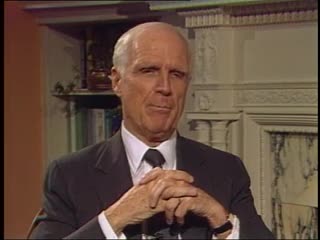
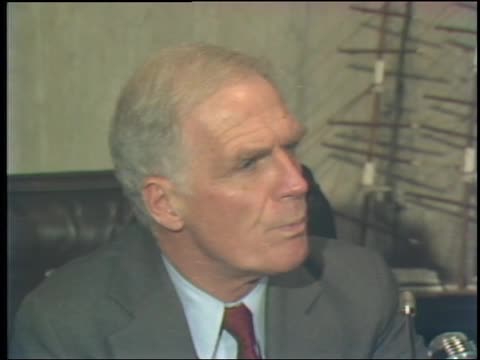
Description: Kevin White sworn in as mayor of Boston by Chief Justice Edward Hennessey. City councillors take oath. Strand Theater exterior. reel one
Collection: Ten O'Clock News
Date Created: 01/07/1980
Description: MAYOR KEVIN WHITE INTERVIEW FINAL YEAR IN OFFICE. ON CORRUPTION, HUD AUDIT.
Collection: Ten O'Clock News
Date Created: 12/16/1982
Description: Interview with former Boston mayor Kevin White, musing about his political career.
Collection: Ten O'Clock News
Date Created: 05/30/1991
Description: Interview with Mayor Kevin White on the Boston mayoral race. He discusses resolving problems within neighborhoods/communities, departments, politics.
Collection: Ten O'Clock News
Date Created: 12/22/1978
Description: Press conference at City Hall. Boston Mayor Kevin White and Police Commissioner Robert DiGrazia read prepared statements about the following day's school opening in the third year of court-ordered busing. White expresses confidence in a peaceful opening of schools. DiGrazia says that police have been instructed to use minimum force, but to act decisively against any disruptions of public order. Both men hope that police can be removed from schools as soon as possible. White notes that the atmosphere seems calmer this year than during the previous two years. White says that he would like to remove police from the schools as soon as possible because their presence hinders the development of a healthy learning environment. Reporters question them on the school opening. Shots of Pam Bullard listening to the press conference.
2:09:33: Visual: Members of the press are assembled for a press conference at City Hall with Kevin White (Mayor, City of Boston) and Robert DiGrazia (Police Commissioner, City of Boston). White begins reading a statement, then stops because there is a problem with sound. 2:11:53: V: White reads a prepared statement. He says that school opens tomorrow; that fewer students face assignments to new schools this year; that more students are attending the schools of their choice; that many schools are benefitting from programs linked with universities and businesses; that three new schools are opening; that he is confident that the school year will be productive. White says that the city is prepared to guarantee the safety of all schoolchildren; that he hopes to reduce the police presence at the schools this year; that police will restore order if disruptions occur. White urges citizens to share in the responsibility for a peaceful school opening; that the city will focus on improving schools this year. 2:14:32: V: DiGrazia reads a prepared statement. He expresses confidence in a peaceful school opening. He reports that police have received instructions to allow peaceful demonstrations, but to maintain public order; that police officers have been instructed to use minimum force and to treat those arrested with respect and courtesy. DiGrazia says that police will not tolerate any acts of violence or disruption; that these acts are often committed by only a few citizens. 2:15:56: V: White invites questions from the reporters. A reporter asks DiGrazia what kind of preparations have been made for additional police support. DiGrazia says that Massachusetts State Police will be assigned to South Boston; that MDC Police will be assigned to Charlestown; that US Marshals will be present for the opening of schools. DiGrazia says that the atmosphere on the streets seems calm; that a few citizens are engaging in disruptive behavior; that the atmosphere seems calmer than in the previous two years; that police presence will be less visible than last year; that additional police will stand by for support. DiGrazia says that the police have not received any indication that there will be outside agitators at the schools. DiGrazia says that he hopes there will be little overtime for police officers this year. DiGrazia says that uniformed State Police officers will be assigned to South Boston High School; that community service officers and juvenile officers will be assigned to monitor the other schools. 2:18:52: V: A reporter asks about cooperative efforts between the School Department, the city of Boston, and the Police Department. White says that the three entities have been working together on school desegregaton for three years; that differences about the school budget have not affected efforts to achieve a successful school opening. DiGrazia says that police will continue to enforce ordinances forbidding the assembly of more than three people along a bus route, or assemblies within 100 yards of schools. Shot of Pam Bullard. White says that he would like to remove police from schools as soon as possible; that police presence hinders a healthy learning atmospheres; that police can be removed if citizens refrain from disrupting the schools. A reporter asks DiGrazia to clarify the term "minimum force" in police conduct. DiGrazia says that he hopes police can dissuade citizens from engaging in disruptive behavior; that he would like to see the police removed from the schools as soon as possible. DiGrazia refuses to elaborate on minimum tolerance policy guidelines, but says that warnings will be given to disruptors before action is taken. DiGrazia says that the school department instituted the use of metal detectors at the schools; that they will be used again this year. DiGrazia refuses to give out information on the number of police officers assigned to the schools
Collection: Ten O'Clock News
Date Created: 09/07/1976
Description: Kevin White after grand jury on George Collatos.
Collection: Ten O'Clock News
Date Created: 10/28/1981
Description: Christopher Lydon interviews cultural historian Kiku Adatto (Harvard University) about Jesse Jackson as a presidential candidate. Lydon's interview with Adatto is accompanied by footage of Jackson throughout his political career. The footage illustrates Jackson's dynamic style of speaking. Adatto notes that Jackson is a religious figure in the political arena. She notes that Jackson's energy and moral fervor are more suited to a preacher than a politician. She says that Jackson's strength lies in his ability to articulate social criticism. Adatto says that many voters see Jackson as an outsider or a social critic instead of as a politician; she adds that some voters may not be able to envision him as president. Lydon's report also includes footage of Martin Luther King, Jr. (American civil rights leader) and Andrew Young (Mayor of Atlanta).
1:00:02: Christopher Lydon interviews Kiku Adatto (Harvard University) about Jesse Jackson (candidate for the Democratic nomination for US President). Adatto talks about the tradition of preachers in American history. She says that many of these preachers, including Martin Luther King (civil rights leader) and Jackson, have become political leaders. Visual: Shot of a black and white photo of Jackson on a balcony with King. Black and white footage of King giving a speech. Shot of a black and white photo of Jackson in a crowd, raising his arm in the black power salute. Adatto says that Jackson has tried to pick up the mantle of King; that Jackson has tried to be the "conscience of America" in the way that King was. V: Footage of Jackson addressing a crowd at Harvard University on April 4, 1985. Jackson talks about the evils of apartheid. Adatto says that there is a tradition in the US of the preacher staying outside of politics; that Jackson has tried to move into the political system in order to effect change. V: Footage of Jackson passing a lobby of a building. He shakes hands with African American bystanders. Jackson enters a room full of supporters. Adatto says that Jackson is concerned with equality and civil rights; that Jackson has been caught exhibiting prejudice against Jews; that Jackson was linked with Reverend Louis Farrakhan (African American Muslim leader). V: Shots of newspaper articles detailing the controversy surrounding Jackson's remarks about Jews in 1984. Adatto adds that the preacher must remain "morally sound" when entering the political arena. V: C-Span footage of Jackson addressing the Democratic Convention in 1984. Adatto says that Jackson has an "insider-outside dilemma"; that Jackson finds it difficult to make the compromises required by electoral politics. Adatto notes that Andrew Young (Mayor of Atlanta) made an easy transition into electoral politics. V: Shot of Young at a press conference in Boston in 1983. Adatto notes that Jackson has lost none of his energy or "moral fervor"; that Jackson still criticizes society from an outsider's point of view. Adatto adds that Young is an "insider." V: Shot of Young at a press conference. Adatto says that Jackson strength lies in his ability to articulate social criticism. V: C-Span footage of Jackson addressing the Democratic Convention in 1984. Shots of audience members. Adatto says that Jackson stirs the emotions of voters in his "outsider" role; that Jackson troubles many voters in his "insider" role. Adatto notes that Jackson's role as social reformer and critic undermines his strength as a presidential candidate; that many voters cannot envision Jackson as president. Adatto notes that many of the nation's great presidents have been calm and quietly strong; that some see Jackson as too much of a preacher; that Jackson's energy and moral fervor are more suited to preacher than politician. V: C-Span footage of Jackson addressing the Democratic Convention in 1984. Adatto says that some see voters as too much of an outsider, social critic or civil rights leader; that some white voters are turned off by Jackson. Adatto quotes statistics from a study which found that 23% of American voters are not ready to vote for any African American for president. V: C-Span footage of Jackson addressing the Democratic Convention in 1984. Adatto says that Jackson has the ability to stir the emotions of the American people; that he is most powerful in his role as "outsider" or critic. Adatto says that many voters are stirred by his message, but cannot envision him as president because he is an outsider. V: Footage of Jackson announcing his candidacy for president in 1988. His supporters stand behind him, cheering. Jackson promises "bold leadership."
Collection: Ten O'Clock News
Date Created: 10/16/1987
Description: Harvard cultural historian Kiku Adatto analyzes images and problems of veterans. Stills of Vietnam Veterans Memorial in Washington DC.
Collection: Ten O'Clock News
Date Created: 11/11/1987
Description: Boston mayoral candidate Robert Kiley is flanked by his campaign team: Jim Marcelino, Dan Payne, Pat Caddell. Press conference on his prospects, recognition, and fundraising progress.
Collection: Ten O'Clock News
Date Created: 05/10/1983
Description: Three composers at Harvard, Earl Kim, Peter Liebersohn, James Yannatos, briefly describe their respective compositions and their missions in new music.
Collection: Ten O'Clock News
Date Created: 02/06/1986