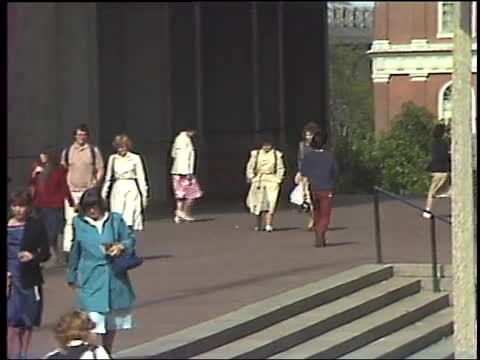
Description: Boston College's 103rd commencement. Walter Mondale speaks to press on strategic arms reduction, before addressing Boston College commencement. He states the need to ratify the recently concluded strategic arms agreement with the Soviet Union. Graduates of the class of 1979 file onto field while band plays. Views of crowd, graduates. Speech welcoming friends and family.
Collection: Ten O'Clock News
Date Created: 05/21/1979
Description: David Boeri reports on the Bank of Boston's new mortgage program for low- and moderate-income city residents. President of Bank of Boston Ira Stepanian and Robert Mahoney announcing the new program to the media at a press conference at a Roxbury branch of the Bank of Boston. Boeri reviews the terms of the program. He notes that many houses in the area are not eligible for the program because their sale prices are too high. Interview with Roxbury resident Diana Strother, who says that many residents do not make enough money to take advantage of the program. Interview with Leon Wilson from the Bank of Boston about the terms of mortgages under the program. Boeri notes that the units in the Fort Hill condominium complex are too expensive to qualify for the Bank of Boston program. Interview with Boston resident Alvin Wilkins and realtor Eve Moss about housing prices in the area. Interview with Bruce Marks from the Hotel and Restaurant Workers Union. Marks calls the Bank of Boston program a "public relations scam" if it does not truly help low-income residents with followup steps.
1:00:03: Visual: Footage of Ira Stepanian (President, Bank of Boston) speaking to the media at a Roxbury branch of the Bank of Boston. Stepanian says that the Bank of Boston would like to help to solve some of the city's problems. Shots of media and audience members listening to Stepanian. David Boeri reports that Stepanian talked about the Bank of Boston's new mortgage program for city residents. Boeri notes that the new program is called First Step With Rate Advantage. Boeri describes the terms of the mortgages offered under the program. Boeri reports that the first year's rate is 8.65%; that the maximum purchase price cannot exceed $140,000 for a single unit; that the maximum purchase price cannot exceed $185,000 for a two-family home; that the maximum purchase price cannot exceed $225,000 for a three-family home. Boeri notes that individuals making $35,000 or less are eligible for the program; that families making $45,000 or less are eligible. V: On-screen text details the terms of the mortgages offered under the program. Footage of Robert Mahoney (Bank of Boston) addressing the audience at the Roxbury branch of the bank. Mahoney says that the program serves the needs of a certain segment of the population. Shots of African American women in the audience. Boeri notes that some Roxbury residents say that the program is out of reach for them. V: Footage of Diana Strother (Roxbury resident) saying that Roxbury residents pay the highest rents in the city; that the average income in Roxbury is $15,000. Strothers says that most Roxbury residents do not make enough to take advantage of the program. Footage of Leon Wilson (Bank of Boston) being interviewed by Boeri. Boeri notes that it is difficult to find a house for $140,000 in this neighborhood. Boeri asks about monthly mortgage payment on a $140,000 house. Wilson says that residents would pay $1,100 per month if they made a downpayment of $14,000. Boeri reports that it is hard to find houses which meet the eligibility requirements of the program. V: Shot of a condominium complex in Fort Hill with units for sale. Shot of Boeri talking to a small group of people on the front porch of one of the Fort Hill condominium buildings. Boeri notes that condominium units in a Fort Hill development are selling between $149,000 and $165,000. Boeri notes that the condominiums do not meet the eligibility requirements of the Bank of Boston program; that the condominiums are not affordable for many residents. V: Shot of homes on a residential street. Footage of Alvin Wilkins (Boston resident) being interviewed by Boeri. Boeri asks Wilkins if it is possible to find homes for $140,000 in the area. Wilkins says that homes selling at $140,000 need a lot of repair. Wilkins says that it is impossible to find a home which is ready to move in to at that price. Footage of Eve Moss (realtor) saying that the average mortgage payment for one of the Fort Hill condominiums is $1,200. Moss says that it is difficult to make those mortgage payments on a salary of $45,000 or less. Footage of Wilson saying that the Bank of Boston is trying to provide an opportunity for some people to own a home. Footage of Bruce Marks (Hotel and Restaurant Workers Union) says that the Bank of Boston is pulling a public relations scam if they are trying to bill the program as an example of a low- and moderate-income home ownership program. Marks says that he would like to see a program which is truly aimed at low- and moderate-income people. Footage of Mahoney addressing the audience at a Roxbury branch of Bank of Boston. Boeri reports that many hope the program's next step will be a bigger one.
Collection: Ten O'Clock News
Date Created: 05/10/1989
Description: This tape includes a short piece documenting a celebration at the Grand Concourse in South Station. Students and city officials celebrate the unveiling of a mural created by Sidewalk Sam and Boston elementary-school students. The mural is made up of personal drawings by students and it celebrates ethnic diversity and racial harmony in Boston. A choir of students performs in South Station. A city official congratulates the students. Sidewalk Sam leads students in a cheer. This tape includes additional footage of the celebration at South Station. Ray Flynn looks on as a student choir performs. Additional footage includes shots of the mural
1:00:30: Visual: Shot of a man conducting a children's choir. The children begin to sing. Shot of a sign reading, "Boston youth celebrate ethnic diversity and harmony." Shots of students in the choir. Footage of a city official speaking from a podium. The official says that the children are promoting racial harmony and peace. Footage of students singing in the choir. Shots of a large mural created by elementary-school students in the Boston Public School System. Shots of students waving at the camera. Shots of a section of the mural, hanging in the Grand Concourse of South Station in Boston. Shots of students in the choir. Shot of Robert Guillemin (artist), also known as "Sidewalk Sam" leading the students in a cheer. Shots of the mural; of the individual drawings making up the mural.
Collection: Ten O'Clock News
Date Created: 05/15/1990
Description: News story about Coolidge Corner Theater Foundation's efforts to save Coolidge Corner Moviehouse from conversion into retail space after sale of property to developer. Conran's at Exeter furniture store was theater owned by same developer and converted into retail space. Reporter talks about Moviehouse's history and threats to its business including video rental stores and Loews theaters. Richard Fraiman, owner of Capitol Theatre in Arlington, argues for relevance of neighborhood theaters. Shots of Capitol Theatre renovation. shots of Coolidge Corner Theater's art deco interior design. Following edited story are b-roll shots of Conran's at Exeter exterior, Coolidge Corner Moviehouse marquee; interior detail shots of art deco design in Coolidge Corner theatre.
Collection: Ten O'Clock News
Date Created: 09/01/1989
Description: E. Edward Clark, a ninety-two-year-old African American man, speaks to a racially integrated class at the Hennigan Elementary School. The son of slaves, Clark tells vivid stories about his family's experiences in the south following emancipation and about growing up in Cambridge. He stresses the importance of a good education and respect for people of all races. The students ask Mr. Clark questions. Tape 1 of 2.
1:00:00: Visual: E. Edward Clark speaks to a racially integrated class at the Hennigan school. Clark describes the lives of his parents, who were slaves. Clark's father bought his freedom eight years before emancipation. His father bought the freedom of his mother, then the two were married. Clark's parents had 13 children. Clark describes the schools he attended as a boy, and the good education he received from New England missionaries who traveled south to teach former slaves. Clark describes race relations in the south after the Civil War. Clark says that his family moved to a cold-water flat at 143 Erie Street in Cambridge in 1898. Clark talks to the students about the importance of a good education and respect for others; about his impressions of how the world has changed. Clark warns the students that an education will prepare them to make a living later on. He reminds the students that the teachers are there to help them. Clark describes growing up in Cambridge in the early part of the century. He describes how the city has changed and how little things cost back then. 1:18:32: V: Clark invites the students to ask him questions. One student asks him about the secret to long life. Clark says that his parents were healthy; that he does not drink or smoke; that he does not believe in hate or violence. Clark stresses again that an education is necessary for success in life. Another student asks Clark if he was ever married.
Collection: Ten O'Clock News
Date Created: 04/27/1977
Description: E. Edward Clark, a ninety-two-year-old African American man, speaks to a racially integrated class at the Hennigan Elementary School. The son of slaves, Clark answers questions from the students, and tells them vivid stories about his family's experiences in the south following emancipation and about growing up in Cambridge. Clark talks about his family and authenticating information about his family's history. He encourages the students to get a good education while they're in school. Tape 2 of 2. The original tape was damaged, and has been copied in sections. There are several jump cuts on the tapes dubbed from the original.
1:00:01: Visual: E. Edward Clark speaks to a racially integrated class at the Hennigan school. A student asks Clark how he found out so much about his background in Wilmington, North Carolina. Clark says that his mother and father talked a lot about the family background; that he was born in Wilmington, North Carolina. Clark says that he and his daughter visited Wilmington to find out facts about his family. Shot of a white female student in the classroom; of another white female student in the classroom. Clark says that he found a US census from the nineteenth century. Clark says that he found a listing for a slave in Wilmington; that he found a listing for his mother. Clark talks to the students about the Boer War in South Africa. Clark says that part of his family came from an area near Capetown, South Africa. A young white male student asks how much Clark's father paid for his freedom. Clark says that his father paid between $400 and $650. Clark says that $650 back then is like $5,000 today. A young white boy asks if free black people could get the same jobs as white people. Clark says that African Americans could not get the same jobs as white people in North Carolina. Clark says that there are now state and federal laws which force employers to hire people regardless of their race, creed or color. Clark says that his daughter's husband is the only African American judge in the Boston Municipal Court system; that his son is a colonel in the US Army. Clark says that African Americans who are educated and qualified can get jobs anywhere. Clark says that the south is better than the north today; that there are fewer problems with school desegregation in the south. Clark tells the students to get a good education in school. Clark says that the students can be whatever they want if they get a good education. Clark tells the students that Martin Luther King Jr. (civil rights leader) and Frederick Douglass (abolitionist) were both "doctors." Clark says that his son-in-law has a doctorate of law from Boston University. Clark tells the students that they have to be ready. Clark recites the saying about "building a better mousetrap." Clark says that the students will succeed if they are ready. 1:06:05: V: An African American female student asks Clark how many children he has. Clark says that he has five children. Another African American female student asks Clark about his job as a cook and waiter. Clark says that most of the waiters in Boston are white; that waiters are looking for good tips. Clark says that waiters do not have to associate with their clientele. Shot of a female teacher in the room. A white boy asks why Clark was not a slave if his parents were slaves. Clark says that he was born after emancipation. Clark says that he was born nineteen years after emancipation. Another white male student asks Clark if he would live his life differently if given the chance. Clark says that he would live the same life again. Clark says that he would not have his wife and children if he had lived his life differently. Clark tells the student that nothing in life is free. Clark says that he worked and paid his dues. A white female student asks Clark how old he was when he started working. Clark says that he started to work when he was twelve. A white male student asks Clark if his father fought in the Civil War. Clark says that his uncle fought in the Civil War. Clark says that he has a citation from the US State Department saying that a member of the Clark family has fought in every major American war. Clark says that he fought in WWI; that his son fought in WWII; that another son fought in the Korean War and the Vietnam War. The student asks if the Clark family documents are worth money. Clark tells the students that a person is not educated if he or she does not understand tolerance. Shot of an African American male student. Clark tells a student that he needs to judge people by their abilities; that people should not be judged by their race, creed, or color. A white female student asks Clark how his family traveled from North Carolina to Boston. Shot of a white male student. Clark says that a steamship traveled between Wilmington and New York; that most shipping, trade, and commerce was done by ship.
Collection: Ten O'Clock News
Date Created: 04/27/1977
Description: Evelyn Murphy addresses women political activists on abortion rights at a celebration of the 17th anniversary of Roe v. Wade. She pledges to uphold pro-choice stand. National Organization of Women (NOW) goes after Frank Bellotti for only recently switching to pro-choice position for political reasons. Interview with Murphy, and footage of Murphy at a campaign rally. B-roll follows of speakers and audience members at the anniversary celebration, and abortion rights picket line in front of Domino's Pizza in Cambridge.
Collection: Ten O'Clock News
Date Created: 01/22/1990
Description: Grand lobby, interior of Music Hall. Ornate chandelier, marble columns, heavenly mural. Gilded architectural details — carved moldings, capitals, medallions, angels. Interview with Harry Lodge, who gives history of Music Hall (formerly Metropolitan Theater), originally designed in 1920s by Clarence Blackhall for Vaudeville and movies. Describes the proposed restoration program to be completed in fall 1980 if lease secured and funds raised. In order to bring the Metropolitan Opera to Boston, the theater needs deeper stage for performing arts, updated communication systems, ventilation systems, and a renovated auditorium (seats 4,300). The theater is used for ballet, concerts, movies. Lodge states that this renovation with revitalize Boston as a major center for the performing arts. Lodge shows a drawing of the proposed plan.
Collection: Ten O'Clock News
Date Created: 06/21/1977
Description: Some deteriorated sound quality and some video corruption. Staff meeting on the revitalization of Massport. Meeting leader briefly mentions an accident of a cargo ship approaching Boston. He provides an update on the current business and port operations. Multiple other speakers. Massport Mystic container terminal in Charlestown. Rows of shipping containers stacked upon each other.
Collection: Ten O'Clock News
Date Created: 11/30/1976
Description: Footage of Massachusetts Port Authority Mystic container terminal in Charlestown. Hundreds of large shipping containers packed together in rows and stacks; vehicles moving and arranging containers. High shot of cranes and fork lifts moving and lowering containers by waterfront.
Collection: Ten O'Clock News
Date Created: 07/20/1976