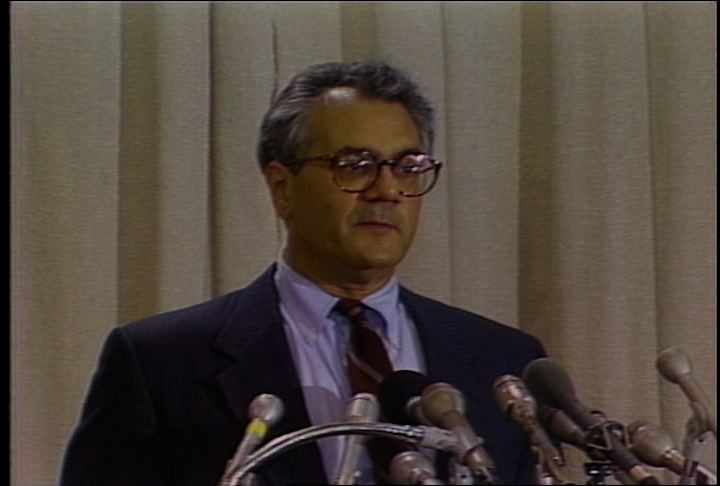
Description: Jan von Mehren reports that Rev. Graylan Hagler of the Church of the United Community has been critical of the Boston Police Department's stop-and-search policy in Roxbury. Hagler has proposed that graduates of the police academy spend 18 months working as coaches and counselors in the community. Interview with Hagler, who says that police officers and the community would benefit from a stronger relationship. He adds that the police must take a more innovative approach to fighting crime in the area. He also says that police officers and young people need to form a partnership. Von Mehren notes that critics do not believe that Hagler's plan is feasible.
1:00:07: Visual: Footage of the Reverend Graylan Ellis-Hagler (Church of the United Community) walking on a street in Roxbury with two African American men. Shots of the exterior of the Church of the United Community; of a sign for the Church of the United Community. Jan von Mehren reports that Ellis-Hagler spends a lot of time on the Roxbury streets. Von Mehren notes that Ellis-Hagler moved his church into a building where drug addicts were regularly shooting up. Von Mehren reports that the church is one of the most active community centers in Roxbury. V: Shots of men standing outside of the church. Two men exchange a hug as a greeting. Shots of a Boston Police Department cruiser on the street outside of the church. Shots of Ellis-Hagler and a group of people entering the church. Von Mehren reports that Hagler has been critical of the Boston Police Department's stop-and-search policy in Roxbury. V: Footage of Ellis-Hagler being interviewed by von Mehren. Ellis-Hagler says that people feel less safe on the street than they did five years ago. Ellis-Hagler says that the police need to try out some new tactics in fighting crime. Ellis-Hagler talks about a proposal he submitted to the Boston Police Department. Hagler says that he has recommended that first-year police officers not be put on the street immediately. Ellis-Hagler says that first-year police officers should have an "intern" relationship with the community. Shots of Boston police officers making drug arrests on the street; of African American kids playing basketball on an outdoor court; of the snowy parking lot of a housing development. Von Mehren reports that Ellis-Hagler wants graduates of the police academy to spend 18 months working as coaches and counselors in the community. V: Footage of Ellis-Hagler saying that most police officers are concerned about the community. Ellis-Hagler says that many police officers realize that an more innovative approach is necessary. Shots of a group of police officers on the street; of a police officer sitting on a motorcycle; of police officers at police headquarters. Von Mehren reports that the police commissioner has not responded to Ellis-Hagler's plan. Von Mehren notes that many citizens are calling for more police protection; that some may not like Ellis-Hagler's idea of employing police officers as coaches and counselors. Von Mehren reports that Ellis-Hagler believes that his plan will result in more effective police officers. V: Shots of Ellis-Hagler talking with a group of African American men at his church. Shots of the individual men in the group. Shot of a group of men standing outside of the church. Ellis-Hagler exits the church and embraces one of the men. Audio of Ellis-Hagler saying that the police depend on cooperation from the community to solve crime. Footage of Ellis-Hagler saying that young people are a good source of information for police officers; that young people know where and when drug activity takes place. Ellis-Hagler says that the police officers should form a partnership with young people; that both sides would benefit from the relationship. Von Mehren stands in the meeting hall of the Church of the United Community. Von Mehren reports that Ellis-Hagler will hold a community summit next Monday; that Ellis-Hagler will discuss his police partnership proposal. Von Mehren says that Ellis-Hagler is pushing the proposal; that some do not believe the plan is feasible.
Collection: Ten O'Clock News
Date Created: 12/15/1989
Description: Carolyn Sawyer reports on Reverend John Borders of the Morningstar Baptist Church, and his efforts to reach out to his community. Borders has conducted at least 15 funerals for teenagers who have died as a result of street violence. Interview with Borders, who talks about the problem of violence in the community. He expresses sadness at the number of young people caught up in the violence. Borders says that adults need to spend more time with young people; he adds that teenagers need to know that someone cares about them. Borders talks about his hopes for positive changes in the community. Sawyer's report includes footage of Borders at his church and footage of Borders at his children's school. Sawyer's report also includes footage from the funeral of Charles Hardison and footage of victims of street violence. Following the edited story is b-roll of the Blue Hill Avenue environs near the Morningstar Baptist Church.
1:00:01: Visual: Footage from the funeral of Charles Hardison (Milton teenager) at Ebenezer Baptist Church in Milton. Pall bearers bring the coffin out of the church. Mourners stand outside the church. Shots of African American and white teenagers standing outside of the church; of teenagers consoling each other with hugs. Shot of two white girls hugging an African American boy. Audio of Reverend John Borders (Morningstar Baptist Church) talks about the heartbreak caused by the violent deaths of teenagers. Borders says that he wants peoples' hearts to break when they hear about these tragedies. Footage of Borders and a young African American man praying in a church. Carolyn Sawyer reports that Borders prays for peace in a community afflicted by crime. Sawyer reports that Borders has conducted at least 15 funerals for teenagers who have died. V: Shot of Border's clasped hands as he prays. Footage of Borders being interviewed. Borders recalls some of the funerals of local teenagers. Shot of Borders walking to his car; of Blue Hill Avenue near the Morningstar Baptist Church. Sawyer reports that Borders grew up not far from the church; that Borders had a career in music before entering the ministry. V: Shots of residential homes in Mattapan. Footage of Borders being interviewed. Borders says that there has been a growth of evil in the neighborhood and a decline in values. Borders says that there is a lack of respect for human life. Footage of Borders at a local school. He speaks to a teacher. Borders speaks to a child standing with other children. Sawyer reports that Borders is 32 years old; that Borders has three children of his own. V: Footage of Borders saying that adults need to turn off the radio and the television; that adults need to spend time with young people. Borders says that parents needs to question where kids are getting money if the kids do not have jobs. Borders says that parents need to ban drug money from their homes. Shots of an African American man pulling a shopping cart along a street; of two African American men standing on a sidewalk. Shot of Borders speaking on the telephone. Sawyer reports that Borders preaches for people to return to the community. V: Footage of Borders being interviewed. Borders says that young people need people who care. Borders says that gang members care about other gang members; that some teenagers do not think that anyone else cares. Shot of Borders hand as he speaks on the telephone. Footage of Borders speaking on the phone. Sawyer reports that Borders puts his faith in change; that Borders wants the church to play a role in future changes. V: Shot of Borders in the church. Borders in on his knees as he prays. Footage of Borders being interviewed. Borders says that people will tire of the murder and violence; that people will turn to God. Borders says that the church will play a prominent role in the community. Shots of a body on a stretcher as it is wheeled toward an ambulance; of paramedics tending to an African American woman. Shots of paramedics putting an African American man on a stretcher; of a police cruiser turning a corner.
Collection: Ten O'Clock News
Date Created: 12/17/1990
Description: Revere Sugar processing plant in Charlestown. Loose sugar offloaded by crane from ship onto conveyor belt. Exteriors of plant with silos and chutes. Charles Bennett does several takes of reporter standup about sugar growers seeking protection from foreign competition.
Collection: Ten O'Clock News
Date Created: 07/12/1982
Description: Charles Bennett interviews man from Revere Sugar about the United States quotas on the importation of sugar and the production of sugar at the Revere plant. Discussion of sugar industry while cutaways are being shot. Exteriors and interiors of Revere Sugar processing plant in Charlestown. Very long shiny Coca-Cola tank truck. Cardboard packaging being formed by machine. Sugar pours from large spout to fill boxes. Sealed boxes pass along assembly line. Five-pound paper sacks filled.
Collection: Ten O'Clock News
Date Created: 07/12/1982
Description: Interview with Mr. Delaney of Revere about storm flood damage to his waterfront home in the Beachmont section during major blizzard. Snow inside home with furniture askew. Exteriors of the house, car, and the neighborhood. Drive down street past detour sign, hazard sawhorses, dirty, crusty snow piles, BostonGas repair trucks. Tide breaking against rocky barrier.
Collection: Ten O'Clock News
Date Created: 02/13/1978
Description: Carmen Fields reports that Richard Taylor, the Massachusetts Secretary of Transportation and Construction, will preside over the Central Artery/Third Harbor Tunnel Construction Project in Boston. Taylor is one of the few African American Republicans in Massachusetts. Interview with Taylor, who talks about his reasons for being a Republican and his career in business. Taylor talks about his commitment to affirmative action and his plans to encourage participation by women and minorities in the Central Artery/Third Harbor Tunnel Project. Taylor says that he has always pushed for fair and equitable opportunities for minority businesses. Fields notes that Taylor says that his appointment signals a commitment to affirmative action on the part of Governor William Weld. Fields' report is accompanied by footage of Rev. Graylan Hagler and unemployed construction workers at a press conference at a construction site in Roxbury. This edition of the Ten O'Clock News also included the following item: Alexandra Marks interviews businessmen Derek Jeter and William Singleton on the challenges faced by minority businesses in Boston
1:00:03: Visual: Footage of Richard Taylor (Secretary of Transportation and Construction) being interviewed. Taylor says that he supports limited taxes, limited regulation, more research, and development and more private sector involvement. Carmen Fields reports that Taylor is a wealthy, well educated entrepreneur; that Taylor is a Republican; that Taylor is also African American. Fields reports that Taylor is part of a small but growing band of African American Republicans. V: Shot of Taylor in his office. Footage of Taylor being interviewed. Taylor says that some have argued that all African Americans should be Republicans; that Abraham Lincoln (former US president) was a Republican. Taylor says that he believes in limited taxation and limited government involvement. Taylor says that the Republican Party encourages people to pursue economic independence; that the Republican Party discourages people from looking to the government for sustainment. Fields reports that Taylor is the State Transportation Secretary; that he presides over the Central Artery-Third Harbor Tunnel Construction Project. V: Shot of Taylor greeting an African American man and a white man as they enter his office. Footage of Taylor at a meeting with the two men and another woman. Taylor talks about the risk of delays in the project. Fields reports that Massachusetts has a high unemployment rate; that the construction project will provide jobs. Fields notes that the Republican Party is often viewed as being anti-minority, anti-women, and anti-civil rights. V: Shots of Taylor at the meeting. Footage of Taylor being interviewed by Fields. Fields asks Taylor if he is against affirmative action. Taylor says that affirmative action is necessary. Taylor says that minority businesses should participate in the project if it strengthens their skills; that minority businesses should be paid for a job well done. Taylor says that affirmative action helps minority businesses be competitive; that affirmative action is part of the remedial process. Taylor says that some affirmative action models are troublesome. Taylor says that he does not support quotas. Taylor says that some affirmative action models do not give minority businesses enough significant responsibility. Fields asks if he will be a reluctant or an enthusiastic supporter of affirmative action. Taylor says that he is inclined to have active and strong participation by women and minorities. Taylor says that he has always pushed for fair and equitable opportunities for minority businesses. Taylor talks about his career in business before entering government.Taylor says that he will do a good job in this area. Fields reports that Roxbury residents halted construction on a new Post Office facility in Dudley Square recently. Fields notes that residents wanted more jobs for community workers on the project. V: Footage of Graylan Ellis-Hagler (Church of the United Community) speaking at a press conference held at the construction site of the new Post Office in Dudley Square. A group of African American men stand behind Hagler. Hagler says that he and the men will not go away with "crumbs." Shots of the construction site. Fields notes that Taylor says that he has learned from the experience in Roxbury. V: Footage of Taylor being interviewed by Fields. Taylor says that the MBTA recently began a $9 million project to renovate Dudley Station. Taylor says that he incorporated some recent provisions from the Post Office project into the MBTA project. Turner says that it is important for the major contractor to be in agreement with the provisions of the contract. Turner says that he hopes that these provisions will be used in the Central Artery Project. Fields reports that Taylor says that his appointment signals the commitment of William Weld (governor of Massachusetts) to affirmative action. Fields notes that Turner believes that there are many opportunities for qualified people of color. V: Shots of Taylor in his office. Footage of Taylor being interviewed by Fields. Taylor talks about a recent business seminar at the Boston World Trade Center. Taylor says that the seminar focused on how minority businesses could participate in the Central Artery Project. Taylor says that he will soon meet with major contractors for the Central Artery Project. Taylor says that he hopes to link minority businesses with the major contractors in order to provide work for minorities.
Collection: Ten O'Clock News
Date Created: 03/29/1991
Description: Robert Dole addresses Massachusetts building trades representatives. Speaks about construction industry, real estate, and inflation. Defends President Ford. Makes several jokes and makes the audience laugh. Makes sarcastic comments about Jimmy Carter.
Collection: Ten O'Clock News
Date Created: 09/16/1976
Description: Video starts with people speaking over color bars. B-roll of Massachusetts Bay Transportation Authority advisory board meeting. Interview with Robert Foster, chair of MBTA. He is requesting a larger operating budget. He discusses the work done by the MBTA and their attempts develop a better relationship with the advisory board. He speaks of plans for transportation demands during Pope John Paul II's visit. They shoot cutaways. Interview with Ed Novakoff, advisory board representative from Brookline, who complains about green line LRVs, and does not support giving the MBTA a larger operating budget. Several takes of reporter standup in the MBTA lot, with buses in the background.
Collection: Ten O'Clock News
Date Created: 09/21/1979
Description: Interview with ICA director David Ross, discussing the late photographer Robert Mapplethorpe whose work is controversial for its erotic and gay subject matter. Discussion of his self-portraiture. Discussion of some members of Congress' attempts to censor the rotating exhibit. Ross argues for freedom of speech.
Collection: Ten O'Clock News
Date Created: 06/16/1989
Description: Meg Vaillancourt reports that Robert Mugabe (Prime Minister of Zimbabwe) was awarded an honorary degree from the University of Massachusetts at Amherst. Vaillancourt's report includes footage of Mugabe receiving his doctoral hood from Maki Mandela (daughter of Nelson Mandela) and footage from Mugabe's speech and press conference. Vaillancourt reports that Mugabe spoke out against apartheid in South Africa and advocated sanctions against the South African government. Vaillancourt reviews Mugabe's career. Comments on President Reagan's political actions concerning Apartheid. Vaillancourt's report includes footage of Mugabe in Zimbabwe.
1:00:06: Visual: Footage of Robert Mugabe (Prime Minister of Zimbabwe) speaking at the commencement ceremonies at University of Massachusetts in Amherst. Mugabe applauds the US Congress for considering sanctions against South Africa. Meg Vaillancourt says that Mugabe talked about sanctions against South Africa in his speech at UMass Amherst; that Mugabe was honored by the university for "his efforts to establish racial harmony between blacks and whites." Vaillancourt notes that Mugabe was presented with an honorary doctorate of laws. V: Shot of Mugabe receiving his doctoral hood from Maki Mandela (daughter of Nelson Mandela). Vaillancourt reports that Mugabe became Zimbabwe's first prime minister in 1980; that Zimbabwe had been known as Rhodesia under colonial rule. V: Shots of Mugabe and his cabinet in 1980; of white colonial rulers before 1980; of a newspaper headline reading, "Black Hitler." Vaillancourt reports that Mugabe was a fierce opponent of apartheid in neighboring South Africa; that Mugabe had spent ten years in prison before emerging as the leader of the Zimbabwean struggle for independence. V: Shots of Mugabe in the Zimbabwean Parliament; of Mugabe being led away by two police officers; of Mugabe entering a military garrison. Vaillancourt notes that Mugabe is a strong supporter of black South African leaders. V: Footage of Mugabe at a press conference. Mugabe says that he advocates using all legitimate means to overthrow apartheid; that he advocates armed struggle against South Africa. Mugabe says that he can understand the desire to fight apartheid using non-violent means. Mugabe encourages the use of "maximum non-violence" through sanctions and political pressure. Shot of the press at the press conference. Vaillancourt says that Mugabe dismissed concerns that sanctions would hurt South African blacks. V: Footage of Mugabe saying that black South Africans are already suffering and dying under apartheid; that black South Africans are prepared to suffer under sanctions because they will yield a positive result. Vaillancourt says that Mugabe was questioned about his leadership of Zimbabwe; that there have been accusations of human rights violations in Zimbabwe under Mugabe. V: Shots of Mugabe in a government building; of Zimbabwean troops uncovering an arms cache. Vaillancourt reports that Mugabe says that he has detained those who have tried to overthrow his government. V: Footage of Mugabe at the commencement ceremony. Mugabe says that the struggle for human rights is a universal struggle. Vaillancourt stands on the campus of UMass Amherst. Vaillancourt says that Ronald Reagan (US President) is trying to win enough votes in the US Congress to sustain his veto of sanctions against South Africa. Vaillancourt notes that Reagan is promising an African American ambassador to South Africa as part of his weaker sanctions package; that Reagan is expressing concern over a disruption of summit talks if sanctions are approved by Congress. Vaillancourt adds that Mugabe said that the time for compromise in South Africa is over.
Collection: Ten O'Clock News
Date Created: 10/01/1986