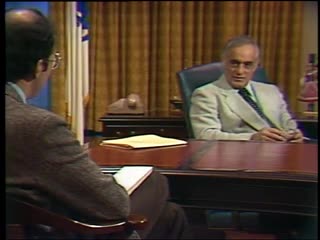
Description: IBM film on computer software that produces words on the screen by human speech recognition. Two speakers using technology to write memos. Demonstration of several features, like adding new words to the dictionary and editing previously written memos.
Collection: Ten O'Clock News
Date Created: 10/01/1984
Description: Carmen Fields reports that Captain William Pinkney is on a solo quest to sail around the five great capes of the world. Pinkney has already rounded three of the capes and children from around the world are tracking his voyages. Interview with Pinkney, who talks about his next voyage around Cape Horn. He says that he wants children from disadvantaged backgrounds to realize that it is possible to achieve one's goals through hard work and determination. Fields' report includes photos of Pinkney on his boat, footage of Pinkney addressing a group of people and footage from Pinkney's video logs of his journey.
0:59:24: Visual: Footage shot from a boat of rough seas. Footage of Captain William Pinkney (sailor) addressing a group of people. Pinkney says that he was told at age fourteen or fifteen that he had a bleak future. Pinkney says that he was told that he would probably be dead at age twenty from drugs or violent crime. Pinkney says that he was told that he would probably be incarcerated if he was not already dead. Shot from a boat of a sunset over the ocean. Footage taken by William Pinkney of his boat sailing into a harbor. Footage of Pinkney addressing the group. Pinkney says that his seventh grade teacher taught him not to believe what he was told. Carmen Fields reports that Pinkney set out from Charlestown Navy Yard on a boat last August; that Pinkney is on a quest to visit the five great capes of the world on his boat. Field reports that Pinkney has already rounded the Cape of Good Hope, Cape Leeuwin of Australia and the South East Cape under Tasmania. V: Shots of color photos of Pinkney in his boat. Footage of Pinkney being interviewed by Fields. Pinkney says that he has covered 14,000 miles so far; that he will wait out the winter in the Southern Hemisphere. Pinkney says that it is iceberg season in the Southern Hemisphere. Pinkney says that his next voyage will be from Hobart, Tasmania to Cape Horn. Fields reports that children from around the world are tracking Pinkney's voyage; that Pinkney is making the voyage in order to set an example for young people. V: Footage taken by Pinkney of a group of schoolchildren in Tasmania. The schoolchildren wave and say, "Hello America." Footage of Pinkney being interviewed by Fields. Pinkney says that a dream can become a goal through hard work. Pinkney says that the goal can become a reality if a person is willing to pay the price to succeed. Pinkney says that children from disadvantaged backgrounds, and other children, must learn that it is possible to achieve their goals and dreams. Fields reports that Pinkney's 47 foot boat is computer-equipped; that Pinkney was able to repair his own steering device at sea. V: Shots of the computer on Pinkney's boat; of rough seas surrounding Pinkney's boat. Fields reports that Pinkney believes that sailors must be resourceful when they are out at sea. V: Footage of Pinkney being interviewed. Pinkney says that his voyage taught him that the present time is what counts. Pinkney says that he never saw any media coverage of the Gulf War while at sea; that he was focused on his journey. Footage from Pinkney's video log from September 8, 1990. Shot of a sunrise near Bermuda. Fields reports that Pinkney will attempt to round Cape Horn next; that Cape Horn is one of the most difficult stretches of water in the world. V: Footage of Pinkney being interviewed. Pinkney says that Cape Horn is "the graveyard of ships"; that many clipper ships were lost there. Pinkney says that Cape Horn is a challenge for all sailors. Pinkney says that he looks forward to the challenge. Pinkney says that he is confident that he will do it.
Collection: Ten O'Clock News
Date Created: 05/22/1991
Description: St. Patrick's Day Lunch at Boys and Girls Club of Boston in South Boston. State Senator William Bulger speaks to the audience and tells jokes. Bulger sings Irish ballad "The Wearing of the Green." Tom McGee is on stage.
Collection: Ten O'Clock News
Date Created: 03/08/1984
Description: Ray Flynn, William Bulger, Thomas McGee, Joseph Casper, Jim Kelly, and Mike Flannery at Annual Saint Patrick's Day Lunch at the Boys and Girls Club of Boston, in South Boston. People eating at tables. People speaking to the crowd, telling anecdotes and jokes, and discussing drug and alcohol problems in South Boston.
Collection: Ten O'Clock News
Date Created: 03/08/1984
Description: Christopher Lydon interviews Sarah Small, who runs the Protestant Ministry at the University of Massachusetts Boston campus. Lydon and Small pray together before the interview. Small talks about her admiration for Martin Luther King, Jr. and her involvement in the civil rights movement. She says that she learned a lot about herself after spending time in jail for participation in the civil rights movement. Small talks about her commitment to helping those in need. She comments on the status of African Americans in US society. This edition of the Ten O'Clock News also included the following items: Banks agree to improve access to banking services in low-income neighborhoods and Julian Bond at Harvard University
1:00:10: Visual: Footage of Sarah Small (United Campus Ministries) being interviewed by Christopher Lydon at Packard Manse in Roxbury. Lydon reports that Small runs the Protestant Ministry at the University of Massachusetts Boston campus. Lydon says that Small grew up in rural North Carolina; that Small is a devout Christian. Lydon reports that their interview began with a prayer. V: Footage of Small and Lydon praying together as they hold hands. Footage of Small saying that she has always had great faith in God. Small says that she has always seen great leaders as humans. Small tells a story about how she refused to stand up for Lyndon Johnson (former US President), saying that she only stands up for Jesus. Small talks about how much she loved and admired Martin Luther King, Jr. (civil rights leader). Small says that King was a leader who was led by the holy spirit. Small says that King knew he had a limited time to accomplish his goals. Lydon reports that Small found her political and spiritual direction when she was in jail in the 1960s. V: Footage of Smalls being interviewed by Lydon. Small says that she ended up in jail a lot; that jail became a restful haven for her. Small says that she is thankful for having gone to jail. Small says that she overcame many fears through going to jail and through her participation in the civil rights movement. Small says that she realized that she is free to do what she wants and to not do what she does not want. Lydon reports that Small often played music for the crowds before King's speeches. Lydon notes that Small's front door at the Packard Manse is always open. V: Shots of Small playing the piano and singing; of three children clapping along with the music. Footage of Small talking about helping the less fortunate. Small says that she feeds and shelters those in need. Small says that she is not afraid to keep her door open, despite the violence on the streets. Small says that she does not own anything that she would not give away to someone else. Lydon reports that Small believes that people need to realize the complexity of real equality. V: Footage of Small being interviewed by Lydon. Small says that African American children learn things twice. Small says that African American culture is different from white culture; that African American children need to learn both cultures. Small says that African American children are not given credit for learning both cultures. Small says that one group of people should not be able to determine cultural standards. Small compares American culture to a vegetable soup. Small says that African Americans are the untapped resource of the US.
Collection: Ten O'Clock News
Date Created: 01/15/1990
Description: Hope Kelly reports that John Sasso, the former Chairman of Michael Dukakis' 1988 campaign, addressed members of the World Trade Club and spoke about the campaign. Sasso spoke about the Democratic Party, the role of Jesse Jackson, and the failure of the Dukakis campaign to win over voters. Sasso talks about the need for the Democratic Party to recognize Jackson's leadership. He also says that negative political advertising was not the reason for Dukakis's defeat. Kelly reviews Sasso's career and his role in the 1988 presidential campaign. She reviews Sasso's resignation from and return to the Dukakis campaign. Kelly's report includes footage of Dukakis and Jackson at the 1988 Democratic National Convention and footage of Sasso during the 1988 presidential campaign.
0:59:07: Visual: Footage of John Sasso (former chairman, 1988 Dukakis campaign) saying that he and Michael Dukakis (Governor of Massachusetts) are taking the time to reflect on the successes and failures of the campaign. Hope Kelly says that Sasso has been taking stock of the 1988 Dukakis campaign. V: Footage of Sasso addressing the World Trade Club. Sasso talks about the need to identify the lessons to be learned from the 1988 campaign. Kelly reports that Sasso says that the Democratic Party needs to recognize the role of Jesse Jackson (African American political leader). V: Shots of Jackson addressing a campaign rally; of Jackson greeting supporters in the street; of Jackson hugging a supporter. Footage of Sasso speaking at the World Trade Club. Sasso says that Jackson has "an original mind;" that Jackson is a "gifted motivator." Sasso says that the Democratic Party needs to find the courage and skill to relate properly to Jackson. Sasso says that Jackson will trouble the Democratic Party until they recognize his role. Shot of Jackson, Jaqueline Jackson (wife of Jackson), Dukakis, and Kitty Dukakis (wife of Dukakis) sitting together at an event in July, 1988. Shots of Dukakis; of Jackson. Audio of Sasso saying that Democratic Party leaders need to get organized to do a better job. Footage of Sasso saying that he does not agree with those who say that negative advertising played a big role in Dukakis's defeat. Kelly reports that Sasso believes that there was a fundamental failure on the part of the Dukakis campaign. V: Shots of the audience at the World Trade Club luncheon. Sasso says that the Dukakis campaign failed to make voters realize the need for a change in leadership. Kelly reports that Sasso reflected on the state of the Democratic Party; that Sasso made no reference to the personal feelings of himself or Dukakis. V: Shot of Dukakis speaking. Sasso stands at his side. Kelly reviews Sasso's role in the Dukakis campaign, including his resignation in September of 1987. V: Footage of a CBS news report from September of 1987. Dan Rather reports that the Dukakis campaign was responsible for damaging revelations about Joseph Biden (US Senator). Dukakis speaks from a podium. Dukakis acknowledges that Sasso provided tapes about Biden to the New York Times. Sasso appears at press conference to resign. Kelly notes that Sasso had also worked on the campaign of Geraldine Ferraro (former US vice-presidential candidate). V: Footage of Ferraro at a campaign rally. Shots of Dukakis and Ray Flynn (Mayor of Boston) sitting in the audience. Sasso whispers in Dukakis' ear, then moves away. Kelly reports that Sasso rejoined the Dukakis campaign after an 11-month absence. V: Footage of Sasso at a gathering. A woman says "Welcome home" to Sasso. Footage of Sasso speaking to the media after his speech at the World Trade Club. Sasso says that his absence from the campaign had nothing to do with Dukakis's loss.
Collection: Ten O'Clock News
Date Created: 01/19/1989
Description: Deborah Wang reports that Saundra Graham (State Representative from Cambridge) lost the Democratic primary election to Alvin Thompson (candidate for State Representative) by a thin margin. Wang notes that Graham has a lot of support among Cambridge voters despite her loss in the primary election. Wang notes that Graham has decided to wage a sticker campaign to run against Thompson as an independent candidate in the election. Wang notes that there is no Republican challenger in the race. Wang interviews Graham about her loss in the primary election and about the sticker campaign. Wang's report includes footage of Graham going door-to-door to campaign and to explain the sticker campaign to voters. Wang interviews Thompson about the race. Thompson criticizes Graham for engaging in negative campaign tactics. Wang notes that sticker campaigns are seldom successful and that some voters seem confused about the process. Wang interviews Cambridge voters on the street about the race. Voters were not aware of Graham's sticker campaign. This tape includes additional footage of Graham campaigning in Cambridge and footage of Graham's campaign headquarters.
1:00:10: Visual: Footage of Saundra Graham (State Representative from Cambridge) approaching the front door of a home in a residential neighborhood. Deborah Wang reports that Graham lost the primary election to Alvin Thompson (candidate for State Representative) by a thin margin. V: Footage of Graham being interviewed by Wang. Graham says that the loss was unexpected; that she lost the election by forty-nine votes. Graham says that her supporters were complacent; that her supporters expected her to win. Wang reports that Graham blames herself for not working harder to get her supporters out to vote. Wang reports that Graham has had strong support in Cambridge; that Graham is an advocate of rent control, day care, and affordable housing. Wang reports that Graham has had personal problems in the past year; that two of her sons were arrested on drug charges; that police accuse Graham's sons of dealing drugs out of Graham's house. V: Footage of Graham saying that her personal problems gave some momentum to her opponents. Footage of Alvin Thompson greeting a white man while campaigning door-to-door. Wang reports that Thompson is a long-time Cambridge resident. V: Shot of Thompson greeting two women in the street. Footage of Thompson saying that Graham cannot serve her constituents as both City Councillor and State Representative. Thompson says that the problems facing the city are complex; that one person cannot be in two places at once. Wang reports that Thompson is now the Democratic nominee; that Thompson has no Republican challenger. V: Shots of Thompson campaign signs and stickers. Wang reports that Graham has decided to wage a sticker campaign. V: Footage of Graham approaching the front door of a residential home. A woman answers the door. Graham explains how to vote for her with a sticker in the upcoming election. Graham hands the woman her campaign literature. Graham shakes the woman's hand and leaves the premises. Wang reports that sticker campaigns are seldom successful; that some voters are confused about the process. V: Footage of a white male voter saying that he will vote for Graham because she supports gay and lesbian issues. The man says that he was not aware of Graham not being on the ballot. Footage of another white male voter saying that he did not know that Graham would not be on the ballot. Footage of Graham approaching another home. Wang reports that Graham is waging a campaign to educate voters; that Graham has repeatedly attacked Thompson on his position on rent control and his refusal to engage in a debate with her. V: Footage of Graham saying that she does not understand why Thompson will not debate her. Wang reports that Thompson has complained about Graham's negative campaign. V: Footage of Thompson saying that he will not engage in negative politics. Shots of a Graham campaign sticker; of Graham's campaign headquarters.
Collection: Ten O'Clock News
Date Created: 11/02/1988
Description: Man gives scholarly history of theater architecture in Boston, commenting on Boston's Theater District - Saxon (Majestic), Colonial, Wilbur, Tremont, Music Hall (Metropolitan). Includes interior details of Saxon - red velvet curtains and rails; gilded rococo balconies; relief of fruit, flowers, leaves, masks, angels.
Collection: Ten O'Clock News
Date Created: 06/17/1977
Description: Hope Kelly reports that the Boston School Committee voted to restructure the student assignment system in the Boston Public Schools. She notes that the rigid geocode assignment system will be eliminated. School Committee members Thomas O'Reilly and Juanita Wade drafted a general plan that was accepted by the Committee. Some Committee members had reservations about the plan. Footage of the Boston School Committee meeting. Committee member John Nucci superintendent Dr. Laval Wilson speak out in favor of the plan. Committee member Jean McGuire criticizes the plan. Interview with Committee member John O'Bryant, who cautions the Committee not to act hastily. The members of the Committee vote on the plan. Three of the four minority members of the Committee voted against the plan. Interview with Wilson about the plan. Wilson says that he will work to resolve the concerns of Committee members who voted against the plan. The specifics of the plan have yet to be decided.
1:00:11: Visual: Shots of the members of the Boston School Committee seated at the front of the School Committee chambers during a meeting. Audience members are crowded into the room. Hope Kelly notes that the audience was packed into the chambers of the Boston School Committee for a meeting tonight. Kelly notes that the School Committee voted to eliminate the rigid geocode system of student placement. V: Footage of John Nucci (President, Boston School Committee) saying that the city has been waiting for a new plan for a long time. Footage of Dr. Laval Wilson (Superintendent, Boston Public Schools) saying that it is time for a change. Kelly notes that some School Committee members had reservations. V: Footage of Jean McGuire (Boston School Committee) saying that the new plan will restructure the school system. McGuire adds that the new plan does not implement great improvements. McGuire notes that the schools will still lack adequate foreign language programs, music programs, advanced studies programs, and computer access. McGuire says that the schools lack adequate funding. Kelly reports that some members were concerned about the hasty implementation of the new plan. V: Footage of John O'Bryant (Boston School Committee) saying that the city of Seattle has taken two full years to implement a similar plan; that the city of Boston needs to take its time. Kelly reports that School Committee members Thomas O'Reilly and Juanita Wade drafted a general plan; that the plan was approved by the members. V: Shots of Nucci, O'Reilly and Wade conferring before the vote. Shots of the School Committee members casting their votes for the plan. Kelly reports that ten members voted to approve the plan; that the plan was rejected by three of the four minority members of the School Committee. V: Footage of Kelly interviewing Wilson. Kelly asks if the vote broke down along racial lines. Wilson says that there was biracial support for the plan; that some African American members of the committee voiced concern over the plan. Wilson says that he will work to resolve those concerns before he returns to the School Committee with recommendations. Kelly stands in the School Committee chambers. Kelly reports that tonight's vote was an endorsement of a general plan; that the specifics of the plan have yet to be decided. Kelly notes that Wilson has until January to work out the specifics of the plan. V: Shot of School Committee members seated in the chambers.
Collection: Ten O'Clock News
Date Created: 12/28/1988
Description: Hope Kelly reports that Superintendent Laval Wilson must improve the reading skills of students in the Boston public schools. Students of all different races read a statement about the importance of literacy. Wilson speaks about the importance of reading skills at a press conference. He says that students are reading below target levels. This edition of the Ten O'Clock News also included the following item: Princess Zenani Dlamini and her husband Prince Thumbumuzi Dlamini will attend Boston University
1:00:00: Visual: Shot of a typed document. The first paragraph of the document summarizes the educational mission of the Boston Public Schools. The last line of the document reads, "For young people to be successful, they have to be literate." Footage of students of different ages and races reading the document. Hope Kelly reports that Dr. Laval Wilson (Superintendent, Boston Public Schools) believes that the Boston Public Schools must improve the reading skills of its students. V: Footage of Wilson at a press conference. Wilson says that students are reading below target levels. Footage of students reading the document. One boy has trouble with the word "literate." Kelly asks him what the word means. The boy answers correctly. Footage of an African American female student says that Wilson is right in saying that students need to be literate; of an Asian American male student saying that students must know how to read in order to get a good job. Footage of an African American male student and an Asian American male student standing together. Both boys say that students need to know how to read. Footage of Wilson says that not all of the schools are performing at the same level. Footage of an Asian American male student saying that he needs to read more books in order to become a better reader; of an African American male student saying that he is "a little good at reading, but not a lot." Footage of an African American male student saying that he is an average reader. Footage of an African American female student saying that her learning environment is not ideal; that her school needs better books. Footage of Wilson saying that school promotion standards are not rigorous enough. Footage of a group of female students. A white female student reads a portion of Wilson's speech about the need for improved reading skills; of an African American female student saying that everyone cannot be expected to read at the same pace. Footage of a white female student saying that her father is not a native English speaker; that he taught her to read. Footage of an African American female student saying that Wilson's standards should not be too strict; that high school students may drop out of school if strict standards are imposed. Footage of a male student saying that a parent is responsible for his or her child's performance in school; of an Asian American male student saying that the student is responsible for his or her performance in school. Footage of an African American male student saying that parents need to take responsibility for their children's performance in school; that parents need to help children with their homework every night. Footage of a white female student saying that she would like to be a doctor when she grows up; of a male student saying that he would like to be a basketball player; of an African American male student saying that he would like to be a lawyer.
Collection: Ten O'Clock News
Date Created: 05/13/1987