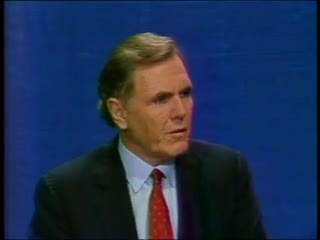
Description: Mayoral candidates Ray Flynn and Mel King participate in a forum on education sponsored by the Citywide Education Coalition (CWEC) at English High School. Flynn says that students graduating from Boston public schools must be prepared to compete in the workplace. He adds that there must be a working relationship between parents, teachers, administrators, and the community. King speaks about the workings of the school administration and advocates the inclusion of parents in the process. King and Flynn respond to questions about how they would have handled school desegregation if they had been mayor at the time. Both candidates answer questions about the role of the mayor upon the court's withdrawal from its supervisory role over the school system and about the school budget. Audience members include John O'Bryant of the Boston School Committee. Tape 2 of 2.
1:00:00: Visual: Ray Flynn (candidate for mayor of Boston) speaks at a forum on education sponsored by the Citywide Education Coalition (CWEC) at English High School. The candidates' forum is held in conjuction with their annual meeting. Flynn says that students graduating from Boston public schools must be able to compete in the workplace. Long shot of candidates on stage from the back of the auditorium. Flynn says that there must be a working relationship between parents, teachers, administrators and the community. The audience applauds. 1:00:56: V: King speaks about the workings of the school administration. Jump cut in the videotape. Shots of John O'Bryant (Boston School Committee); of members of the audience. King says that parents must be included in the workings of the school system. Shot of the candidates on stage. An audience member asks what each candidate would have done about school desegregation if he had been mayor at the time. The audience member also asks about the role of the mayor when the court pulls withdraws from its supervisory role over the school system. King says that community control over schools is important; that community accountablility is an important aspect of community control; that members of the community must be held accountable for the state of neighborhood schools. King says that he had suggested a community approach to schools which could have prevented the kind of sweeping court order imposed by the federal court to accomplish school desegregation. King says that he would have tried to bring people together in support of school desegregation if he had been mayor at the time; that there were many people acting in opposition to the court order at the time of school desegregation. King says that he would provide leadership on the issue of quality, integrated education upon the withdrawal of the court. 1:05:08: V: Flynn responds to the same question about school desegregation. Flynn notes that the State Department of Education will continue to oversee the Boston Public School System after the withdrawal of the court. Flynn says that he will work with the State Department of Education to protect the Constitutional rights of public schoolchildren in Boston. Flynn says that political and moral leadership was absent during school desegregation in Boston. Flynn says that he would have defended the rights and the safety of Boston schoolchildren as mayor, even if he disagreed with the court order. Flynn notes that he was a state legislator at the time of school desegregation; that he was criticized at the time for standing up for his beliefs; that he was criticized for living in a certain community; that he acted responsibly on behalf of all of Boston's schoolchildren at the time. 1:07:15: V: An audience member asks about the school budget. Flynn says that it is important to educate children; that it is more expensive to remedy social problems resulting from poor education. Flynn says that he supported funding for Boston schools even when it was politically unpopular to do so; that he is committed to providing the necessary funds to assure a good school system. Flynn says that accountability is as important as funding; that the school system has too many administrators. King responds to the same question. King says that he is aware of the lack of resources available to teachers and students in the Boston Public School System; that the lack of resources is embarrassing for a school system with a large budget; that the school administrators must make a commitment to provide resources for students and teachers.
Collection: Ten O'Clock News
Date Created: 10/13/1983
Description: Reporter Christopher Lydon interviews attendees of the inauguration of Ray Flynn as Mayor of Boston, in the Wang Center. The crowd cheers as Flynn and former mayor Kevin White pass by. Lydon interviews attendees of the inauguration in the lobby of the Wang Center. Interviewees express concerns about unemployment, crime, the restoration of city services and the city budget. Cynthia Silveira (Dorchester resident) says that she appreciates Flynn's commitment to diversity and unity but is suspicious of his past voting record on racial issues. Lydon interviews people outside of the Wang Center. Harry Spence (Boston Housing Authority) says that Flynn delivered a "solid" speech, but will face difficulties in delivering city services and achieving racial harmony. George Keverian (State Representative) says that Flynn is the right person to unite the city. Louise Day Hicks (former member of the Boston City Council) says that Flynn must strike a balance between downtown concerns and neighborhood interests. Hicks says that South Boston is the "center of the city." Hicks speaks to Dapper O'Neil outside of the Wang Center. Felix Arroyo (Latino activist) hopes that Flynn will deliver on his promises; Arroyo believes that it will be difficult for Flynn to integrate the city's neighborhoods. Elma Lewis (African American activist) says that she and others will work with Flynn to improve the city. Lewis adds that she is "always looking for diversity." Claire Crawford (Boston resident) says that Flynn is a "people's mayor." Flynn exits the Wang Center and gets in his station wagon; crowd cheers. Lydon interviews James Kelly (South Boston Information Center). Kelly expresses reservations about Flynn's proposal for District Advisory Councils. Thomas Menino (Boston City Council) compliments Flynn's inaugural speech.
1:00:00: Visual: Christopher Lydon interviews a white male about the inaugural speech of Ray Flynn (Mayor, City of Boston) at the Wang Center for the Performing Arts. The man says that Flynn gave a strong speech; that he is optimistic about Flynn's administration. The man says that Flynn will face challenges in improving the schools. Lydon speaks informally to the man. 1:00:45: V: Uniformed officers march up the stairs in the lobby of the Wang Center. People are gathered in the lobby. The audience cheers as Flynn exits a room and proceeds up the stairs. Flynn's young daughter holds his hand as he walks up the stairs. Flynn stops to greet bystanders as he passes. Kevin White (former Mayor of Boston) and Kathryn White (wife of Kevin White) proceed up the stairs after Flynn. 1:02:12: V: Lydon interviews a white man who is a Dorchester resident. The man says that Flynn is the first mayor since Josiah Quincy to have a "sense of the city"; that Flynn is familiar with the neighborhoods and the downtown. Lydon interviews a white middle-aged man about Flynn's speech. The man says that Flynn's speech was very good; that Flynn understands that the government exists to serve the people. The man says that Flynn will face a challenge in restoring city services during an economic crisis. An older white woman says that Flynn's speech was "wonderful." The woman says that Flynn will face a challenge in reducing unemployment; that Flynn's emphasis on unity was important. Cynthia Silveira (Dorchester resident) says that Flynn's speech was good; that she hesitates to trust Flynn because of his past voting record on racial issues. Silveira says that it will be difficult for Flynn to give his full attention to Boston neighborhoods; that she appreciates his commitment to diversity and unity. An older Irish woman recognizes Lydon from television. Her companions explains that they are from the region of Ireland where Flynn's family is from. The second Irish woman says that the speech was "wonderful." An older white woman says that Flynn will be a good mayor if he delivers what he promised in the speech; that it will be difficult for Flynn to reduce the crime rate. An older white man says that Flynn has the right idea; that Flynn will "economize." 1:06:59: V: A crowd streams out of the doors of the Wang Center. Lydon interviews Harry Spence (Boston Housing Authority). Spence says that Flynn delivered a "solid" speech; that it will be difficult for Flynn to deliver services and to achieve racial harmony. Spence says that Flynn's speech expressed his decency and commitment to the people. The crowd continues to exit the building. Groups of people are gathered outside of the doors. Members of the crowd greet Lydon. George Keverian (Massachusetts House of Representatives) greets Lydon and his two daughters. Keverian says that Flynn delivered a good speech; that Flynn's humanity was in evidence. Keverian says that Flynn is the right person to unite the people of Boston. Keverian continues to speak informally to Lydon and his daughters. 1:12:07: V: Louise Day Hicks greets Lydon. Hicks says that Flynn's speech covered many "interesting" and important topics; that South Boston is the "center" of the city. Hicks says that Flynn will need to strike a balance between the neighborhoods and the downtown interests; that Flynn needs to concentrate on affordable housing and crime reduction. Hicks confers with Dapper O'Neil (Boston City Council) on the street outside of the Wang Center. Lydon interviews Felix Arroyo (Latino activist). Arroyo says that the city will be a better place if Flynn can deliver on his promises. Arroyo says that Flynn will face challenges in integrating the neighborhoods; that he appreciates Flynn's commitment to education. Shot of a black car pulled up to the curb in front of the Wang Center. Lydon asks Elma Lewis (African American activist) about Flynn's speech. Lewis say that Flynn put on a good "show"; that inaugural speeches do not mean much; that she and others will work with Flynn to improve the city. Lewis says that she has attended inaugurals for many years; that she would like to have seen "more diversity"; that she is "always looking for more diversity." 1:17:04: V: Claire Crawford (Boston resident) says that Flynn is a "people's mayor." Crawford says that Flynn will face challenges in eliminating racial discrimination. Flynn exits the Wang Center. He greets several groups of bystanders. Photographers crowd around Flynn's station wagon. Flynn clears snow from his windshield. Flynn gets in the car and drives away. The crowd cheers briefly. 1:20:37: V: Lydon interviews Jim Kelly (South Boston Information Center). Kelly says that Flynn gave a good speech; that parts of the speech "concerned" him. Kelly expresses reservations about the District Advisory Councils. Kelly says that Flynn face difficulties in providing services to the city during an economic crisis. Kelly says that the people of South Boston are happy to "have a say" in how the city is run. Lydon begins to interview Thomas Menino (Boston City Council). Menino says that Flynn made an excellent speech.
Collection: Ten O'Clock News
Date Created: 01/02/1984
Description: INTERVIEW WITH RAYMOND DOOLEY ON FLYNN TRANSITION. VISUALS OF 'WORLD CLASS' BROCHURES
Collection: Ten O'Clock News
Date Created: 11/23/1983
Description: Meg Vaillancourt reports on controversy over a new student assignment plan for the Boston Public Schools, which minority members of the Boston School Committee spoke out against at a breakfast commemorating the birthday of Martin Luther King, Jr.. School Committee members John O'Bryant, Juanita Wade, Jean McGuire, and Gerald Anderson speak to the media. They do not believe that the plan will provide equitable education for all. The plan was proposed by mayor Ray Flynn. It will allow parents to choose which schools their children will attend. Interview with Flynn, who defends the proposal, saying that it's supported by parents. He adds that School Committee members have been asked for input on the plan. Vaillancourt also reports that Flynn has proposed the decentralization of the Boston School Department and selling off the headquarters of the Boston School Department. Vaillancourt reports that minority members of the School Committee may rescind their support for superintendent Laval Wilson if he supports Flynn's school choice proposal. This edition of the Ten O'Clock News also included the following items: Elma Lewis in Marsh Chapel at Boston University on Martin Luther King Day and Carmen Fields interviews Robert Nemiroff about the playwright Lorraine Hansberry
1:00:26: Visual: Footage of city and state leaders including Michael Dukakis (Governor of Massachusetts), Charles Stith (Union United Methodist Church), Bernard Cardinal Law (Archidiocese of Boston), and Ray Flynn (Mayor of Boston) singing together at celebration in honor of the birthday of Martin Luther King, Jr. (civil rights leader). Meg Vaillancourt reports that local leaders gathered over breakfast today to celebrate Martin Luther King's birthday. Vaillancourt notes that there was controversy at the breakfast over a new assignment plan for students in Boston Public Schools. V: Footage of Juanita Wade (Boston School Committee) speaking to the media. School Committee members John O'Bryant and Jean McGuire sit beside Wade. Wade calls the new plan "segregation redux." Wade says that the Boston Public Schools need to provide choice, equity, and a quality education right now. Footage of Flynn speaking to the media. Flynn says that the plan has the support of the citizens of Boston; that parents are looking for this kind of reform. Vaillancourt reports that the new plan would allow parents to choose which schools their children will attend; that parents have not been able to choose schools since school desegregation began in 1974. V: Shots of buses pulling up to the front of South Boston High School in 1974; of South Boston residents jeering at the buses. Shots of buses parked in front of South Boston High School; of African American students walking among the buses. Vaillancourt notes that the population of white students in Boston Public Schools has declined since 1974; that non-white students make up 70% of the student population in Boston Public Schools. Vaillancourt adds that the School System has been criticized for not providing students with a quality education. V: Shots of non-white students in a classroom; of an African American male student sitting in a classroom. Shot of Flynn. Vaillancourt reports that Flynn and two consultants have proposed a plan to improve the schools and to increase parental choice. V: Footage of School Committee members O'Bryant, Wade, McGuire, and Gerald Anderson sitting on a couch. African American community leaders, including Charles Yancey (Boston City Council), Eugene Rivers (African Peoples Pentecostal Church) and Louis Elisa (Boston chapter of the NAACP), stand behind them. Anderson addresses the media. Anderson says that the Boston School System needs to provide a quality education to all before it can claim to be equitable. Anderson says that the mayor needs to provide more funding to the schools. Shots of O'Bryant and other community leaders. Footage of Flynn being interviewed by Vaillancourt. Vaillancourt asks Flynn if he is surprised by the attitude of the African American community leaders. Flynn says that he has been working on the proposal for several months; that community leaders have had many opportunities to review and give input on the proposal. Footage of Anderson saying that he is offended by Flynn's attitude. Anderson notes that Flynn has said that the statements of the African American leaders are "bogus." Anderson says that the community leaders are standing up for their constituents; that Flynn's statements are "bogus." Footage of Flynn saying that the members of the School Committee have had input on the proposal; that the members of the School Committee voted twelve-to-one in favor of the plan. Flynn says that the School Committee members were told that they would have further opportunities to give input on the proposal. Footage of McGuire saying that Flynn's proposal will cost more money. McGuire says that the School Committee has not been given additional money to fund Flynn's proposal. Vaillancourt reports that the Boston Public School System spends more money per student than any other public school system in the nation. V: Shot of an African American teacher and student at the front of a classroom; of a white male student seated in a classroom; of an African American female student seated in a classroom. Vaillancourt notes that Flynn has come up with another controversial proposal to fund neighborhood schools; that Flynn has suggested the decentralization of the Boston School Department. Vaillancourt adds that the proposal would sell off the downtown headquarters of the Boston School Department on Court Street. V: Shots of the exterior of the Boston School Department headquarters. Footage of Flynn saying that the downtown headquarters of the School Department should be sold; that the money should be put into neighborhood schools. Footage of O'Bryant saying that the School System is going to end up back in court if it does not receive support from the city. Vaillancourt reports that Dr. Laval Wilson (Superintendent, Boston Public Schools) has supported Flynn's school choice plan; that Wilson's contract ends in June. V: Shots of a meeting in the chambers of the Boston School Committee; of Wilson speaking at a School Committee meeting. Vaillancourt reports that the African American members have voted to extend Wilson's contract in the past. Vaillancourt notes that Wilson's future support among the Committee's African American members may depend on his position on Flynn's school choice plan.
Collection: Ten O'Clock News
Date Created: 01/16/1989
Description: Ray Flynn interview on opening Division of Employment Security office in Uphams Corner. DES exterior with signs: Job Matching, Job Insurance. Uphams Corner environs from moving car in rain. jobs.
Collection: Ten O'Clock News
Date Created: 02/15/1984
Description: Day after election, John Silber holds press conference in which he is bitter about Natalie Jacobson interview and Ray Flynn's absence, and generally vindictive.
Collection: Ten O'Clock News
Date Created: 11/07/1990
Description: Boston Teachers Union president Ed Doherty announces his candidacy for mayor of Boston. Says Flynn gives ‘only an illusion of leadership.’ File of teachers on strike.
Collection: Ten O'Clock News
Date Created: 04/25/1991
Description: Ray Flynn's State of the City address focuses on Stuart murder case, police behavior, and racism. He contrasts and challenges stereotypes of different Boston neighborhoods. Interviews with people responding the speech.
Collection: Ten O'Clock News
Date Created: 01/10/1990
Description: Boston Public Library trustee defends BPL policies and administrative practices against Ray Flynn's criticism. Jamaica Plain branch library. Signs: Large Print Books, Talking Books, Kurzweil Reading Machine.
Collection: Ten O'Clock News
Date Created: 06/28/1989
Description: Mayor Raymond Flynn's State of the City address.
Collection: Ten O'Clock News
Date Created: 01/10/1990