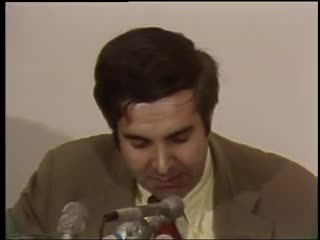
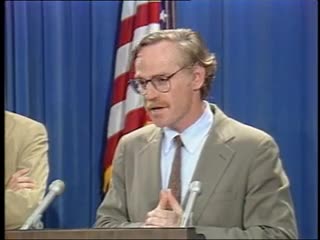
Description: B-roll of bulldozer clearing debris from Symphony Road fire. Exteriors of buildings with broken and boarded up windows and smoke stains. Interview with David Scondras of Symphony Tenants Organizing Project. He talks about why the rash of 29 fires in three years is suspected as arson: absentee landlords, high vacancy rate, poor condition of structures, lodging houses, lapsed mortgages. He adds that there is nothing the city can do about the problem and explains why. He hopes that State legislators will back his organization's bill which removes the financial motivation for landlords to burn down houses in poor condition. He discusses the number of people affected while they shoot cutaways. Reporter reasks question for editing purposes. Exteriors of a Red Cross Disaster Service Center. Several takes of reporter standup.
Collection: Ten O'Clock News
Date Created: 02/23/1977
Description: Seth Rolbein reports on a dramatic increase in syphilis cases in the late 1980s among women and people of color. Rolbein compares statistics on the incidence of syphilis cases among men and women in the white, Latino, and African American communities. Interviews with Dr. Tony Japour, a medical fellow in infectious disease; Barbara Neustadt, a registered nurse at Beth Israel Hospital; and Dr. Judith Steinberg of Boston City Hospital, about the latest epidemic of syphilis cases. Rolbein reports that the resurgence of cases can be traced to crack cocaine users, who may engage in sexual activity with multiple partners in crack houses. Rolbein notes that victims of syphilis may be at risk for HIV and AIDS. Rolbein's report is accompanied by clinical photos of syphilis patients and by footage of police officers investigating a crack house.
1:00:03: Visual: Shots of clinical photos of syphilis patients. The patients have severe skin lesions. Seth Rolbein reports that there has been an increase in syphilis cases. V: Footage of Dr. Tony Japour (medical fellow in infectious diseases) being interviewed by Rolbein. Japour says that syphilis was epidemic before 1945; that it was an epidemic among sexually active adults. Japour says that the disease declined after the discovery of penicillin; that penicillin cured syphilis. Japour says that after 1945, the disease declined from a rate of 70 cases per 100,000 people to 5 cases per 100,000 people. Rolbein reports that the Massachusetts Department of Public Health has compiled the latest figures for syphilis. Rolbein reports that there were 710 diagnosed cases of syphilis in 1986; that the number of syphilis cases grew steadily and then grew dramatically in 1990. Rolbein reports that more than 1700 new cases of syphilis were reported in 1990. V: An on-screen chart details the numbers of syphilis cases from 1986 to 1990. Shot of a bacteria culture. Rolbein reports that researchers had seen a dramatic growth in the number of syphilis cases only one time since the 1940s. V: Footage of Dr. Judith Steinberg (Co-director, Public Health Clinic, Boston City Hospital) being interviewed. Steinberg says that there were a high number of syphilis cases among white, homosexual men in the late 1970s and early 1980s. Rolbein reports that Barbara Neustadt (registered nurse, Public Health Clinic, Beth Israel Hospital) believes that there must be another population involved in the latest epidemic. V: Footage of Neustadt being interviewed by Rolbein. Neustadt says that the gay community in Boston has worked hard to educate community members about safe sex; that there has been a significant drop in all sexually transmitted diseases in the gay population. Footage of Japour being interviewed. Japour says that the disease is in an epidemic stage. Japour says that the number of cases among gay and bisexual white men has decreased dramatically; that the number of cases among people of color and women has increased dramatically. Rolbein reports that there was approximately one case per 100,000 people among white men and women under the age of twenty in Massachusetts in 1988 and 1989. Rolbein reports that the number of syphilis cases increased dramatically among African American men and women under the age of twenty in Massachusetts in 1988. Rolbein reports that the number of cases among African American men and women under the age of twenty doubled in 1989. Rolbein reports that there were 80 cases per 100,000 people among African American women under the age of twenty in 1989. Rolbein reports that there has been a dramatic increase of syphilis cases in the Massachusetts Latino community in 1988 and 1989. Rolbein reports that there were 135 cases per 100,000 people among Latina women under the age of twenty in 1989. Rolbein reports that statistics are comparable across the nation. V: An on-screen chart details statistics for the numbers of syphilis cases among men and women under the age of twenty in the white, African American, and Latino communities in Massachusetts in 1988 and 1989. Rolbein reports that medical investigators from Philadelphia, Connecticut and Massachusetts believe that crack cocaine is at the root of the epidemic. V: Shots of workers in a laboratory setting. An African American man hands a white bag over the counter. Shot of people walking on a street. Shot through the window of a car of a housing development. Shot of a bag of crack. Footage of Japour being interviewed. Japour says that there are crack houses where individuals sell sex for drugs. Japour says that crack houses are the equivalent of the "gay bath houses" of the 1970s. Japour says that crack makes people sexually aggressive; that clients of the crack houses may have several sexual encounters in the course of an evening. Rolbein says that syphilis is spreading quickly. V: Shots of police officers entering an apartment; of police investigating a room of an apartment. The floor of the room is strewn with trash. Footage of Neustadt being interviewed. Neustadt says that it is frightening to see young people with syphilis; that syphilis patients may eventually contract HIV and AIDS. Rolbein says that AIDS and syphilis are both spread through sexual contact; that syphilis is curable while AIDS is not. V: Shot of an AIDS prevention poster. Footage of Neustadt being interviewed. Neustadt says that the increase in syphilis probably reflects an imminent increase in HIV-positive people in Boston. Rolbein reports that the syphilis epidemic is moving away from the gay community; that the syphilis epidemic is affecting people of color and communities in the inner city. V: Shot of the entrance to Boston City Hospital.
Collection: Ten O'Clock News
Date Created: 03/01/1991
Description: First day of school in Boston, Phase IIB of court ordered desegregation. 1) Superintendent Marion Fahey is proud of faculty and students. Associate superintendent Charles Leftwich reports van and three buses were stoned. Mayor Kevin White says unlawful conduct will not be tolerated. 2) Gary Griffith reports on opening commotion at Charlestown High. One-third of enrolled students show up. Federal marshals and police outside. One arrest for disorderly conduct. Neighborhood crowd gathers in street. 3) Pamela Bullard at South Boston High. Black students get off bus to less tension than last year. Police are present but not in riot gear. 4) Art Cohen at Mackey Middle School where teacher student ratio is 1:18. Principal Lloyd Leake. 5) Bullard on magnet program encompassing 21 schools. Exterior, interior of English High. Gregory Anrig, state commissioner of education. Headmaster William Peterkin. 6) Karin Giger on bilingual program at Grover Cleveland Middle School. 7) Bullard talks to boycotting (white) Cormiers of Charlestown. Mother keeps son out of Timilty School where he was assigned to be bused; he has part-time tutoring. 8) Steve Curwood talks to participating (black) Price family from Roxbury, whose children are bused to white neighborhoods. 9) 5 Hyde Park High students, 3 minority, 2 white, discuss racial separation inside school. They expect conflict to be less than last year. 10) Steve Nevas was almost thwarted from covering a Kevin White press conference because mayor felt Nevas could not be objective. (He had investigated fundraising in White campaign.) White attempts to disassemble Channel 2 microphone and asserts he can exclude any reporter from access. Ed Baumeister says this raises First Amendment issue.
Collection: Ten O'Clock News
Date Created: 09/08/1976
Description: Reporter Christopher Lydon talks about presidential campaign. Reporter Gail Harris reports on President Ronald Reagan's press conference about an environmental report; footage of Lieutenant Governor John Kerry, David Bartley, and Congressman James Shannon (all candidates for US Senate) commenting on acid rain. Bartley says Kerry and Shannon are not doing enough about acid rain. Harris reports on new seat belt and air bag regulations. Lydon presents mobster Raymond Patriarca obituary, compares Patriarca to "The Godfather." Harris reports on new technology for detecting cancer. Footage of South Norfolk Council for Children representative Cathy Wheeler telling story of "Angie." Reporter Meg Vaillancourt gives stats for residential programs for youth with mental health issues. Footage of New Bedford Council for Children representative Jean Peterson talking about budget. Philip Johnston, human services secretary talks about state of children's mental healthcare. Dr. Eli Newberger (of Children's Hospital) testifies on state funding of mental health support services for children. Dr. Michael Jellinek (Chief of Child Psychology at Mass. General Hospital) talks about budget. Vaillancourt talks about growing difficulty of mental health over time. Charles Fried (Harvard Law School) and Anthony Lewis (New York Times) studio interview on Supreme Court at term's end: apparently conservative trend and states' rights inclination in recent decisions. Broadcast ends with international news: OPEC; Libyan bombing; dock worker strike in Great Britain; correspondent in England talks about economic situation of British Pound Sterling.
Collection: Ten O'Clock News
Date Created: 07/11/1984
Description: Before news broadcast: Ted O'Brien advertises WGBH membership; advertisement for "Vietnam: Present Tense" program with Seth Rolbein; James Earl Jones advertises "Long Ago and Far Away" program; 1)Carmen fields reports on revelations on Sen. William Bulger's questionable investment in American Cablesystems Midwest with Harold Brown and Thomas Finnerty. 2) David Boeri debriefing on set on Bulger. 3) Sludge processing at Deer Island treatment plant turns sewage into compost and pelletized fertilizer; Paul Levy of MWRA and Michael Deland of EPA; incinerator in Lynn. 4) History of Spectacle Island in Boston Harbor, now landfill repository. Anchors Lydon and Fields. 5) Report on President George Bush Sr.'s tax campaign and Congressional leaders meeting about budget. Federal Reserve Chairman Alan Greenspan recommends budget restrictions, rather than taxes. 6) New childcare package is political olive branch between political parties. 7) National Urban League report on poverty and income conditions among black people. 8) Execution of serial murderer Ted Bundy in Florida. 9) Pennsylvania native Barbara Harris chosen as first woman bishop in Anglican Communion, ordained by Boston Archdiocese.
Collection: Ten O'Clock News
Date Created: 01/24/1989
Description: Ten O'Clock News broadcast. Anchors Christopher Lydon and Gail Harris. David Williams reports on gubernatorial political campaigns of Michael Dukakis and Greg Hyatt. Marcus Jones reports on Healthy Start program providing better maternal health services to poorer women. Interviews with Dr. Juliette Tuakli-Williams, Sen. Jack Backman, Joan Tighe, Rep. Patricia Fiero, and Kathy O'Donnell. "Today on Wall Street" segment. Gail Harris reports on 1987 federal budget and tax reform bills. Christopher Lydon reports on Reagan Administration and Tip O'Neill's views on US aid to Nicaraguan Contras. On-set interview with Noam Chomsky and John Silber on contra aid. Silber argues for and Chomsky argues against US aid to the Contras. The two guests interrupt each other and talk over each other. Gail Harris reports on employee strikes in several business. Christy George reports on the development of Massachusetts Avenue in Cambridge through history. Interview with Charles Sullivan, Director of the Cambridge Historical Commission. Interview with Kevin Crane, attorney for a developer, on the development plans along Mass Ave. Interview with Kate Mattes, local business owner of Kate's Mystery Books. Interview with author Robert Parker. Interview with Betty Desrosiers on the effect of the Red Line extention on Mass. Ave development plans. Interview with Cambridge resident Joel Bard. Interview with developer Peter Wasserman. Weather and Sports reports. Lydon reports on Chilean human rights violations and South African funerals. Harris reports on a Soviet launch of a manned space craft and Haley's Comet.
Collection: Ten O'Clock News
Date Created: 03/13/1986
Description: Footage for a story on the commercialization of cartoons and the link between cartoons and toys. Interiors of a toy store with closeups on individual toys, especially action figures. Shots of shoppers in the story, a child with her grandparents. Interview with shopper, Virginia Bernard, on toys, TV and how she buys her granddaughter toys from shows she doesn't actually like. Several takes of each section of reporter stand up. Interview with psychiatrist from Beth Israel Hospital and Harvard Medical School about the link between cartoons, toys, and the effect on children.
Collection: Ten O'Clock News
Date Created: 02/18/1985
Description: Mayor Kevin White exchanges banter with journalist, and goes on to deliver statement on increasing Boston property tax (one-time levy at $16.40) to finance the $27.5 million deficit caused by court ordered desegregation, at Judge Arthur Garrity's request. City treasurer Jim Young elaborates on choosing assessment method over borrowing. Mayor White takes questions from reporters. White accuses school committee of mismanagement in busing effort. He also comments that the teachers will have to work knowing they are in a debt situation.
0:00:30: Visual: Members of the press wait for Kevin White (Mayor, City of Boston) to arrive at press conference at City Hall. Walt Sanders (WBZ) and Gary Griffith (WGBH) are among the reporters. White arrives, begins reading his statement and is interrupted by a knock on the door. He jokes lightheartedly about the interruption. 0:01:53: V: White reads a statement about the school deficit caused by desegregation and school mismanagement. He says that an additional $16.40 will be added to property taxes this year; that Boston's property tax is already the highest in the nation; that Judge Garrity has ordered the city to find new revenue sources to fund the court-ordered desegregation. White says that he is submitting three pieces of legislation to the city council: an appropriation order for $10 million to cover the costs of police overtime; an appropriation order for $17.5 million to keep the schools operating for the remainder of the term; legislation to raise new revenue through the property tax. White says that he is faced with an unpleasant task; that this tax levy is the most efficient way to raise funds; that the tax will be levied only once. White says that he hopes Garrity acts to overhaul the city's school system, personnel, and management; that mismanagement of the school system has caused the deficit. 0:06:50: V: James Young (Treasurer, City of Boston) explains that the taxpayers must pay for the expenditures of the city government; that a tax levy is the most prudent and cost-effective way to raise revenues. Young says that borrowing money to cover the deficit is not a financially sound course of action; that the appropriation orders will allow the city to continue paying for the police and schools; that the tax levy will cover the appropriations; that the tax levy is related to a home rule petition to be brought before the state legislature. 0:08:26: V: White takes questions from reporters. White says that he does not know how quickly the city council will respond; that the tax levy is the most responsible way to cover the deficit. A reporter asks if a lengthy review of the legislation by the city council will allow enough time for the money to be raised. White says that he does not know how long the city council will take to make a decision on the legislation; that he did his best to respond expeditiously to the request by Judge Garrity. A reporter brings up other suggestions of ways to fund the deficit. White says that there are only a few rational and responsible ways to raise the funds; that the tax levy is the easiest, fairest, and cheapest way to cover the deficit. White says that extra police overtime is directly related to the desegregation order and should be covered along with the school deficit; that the taxes will be levied only to cover expenses resulting from the court order; that the deficit does not reflect any of the busing costs from the previous year. 0:12:19: V: A reporter asks about a rumored $8 million surplus in the budget. Young refutes those numbers and says there is no surplus. White says that money needs to be allocated in order to cover the next School Department payroll on June 1; that presently there is no more money to cover School Department payroll; that payroll will be owed to employees if the hours are worked. Young admits that there will be short-term borrowing to cover the deficit until the tax is levied; that he does not know how much will be borrowed; that $5.5 million is needed to cover payroll in 2 weeks. White says that he will not comment on speculation that some city residents will not pay the tax. A reporter accuses White of waiting until the last possible moment to raise the funds. White says that he notified all parties of the shortfall six months ago; that Judge Garrity did not consider the shortfall to be an emergency situation; that he warned the School Committee to make cuts; that neither the court nor the School Committee responded to his warnings. White accuses the School Committee of "total mismanagement" of the desegregation process. White says that some people have profited from school desegregation; that the city absorbed the costs of desegregation without comment last year; that the school deficit must be brought to the attention of the taxpayers. 0:19:03: V: White says that he does not want to close the city schools; that he refuses to borrow money to cover the costs of mismanagement of the school system. White admits that school teachers are going to work with the knowledge that there is no money for payroll; that the management of the schools must be overhauled next year. White says that he is responding to a request from the court to cover the deficit.
Collection: Ten O'Clock News
Date Created: 05/17/1976
Description: Meg Vaillancourt interviews South Boston high school sophomore boys about their view of confessed teenage murderer William Flynn in the Pamela Smart trial. Interview with Edward Loughran, Commissioner of the Department of Youth Services, about regulations surrounding juvenile offenders charged with capital crimes in Massachusetts.
Collection: Ten O'Clock News
Date Created: 03/18/1991
Description: Rebecca Rollins reports that the murder rate in the city is rising. She notes that an overwhelming number of teenagers are involved in these homicides. Rollins interviews teenagers Grantley Payne, Michael Duval, and Pinto Triplett about why teenagers carry guns. Payne says that guns provide protection and grant status to teenagers. Payne and another teenager play basketball on an outdoor court. Rollins interviews Franklin Tucker (counselor) about teenagers and guns. Tucker talks about how teenagers obtain firearms. Tucker talks about the lack of programs aimed at preventing violence. He adds that many teenagers involved in violence come from disadvantaged backgrounds. Rollins' report is accompanied by footage of an African American teenager being treated by paramedics. This tape includes additional footage of Payne and another teenager playing basketball on an outdoor court.
1:00:01: Visual: Footage of a body on a stretcher being wheeled by medics to an ambulance; of an African American police officer speaking to an African American male suspect. Shots of Grantley Payne (age 18) and another teenager playing basketball on an outdoor court. Rebecca Rollins reports that the death toll in the city is rising at record pace; that the number of homicides may total 150 by the end of the year. Rollins notes that an overwhelming number of teenagers are involved in the homicides as victims or suspects. V: Shot of medics lifting the body of an African American teenager onto a stretcher. Shots of guns and weapons laid out on a table. Footage of Payne being interviewed. Payne says that guns provide protection and grant status to teenagers. Footage of Franklin Tucker (Barron) being interviewed by Rollins. Tucker says that teenagers are importing their own guns; that teenagers are ordering them by mail from states with lenient gun laws. Barron says that guns are being brought in by bus and car. Tucker says that teenagers are carrying new guns and serious firearms. Rollins reports that Tucker is an expert on the subject of kids, guns, and schools; that Tucker directs counseling services for kids caught with weapons on or near school property. V: Footage of Tucker being interviewed by Rollins. Tucker says that many teenagers carry guns for protection. Footage of Michael Duval (age 16) being interviewed by Rollins. Duval says that fighting and violence have progressed from hands to knives to guns. Duval says that a lot of movies have violence. Duval mentions the 1988 film Colors. Rollins asks why kids carry guns. Pinto Triplett (age 18) says that it is difficult to be a teenager in the projects; that teenagers who carry guns live in rough neighborhoods. Triplett says that many of these teenagers do not come from good backgrounds; that many teenagers cannot get jobs. Triplett says that some of these teenagers are the victims of racial discrimination. Footage of Tucker being interviewed by Rollins. Tucker says that there are no programs focusing on prevention; that society is trying to put these kids in jail. Tucker says that prisons are already overcrowded. Rollins stands in front of a basketball court. A group of teenagers play basketball on the court. Rollins says that the Boston Police Department and City Hall will officials will meet to discuss the problem of guns and violence.
Collection: Ten O'Clock News
Date Created: 12/19/1990