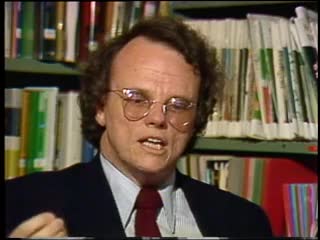
Description: Interview with headmaster Jerome Wynegar about changes at South Boston High School in last two years in four areas: administration, discipline, curriculum review, community relations. He sees improvement in students' ability to learn with fewer disruptions than in first years of busing. He discusses the school's attempt to prepare students for their futures. He says more research is needed into educational methods for a changing world; experiential learning should be emphasized over traditional lectures. He endorses alternative programs because attendance is encouraged. reel 1 of 2
Collection: Ten O'Clock News
Date Created: 06/01/1978
Description: Interview with headmaster Jerome Wynegar. Says there are more opportunities at South Boston High School than at any other school in the city. He is very sanguine about the integration of the student body, and the array in curriculum from basic skills to electives to vocational education. Compliments the administrative involvement of Joseph McDonough (community district superintendent). Says Boston School Department is notoriously bad in paying bills. reel 2 of 2
Collection: Ten O'Clock News
Date Created: 06/01/1978
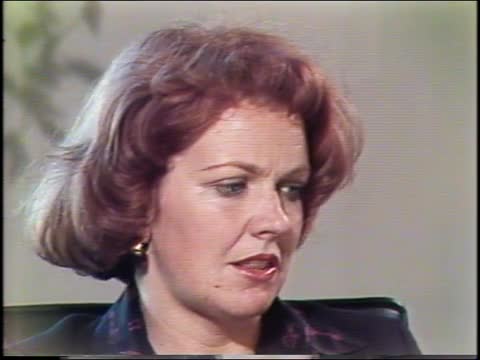
Description: Kathleen Sullivan complains that her chief role as School Committee member is helping constituents obtain patronage jobs, rather than focusing on public education issues.
Collection: Ten O'Clock News
Date Created: 09/28/1976
Description: Kathleen Sullivan complains that the School Committee is too much a 'political' organization rather than a guardian of educational interests of the city. Patronage.
Collection: Ten O'Clock News
Date Created: 09/28/1976
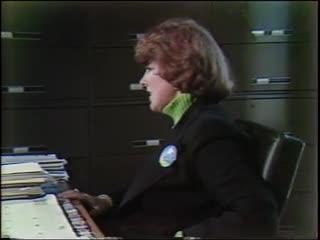
Description: Pam Bullard interviews Kathleen Sullivan (Boston School Committee) about the quality of education in Boston. Sullivan says that she is frustrated because Boston schools have not improved since court-ordered desegregation began in 1974. Sullivan calls Arthur Garrity (federal judge) a "crazy judge." Sullivan says that the desegregation plans since 1974 have been disruptive. She says that neither African American nor white students have benefitted from school desegregation; that students should not be assigned to different schools each year. Sullivan and her assistant discuss Judge Garrity's latest order concerning the Boston schools. Bullard explains to Sullivan that she is putting together a piece which contrasts Sullivan's views on schools and court-ordered desegregation with the views of African American leader Melnea Cass
0:59:44: V: Pam Bullard interviews Kathleen Sullivan in her office. Bullard comments that Sullivan was elected to the School Committee because voters were impressed with her commitment to quality education and better schools. Bullard asks Sullivan how she would have fared if voters were less concerned with the state of the schools and more concerned with politics as usual. Sullivan says that she could have been re-elected. Sullivan says that parents are concerned about education; that a difficult economy coupled with the costs of school desegregation has made school improvement difficult. Sullivan says that the quality of education has not improved in the city since she was elected to the School Committee; that she feels frustrated in her efforts to improve the schools. 1:03:48: V: Bullard asks if it would damage Sullivan politically to admit that desegregation has improved Boston schools. Sullivan says that voters in Boston are beginning to accept desegregation as a fact; that the anti-busing movement has lost steam because people are tired; that voters would be happy to hear that schools have improved, even if the improvement was a direct result of desegregation and a "crazy judge on the scene." Sullivan says that there has been little improvement except in a few schools. Sullivan mentions that Roxbury High School, the Lewenberg School and the Curley School have seen improvement. Bullard asks why Sullivan never mentions the positive impact that desegregation has had on African American students, who now have access to an equal education. Sullivan says that she has been preoccupied with the budget this year; that she visited last year with African American students who had been assigned to three different schools in three years, and had not benefitted from the experience. Sullivan says that the school situation has begun to stabilize this year; that one can begin to talk about better education for African American students this year; that police presence in schools and community hostility to busing prevented a healthy school situation for African American students in 1974 and 1975; that she understands why African American parents might disagree with her because they wanted access to better schools for their children. Sullivan says that she hopes schools can be improved for all students; that she is worried because only 51,000 children attended Boston Public Schools last year, out of a school-age population of 117,000. Sullivan says that she taught African American students in Dorchester; that she thinks desegregation has been disruptive for those students; that the desegregation of Boston schools could have been beneficial for African American students and white students in 1974 and 1975 if it had been implemented differently. 1:10:34: V: An administrative assistant enters Sullivan's office to go over some papers with her. The assistant points out that Judge Garrity has ordered the School Committee to appoint a new Transitional Director of Program Development at South Boston High School. Sullivan and the assistant discuss Garrity's instructions. Sullivan and her assistant tell Bullard that Judge Garrity has approved 160 transfers out of 1,782 requests. Sullivan alludes to Garrity's heavy involvement in managing the Boston schools. 1:12:57: V: Bullard explains to Sullivan how she will edit the final piece. Shots of Sullivan's office. Bullard explains that she has also interviewed Melnea Cass (African American community leader) and wants the final piece to reflect the positions of the two women. Bullard says that both women are leaders, but that their positions on school desegregation reflect their ethnic heritage; that their positions are as far apart as the communities they represent. Sullivan points out that she has done a lot of work with African American students. Bullard says that Sullivan and Cass have a good working relationship because neither harbors strong racial prejudices; that both have friends of other races and backgrounds.
Collection: Ten O'Clock News
Date Created: 09/28/1976
Description: School Committee member Kathleen Sullivan talks about evening centers (night classes in vocations for adults) run by Boston Public Schools. She says they are underenrolled and should be closed.
Collection: Ten O'Clock News
Date Created: 10/04/1976
Description: Kent Elementary School in Charlestown, exterior and open classrooms. Chinese students, Chinese storybook. Bilingual name placards. Interview with principal, Mr. Fuller, on problems of desegregation,the great teachers at Kent Elementary School, problems with lack of parental involvement and the Charlestown community. Ends with silent footage of Pam Bullard during the interview for cut-aways, and footage of the Bunker Hill monument.
Collection: Evening Compass, The
Date Created: 12/02/1975
Description: Press conference at City Hall. Boston Mayor Kevin White and Police Commissioner Robert DiGrazia read prepared statements about the following day's school opening in the third year of court-ordered busing. White expresses confidence in a peaceful opening of schools. DiGrazia says that police have been instructed to use minimum force, but to act decisively against any disruptions of public order. Both men hope that police can be removed from schools as soon as possible. White notes that the atmosphere seems calmer this year than during the previous two years. White says that he would like to remove police from the schools as soon as possible because their presence hinders the development of a healthy learning environment. Reporters question them on the school opening. Shots of Pam Bullard listening to the press conference.
2:09:33: Visual: Members of the press are assembled for a press conference at City Hall with Kevin White (Mayor, City of Boston) and Robert DiGrazia (Police Commissioner, City of Boston). White begins reading a statement, then stops because there is a problem with sound. 2:11:53: V: White reads a prepared statement. He says that school opens tomorrow; that fewer students face assignments to new schools this year; that more students are attending the schools of their choice; that many schools are benefitting from programs linked with universities and businesses; that three new schools are opening; that he is confident that the school year will be productive. White says that the city is prepared to guarantee the safety of all schoolchildren; that he hopes to reduce the police presence at the schools this year; that police will restore order if disruptions occur. White urges citizens to share in the responsibility for a peaceful school opening; that the city will focus on improving schools this year. 2:14:32: V: DiGrazia reads a prepared statement. He expresses confidence in a peaceful school opening. He reports that police have received instructions to allow peaceful demonstrations, but to maintain public order; that police officers have been instructed to use minimum force and to treat those arrested with respect and courtesy. DiGrazia says that police will not tolerate any acts of violence or disruption; that these acts are often committed by only a few citizens. 2:15:56: V: White invites questions from the reporters. A reporter asks DiGrazia what kind of preparations have been made for additional police support. DiGrazia says that Massachusetts State Police will be assigned to South Boston; that MDC Police will be assigned to Charlestown; that US Marshals will be present for the opening of schools. DiGrazia says that the atmosphere on the streets seems calm; that a few citizens are engaging in disruptive behavior; that the atmosphere seems calmer than in the previous two years; that police presence will be less visible than last year; that additional police will stand by for support. DiGrazia says that the police have not received any indication that there will be outside agitators at the schools. DiGrazia says that he hopes there will be little overtime for police officers this year. DiGrazia says that uniformed State Police officers will be assigned to South Boston High School; that community service officers and juvenile officers will be assigned to monitor the other schools. 2:18:52: V: A reporter asks about cooperative efforts between the School Department, the city of Boston, and the Police Department. White says that the three entities have been working together on school desegregaton for three years; that differences about the school budget have not affected efforts to achieve a successful school opening. DiGrazia says that police will continue to enforce ordinances forbidding the assembly of more than three people along a bus route, or assemblies within 100 yards of schools. Shot of Pam Bullard. White says that he would like to remove police from schools as soon as possible; that police presence hinders a healthy learning atmospheres; that police can be removed if citizens refrain from disrupting the schools. A reporter asks DiGrazia to clarify the term "minimum force" in police conduct. DiGrazia says that he hopes police can dissuade citizens from engaging in disruptive behavior; that he would like to see the police removed from the schools as soon as possible. DiGrazia refuses to elaborate on minimum tolerance policy guidelines, but says that warnings will be given to disruptors before action is taken. DiGrazia says that the school department instituted the use of metal detectors at the schools; that they will be used again this year. DiGrazia refuses to give out information on the number of police officers assigned to the schools
Collection: Ten O'Clock News
Date Created: 09/07/1976
Description: Stanley Forman's Herald American photographs of Theodore Landsmark being attacked on City Hall plaza by Joseph Rakes and teenage boys from South Boston. Sen. Bill Owens addresses crowd, withdrawing vote of confidence for Kevin White's ability to ease Boston's racial tension and saying that Boston is not a safe city for people of color. Report of the reactions of Robert DiGrazia (police commissioner), Mayor Kevin White, and James Kelly (head of Home and School Association of South Boston).
1:00:17: Steve Nevas reads the news the set of The Ten O'Clock News. Behind Nevas is a photo of Ted Landsmark, after he was attacked at City Hall Plaza. Nevas reports that Boston police have identified four of the men who attacked Landsmark; that one of the youths from South Boston has been arrested for assault and battery; that police have issued a warrant for Joseph Rakes and two others involved in the attack yesterday. Nevas reports that the Massachusetts House of Representatives has passed a resolution condemning the attack; that Governor Michael Dukakis has issued a similar statement. 1:00:57: Pam Bullard reports that a group of white youths attacked Theodore Landsmark (attorney) as he passed through City Hall Plaza on his way to a meeting at City Hall yesterday. Bullard reports that the youths were at City Hall Plaza to protest busing with a group of 250 South Boston and Charlestown students. Visual: Still photographs of the attack on Landsmark at City Hall Plaza by Stanley Forman of the Boston Herald American. Bullard reports that the students involved in the protest were demanding an end to school desegregation; that several people were harassed by the youths at City Hall Plaza; that Landsmark suffered a broken nose and facial lacerations. Bullard reports that the African American community gathered today at City Hall Plaza; that African American leaders condemned police for failing to respond effectively to the attack; that leaders condemned the city's leadership for encouraging the growing violence. V: Footage of a crowd of African Americans and whites gathered at City Hall Plaza. State Senator William Owens addresses the crowd, saying that people of color are not safe in Boston; that people of color from other parts of the nation should stay away from Boston; that people of color must unite against the climate of racism in the city; that people of color in Boston should ask for federal protection because the city has failed to protect them. Bullard reports that African American leaders have accused Kevin White (Mayor, City of Boston) of encouraging violence by tolerating disruptions in the schools; that African American leaders have condemned the use of City Hall for anti-busing rallies. V: Footage of Owens saying that he is withdrawing his support of White. Bullard reports that African American leaders appear united in the belief that White and Robert DiGrazia (Police Commissioner, City of Boston) have broke their promises to the African American community. V: Footage of White on September 3, 1975, saying that no breach of public safety will be tolerated by the city. Footage of DiGrazia on February 16, 1976, saying that violent behavior will not be tolerated; that those participating in violent behavior will be arrested and prosecuted. Bullard reports that White and DiGrazia say that they have not broken any promises; that DiGrazia is confident that Landsmark's attackers will be apprehended; that White had no comment on calls for his resignation by the African American community. Bullard reports that James Kelly (South Boston Home and School Association) blamed the violence on the liberal press. Bullard comments that the racial tension in Boston is worse than it has been in several months; that little effort is being made to ease the tension in the city.
Collection: Ten O'Clock News
Date Created: 04/06/1976
Description: Joseph Lee Elementary School students sing “Sur le Pont d'Avignon.” Young students practice reading. Black and white students sit together at tables. Cover of primer “In the Big City” illustrated with integrated children. Beginning of Wizard of Oz play on colorfully decorated stage in auditorium.
Collection: Ten O'Clock News
Date Created: 06/09/1978