Description: NATIONAL SECURITY ADVISOR ROBERT MCFARLANE SPEECH AT KENNEDY SCHOOL
Collection: Ten O'Clock News
Date Created: 04/28/1986
Description: NATIONAL SECURITY ADVISOR ROBERT MCFARLANE Q&A AT HARVARD ON COMBATING TERRORISM
Collection: Ten O'Clock News
Date Created: 04/28/1986
Description: Evelyn Murphy addresses women political activists on abortion rights at a celebration of the 17th anniversary of Roe v. Wade. She pledges to uphold pro-choice stand. National Organization of Women (NOW) goes after Frank Bellotti for only recently switching to pro-choice position for political reasons. Interview with Murphy, and footage of Murphy at a campaign rally. B-roll follows of speakers and audience members at the anniversary celebration, and abortion rights picket line in front of Domino's Pizza in Cambridge.
Collection: Ten O'Clock News
Date Created: 01/22/1990
Description: BREAK-IN AT OLD CAMBRIDGE BAPTIST CHURCH HOUSING CENTRAL AMERICAN ADVOCACY GROUPS. CASA. John Roberts of Civil Liberties Union of Mass.
Collection: Ten O'Clock News
Date Created: 06/12/1986
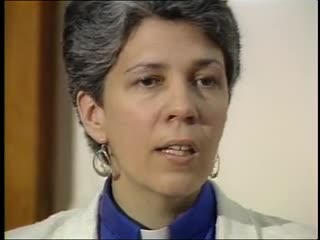
Description: ROBERT HEALY, CAMBRIDGE POLICE AND REV. MONICA STYRON on break-in at Old Cambridge Baptist Church which provides sanctuary to Central American refugees. steeple.
Collection: Ten O'Clock News
Date Created: 06/12/1986
Description: Christy George reports on efforts by the National Conference of Black Lawyers and women's groups to fight the nomination of Judge Robert Bork to the Supreme Court. Bork believes in a strict interpretation of the Constitution, while African American and women's groups believe that the Constitution needs to be interpreted according to the changes in society since the 18th century. Julie Walker (professor, University of Illinois at Urbana) and Adjoa Aiyetoro (Co-chair, National Conference of Black Lawyers) address a meeting of the National Conference of Black Lawyers in Cambridge. Women's groups held an anti-Bork demonstration on City Hall Plaza. Interviews with Gerald Horne (attorney and professor at Sarah Lawrence College), Margaret Burnham (attorney and retired judge) and Barbara Arnwine (Director, Lawyer's Committee for Civil Rights) about their opposition to Bork. George's report uses supporting shots of racist literature from the 19th and 20th centuries.
1:00:15: Visual: Footage of Julie Walker (professor, University of Illinois at Urbana) saying that the Fourteenth Amendment to the Constitution is not strong enough to secure the protection of women and African Americans. Shots of a historical advertisement for a slave auction; of a historical pamphlet titled, "Why I am a clansman"; of a racist photo of an African American girl on the cover of the Pictorial Review; of a sign reading, "No dogs, negroes, Mexicans; of a signs for separate white and "colored" facilities. Christy George notes that the civil rights movement has struggled for equal rights ever since the abolition of slavery; that the Supreme Court has played a crucial role in some of their victories. George reports that the National Conference of Black Lawyers met in Cambridge today; that the Conference opposes the nomination of Robert Bork to the Supreme Court. V: Shots of the meeting of the National Conference of Black Lawyers in Cambridge; of Bork standing beside Ronald Reagan (US President). Footage of Adjoa Aiyetoro (Co-chair, National Coference of Black Lawyers) at the conference, talking about a recent Supreme Court decision. Aiyetoro says that the recent decision allows African Americans to be put to death at higher rates than whites. Aiyetoro says that Bork's appointment to the Supreme Court would strengthen the conservative bent of the Court. Footage of woman at a table set up in City Hall Plaza. A sign on the table indicates that the campaigners are against Bork's nomination. The woman at the table talks to passersby. George reports that women are against Bork's nomination; that Bork has said that women have no Constitutional protection against discrimination. George notes that women campaigned againse Bork on City Hall Plaza yesterday. V: Shots of a woman handing out anti-Bork flyers. Footage of a woman addressing a crowd at City Hall Plaza. She stands in front of a group of women holding anti-Bork signs. She speaks from a podium. A sign hanging on the podium reads, "Reject Bork." The woman says that Bork is a "right-wing ideologue"; that Bork will not support the struggle for equal rights for women. Shots of women at the rally at City Hall Plaza. George reports that Bork believes that the Supreme Court should not overturn legislation unless it is clearly contradict the Constitution. George notes that African Americans and women believe that the Constitution needs to be interpreted according to the changes in society. V: Shot of a young infant wearing an anti-Bork pin. Footage of a woman addressing the crowd on City Hall Plaza. The woman says that the Supreme Court has validated social changes over the past thirty years. George reports that Bork believes in a strict interpretation of the Constitution; that Bork points out that the Fourteenth Amendment guarantees equal protection under the law. V: Footage of Gerald Horne (attorney and professor at Sarah Lawrence College) saying that the Constitution should not be interpreted by 18th century standards. Footage of Margaret Burnham (attorney and retired judge) saying that Bork's interpretation of the Constitution will not protect women and minorities from many acts of discrimination. Footage of Barbara Arnwine (Director, Lawyers' Committee for Civil Rights) saying that Bork opposed the public accomodations provisions of the 1964 Civil Rights Act; that those provisions allowed the desegregation of public transportation. V: Shots of women at the rally at City Hall Plaza. George notes that Bork's critics do not dispute his legal skills. V: Footage of a woman at the rally talking about Bork firing Archibald Cox (Special Prosecutor). She admits that Bork has a good legal record. Shots of women at the rally holding anti-Bork signs.
Collection: Ten O'Clock News
Date Created: 09/11/1987
Description: Costa Rican president Oscar Arias, author of Central American peace plan, speaks at Harvard.
Collection: Ten O'Clock News
Date Created: 09/24/1987
Description: Financial advisor Carmen Elio urges cautious investments by public pension funds to cushion blow of drastic stock market drop. Cambridge firehouse, police, high school, library. Brookline police dept.
Collection: Ten O'Clock News
Date Created: 10/21/1987
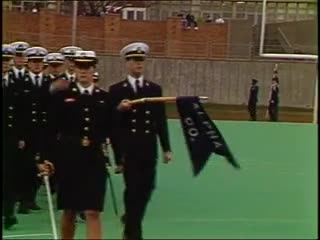
Description: Gay MIT student Robert Bettiker is discharged from ROTC and billed for scholarship. ROTC students put on uniformed drill on BU field. MIT main building. Students walk on campus, lounge on green. ROTC cadets march in parade dress.
Collection: Ten O'Clock News
Date Created: 04/27/1990
Description: Christy George reports that the Reverend Allan Boesak, an anti-apartheid activist, received an award at Harvard University. He gives a speech at the university in which he urges western countries to place economic sanctions on the South African government. He criticizes Ronald Reagan and other western leaders for supporting the South African government. Boesak, at a press conference after the awards ceremony, praises Dukakis for imposing sanction and and urges George Bush to impose sanctions on South Africa. Boesak talks about the effectiveness of sanctions. George's report includes footage of Bush talking about South Africa and footage of apartheid South Africa. Following the edited story is additional footage of Boesak's press conference at Harvard.
1:00:00: Visual: Footage of Dr. Allan Boesak (anti-apartheid activist) preaching at Memorial Church at Harvard University. Boesak says that the lives of many South African blacks could have been saved if Ronald Reagan (US President) and other Western leaders had divested from South Africa in 1985. Footage of South African police brutally arresting South African blacks. Christy George reports that Boesak is one of the few South African church leaders who would dare to blame Reagan for the deaths of South African children. V: Footage of Boesak at Harvard. Boesak accuses Reagan, Margaret Thatcher (Prime Minister of Great Britain), and Helmut Kohl (Chancellor of Germany) of supporting the South African government. Boesak says that these leaders refused to impose sanctions on the apartheid government. George reports that Boesak is outspoken; that Boesak received an award from Harvard University today; that Boesak chided Harvard for investing in South Africa. V: Shots of Memorial Church at Harvard University; of Boesak receiving an award from a Harvard official. George notes that Boesak praised Michael Dukakis (Governor of Massachusetts) for imposing sanctions against South Africa; that Boesak begged George Bush (US President-elect) to do the same. V: Footage of Bush on October 25, 1988. Bush says that the South African government is racist; that the US needs to stay engaged; that the US needs to use its "moral influence" to change the South African government. Footage of Boesak at a press conference at Harvard University. Boesak says that he hopes Bush will follow the example of Massachusetts; that the US should divest from South Africa. Boesak says that he wishes Dukakis had been elected president. Boesak says that Bush has talked about his commitment to civil rights; that Bush needs to act on his commitment. Footage of South African blacks running from police on January 10, 1988. George reports that Boesak says that the South African government is redoubling its efforts to enforce apartheid laws. V: Footage of Boesak saying that he his tired of lame excuses from western governments. Boesak says that western leaders are lying when they talk about their concern for South African blacks. Boesak talks about the US government's commitment to sanctions against Cuba, Libya, Argentina and Nicaragua. George reports that Boesak says that sanctions are effective; that war has become too expensive for the South African government. George reports that Boesak points to the end of wars in Namibia and Angola as proof of the effectiveness of sanctions. V: Footage of Africans celebrating in the streets; of Africans marching in the street; of African soldiers watching a plane taxi on a runway. Footage of Boesak at a press conference. Boesak talks about sanctions. Boesak says that the South African government should be cut off from oil and from access to the international money market. Boesak says that no South African blacks would be hurt if air links to and from South African were cut off. Boesak says that he and Desmond Tutu (South African anti-apartheid leader) are the only two South African blacks who fly anywhere.
Collection: Ten O'Clock News
Date Created: 01/17/1989