Description: Christy George reports from Atlanta on African American residents' views of the Democratic presidential ticket and the Democratic National Convention. George notes that Michael Dukakis needs to show African American voters that he wants their support. Interviews with employees and customers at the Auburn Rib Shack. The interviewees support Jesse Jackson and hope that Jackson will be named as Dukakis's running mate. George notes that both Dukakis and Lloyd Bentsen have good records on civil rights and that Jackson's supporters may be waiting for Jackson to throw his support behind Dukakis. Interviews with African Americans in Atlanta about Jackson and Dukakis. Many interviewees are skeptical about Dukakis. George's report also features footage of Jackson speaking to an audience and footage of Dukakis addressing the Democratic National Convention.
1:00:21: Visual: Footage of James Wyatt (Atlanta resident) driving his cab in Atlanta. Wyatt talks about how life has changed in Atlanta since the civil rights movement. Christy George reports that Wyatt is 84 years old; that he has been driving a cab for 52 years. V: Footage of Wyatt talking about how is mother used to work in the cafeteria of a white school. Wyatt says that she would bring the leftovers home to him. Footage of Jesse Jackson (African American leader) addressing an audience. Jackson talks about how his mother could not prepare a Thanksgiving meal for his family. Jackson say that his mother was busy serving another family's meal. Footage of Wyatt saying that he would have liked to have seen Jackson as the Democratic nominee or as the running mate of Michael Dukakis (Democratic nominee for US President). Christy George stands in front of the Auburn Rib Shack in Atlanta. George reports that Dukakis needs to ask African American voters what they want. V: Footage of an African American female working behind a counter in a restaurant. The woman says that some voters may vote for the Republican ticket if they are disappointed in the Democratic ticket. Footage of an African American male saying that many voters will be upset if Jackson is left off of the Democratic ticket. Shot of an African American man working in the kitchen of the Auburn Rib Shack. George reports that workers and customers at the Auburn Rib Shack are hoping that Jackson will named to the Democratic ticket. V: Footage of an African American man saying that many African Americans registered to vote in order to vote for Jackson. Footage of Dukakis speaking from a podium at the Democratic National Convention. Jackson and Lloyd Bentsen (US Senator) stand on each side of Dukakis. Dukakis says that he wants Jackson and his supporters to play a major role in the presidential campaign. George reports that Dukakis and Bentsen both have good civil rights records. George notes that African American voters may be waiting for Jackson to throw his support behind Dukakis. V: Footage of an African American woman in the driver's seat of a car. The woman says that Jackson deserves a chance. Footage of an African American woman saying that it is time for a change; that the US is ready for an African American candidate. Footage of two women wearing T-shirts which read, "Jesse Walk Out." The women say that Dukakis should go back to Massachusetts. Footage of Wyatt talking about Dukakis. Wyatt says that he has not heard much about Dukakis; that the Democratic Party needs a good leader. Shot of Wyatt's cab turning a corner.
Collection: Ten O'Clock News
Date Created: 07/18/1988
Description: Christy George reports from the Democratic National Convention in Atlanta. George reports that Atlanta is the heart of the new South; she adds that the region is becoming more diverse, and has been energized by an influx of industry and culture. George reports that the Mississippi Delegation to the Democratic National Convention is said to lead the region on issues of race relations. George notes that the Mississippi delegates are representative of the new South. Interviews with Mississippi delegates Jesse Banks, Ed Cole, Isaiah Frederides, Sherry Fisher, Deborah Dunn and Joe Gaitlin. Each delegate expresses pride in the political process and talks about the changes in the state of Mississippi. George reviews the struggle by African Americans for inclusion in the Democratic Party. George discusses the history of African Americans at the Democratic National Convention from 1948 to 1968. George's report includes footage of civil rights protesters in the 1960s and footage of the Democratic National Convention in the 1960s. George's report is also accompanied by footage of Jesse Jackson at the 1988 Democratic National Convention. George notes that Jackson has led a new group of people into the Democratic Party.
1:00:16: Visual: Black and white footage from Eyes on the Prize of Fannie Lou Hamer (Mississippi Freedom Delegation) at the Democratic National Convention in 1964. Black and white footage from "Eyes on the Prize" of African Americans exiting a bus; of white political officials. Shots of a uniformed man taking American flags from the hands of African American demonstrators; of African American demonstrators marching with American flags. Shots of a Democratic National Convention from the 1960s. Christy George reports that African Americans have been fighting for inclusion in the Democratic Party since 1948; that white delegates from Mississippi and Alabama walked out of the convention in 1948 to protest a civil rights plank in the party platform. George notes that the Mississippi Freedom Delegation was seated at the Democratic National Convention in 1968. V: Footage of Jessie Banks (resident of Tchula, Mississippi) talking about the seating of the Mississippi Freedom Delegation at the 1968 convention. George reports that Banks is now a Mississippi delegate to the Democratic National Convention; that the Mississippi delegation is said to lead the South on the issue of race relations. V: Shot of the Mississippi delegation on the floor of the 1988 Democratic National Convention. Footage of Jesse Jackson (African American political leader) addressing the convention on July 19, 1988. Jackson announces that Ed Cole (Mississippi delegate) is the leader of the Mississippi delegation; that Cole is African American. Shots of Jackson exiting a building. He waves to voters. A bus awaits Jackson. A banner on the bus reads, "Rainbow voter registration campaign." Jackson stands in the entrance to the bus, waving to supporters. George reports that Jackson has a led a new group of people into the Democratic Party. V: Footage of State Representative Isaiah Frederides (resident of Gulfport, Mississippi) says that his mother was a domestic servant; that his mother was fired from her job when he tried to register to vote; that his father-in-law's job was threatened. Frederides says that he and his wife were the first two African Americans to register to vote in his county. Footage of Sherry Fisher (resident of Vicksburg, Mississippi) saying that she is attending a convention for the first time; that she wants to be a part of the US democracy. She says that it feels good to be a part of the changes in Mississippi and the US. Shot of delegates on the floor of the 1988 convention. George says that the "new South" is focused on sharing power between those of common backgrounds. V: Footage of Deborah Dunn (resident of Bruce, Mississippi) being interviewed by George. Dunn says that she is a white woman who has picked cotton and worked hard for what she has. Dun says that all southerners are proud of what they have achieved. Footage of Jackson addressing the 1988 Democratic National Convention. Jackson calls Atlanta the "crucible of the new South." V: Shots of the Atlanta skyline; of construction workers working on a new building in Atlanta. George reports that Atlanta is becoming a major urban center. V: Footage from WNEV-TV of an Atlanta Hawks basketball game. Footage of Joe Gatlin (resident of Laurel, Mississippi) saying that industry has come to Atlanta from the north; that industry has brought culture and diversity. Gatlin says that the South is diversifying while keeping some of its old values. Shots of the Atlanta skyline. George reports that diversity and new people may energize the Democratic Party as it is energizing the South. V: Footage of Banks saying that she has great hope for the nation; that the Democratic Party has great African American and white leaders. Christy George stands in downtown Atlanta. George reports that African Americans and whites live in harmony and prosperity in Atlanta; that the Democratic Party will begin to understand the "new South" after holding its convention in Atlanta.
Collection: Ten O'Clock News
Date Created: 07/20/1988
Description: Massachusetts Fair Share register African American voters to vote in Roxbury. Christy George interviews a female community worker who discusses Mass Fair Share's voter registration drive, its lawsuit against the Boston Election Department and the importance of voter education in the African American community. The woman says that some city officials do not want to disrupt current voting patterns by registering new voters; that the Boston Election Department started to cooperate only after the lawsuit was filed. She adds that the recent voter registration drives have been successful.
0:59:57: V: An African American man and an African American woman sit behind a table on a sidewalk in front of the Charles Drew Neighborhood Health Center in Roxbury. Handmade signs for voter registration are posted behind the table. The signs read, "Voter registration here today" and "Save your health center. Register and vote." An African American woman stands in front of the table. A young African American man in a blue shirt sits beside the woman at the table. He watches her fill out forms. More young African Americans stand in front of the table. The male community worker fills out a form for another young African American male. He asks the young man questions as he fills out the form. The young man signs the form. Shot of the community worker's hand as he fills out the form. 1:03:29: V: The two community workers sit behind the table. The young man in the blue shirt stands in front of the table. The young man hands his license to the male community worker, who is filling out a form. The young man signs the form and walks away. Three more young African American males stand in line in front of the table. Close up shot of one of the African American males. The male community worker fills out forms for one of the young men. The young man gives his license to the community worker. Shots of the female community worker; of the book and papers she is studying. 1:10:19: V: A middle-aged African American woman stands at the voter registration table. An African American man registers to vote with the male community worker. The young woman in the red skirt passes by the people gathered at the bus stop. She speaks to two men standing on the sidewalk. She turns and walks back to the voter registration table. The young woman in the red skirt directs someone to the voter registration table. A middle-aged African American woman registers to vote at the table. Shot of the exterior of the Charles Drew Building. The young woman in the red skirt speaks to two young African American men on the sidewalk. 1:13:17: V: An African American woman exits an MBTA bus. The young woman in the red skirt directs her to the voter registration table. They young woman continues to approach people on the street and direct them to the table. 1:14:44: V: Christy George interviews the female community worker. The worker says that Mass Fair Share filed a lawsuit concerning voting discrepancies in the primary elections of September,1982. The worker says that the Boston Election Department was not cooperative last year; that the department failed to provide reliable registrars and sites for Mass Fair Share voting registration drives. The worker says that Mass Fair Share fought to set up voting registration tables at MBTA stations. George notes that voting registration tables need to be set up in a "site of principal activity." The worker says that the Boston Election Department determines which sites can be used; that the department has not made it clear which sites are allowed. The worker says that parks are now allowed as voter registration sites; that the Boston Election Department had previously allowed mills, schools, factories; that churches and welfare offices are recent additions to the list. The worker says that the Boston Election Department began to cooperate after Mass Fair Share filed a lawsuit. George notes that Mass Fair Share has organized voter registration drives all week long. The worker says that the turnout has been excellent at the drives; that the Boston Election Department had predicted a low turnout; that Mass Fair Share is trying to create a momentum around voter registration. George asks the worker if the City of Boston was trying to make voter registration difficult. The worker says that the city can predict which areas vote and how they will vote; that the city does not want to disrupt current voter patterns by registering new voters. The worker says that Mass Fair Share wants to educate people on the importance of voting and on the issues; that the organization is not supporting individual candidates. George asks if voter registration is a civil rights issue. The worker says that voter turnout in the African American community was below the city average; that Mass Fair Share would like to encourage voting in the African American community; that voter registration is more of a problem than voter turnout. The worker says that voter education is important in the African American community; that citizens need to know that voting is a basic right; that citizens need to understand why voting is important. The crew takes cutaway shots of George and the worker.
Collection: Ten O'Clock News
Date Created: 04/28/1983
Description: Sen. Bill Owens comments on dangerous traffic on Blue Hill Avenue. Problems: road used as drag strip, accidents involving stolen cars and drivers leaving scene, speeding, sideswiping, children in harm's way. Wants appropriate criminal category defined between manslaughter and vehicular homicide. Storefronts, youth crossing street. Minister Don Straughter (aka Muhammad) talks about Muslim mission in the community: teaching respect, eschewing alcohol, cleaning up empty lots.
Collection: Ten O'Clock News
Date Created: 07/30/1982
Description: Boston Fire Department Layoffs, Bay Village Fire.
Collection: Ten O'Clock News
Date Created: 01/19/1982
Description: Hotel workers union Local 26 is not being permitted to protest against Boston Marathon sponsor and Back Bay Hilton owner, John Hancock, during the race. Start of the Boston Marathon. Interview with union leader Domenic Bozzotto. Hearing on the protesting. Several union protests. Footage from a John Hancock Boston Marathon commercial.
Collection: Ten O'Clock News
Date Created: 04/16/1987
Description: Civil engineers talk about solidity of Boston roads, bridges, high-rise buildings in event of earthquake, and the need to retrofit older structures. Boston skyline on cloudy day. Storrow Drive traffic. Beacon Hill.
Collection: Ten O'Clock News
Date Created: 10/19/1989
Description: Local 26 hotel workers union president Domenic Bozzotto wins struggle in contract negotiations: establishment of affordable housing fund by hotel management,pending enabling legislation. Union sign.
Collection: Ten O'Clock News
Date Created: 12/01/1988
Description: Christy George reports on the end of a two-week fast by chaplains at Brandeis University. George notes that the chaplains fasted to protest the university's investments in South Africa. George's report includes footage from a gathering of apartheid protesters on the Brandeis campus. Father Maurice Loiselle, Rabbi Albert Axelrad and Reverend Diane Moore discuss their fast and the university's policy regarding South Africa. The protesters sing and hold hands at the gathering. George reports that the chaplains' fast serves as the last phase of a community protest against apartheid. George notes that Brandeis trustees will review their investment policy at an upcoming meeting. George reviews the apartheid protest at Brandeis University since last year. George's report includes footage of Brandeis students at a shantytown on campus from the previous year.
Collection: Ten O'Clock News
Date Created: 02/13/1987
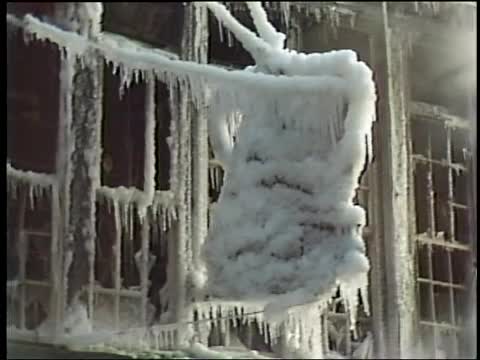
Description: Fire at 5 West Street Boston, housing the Brattle Book Shop. Firefighters on ladder aim hoses into upper windows. Ice chunks flow in street. Badly damaged books lie in puddles. Ice encrusts burnt out building. Icicles cover hydrant. Ken Gloss says loss is total (400,000 antiquarian books and rare manuscripts). He and his father George are determined to reopen in new location next week.
Collection: Ten O'Clock News
Date Created: 02/01/1980