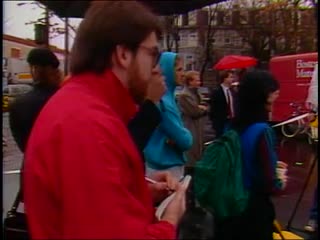
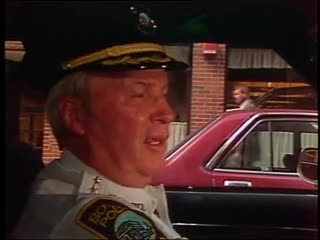
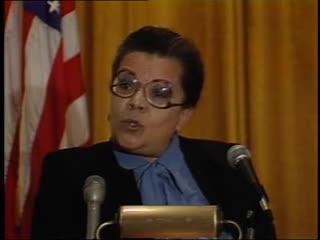
Description: Marcus Jones reports on an exhibit at the Boston Athenaeum celebrating Black History Month. Jones notes that the exhibit features photographs of prominent people in Boston's African American community. Jones interviews Marie Cosindas (photographer) about the photographs. Jones' report includes shots of the photographs. Jones reports that the exhibit also includes documents, books and artworks representing the African American artistic, cultural and political traditions. Jones interviews Marilyn Richardson (exhibit advisor and MIT professor) about the exhibit. Richardson talks about a display of census documents and artworks by Edmonia Lewis (sculptor) and Allan Crite (artist). Jones' report includes footage of artworks in the exhibit.
1:00:07: Visual: Shots of color photographs of African Americans in Boston. Shot of a group photograph of Ruth Batson (community activist) and three others. Shot of a photograph of Hugh Morgan Hill (storyteller), also known as Brother Blue. The photographs are displayed at the Boston Athenaeum. Footage of Marie Cosindas (photographer) talking about the photographs. Cosindas says that the photographs were made with commercial cameras and Polaroid film. Marcus Jones reports that Cosindas made portraits of prominent African Americans in Boston; that her photographs are part of a Black History Month exhibit at the Boston Athenaeum. V: Shots of the portraits, including portraits of Elma Lewis (Roxbury community leader); of Mel King (community activist) and Joyce King (wife of Mel King); of Byron Rushing (State Representative). Shot of a portrait of Tanya Hart (WBZ television personality), Philip Hart (professor, University of Massachusetts), and a young woman. Footage of Cosindas saying that she is glad to have had the opportunity to meet these people; that she was able to learn about each person's character and personality. Shot of a portrait of Bruce Bolling (Boston City Council), Royal Bolling, Sr. (state senator), and Royal Bolling, Jr. (former state representative). Footage of Marilyn Richardson (exhibit advisor and MIT professor) talking to Jones about the exhibit. Richardson says that the exhibit includes one of the earliest census documents of the city of Boston; that the 1765 census includes blacks and Indians. Shot of the census document. Jones reports that Richardson helped to organize the 118-piece exhibit about African Americans in Boston. V: Shots of a display of books; of a painting; of a piece of sculpture. Footage of Richardson talking about a bust of Robert Gould Shaw. Richardson says that Shaw was the white captain of the Massachusetts 54th regiments, which was comprised of African American soldiers. Shot of a painting depicting the Massachusetts 54th regiment in battle. Footage of Richardson saying that the sculpure of Shaw was made by Edmonia Lewis (nineteenth-century sculptor); that Lewis was the first African American to gain an international reputation as a sculptor. Shots of photographs of Lewis; of an 1930s ink drawing. Footage of Richardson talking about the india ink drawings from the 1930s. Richardson says that Allan Crite (artist) portrayed black angels, black saints and a black Christ in his work from the 1930s. Shots of religious drawings by Crite; of a group of sculptures. Shots of a display of books. Footage of Richardson saying that the exhibit organizers have tried to gather rare and unusual documents to demonstrate the complexity and strength of the African American artistic and political traditions. Shots of a museum-goer looking at the exhibit; of a display of books; of paintings included in the exhibit. Jones reports that the exhibit will be on display until April.
Collection: Ten O'Clock News
Date Created: 02/29/1988
Description: COMMISSIONER FRANCIS ROACHE VOWS TO COMBAT POLICE DEPARTMENT CORRUPTION
Collection: Ten O'Clock News
Date Created: 10/22/1986
Description: Marcus Jones reports that Sadiki Kambon (community activist) and others have accused police of using excessive violence when pursuing African American crime suspects. He notes that Donald Johnson (shooting victim) was shot dead this evening by police while he was driving a stolen bus. Jones' report includes footage of the bus and the aftermath of Johnson's shooting. Jones notes that police have shot and killed five suspects of non-violent crimes this year; he adds that four of those five suspects were African American. Jones interviews Kambon. Kambon blames police for Johnson's death, saying that police officers would not have fired on Johnson if he were white. Kambon says that he fears for his life when interacting with police because he is an African American male. Jones reviews the case of Levi Hart (shooting victim), who was shot by police while fleeing a stolen car. Jones adds that African American communities across the nation are concerned about police behavior toward African Americans. Jones' report features footage from various sources of African Americans interacting with police and footage of race riots in Miami. Following the edited story is b-roll of the aftermath of Johnson's shooting. Police and EMTs on the scene.
1:00:08: Visual: Footage from WNEV-TV of police running after a bus on a crowded street in Jamaica Plain. Footage of police and paramedics in Jamaica Plain transporting an injured Donald Johnson (shooting victim) on a stretcher. The footage is from January 31, 1988. Marcus Jones reports that Donald Johnson was shot dead by police while driving a stolen bus in Jamaica Plain. Jones reports that some members of the African American community say that police used excessive violence against Johnson. V: Footage of Sadiki Kambon (community activist) saying that Johnson would still be alive if police had reacted properly to the situation. Shots of Johnson being put into an ambulance by police and paramedics. Jones reports that police say that they fired at Johnson because he posed a threat to their safety and the safety of others. V: Footage of Kambon saying that every issue revolves around race; that situations are seen in terms of "us and them." Jones asks Kambon if he thinks the police would have fired on Johnson if he had been white. Jones says that Kambon would not have been shot if he were white; that police knew an African American man was driving the bus. Jones reports that Johnson's shooting marks the fifth time that police have shot and killed suspects of non-violent crimes. Jones reports that four of the five shootings involved teenagers; that one of the shootings involved a case of mistaken identity; that only one of the five shooting victims was white. V: Shots of police officers and residents standing near a cordoned-off crime scene. On-screen text details statistics of police shootings. Footage of Kambon saying that he fears for his life when he interacts with police because he is an African male. Kambon describes the behavior of police officers when they stop African American males for speeding violations. Jones reports on the case of Levi Hart (shooting victim). Jones says that Hart was shot by police while fleeing from a stolen car. Jones reports that African American communities across the nation are concerned over police behavior toward African Americans. Jones notes that a police shooting touched of riots in Miami recently. Jones adds that an African American man was searched during a church service in Broward County, Florida; that churchgoers thought his afro pick was a gun. V: Shots of a photo of Hart; of a newspaper article with a headline reading, "Hart case will go to grand jury." Footage from Say Brother of an African American man fleeing from police. Footage from NBC of race riots in Miami. Footage from Fox television of police searching an African American man in the back of a church. Police pull an afro pick from the man's coat. Shot of an ambulance on a Boston street. Jones reports that the Boston Police Department will not comment on the shooting of Johnson or on any other shootings. Jones notes that the matter is under investigation.
Collection: Ten O'Clock News
Date Created: 02/06/1989
Description: Marcus Jones reports on current events regarding racism against Asian immigrants to the Boston area. He reports the delay of the trial of Scott Arsenault and John Febbi, charging them with manslaughter for beating and killing Bun Vong, a Cambodian immigrant. Jones interviews Elaine Song, from Asians for Justice, on the hate crimes against Asians in the Boston area. Jones reports on the Revere school system's attempts to encourage racial harmony through education about Cambodian culture to promote more understanding between white and Cambodian students. Jones interviews history teacher Nunzio Benevento about this program and the status of all immigrant communities when they first arrive in America. Jones also interviews white and Asian students about how they get along with each other.
Collection: Ten O'Clock News
Date Created: 04/03/1986
Description: Boston Food Co-op opens a recycling center to handle newspapers, and eventually glass. Stacks of old newspapers.
Collection: Ten O'Clock News
Date Created: 11/17/1988
Description: Republican senators discuss budget cutting proposal. Paul Cellucci, David Locke. People walk up State House steps in winter coats.
Collection: Ten O'Clock News
Date Created: 12/11/1989
Description: Retirement of Boston police deputy superintendent Ed Walsh, "a cop's cop." He reflects on his career.
Collection: Ten O'Clock News
Date Created: 08/21/1987
Description: Marcus Jones reports on efforts to provide positive male role models for young African American boys through the Paul Robeson Institute for Positive Self-Development. Third and fourth grade boys attend the Institute every Saturday, and 25 men from diverse backgrounds assist the boys in developing their understanding of math, science and history. Interviews with Pamela Brodie and Delores Wilson, who are both teachers at the Holland Community School. Both teachers praise the program. Brodie talks about the need for positive male role models. Interview with Keith Motley, a member of the Paul Robeson Institute, about the program. Motley says that programs like this one can help to end the violence on the streets. Interviews with two African American boys who attend the Institute. Following the edited story is additional footage of Brodie and her students in class at the Holland School.
1:00:14: Visual: Footage of students in a classroom at the Holland Community School in Dorchester. Shot of students are getting out their textbooks. The students are seated at their desks. Pamela Brodie (teacher, Holland Community School) stands at the front of the room. Shot of students raising their hands to be called on. Most of the students are non-white. Marcus Jones reports that the majority of students in public elementary schools in Boston are non-white. Jones reports that most of the teachers are female. Jones notes that male authority figures are limited; that African American male authority figures are virtually absent. V: Footage of Brodie being interviewed. Brodie says that most school systems have a lot of female teachers. Brodie says that it is important to have positive male role models for students; that some students do not have a male role model at home. Brodie says that schools need more male role models. Jones reports that elementary school students are in their formative years. Jones reports that a group called Concerned Black Men of Massachusetts visit the Holland School to help students make the right choices. V: Shots of students eating lunch at their desks. Shots of an African American boys walking around the classroom. Footage of Keith Motley (Paul Robeson Institute) being interviewed. Motley says that the group wants to fight against violence; that education is necessary to end violence. Footage from the Paul Robeson Institute. An African American man addresses a group of African American boys. The man speaks from a podium, while the boys sit in seats. The man encourages the boys to be the best people they can be. The man says that the future depends on them. Jones reports that the organized effort to provide positive role models is called The Paul Robeson Institute for Positive Self-Development. Jones reports that African American boys from the third and fourth grades in the Holland and Fifield Schools are involved in the program; that the boys visit the African American Institute at Northeastern University on Saturdays. Jones reports that 25 men from diverse backgrounds assist the boys in developing their understanding of math, science, and history. Jones says that the Institute focuses on African American history. V: Shot of an African American man speaking to a group of African American boys in a classroom. The boys are seated at desks. Shot of a sign for the African American Institute on the exterior of a building. Shot of an African American man standing at the front of a classroom. African American boys are seated at desks. A second African American man leans on a chalkboard as the other man teaches. Shot of a group of African American boys in orange T-shirts standing in a circle. The boys hold hands. An African American man stands in the center of the circle. African American men stand in a circle surrounding the boys. Footage of an African American boy being interviewed by Jones. Jones asks if the teachers at the institute are teaching him to be proud of himself. The boy says yes. Footage of another African American boy being interviewed by Jones. The boy says that the program has taught him that he can do something else besides sell drugs on the street. Shots of Brodie standing in her classroom; of an African American boy flipping through a textbook. Jones reports that the Robeson Institute has been operating for a year; that the Robeson Institute has earned praise from parents and teachers. V: Footage of Delores Wilson (teacher, Holland Community School) being interviewed. Wilson talks about one of her students who has behavior problems. Wilson says that the student's behavior has improved since attending the Robeson Institute. Wilson says that the student now helps other kids. Footage of Motley being interviewed. Motley says that programs like the Robeson Institute should be promoted and encouraged; that men and women should get involved. Shot of the African American boys at the Institute standing in a circle while holding hands. African American men form a circle around the boys. An African American man stands in the center.
Collection: Ten O'Clock News
Date Created: 12/13/1990
Description: Marcus Jones reports that State Rep. Byron Rushing and Republican candidate Mike Duffy are competing for the state representative seat in the ninth Suffolk District. Interviews with both Rushing and Duffy. Rushing accuses Duffy of lying about Rushing's political record. Rushing says that Duffy cannot find issues on which to challenge him. Duffy says that Rushing is arrogant and out of touch with his constituents. Duffy calls Rushing presumptuous for declaring himself "the lesbian and gay candidate." Duffy is openly gay in a district with a high percentage of gay and lesbian voters. Rushing has been endorsed by several gay and lesbian activists. He adds that lesbian and gay voters may decide the race. Jones reviews the candidates' positions on the issues. Jones notes that Rushing must prove himself to voters. He adds that there is hostility toward incumbents on the part of many voters during this election season. Jones report is accompanied by footage of both candidates campaigning and by footage of both candidates at their campaign headquarters. This edition of the Ten O'Clock News also included the following item: Winnie Mandela speaks at the Twelfth Baptist Church
1:00:05: Visual: Footage of Byron Rushing (State Representative) campaigning in the street. Rushing speaks to an African American man and an African American woman who are seated on the front steps of a building. Shot of Rushing shaking hands with an African American man and a white woman on the street. Marcus Jones reports that Democrats outnumber Republicans ten to one in Rushing's district. Jones notes that Rushing is campaigning hard against Mike Duffy (Republican candidate for state representative) in the Ninth Suffolk District. Jones notes that Duffy is a twenty-seven year old Republican. V: Shot of Duffy working at a desk. Duffy answers the telephone. Footage of Rushing being interviewed on the street. Rushing says that he is taking the campaign seriously. Rushing accuses Duffy of lying about Rushing's political record. Rushing says that Duffy is waging a "dirty campaign." Rushing says that Duffy does not deserve to get any votes. Footage of Rushing campaigning on the street. Rushing shakes hands with an African American woman on the street. A Rushing supporter stands nearby, holding a campaign sign. Rushing approaches a white woman on the street. He shakes her hand. Jones reports that the Ninth Suffolk District includes parts of the South End, the Fenway, Back Bay, and lower Roxbury. Jones reports that the race may be decided by lesbian and gay voters in the district. Jones reports that Duffy has been going door-to-door in order to introduce himself to voters. Jones notes that Duffy has never denied his homosexuality. Jones reports that Duffy believes that his homosexuality may give him an advantage. Jones adds that the district has a high concentration of gays and lesbians. Jones reports that Duffy proposes to increase the government's role in the fight against AIDS. V: Footage of Duffy knocking on the door of a housing development building. Duffy enters the building and climbs the stairs. Duffy knocks on an apartment door. Footage of Duffy being interviewed. Duffy says that the state government needs to do more to fight AIDS. Jones reports that Rushing is not conceding the lesbian and gay vote to Duffy. Jones reports that Rushing is not gay; that Rushing has been endorsed by several lesbian and gay activists. V: Shot of Rushing in his office with a campaign worker. Shots of Rushing's campaign literature; of a campaign flyer which reads, "Rushing is the lesbian and gay candidate." Footage of Rushing being interviewed on the street. Rushing says that most of his lesbian and gay constituents support him. Rushing says that he wanted his campaign literature was prepared by lesbian and gay supporters. Rushing says that he wants his campaign literature to focus on his support in the gay and lesbian community. Footage of Duffy being interviewed by Jones. Duffy says that Rushing's campaign literature is offensive; that Rushing should not call himself the "gay and lesbian candidate." Duffy says that it is unthinkable for a candidate who is not African American to run as the African American candidate. Duffy says that Rushing is presumptuous; that Rushing's campaign is offensive and demeaning. Jones reports that the two candidates differ on issues of affordable housing, crime prevention, and the budget. Jones notes that both candidates oppose the tax-rollback petition. V: Shot of Duffy and a group of campaign workers folding campaign literature. Shot of a campaign sign opposing the tax rollback; of a campaign sign for William Weld (Republican candidate for governor of Massachusetts) and Paul Cellucci (Republican candidate for lieutenant governor of Massachusetts). Jones reports that Duffy has accused Rushing of being out of touch with the people who have elected him. Jones notes that Rushing may be vulnerable to attacks on that issue. Jones adds that there seems to be hostility toward incumbents during this election season. V: Shot of Rushing waving to cars passing by on the street. Footage of Duffy being interviewed by Jones. Duffy says that voters harbor a great degree of resentment toward Rushing. Duffy says that Rushing is arrogant; that Rushing has not been there for his constituents. Footage of Rushing being interviewed. Rushing says that Duffy cannot find an issue on which to disagree with him. Rushing says that Duffy is now lying about Rushing's record. Jones stands on a street in the Ninth Suffolk District. Jones reports that the Ninth Suffolk District is evolving socially; that the district may be evolving politically. Jones notes that Rushing must prove to voters that he is still in touch with them.
Collection: Ten O'Clock News
Date Created: 10/22/1990
Description: OFFICIALS SUGGEST RESTRUCTURING OF SCHOOL COMMITTEE FOR BETTER EDUCATION. RAY FLYNN, EDWARD DOHERTY.
Collection: Ten O'Clock News
Date Created: 04/21/1987