Description: Employment retraining becomes necessary in the slumping Massachusetts economy. Former Amstar worker learns to repair appliances at lower starting wage.
Collection: Ten O'Clock News
Date Created: 12/12/1988
Description: Marcus Jones interviews Eugene Rivers of the African Peoples Pentecostal Church about his community work in the greater Roxbury neighborhood. Jones notes that Rivers is an outspoken critic of the religious establishment. He adds that Rivers spends a lot of time counseling troubled youth and acting as a legal advocate for them. Rivers talks about his work with neighborhood youth. Rivers says that many troubled teenagers come from disadvantaged socioeconomic backgrounds. Rivers talks about the need for churches to do more to reach out to young people. Rivers says that churches must provide alternatives for young people. Rivers talks about violence in the community and about his commitment to young people in the neighborhood. Jones notes that violence is a problem in the neighborhood. He adds that Rivers is committed to fighting the problem. Jones' report is accompanied by footage of Rivers talking to young people on the street and footage of Rivers' church van, damaged from gunfire.
1:00:06: Visual: Footage of Eugene Rivers (Pastor, African Peoples Pentecostal Church) talking to two young African American men in front of a courthouse. Marcus Jones reports that Rivers is not a social worker; that Rivers spends a lot of time counseling troubled youth. Jones reports that Rivers is the pastor of the African Peoples Pentecostal Church; that Rivers' church holds its meetings at the Freedom House in Roxbury. V: Footage of Rivers being interviewed by Jones. Jones asks how much of Rivers' time is taken up by troubled youth. Rivers says that his wife thinks that he spends too much time. Jones asks Rivers how often he is in the courthouse. Rivers says that he is in the courthouse three or four days per week. Rivers says that a large number of teenagers end up getting into trouble for legitimate reasons; that many these teenagers get into trouble stemming from their socio-economic backgrounds. Rivers says that he tries to make himself available to help these people. Shot of Rivers walking on a sidewalk with a young African American man. Jones reports that Rivers is an outspoken critic of the religious establishment. Jones reports that Rivers believes that religious leaders have failed the young people of Roxbury, Dorchester, and Mattapan. Jones notes that Rivers believes that religious organizations need to provide alternatives to drugs, gangs, and violence. V: Shot of a group of African American teenage boys standing in front of a house. Another group of African American teenage boys rides by on bicycles. Footage of Rivers being interviewed by Jones. Rivers says that churches are the premier institutions in the African American community. Rivers says that churches, including his own, are not doing enough to reach out to young people. Rivers says that the absence of the churches on the street is more conspicuous than the presence of drugs. Shot of Rivers walking on the street with another African American man. Rivers stops an African American teenage boy. Rivers starts talking to the boy. Footage of Rivers being interviewed by Jones. Rivers says that many young men are involved in illegal activities because no other form of activity was available to them. Rivers says that many young drug dealers never had adult role models; that many young drug dealers never had access to any kind of significant alternative. Shot of Rivers walking down the courthouse steps with another man. Jones reports that Rivers speaks from experience when he talks about role models. Jones reports that Rivers was a gang member and drug dealer in Philadelphia before he enrolled at Harvard University. Jones notes that Rivers is trying to make a difference on the streets of a neighborhood where gang violence is commonplace. V: Shot of bullet holes in the windshield of Rivers's van. Footage of Rivers counting the bullet holes on his van. Rivers points out the damage done to his van. Close-up shot of a bullet hole on the side of the van. Jones reports that gang members fired dozens of bullets into the home of Rivers's next-door nieghbor last month. Jones reports that many of the bullets hit Rivers's church van; that two bullets pierced the wall of his home. V: Shot of Rivers and Jones outside of Rivers's home. Shot of a bullet hole in the window of a home. Shots of the broken windows of the church van; of broken glass inside of the van. Shot of a bullet hole in the wall of Rivers's home. Footage of Rivers being interviewed by Jones outside of his home. Jones comments that Rivers's neighbors have moved out of their home. Rivers says that he feels a commitment toward the community; that he wants to make something happen here. Shot of Rivers and Jones framed by the broken window of the van. Jones reports that Rivers, his family and his congregation want to make the African American community aware of its responsibility to change things. Jones reports that Rivers wants the community to work at making improvements instead of blaming outsiders. V: Footage of Rivers being interviewed by Jones. Rivers says that kids will participate in legitimate acitivities if those activities are provided. Jones asks who will provide the activities. Rivers says that African American churches need to come up with alternatives for youth; that the churches should close shop if they fail to provide alternatives. Rivers says that African American churches should become employers, educators, advocates; that the churches should be in the courts and in the jails. Rivers says that the churches have failed to understand the meaning of the gospel if they fail to take up this challenge.
Collection: Ten O'Clock News
Date Created: 08/15/1990
Description: James Moseley proposes to revive horse racing at dormant Suffolk Downs. Dog track owner Charles Sarkis also seeks approval for horse racing at Foxboro. Government regulations committee hearing.
Collection: Ten O'Clock News
Date Created: 05/13/1991
Description: Marcus Jones reports on efforts to provide positive male role models for young African American boys through the Paul Robeson Institute for Positive Self-Development. Third and fourth grade boys attend the Institute every Saturday, and 25 men from diverse backgrounds assist the boys in developing their understanding of math, science and history. Interviews with Pamela Brodie and Delores Wilson, who are both teachers at the Holland Community School. Both teachers praise the program. Brodie talks about the need for positive male role models. Interview with Keith Motley, a member of the Paul Robeson Institute, about the program. Motley says that programs like this one can help to end the violence on the streets. Interviews with two African American boys who attend the Institute. Following the edited story is additional footage of Brodie and her students in class at the Holland School.
1:00:14: Visual: Footage of students in a classroom at the Holland Community School in Dorchester. Shot of students are getting out their textbooks. The students are seated at their desks. Pamela Brodie (teacher, Holland Community School) stands at the front of the room. Shot of students raising their hands to be called on. Most of the students are non-white. Marcus Jones reports that the majority of students in public elementary schools in Boston are non-white. Jones reports that most of the teachers are female. Jones notes that male authority figures are limited; that African American male authority figures are virtually absent. V: Footage of Brodie being interviewed. Brodie says that most school systems have a lot of female teachers. Brodie says that it is important to have positive male role models for students; that some students do not have a male role model at home. Brodie says that schools need more male role models. Jones reports that elementary school students are in their formative years. Jones reports that a group called Concerned Black Men of Massachusetts visit the Holland School to help students make the right choices. V: Shots of students eating lunch at their desks. Shots of an African American boys walking around the classroom. Footage of Keith Motley (Paul Robeson Institute) being interviewed. Motley says that the group wants to fight against violence; that education is necessary to end violence. Footage from the Paul Robeson Institute. An African American man addresses a group of African American boys. The man speaks from a podium, while the boys sit in seats. The man encourages the boys to be the best people they can be. The man says that the future depends on them. Jones reports that the organized effort to provide positive role models is called The Paul Robeson Institute for Positive Self-Development. Jones reports that African American boys from the third and fourth grades in the Holland and Fifield Schools are involved in the program; that the boys visit the African American Institute at Northeastern University on Saturdays. Jones reports that 25 men from diverse backgrounds assist the boys in developing their understanding of math, science, and history. Jones says that the Institute focuses on African American history. V: Shot of an African American man speaking to a group of African American boys in a classroom. The boys are seated at desks. Shot of a sign for the African American Institute on the exterior of a building. Shot of an African American man standing at the front of a classroom. African American boys are seated at desks. A second African American man leans on a chalkboard as the other man teaches. Shot of a group of African American boys in orange T-shirts standing in a circle. The boys hold hands. An African American man stands in the center of the circle. African American men stand in a circle surrounding the boys. Footage of an African American boy being interviewed by Jones. Jones asks if the teachers at the institute are teaching him to be proud of himself. The boy says yes. Footage of another African American boy being interviewed by Jones. The boy says that the program has taught him that he can do something else besides sell drugs on the street. Shots of Brodie standing in her classroom; of an African American boy flipping through a textbook. Jones reports that the Robeson Institute has been operating for a year; that the Robeson Institute has earned praise from parents and teachers. V: Footage of Delores Wilson (teacher, Holland Community School) being interviewed. Wilson talks about one of her students who has behavior problems. Wilson says that the student's behavior has improved since attending the Robeson Institute. Wilson says that the student now helps other kids. Footage of Motley being interviewed. Motley says that programs like the Robeson Institute should be promoted and encouraged; that men and women should get involved. Shot of the African American boys at the Institute standing in a circle while holding hands. African American men form a circle around the boys. An African American man stands in the center.
Collection: Ten O'Clock News
Date Created: 12/13/1990
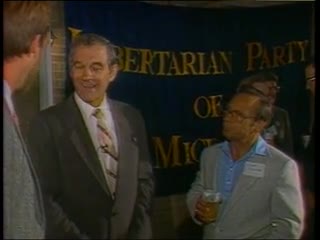
Description: Libertarian Party presidential candidate Ron Paul (former Republican Congressman from Texas) states his platform: free enterprise, unrestricted individual freedom, no income tax, US out of other governments.
Collection: Ten O'Clock News
Date Created: 10/26/1988
Description: S. Stephen Rosenfeld is appointed Dukakis' chief of staff. Cabinet secretaries comment. Charles Barry, Paula Gold.
Collection: Ten O'Clock News
Date Created: 11/28/1988
Description: Rowe Quarry on Malden Saugus Revere border is site proposed by MWRA for landfill/ sludge disposal. Owner will fight eminent domain seizure of his property. Rep. William Reinstein, Sen. John Brennan.
Collection: Ten O'Clock News
Date Created: 10/04/1988
Description: Marcus Jones reports that Roxbury community leaders met behind closed doors to draw up a plan to deal with the growing problem of gang violence in the community. Jones reports on the recent deaths of Roxbury residents Darlene Tiffany Moore and Richard Bailey. Jones' report includes photos of Bailey and Moore. Four suspects in the Bailey murder, including Shango Dilday, Demetrius Dunston, and Emmett Snow, were arraigned today in Roxbury District Court. Interview with Barry Snow (uncle of Emmett Snow) about the arraignment. Police have arrested Roxbury resident Shawn Drumgold and another suspect in connection with Moore's death. Information from the community led to Drumgold's arrest. Press conference with Police Commissioner Francis "Mickey" Roache, who says that police are working with members of the community to solve crimes. Interview with Roxbury resident Terrence Kelley about the increase in violence. City Councilor Bruce Bolling speaks to the press.
1:00:05: Visual: Footage of Bruce Bolling (Boston City Council) and Gloria Fox (State Representative) entering a building. Members of the press remain outside. Marcus Jones reports that Roxbury leaders met behind closed doors to draw up a plan to deal with the growing problem of gang violence. V: Shot of a Boston Herald newspaper article a headline reading, "Police vow to capture girl's killers." The article features a photo of Darlene Tiffany Moore (Roxbury resident and shooting victim). Jones reports that two Roxbury youngsters have been killed in less than two weeks; that Moore was killed in the crossfire of two warring drug gangs on August 19. V: Shot of the Humboldt Street location where Moore was killed. Jones reports that Richard Bailey (Roxbury resident, age 14) was stabbed to death by a rival gang member over the past weekend. V: Shot of a color photo of Bailey. Jones stands on the corner of Copeland Street in Roxbury. Jones reports that Bailey was one of several gang members being chased by a rival gang; that Bailey was caught and stabbed by the rival gang member. Jones reports that four suspects in the Bailey murder were arraigned today in Roxbury District Court. V: Shot of Francis "Mickey" Roache (Police Commissioner, City of Boston) approaching the podium at a press conference. William Celester (Deputy Superintendent, Boston Police Department) and another man stand stand behind him. Footage of a lawyer at the arraignment of the suspect. The lawyer addresses the judge, saying that the government does not have a case against his client. Shots of Clarence Dilday (father of Shango Dilday) in the audience of the courtroom; of Barry Snow (uncle of Emmett Snow) in the audience of the courtroom; of other audience members. Jones reports that a 14-year-old juvenile was arraigned in court today; that Shango Dilday (Roxbury resident), Demetrius Dunston (Roxbury resident) and Emmett Snow (Roxbury resident) were also arraigned. V: Footage of Barry Snow saying that he brought Emmett Snow to court today so that the situation could be straightened out. Shot of Shawn Drumgold (Roxbury resident) in Roxbury District Court. Jones reports that police have arrested Drumgold and another suspect in connection with the Moore shooting; that police arrested Drumgold in court where he was being arraigned on a heroin charge. [Shot of Drumgold in Roxbury District Court. Jones reports that the information from the community aided police in making Drumgold's arrest. V: Footage of Roache at a press conference. Roache says that he has spoken to members of the Roxbury community; that members of the community are willing to do whatever they can to help police. Footage of Jones interviewing Terrence Kelley (Roxbury resident) on the street. Jones asks Kelley if there will be an end to the violence. Kelley says that the violence may only be at its beginning. Shot of Jones stands with other members of the media outside of the building in which Roxbury community leaders are meeting. Jones reports that today's meeting is a signal that Roxbury leaders are serious about ending the violence. V: Footage of Bolling speaking to the press outside of the building. Bolling says that community leaders are going to work together to get rid of the negative elements in the community. Shot of Copeland Street.
Collection: Ten O'Clock News
Date Created: 08/29/1988
Description: Marcus Jones reports that State Rep. Byron Rushing and Republican candidate Mike Duffy are competing for the state representative seat in the ninth Suffolk District. Interviews with both Rushing and Duffy. Rushing accuses Duffy of lying about Rushing's political record. Rushing says that Duffy cannot find issues on which to challenge him. Duffy says that Rushing is arrogant and out of touch with his constituents. Duffy calls Rushing presumptuous for declaring himself "the lesbian and gay candidate." Duffy is openly gay in a district with a high percentage of gay and lesbian voters. Rushing has been endorsed by several gay and lesbian activists. He adds that lesbian and gay voters may decide the race. Jones reviews the candidates' positions on the issues. Jones notes that Rushing must prove himself to voters. He adds that there is hostility toward incumbents on the part of many voters during this election season. Jones report is accompanied by footage of both candidates campaigning and by footage of both candidates at their campaign headquarters. This edition of the Ten O'Clock News also included the following item: Winnie Mandela speaks at the Twelfth Baptist Church
1:00:05: Visual: Footage of Byron Rushing (State Representative) campaigning in the street. Rushing speaks to an African American man and an African American woman who are seated on the front steps of a building. Shot of Rushing shaking hands with an African American man and a white woman on the street. Marcus Jones reports that Democrats outnumber Republicans ten to one in Rushing's district. Jones notes that Rushing is campaigning hard against Mike Duffy (Republican candidate for state representative) in the Ninth Suffolk District. Jones notes that Duffy is a twenty-seven year old Republican. V: Shot of Duffy working at a desk. Duffy answers the telephone. Footage of Rushing being interviewed on the street. Rushing says that he is taking the campaign seriously. Rushing accuses Duffy of lying about Rushing's political record. Rushing says that Duffy is waging a "dirty campaign." Rushing says that Duffy does not deserve to get any votes. Footage of Rushing campaigning on the street. Rushing shakes hands with an African American woman on the street. A Rushing supporter stands nearby, holding a campaign sign. Rushing approaches a white woman on the street. He shakes her hand. Jones reports that the Ninth Suffolk District includes parts of the South End, the Fenway, Back Bay, and lower Roxbury. Jones reports that the race may be decided by lesbian and gay voters in the district. Jones reports that Duffy has been going door-to-door in order to introduce himself to voters. Jones notes that Duffy has never denied his homosexuality. Jones reports that Duffy believes that his homosexuality may give him an advantage. Jones adds that the district has a high concentration of gays and lesbians. Jones reports that Duffy proposes to increase the government's role in the fight against AIDS. V: Footage of Duffy knocking on the door of a housing development building. Duffy enters the building and climbs the stairs. Duffy knocks on an apartment door. Footage of Duffy being interviewed. Duffy says that the state government needs to do more to fight AIDS. Jones reports that Rushing is not conceding the lesbian and gay vote to Duffy. Jones reports that Rushing is not gay; that Rushing has been endorsed by several lesbian and gay activists. V: Shot of Rushing in his office with a campaign worker. Shots of Rushing's campaign literature; of a campaign flyer which reads, "Rushing is the lesbian and gay candidate." Footage of Rushing being interviewed on the street. Rushing says that most of his lesbian and gay constituents support him. Rushing says that he wanted his campaign literature was prepared by lesbian and gay supporters. Rushing says that he wants his campaign literature to focus on his support in the gay and lesbian community. Footage of Duffy being interviewed by Jones. Duffy says that Rushing's campaign literature is offensive; that Rushing should not call himself the "gay and lesbian candidate." Duffy says that it is unthinkable for a candidate who is not African American to run as the African American candidate. Duffy says that Rushing is presumptuous; that Rushing's campaign is offensive and demeaning. Jones reports that the two candidates differ on issues of affordable housing, crime prevention, and the budget. Jones notes that both candidates oppose the tax-rollback petition. V: Shot of Duffy and a group of campaign workers folding campaign literature. Shot of a campaign sign opposing the tax rollback; of a campaign sign for William Weld (Republican candidate for governor of Massachusetts) and Paul Cellucci (Republican candidate for lieutenant governor of Massachusetts). Jones reports that Duffy has accused Rushing of being out of touch with the people who have elected him. Jones notes that Rushing may be vulnerable to attacks on that issue. Jones adds that there seems to be hostility toward incumbents during this election season. V: Shot of Rushing waving to cars passing by on the street. Footage of Duffy being interviewed by Jones. Duffy says that voters harbor a great degree of resentment toward Rushing. Duffy says that Rushing is arrogant; that Rushing has not been there for his constituents. Footage of Rushing being interviewed. Rushing says that Duffy cannot find an issue on which to disagree with him. Rushing says that Duffy is now lying about Rushing's record. Jones stands on a street in the Ninth Suffolk District. Jones reports that the Ninth Suffolk District is evolving socially; that the district may be evolving politically. Jones notes that Rushing must prove to voters that he is still in touch with them.
Collection: Ten O'Clock News
Date Created: 10/22/1990
Description: Teacher with Hispanic students in classroom at William Russell Elementary School.
Collection: Ten O'Clock News
Date Created: 06/15/1987