Description: Composer John Harbison working with Boston Symphony Orchestra conductor Seiji Ozawa on a piece commissioned by the BSO. Interview Harbison on his composing process and what he wants to listener to get out of his work. Ozawa leads the BSO in rehearsal of Harbison's work. Violinist Joel Smirnoff in back of orchestra.
Collection: Ten O'Clock News
Date Created: 03/22/1984
Description: Federal Reserve Board appointee John LaWare on contribution to public education by Boston business leaders; state of Massachusetts economy; admiration for Dukakis.
Collection: Ten O'Clock News
Date Created: 08/11/1988
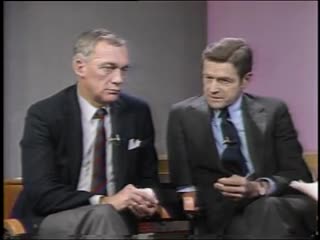
Description: On-set interview with BU president John Silber and former ambassador to El Salvador Robert White on the Kissinger Commission report on El Salvador.
Collection: Ten O'Clock News
Date Created: 01/19/1984
Description: Interview with John Silber as maverick Democratic candidate for governor. He refuses to discuss his association with Kevin White.
Collection: Ten O'Clock News
Date Created: 05/30/1990
Description: Another audio track is in the background of this video. Excerpt from an interview with John Updike on Rabbit is Rich. He answers questions about his connections to protagonist Harry "Rabbit" Angstrom. He talks about America running out of gas, literally and metaphorically.
Collection: Ten O'Clock News
Date Created: 05/07/1982
Description: Interview with John Updike on the occasion of his winning the Pulitzer Prize for fiction for "Rabbit at Rest."
Collection: Ten O'Clock News
Date Created: 04/09/1991
Description: Interview with Boston Pops conductor John Williams in back room at Symphony Hall. He compares the repertoires and missions of the Pops versus the Boston Symphony Orchestra. He speaks about his possible plans for expanding the repertoire of the orchestra, the types of music they might adapt, and the changes it would require. He says he doesn't want to use Pops as a place to showcase his own work. He laughs about kids always asking why he doesn't play Star Wars. He discusses his future involvement with Pops and staying in Boston. They shoot cutaways with no audio. Lydon reasks questions, with audio.
Collection: Ten O'Clock News
Date Created: 07/01/1981
Description: Harpsichordist Joseph Payne plays Bach on Bach's 300th birthday, and explains counterpoint.
Collection: Ten O'Clock News
Date Created: 03/21/1985
Description: First seven minutes are shots of photographs of community activist Mel King throughout his life. Then Christopher Lydon interviews his wife Joyce King in the kitchen of their home. Joyce says that Mel's parents taught him the importance of sharing with others, and adds that he was very proud of his father, who was active in a union. Joyce talks about Mel's generosity. Lydon asks about the West Indian background of Mel's family, and about his formative years. She says that Mel's family was proud of their West Indian heritage and discusses his experiences while attending college in South Carolina. Joyce says that he learned about racism and oppression while living in South Carolina.
1:00:02: Visual: Shots of black and white photographs of Mel King throughout his life; of Mel King's high school yearbook photograph. 1:06:55: V: Christopher Lydon interviews Joyce King (wife of Mel King) in the kitchen of her home. Lydon asks Joyce King about Mel King's family. Joyce King says that Mel King's family always shared what they had with others; that Mel King's mother was able to make do with the few resources she had. Joyce King says that Mel King's father was active in a union; that Mel King is very proud of his father. Joyce King tells a story about the generosity of Mel King's father. Joyce King says that Mel King has an "open door policy"; that Mel King is not protective of his privacy. Joyce King says that Mel King often brings people to their home. Joyce King says that Mel King often gives clothing or money to those in need; that he does it in a quiet manner. 1:15:06: V: Lydon asks about the West Indian culture of Mel King's family. Joyce King says that Mel King's family is proud of their heritage; that his parents grew up in Barbados; that the family has strong connections to their heritage. Lydon asks about Mel King's formative years. Joyce King says that Mel King's membership in the Church of All Nations was important in his younger years; that Mel King attended a church-sponsored school in South Carolina; that the public school system discouraged African Americans from attending university. Joyce King says that Mel King learned a lot about race and oppression when he was at college in South Carolina; that Mel King traveled through the South as a member of the sports teams at his college. Joyce King says that Mel King returned from South Carolina with ideas about race and the fight against oppression.
Collection: Ten O'Clock News
Date Created: 11/06/1983
Description: KIM DAE JUNG SPEAKING ON LIFE IN KOREA AND DEMOCRACY
Collection: Ten O'Clock News
Date Created: 01/31/1985