Description:
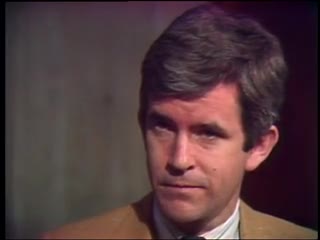
Christopher Lydon interviews cultural historian Kiku Adatto (Harvard University) about Jesse Jackson as a presidential candidate. Lydon's interview with Adatto is accompanied by footage of Jackson throughout his political career. The footage illustrates Jackson's dynamic style of speaking. Adatto notes that Jackson is a religious figure in the political arena. She notes that Jackson's energy and moral fervor are more suited to a preacher than a politician. She says that Jackson's strength lies in his ability to articulate social criticism. Adatto says that many voters see Jackson as an outsider or a social critic instead of as a politician; she adds that some voters may not be able to envision him as president. Lydon's report also includes footage of Martin Luther King, Jr. (American civil rights leader) and Andrew Young (Mayor of Atlanta).
1:00:02: Christopher Lydon interviews Kiku Adatto (Harvard University) about Jesse Jackson (candidate for the Democratic nomination for US President). Adatto talks about the tradition of preachers in American history. She says that many of these preachers, including Martin Luther King (civil rights leader) and Jackson, have become political leaders. Visual: Shot of a black and white photo of Jackson on a balcony with King. Black and white footage of King giving a speech. Shot of a black and white photo of Jackson in a crowd, raising his arm in the black power salute. Adatto says that Jackson has tried to pick up the mantle of King; that Jackson has tried to be the "conscience of America" in the way that King was. V: Footage of Jackson addressing a crowd at Harvard University on April 4, 1985. Jackson talks about the evils of apartheid. Adatto says that there is a tradition in the US of the preacher staying outside of politics; that Jackson has tried to move into the political system in order to effect change. V: Footage of Jackson passing a lobby of a building. He shakes hands with African American bystanders. Jackson enters a room full of supporters. Adatto says that Jackson is concerned with equality and civil rights; that Jackson has been caught exhibiting prejudice against Jews; that Jackson was linked with Reverend Louis Farrakhan (African American Muslim leader). V: Shots of newspaper articles detailing the controversy surrounding Jackson's remarks about Jews in 1984. Adatto adds that the preacher must remain "morally sound" when entering the political arena. V: C-Span footage of Jackson addressing the Democratic Convention in 1984. Adatto says that Jackson has an "insider-outside dilemma"; that Jackson finds it difficult to make the compromises required by electoral politics. Adatto notes that Andrew Young (Mayor of Atlanta) made an easy transition into electoral politics. V: Shot of Young at a press conference in Boston in 1983. Adatto notes that Jackson has lost none of his energy or "moral fervor"; that Jackson still criticizes society from an outsider's point of view. Adatto adds that Young is an "insider." V: Shot of Young at a press conference. Adatto says that Jackson strength lies in his ability to articulate social criticism. V: C-Span footage of Jackson addressing the Democratic Convention in 1984. Shots of audience members. Adatto says that Jackson stirs the emotions of voters in his "outsider" role; that Jackson troubles many voters in his "insider" role. Adatto notes that Jackson's role as social reformer and critic undermines his strength as a presidential candidate; that many voters cannot envision Jackson as president. Adatto notes that many of the nation's great presidents have been calm and quietly strong; that some see Jackson as too much of a preacher; that Jackson's energy and moral fervor are more suited to preacher than politician. V: C-Span footage of Jackson addressing the Democratic Convention in 1984. Adatto says that some see voters as too much of an outsider, social critic or civil rights leader; that some white voters are turned off by Jackson. Adatto quotes statistics from a study which found that 23% of American voters are not ready to vote for any African American for president. V: C-Span footage of Jackson addressing the Democratic Convention in 1984. Adatto says that Jackson has the ability to stir the emotions of the American people; that he is most powerful in his role as "outsider" or critic. Adatto says that many voters are stirred by his message, but cannot envision him as president because he is an outsider. V: Footage of Jackson announcing his candidacy for president in 1988. His supporters stand behind him, cheering. Jackson promises "bold leadership."
Date Created:
10/16/1987