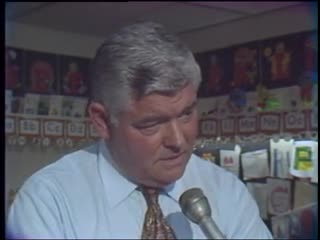
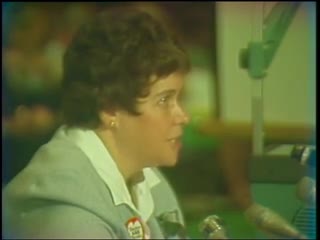
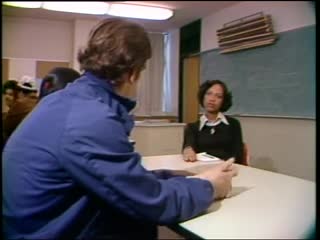
Description: Boston School Committee Meeting at Quincy School. .
Collection: Ten O'Clock News
Date Created: 05/11/1981
Description: Boston School Teachers gathered at Hynes Auditorium.
Collection: Ten O'Clock News
Date Created: 08/13/1981
Description: Boston School Teachers gathered at Hynes Auditorium.
Collection: Ten O'Clock News
Date Created: 08/13/1981
Description: Senator Edward Brooke concedes the Senate race to Paul Tsongas in the ballroom of the Copley Plaza Hotel. With him on the stage are supporters including State Sen. William Owens, his mother Helen Brooke, community leader Elma Lewis, and campaign field director Thomas Trimarco. Sharon Stevens reports from behind the cheering crowd, anticipating Brooke's speech; Natalie Jacobson (WCVB reporter) is on the stage, waiting to interview Brooke after the speech. Brooke thanks the crowd, his family, and his campaign staff. Brooke congratulates Tsongas for waging an honorable campaign. Brooke says that he will do his best to assure the smooth transition of the Senate seat and that he continues to support full equality and justice for all. Brooke thanks voters for giving him the opportunity to have served as both State Attorney General and US Senator and assures those who did not vote for him that he has no bitterness toward them. Brooke shakes hands and answers questions from the press as he slowly makes his way off stage surrounded by an entourage. B-roll of Brooke supporters in ballroom after the speech.
0:58:17: Visual: Shot of Edward Brooke (US Senator) at a podium, waving to a cheering crowd in the ballroom of the Copley Plaza Hotel. A large campaign banner behind him reads, "Brooke - United States Senator." William Owens (State Senator), Helen Brooke (Edward Brooke's mother), Elma Lewis (African American community leader), Thomas Trimarco (field director for Brooke's campaign) and other supporters are all on stage with Brooke. Sharon Stevens (WGBH reporter) stands behind the cheering crowd, anticipating Brooke's speech. 0:59:15: V: Brooke thanks the crowd, which continues to cheer for him. Brooke says that preliminary results show Paul Tsongas (candidate for US Senator) to be the victor. Brooke congratulates Tsongas for waging an honorable campaign. Brooke says that he will do his best to assure the smooth transition of the Senate seat. Brooke thanks his campaign workers and contributors for their support. Brooke notes that there are US Senators who will continue to fight for senior citizens, minorities, the poor, and the handicapped. Brooke says that he continues to support full equality for women and equal justice for all. Brooke thanks voters for giving him the opportunity to have served as both State Attorney General and US Senator. Brooke assures those who did not vote for him that he has no bitterness toward them. Brooke says that he leaves the Senate with the feeling that there is much left to be accomplished; that he remains committed to the causes he has supported. Brooke paraphrases Lillian Hellman, saying that "I could never cut my consciensce to fit the fashion of any year." Brooke commends his supporters for their hard work, faith and courage. Brooke thanks his family, his campaign manager, John Volpe (chairman of Brooke's campaign committee), and Trimarco. Brooke says that he regrets not having spent enough time with the voters of Massachusetts during the campaign. He notes that his Senate responsibilities kept him in Washington D.C. during much of the campaign. Brooke says that he wishes Tsongas well; that he is sorry he did not deliver a victory for his campaign workers and supporters. Brooke says that he is very happy that a woman has been elected to the US Senate. He jokes about going out to look for a job and wishes his supporters well. 1:09:35: V: Brooke shakes hands with members of the crowd. Natalie Jacobson (WCVB reporter) is on the stage with a microphone, waiting to interview Brooke. The crowd continues to clap for Brooke. Stevens recaps Brooke's speech. Brooke is still on the stage, talking to members of the media. The crowd remains on the floor. 1:11:11: V: Brooke remains on the stage. He waves to supporters. Members of the media surround him. He answers questions about the race and his future plans. A jazz band plays and the noise of the crowd is audible. Brooke attempts to move off of the stage. The media continue to surround him. Brooke waves at the crowd as he moves slowly off the stage. Flashbulbs go off as the media take his photograph. 1:15:51: V: Shot of a sign reading, "We still love you Ed. You're the best.". Shots of campaign supporters on the floor; of members of the crowd. Shots of the media and their equipment in the corner of the room. Members of the crowd mill about in the ballroom. Shot of the jazz band playing.
Collection: Ten O'Clock News
Date Created: 11/07/1978
Description: Interview with jazz pianist and band leader Count Basie at the Berklee Performance Center. He talks about his long career and current musicians.
Collection: Ten O'Clock News
Date Created: 03/25/1982
Description: The Boston School Committee holds a meeting in the School Committee chambers. Members of the School Committee discuss school business. John O'Bryant (Boston School Committee) reports on the need for school repairs; Robert Spillane (Superintendent, Boston Public Schools) reports on staffing issues. Sharon Stevens (WGBH reporter) interviews Kathleen Kelly (President, Boston Teachers Union) about a proposed school choice plan. Kelly says that many parents support a school choice plan because the current system allows little flexibility. Kelly says that the school choice plan must be considered carefully to prevent a return to segregated schools. Stevens interviews O'Bryant about the proposed school choice plan. O'Bryant says that the plan promotes greater access to schools across the city; that the current system is archaic and inflexible. Stevens interviews Barbara Gray (parent) about the proposed school choice plan. Gray says that parents should be allowed to choose a school with programs suited to the needs of their children. Gray says that the schools need to be improved; that the Boston Public Schools are not truly integrated because there are few white students. Stevens has extended conversations with interviewees while cutaways are shot. Takes of Stevens doing standup about supporters of the school choice plan working on an official proposal for the end of the month. The audio quality on this tape is uneven.
1:00:12: Visual: A Boston School Committee meeting is held in the chambers of the Boston School Committee. School committee members Jean McGuire, John O'Bryant, Jean Sullivan McKeigue, Kevin McCluskey, and Rita Walsh Tomasini are seated at the front of the room. Robert Spillane (Superintendent, Boston Public Schools) sits at the front with the members of the School Committee. Community members and the press are seated in the audience. O'Bryant talks about the need for $40 million to make school repairs. He says that the mayor, the Boston City Council, and the community must be made aware of the money needed for repairs. Shots of the various committee members. McKeigue agrees that school repairs are needed. A vote is taken on approving a draft of a letter to the mayor and the Boston City Council. O'Bryant thanks Spillane for his report. O'Bryant asks Spillane a question about staffing. Spillane says that more staff is needed before instituting a certain program. Audio is muffled. Shots of Sharon Stevens (WGBH reporter); of members of the audience; of the stenographer; of the committee; of the audience. The committee members discuss school business. Audio remains muffled. Shot of the committee members from the perspective of the audience. 1:05:10: Visual: Spillane talks about setting objectives for the school Social Studies programs. Shots of the committee members; of the audience. Audio is muffled. The committee members take a vote. Committee members discuss school contract issues. Shot of Stevens; of Kathleen Kelly (President, Boston Teachers Union) speaking to another audience member; of audience members. 1:08:15: V: Stevens sets up an interview with Kelly. Stevens asks Kelly about a "freedom of choice" proposal supported by some African American parents. Kelly says that she has not yet seen the proposal; that many African American and white parents support a "freedom of choice" plan because the geocode system allows little flexibility; that parents are more interested in good education than racial statistics. Kelly says that a control mechanism must be put in place to prevent a return to segregated schools; that the plan must be given careful thought. Kelly says that the choice of educational programs is more important than the choice of school location. Stevens asks Kelly if busing is "almost dead." Kelly says that busing is no longer the only remedy for Boston schools; that busing can serve as a tool to further the goals of desegregation and educational quality. The crew takes cutaway shots of Stevens and Kelly. Stevens and Kelly speak informally. 1:12:36: V: Stevens sets up an interview with O'Bryant. Stevens asks for O'Bryant's opinion of the "freedom of choice" proposal. O'Bryant says that parents are trying to reform the rigid geocode system; that students have been denied access to schools because of the geocode system. O'Bryant mentions students who have been denied access to the Trotter School. O'Bryant says that the parents are asking for more accessibility to the schools; that the "freedom of choice" proposal has been made into a bigger issue than it should be. O'Bryant says that the geocode system assigns students to schools based upon their residence; that the geocode system is archaic and inflexible; that the geocode system must be addressed in the consent decrees put forth by the court; that leaving the geocode system in place would have "disastrous" consequences. Stevens asks O'Bryant about NAACP intervention in the court case, and NAACP opposition to the "freedom of choice" plan. O'Bryant says that there is a lack of communication between the NAACP and supporters of the plan; that supporters of the plan want greater access to the schools. Stevens asks if the "freedom of choice" plan could result in a return to segregated schools. O'Bryant says that schools in Boston are already segregated because white parents refuse to send their children to most schools located in African American communities; that African American parents want greater access to quality schools all over the city. The crew takes cutaway shots of Stevens and O'Bryant. O'Bryant says again that the "freedom of choice" plan does not represent a return to segregated schools. 1:16:13: V: Stevens sets up an interview with Barbara Gray (parent), who supports the "freedom of choice" plan. Gray says that the supporters of the plan want greater access to all of the schools; that supporters of the plan want an end to the rigid geocode system. Gray explains that the geocode system assigns children to schools according to address and race. Gray says that all of Boston schools need to have high standards; that the each of the schools should have different programs designed to suit specific needs; that students should be able to choose a school whose programs suit their needs. Gray says that education needs to be improved so that all of the schools are equally competitive and able to provide a good education. Stevens asks if the "freedom of choice" plan could result in a return to segregated schools. Gray says that she does not want to go back to segregated schools; that true integration does not exist in Boston because there are not enough white students in the school system; that white students might return to the system if the schools are reformed. The crew takes cutaway shots of Stevens and Gray. Gray says that parents want more control over the education of their children. 1:19:59: V: Stevens records the closing segment of the story from outside of the headquarters of the Boston School Committee. She reports that the supporters of the "freedom of choice" plan are working on an official proposal for the end of the month; that the Massachusetts State Board of Education will propose an end to court intervention in the Boston School System. Stevens does two more takes of the closing segment.
Collection: Ten O'Clock News
Date Created: 03/08/1982
Description: English High School Basketball Game. .
Collection: Ten O'Clock News
Date Created: 12/16/1980
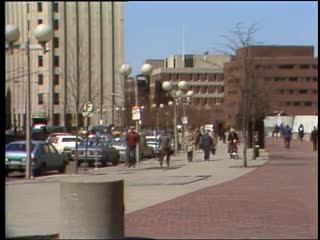
Description: GOOD WIDE SHOT OF PEOPLE WALKING DOWN STREET, BUILDINGS IN GOVERNMENT CENTER
Collection: Ten O'Clock News
Date Created: 04/05/1982
Description: Joseph Jordan, Boston Police Commissioner. .
Collection: Ten O'Clock News
Date Created: 07/18/1980
Description: MBTA shots at Park Street Station. .
Collection: Ten O'Clock News
Date Created: 11/11/1980