Description: Vice President Dan Quayle makes a carefully orchestrated trip to Boston, visiting a first grade class, Republican fundraising luncheon, and Boston Police Patrolman's Association.
Collection: Ten O'Clock News
Date Created: 01/22/1990
Description: Meg Vaillancourt reports that the Federal Reserve Bank has released a study finding that banks in Boston are guilty of redlining. Vaillancourt notes that three times as many mortgages are approved in Boston's white neighborhoods as in African American neighborhoods. Vaillancourt reviews the findings of the study. Vaillancourt interviews African Americans on the street. They talk about their experiences in applying for mortgages. Vaillancourt reports that African Americans earn less than whites on average. She adds that these economic factors do not explain the gap in mortgage lending practices. Vaillancourt interviews Joseph Kennedy (US Congressman). Kennedy condemns redlining practices. He adds that banks should not practice discrimination, noting that many banks receive federal funds. Vaillancourt reports that Boston banks have agreed to change their lending practices. She adds that meetings between community activists and banks are scheduled for next month. Vaillancourt's report is accompanied by footage of employees and customers in banks and shots of residential homes.
1:00:14: Visual: Shots of residential homes in suburban areas. Meg Vaillancourt reports that home prices are on the rise. Vaillancourt notes that race can also be obstacle to home ownership. V: Footage of an African American man being interviewed at Downtown Crossing in Boston. The man says that he is turned down every time he applies for a mortgage. Footage of an African American woman being interviewed at Downtown Crossing. The woman says that she has had to submit a great deal of paperwork when applying for a mortgage; that she has been examined more carefully than her income would merit. Footage of Joseph Kennedy (US Congressman) saying that redlining is practiced across the nation; that many officials try to deny it. Vaillancourt reports that the Federal Reserve Bank has released a study which finds that three times as many mortgages are approved in Boston's white neighborhoods as in Boston's African American neighborhoods. V: Shot of an African American woman looking out of the window of an apartment building. On-screen visuals and text detail the findings of the study. Footage of an African American man being interviewed at Downtown Crossing. The man says that banks seem to believe that African Americans do not have money. Footage of another man being interviewed. The man says that there should be no discrimination in lending practices. Shots of homes in a residential neighborhood; of two white women and a child standing in front of one of the homes. Vaillancourt reports that some blamed economic factors instead of race for redlining practices. Vaillancourt quotes statistics which show that African Americans earn less than whites on average; that homes in African American neighborhoods cost less; that there is less development in African American neighborhoods. V: Shots of residential homes in a variety of neighborhoods. Vaillancourt notes that economic factors do not explain the gap in mortgage lending practices. Vaillancourt quotes the study as finding that a 24% difference in mortgages between white and African American neighborhoods is found even when economic factors are taken into account. Vaillancourt reports that the study found that economic factors do not explain the gap in lending practices. V: On-screen text and visuals detail the study findings. Footage of Kennedy saying that poor people are receiving credit; that people of color are being denied access to credit. Vaillancourt reports that the banking industry is in crisis after the savings and loan scandal; that many banks have been forced to close. Vaillancourt notes that taxpayers are bailing out some banks; that banks are having a hard time collecting on bad loans. V: Shots of employees and customers in the lobby of a bank; of a client filling out a loan application; of bank employees sitting at their desks while helping customers. Shot of an African American bank employee helping a white customer with a loan application. Footage of Kennedy saying that banks have access to federal funds; that banks receiving federal funds should not practice discrimination. Shot of two triple-decker houses in a residential neighborhood. One of the houses is dilapidated. Vaillancourt reports that Boston banks have agreed to change their lending practices; that meetings between community activists and banks are scheduled for next month. V: Footage of the first African American man at Downtown Crossing. The man says that he has been forced to look elsewhere for loans; that the banks' lending practices will not stop him.
Collection: Ten O'Clock News
Date Created: 08/31/1989
Description: Alexander Tennant boasts about the many new Republican candidates for legislature. Monica Staaf, Nancy Sullivan, Alba Castillo, John DeJong and others assembled in front of State House.
Collection: Ten O'Clock News
Date Created: 05/03/1990
Description: Profile of Robert Spillane, superintendent of Boston Public Schools as he prepares to leave Boston for a post in Virginia. Vaillancourt reports on Spillane's accomplishments in improving the Boston Public School System and cutting the school budget deficit. Interview with Spillane where he compliments the teaching staff in the Boston Public Schools and talks about his opinion of Arthur Garrity. He says that Garrity's stewardship of the school system was a disaster. Interview with Peter McCormick, the President of the Bank of New England, about Spillane's good relationship with the business community. Vaillancourt speculates about whether Spillane will one day pursue a career in politics.
1:00:21: Visual: Footage of Robert Spillane (Superintendent, Boston Public Schools) speaking to an audience. Spillane says that the quality of every school must be improved in order for school desegregation to be considered a success. Meg Vaillancourt reports that Spillane took over as Superintendent of the Boston Public Schools four years ago; that Boston was undergoing school desegregation. V: Shot of a young African American boy watching an anti-busing march. White protesters chant, "Here we go, Southie." Shot of a police officer pushing an angry white man against a car. Vaillancourt reports that the quality of education was very low. Vaillancourt notes that school officials admitted that more than one-third of the graduates from Boston Public Schools could not read. V: Shots of students descending an elevator at English High School. Shot of an African American male student reading at a his desk; of two white male students sitting together in a classroom; of students in a classroom. Shots of a group of students sitting together in a study hall; of a teacher in the study hall. Vaillancourt reports that there were six superintendents during the first seven years of school desegregation in Boston. Vaillancourt reports that Spillane was committed to changing the schools in Boston. V: Shot of Spillane seating himself as he prepares to speak to an audience. The audience applauds. Vaillancourt reports that Spillane instituted the first changes to the school curriculum in fifteen years; that promotion standards were established; that students' test scores began to improve. V: Shot of two elementary school students seated in front of computers. A teacher looks over the shoulder of one of the students. Vaillancourt reports that Spillane shares credit for success with his staff. V: Footage of Spillane being interviewed. Spillane says that there is an excellent teaching staff in the Boston Public Schools. Spillane says that the rising levels of student achievement reflect the dedication of the teaching staff. Spillane says that he provided help and direction. Spillane says that he challenged the teachers by publishing the test scores of each school. Shots of Spillane in his office. Vaillancourt reports that Spillane is known as the "velvet hammer." V: Shot of a hammer with a velvet grip on display in Spillane's office. Vaillancourt reports that Spillane is credited with pushing Arthur Garrity (federal judge) aside; that Spillane allowed the Boston School Department to take charge of the schools once again. Vaillancourt notes that Garrity is slowly handing over his control of the Boston Public Schools. V: Shot of Garrity at a community meeting in January of 1976. Vaillancourt reports that Spillane has few kind words for Garrity. V: Footage of Spillane being interviewed by Vaillancourt. Spillane says that Garrity was a "disaster"; that Garrity was not a good manager of the schools. Spillane says that Garrity did what was necessary to desegregate the schools; that Garrity tried to manage the schools as well. Spillane says that a federal judge has no qualifications to manage a school system. Vaillancourt reports that Spillane considers his ability to manage the school system as his strength. Vaillancourt reports that the school budget had tripled in the decade before Spillane's arrival. Vaillancourt reports that Spillane cut the school deficit from $30 million to $3 million within one year. Vaillancourt notes that Spillane got Boston businesses involved in the schools; that Boston businesses have given over $5 million in additional funds to the schools. Vaillancourt adds that the Boston Public Schools have the largest private endowment in the nation. V: Footage of a woman introducing Spillane to an audience. Spillane rises from his seat, shakes the woman's hand and prepares to address the audience. The audience applauds. Shots of audience members. Footage of Spillane receiving an award in front of an audience. Footage of Peter McCormick (President, Bank of New England) being interviewed. McCormick says that Spillane is highly respected by the business community. McCormick says that Spillane understands the problems of the business community; that Spillane has been willing to be flexible. McCormick says that the business community responded in kind to Spillane. Vaillancourt reports that Spillane is leaving Boston for Virginia; that Spillane will make an additional $30,000 per year in his new job. Vaillancourt reports that Spillane made $70,000 per year in Boston; that his salary is considered low. V: Footage of Spillane talking with a small group of people. Spillane shakes hands with an Asian American woman. Footage of Spillane being interviewed by Vaillancourt. Spillane says that superintendents are like athletes in that they have a short span of time in which to perform well and make money. Spillane says that there is a good market for superintendents. Vaillancourt reports that some are speculating that Spillane is looking for a political appointment in Washington DC. in the future. Vaillancourt notes that Spillane is a former Deputy Commissioner of Education in New York. V: Shot of Spillane socializing with a group of people at a gathering. Footage of Spillane being interviewed by Vaillancourt. Spillane says that public service is a great opportunity; that he loves public service. Spillane says that he may enter politics in the future; that he might like to be a city councillor or school committee member someday.
Collection: Ten O'Clock News
Date Created: 06/28/1985
Description: Democratic Party chair Ron Brown addresses party luncheon in Boston and alludes to lessons learned from Michael Dukakis' presidential defeat. Paul Kirk, Edward Kennedy, John Kerry.
Collection: Ten O'Clock News
Date Created: 04/03/1989
Description: INTERVIEW WITH SUPERINTENDENT ROBERT SPILLANE ON DECISION TO LEAVE BOSTON PUBLIC SCHOOLS
Collection: Ten O'Clock News
Date Created: 11/30/1984
Description: Secretaries of State from around the country gather in Boston, hear Michael Dukakis speak, appraise him as presidential candidate.
Collection: Ten O'Clock News
Date Created: 07/13/1987
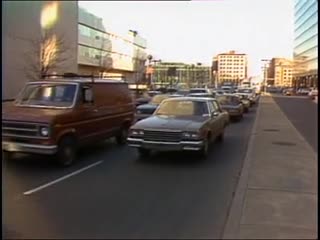
Description: Congested traffic around South Station, Fort Point Channel bridge. Gridlock. High wide shots. Giant milk bottle statue on Museum Wharf. Lobster traps on wharf. Custom House. Northern Avenue bridge.
Collection: Ten O'Clock News
Date Created: 01/31/1986
Description: Ray Flynn's State of the City address focuses on Stuart murder case, police behavior, and racism. He contrasts and challenges stereotypes of different Boston neighborhoods. Interviews with people responding the speech.
Collection: Ten O'Clock News
Date Created: 01/10/1990
Description: 1) In State of the City address at JP High Mayor Ray Flynn laments struggling economic health of Boston even as state is booming. 2) Interview with Samuel Tyler of Boston Municipal Research Bureau on city's tenuous finances. 3) Gov. Michael Dukakis signs bill to hasten conversion of abandoned buildings to affordable housing. 4) Reps. William Robinson and David Cohen debate rules reform on late night legislative sessions; Reps. Gregory Sullivan, Lawrence Alexander, Andrew Natsios; Robinson on speaker's platform with George Keverian. 5) Brief on aggressive tactics of anti- abortion protesters, reporting that Joseph Stanton of Citizens for Life denies escalating attacks on clinics, calling protesters “sidewalk counselors.” 6) Interview with Roger Fisher on Geneva arms limitations talks. 7) Felicia Lamport verse on arms talks. Anchors Lydon and Vaillancourt.
Collection: Ten O'Clock News
Date Created: 01/07/1985