Description: Meg Vaillancourt reports that Robert Mugabe (Prime Minister of Zimbabwe) was awarded an honorary degree from the University of Massachusetts at Amherst. Vaillancourt's report includes footage of Mugabe receiving his doctoral hood from Maki Mandela (daughter of Nelson Mandela) and footage from Mugabe's speech and press conference. Vaillancourt reports that Mugabe spoke out against apartheid in South Africa and advocated sanctions against the South African government. Vaillancourt reviews Mugabe's career. Comments on President Reagan's political actions concerning Apartheid. Vaillancourt's report includes footage of Mugabe in Zimbabwe.
1:00:06: Visual: Footage of Robert Mugabe (Prime Minister of Zimbabwe) speaking at the commencement ceremonies at University of Massachusetts in Amherst. Mugabe applauds the US Congress for considering sanctions against South Africa. Meg Vaillancourt says that Mugabe talked about sanctions against South Africa in his speech at UMass Amherst; that Mugabe was honored by the university for "his efforts to establish racial harmony between blacks and whites." Vaillancourt notes that Mugabe was presented with an honorary doctorate of laws. V: Shot of Mugabe receiving his doctoral hood from Maki Mandela (daughter of Nelson Mandela). Vaillancourt reports that Mugabe became Zimbabwe's first prime minister in 1980; that Zimbabwe had been known as Rhodesia under colonial rule. V: Shots of Mugabe and his cabinet in 1980; of white colonial rulers before 1980; of a newspaper headline reading, "Black Hitler." Vaillancourt reports that Mugabe was a fierce opponent of apartheid in neighboring South Africa; that Mugabe had spent ten years in prison before emerging as the leader of the Zimbabwean struggle for independence. V: Shots of Mugabe in the Zimbabwean Parliament; of Mugabe being led away by two police officers; of Mugabe entering a military garrison. Vaillancourt notes that Mugabe is a strong supporter of black South African leaders. V: Footage of Mugabe at a press conference. Mugabe says that he advocates using all legitimate means to overthrow apartheid; that he advocates armed struggle against South Africa. Mugabe says that he can understand the desire to fight apartheid using non-violent means. Mugabe encourages the use of "maximum non-violence" through sanctions and political pressure. Shot of the press at the press conference. Vaillancourt says that Mugabe dismissed concerns that sanctions would hurt South African blacks. V: Footage of Mugabe saying that black South Africans are already suffering and dying under apartheid; that black South Africans are prepared to suffer under sanctions because they will yield a positive result. Vaillancourt says that Mugabe was questioned about his leadership of Zimbabwe; that there have been accusations of human rights violations in Zimbabwe under Mugabe. V: Shots of Mugabe in a government building; of Zimbabwean troops uncovering an arms cache. Vaillancourt reports that Mugabe says that he has detained those who have tried to overthrow his government. V: Footage of Mugabe at the commencement ceremony. Mugabe says that the struggle for human rights is a universal struggle. Vaillancourt stands on the campus of UMass Amherst. Vaillancourt says that Ronald Reagan (US President) is trying to win enough votes in the US Congress to sustain his veto of sanctions against South Africa. Vaillancourt notes that Reagan is promising an African American ambassador to South Africa as part of his weaker sanctions package; that Reagan is expressing concern over a disruption of summit talks if sanctions are approved by Congress. Vaillancourt adds that Mugabe said that the time for compromise in South Africa is over.
Collection: Ten O'Clock News
Date Created: 10/01/1986
Description: Meg Vaillancourt interviews Robert Peterkin (Superintendent, Cambridge Public Schools) about school desegregation in Boston. Peterkin reviews desegregation in Boston, both the positive and negative outcomes. He talks about the challenges that lie ahead for desegregation. Peterkin discusses his belief in the potential for educational innovation and quality in a minority school system, stating that quality education will desegregate schools more effectively than a court order. He discusses the difficulties in moving from a "numerical desegregation" plan to a "freedom of choice" plan and notes that the Cambridge Public School System desegregated its schools through a "freedom of choice" plan. Peterkin says that busing was necessary to desegregate the Boston school system; notes that the city had been given opportunities to explore other desegregation models; that the resistance to busing was very strong. Peterkin discusses the magnet school concept and the need to institute valuable educational programs at every school. Peterkin talks about the problems with the court-ordered desegregation plan in Boston, but says that the positive result of equal access to the schools far outweighs the negative results. Peterkin discusses the prospect of more students returning to Boston schools in the future. Peterkin says that Arthur Garrity (federal judge) should end his supervision of Boston's schools; that the Boston School Department is able to assume the responsibility of continued desegregation of the schools, but that safeguards are required to prevent a return to discriminatory practices. Peterkin discusses his perceptions of what Martin Luther King would have thought about school desegregation in Boston.
1:00:02: Visual: Meg Vaillancourt interviews Robert Peterkin (Superintendent, Cambridge Public Schools) about school desegregation in Boston. Vaillancourt asks Peterkin to review desegregation in Boston. Peterkin says that school desegregation has given minority students access to better school programs; that school desegregation opened up the Boston Public School System. Peterkin talks about partnerships between the school system and businesses and universities in the community. Peterkin mentions the cooperation between the school system and human services agencies. Peterkin says that school desegregation exposed the educational shortcomings of the system. Peterkin says that school desegregation is still a difficult issue in Boston; that white and middle-class students have abandoned the school system; that the population of the Boston schools is overwhelmingly minority. Peterkin says that the desegregation effort needs to focus on educational programs; that Robert Spillane (Superintendent, Boston Public Schools) is focusing more on educational reform; that parents support the renewed focus on educational programs. Vaillancourt asks Peterkin if improvements in education are possible with a minority student population and an overwhelmingly white city government. Peterkin says that he resents the implication that educational innovation and quality are not possible in a minority school system. Peterkin notes that the school system must spend their resources wisely; that the quality of education will determine whether or not students will attend; that quality education will desegregate schools more effectively than a court order. 1:05:00: V: Vaillancourt asks Peterkin's opinion on the "freedom of choice" proposal. Peterkin says that the "freedom of choice" plan will not work until the quality of education improves in all schools across the city; that there is varying quality among the schools in Boston; that each neighborhood school needs to offer strong educational programs. Peterkin says that it will be difficult to switch from a "numerical desegregation" plan to a "freedom of choice" plan; that the "freedom of choice" plan will require an enormous leap of faith for the minority community and the court. Peterkin mentions that the Cambridge Public School System desegregated its schools through a "freedom of choice" plan. Vaillancourt asks Peterkin if busing was necessary for desegregation in Boston. Peterkin says that busing was necessary at the time; that the city had been given opportunities to explore other desegregation models; that the resistance to busing was very strong. Peterkin says that Arthur Garrity (federal judge) made efforts to improve the schools through magnet programs and partnerships with businesses; that parents are more willing to bus their children to a school with strong educational programs. Vaillancourt asks Peterkin if all schools should be follow the magnet school model. Peterkin says that there must be an effort to institute valuable educational programs in every school; that parents will send there children to schools with sound educational programs; that it is not necessary to make every school a magnet school. Vaillancourt asks about the problems with the court-ordered desegregation plan in Boston. Peterkin says that the schools were ignored recently by city officials and the community in the late 1970s and early 1980s; that many residents and city officials did not pay attention to the schools because of a fiscal crisis and low attendance; that a declining school system can adversely affect the whole city. Peterkin says that a reduced student population was a negative result of school desegregation; that the positive result of equal access to the schools far outweighs the negative result. 1:11:24: V: Vaillancourt asks Peterkin if students will return to the schools. Peterkin says that there has been a renewed commitment to the schools in the past few years; that improvements in the educational programs will prompt younger parents to consider sending their children to the Boston Public Schools. Peterkin notes that the decline in attendance has leveled off. Vaillancourt asks Peterkin if Garrity should end his supervision of the schools. Peterkin says that Garrity should end his supervision; that the Boston School Department is able to assume the responsibility of continued desegregation of the schools. Peterkin says that there need to be some safeguards in the system to prevent a return to discriminatory practices. Peterkin says that flexible guidelines must be established to guarantee the percentages of children in neighborhood schools; that educational standards must be guaranteed. Vaillancourt asks Peterkin what Martin Luther King would have thought about school desegregation in Boston. Peterkin says that King would have been disheartened by the violence and turmoil resulting from school desegregation; that King would have been encouraged by the positive changes in the system and in the city. The crew takes cutaway shots of Vaillancourt and Peterkin. Peterkin and Vaillancourt speak informally about the state of schools in Boston.
Collection: Ten O'Clock News
Date Created: 03/17/1983
Description: Profile of Robert Spillane, superintendent of Boston Public Schools as he prepares to leave Boston for a post in Virginia. Vaillancourt reports on Spillane's accomplishments in improving the Boston Public School System and cutting the school budget deficit. Interview with Spillane where he compliments the teaching staff in the Boston Public Schools and talks about his opinion of Arthur Garrity. He says that Garrity's stewardship of the school system was a disaster. Interview with Peter McCormick, the President of the Bank of New England, about Spillane's good relationship with the business community. Vaillancourt speculates about whether Spillane will one day pursue a career in politics.
1:00:21: Visual: Footage of Robert Spillane (Superintendent, Boston Public Schools) speaking to an audience. Spillane says that the quality of every school must be improved in order for school desegregation to be considered a success. Meg Vaillancourt reports that Spillane took over as Superintendent of the Boston Public Schools four years ago; that Boston was undergoing school desegregation. V: Shot of a young African American boy watching an anti-busing march. White protesters chant, "Here we go, Southie." Shot of a police officer pushing an angry white man against a car. Vaillancourt reports that the quality of education was very low. Vaillancourt notes that school officials admitted that more than one-third of the graduates from Boston Public Schools could not read. V: Shots of students descending an elevator at English High School. Shot of an African American male student reading at a his desk; of two white male students sitting together in a classroom; of students in a classroom. Shots of a group of students sitting together in a study hall; of a teacher in the study hall. Vaillancourt reports that there were six superintendents during the first seven years of school desegregation in Boston. Vaillancourt reports that Spillane was committed to changing the schools in Boston. V: Shot of Spillane seating himself as he prepares to speak to an audience. The audience applauds. Vaillancourt reports that Spillane instituted the first changes to the school curriculum in fifteen years; that promotion standards were established; that students' test scores began to improve. V: Shot of two elementary school students seated in front of computers. A teacher looks over the shoulder of one of the students. Vaillancourt reports that Spillane shares credit for success with his staff. V: Footage of Spillane being interviewed. Spillane says that there is an excellent teaching staff in the Boston Public Schools. Spillane says that the rising levels of student achievement reflect the dedication of the teaching staff. Spillane says that he provided help and direction. Spillane says that he challenged the teachers by publishing the test scores of each school. Shots of Spillane in his office. Vaillancourt reports that Spillane is known as the "velvet hammer." V: Shot of a hammer with a velvet grip on display in Spillane's office. Vaillancourt reports that Spillane is credited with pushing Arthur Garrity (federal judge) aside; that Spillane allowed the Boston School Department to take charge of the schools once again. Vaillancourt notes that Garrity is slowly handing over his control of the Boston Public Schools. V: Shot of Garrity at a community meeting in January of 1976. Vaillancourt reports that Spillane has few kind words for Garrity. V: Footage of Spillane being interviewed by Vaillancourt. Spillane says that Garrity was a "disaster"; that Garrity was not a good manager of the schools. Spillane says that Garrity did what was necessary to desegregate the schools; that Garrity tried to manage the schools as well. Spillane says that a federal judge has no qualifications to manage a school system. Vaillancourt reports that Spillane considers his ability to manage the school system as his strength. Vaillancourt reports that the school budget had tripled in the decade before Spillane's arrival. Vaillancourt reports that Spillane cut the school deficit from $30 million to $3 million within one year. Vaillancourt notes that Spillane got Boston businesses involved in the schools; that Boston businesses have given over $5 million in additional funds to the schools. Vaillancourt adds that the Boston Public Schools have the largest private endowment in the nation. V: Footage of a woman introducing Spillane to an audience. Spillane rises from his seat, shakes the woman's hand and prepares to address the audience. The audience applauds. Shots of audience members. Footage of Spillane receiving an award in front of an audience. Footage of Peter McCormick (President, Bank of New England) being interviewed. McCormick says that Spillane is highly respected by the business community. McCormick says that Spillane understands the problems of the business community; that Spillane has been willing to be flexible. McCormick says that the business community responded in kind to Spillane. Vaillancourt reports that Spillane is leaving Boston for Virginia; that Spillane will make an additional $30,000 per year in his new job. Vaillancourt reports that Spillane made $70,000 per year in Boston; that his salary is considered low. V: Footage of Spillane talking with a small group of people. Spillane shakes hands with an Asian American woman. Footage of Spillane being interviewed by Vaillancourt. Spillane says that superintendents are like athletes in that they have a short span of time in which to perform well and make money. Spillane says that there is a good market for superintendents. Vaillancourt reports that some are speculating that Spillane is looking for a political appointment in Washington DC. in the future. Vaillancourt notes that Spillane is a former Deputy Commissioner of Education in New York. V: Shot of Spillane socializing with a group of people at a gathering. Footage of Spillane being interviewed by Vaillancourt. Spillane says that public service is a great opportunity; that he loves public service. Spillane says that he may enter politics in the future; that he might like to be a city councillor or school committee member someday.
Collection: Ten O'Clock News
Date Created: 06/28/1985
Description: Presidential candidate Pat Robertson shakes hands with young people, speaks in church, waves on airplane steps (accompanied by wife). Religious voters tell why they support him.
Collection: Ten O'Clock News
Date Created: 02/15/1988
Description: Democratic Party chair Ron Brown addresses party luncheon in Boston and alludes to lessons learned from Michael Dukakis' presidential defeat. Paul Kirk, Edward Kennedy, John Kerry.
Collection: Ten O'Clock News
Date Created: 04/03/1989
Description: EIGHTH DISTRICT CANDIDATES COMMENT ON JAMES ROOSEVELT'S QUESTIONABLE CAMPAIGN TACTICS. George Bachrach, Mel King. Joseph Kennedy's rude behavior in NNN interview.
Collection: Ten O'Clock News
Date Created: 08/04/1986
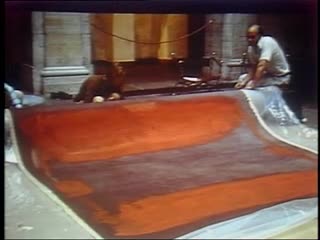
Description: Suite of paintings done by Mark Rothko for Harvard faded severely in sun because of fugitive pigments. The murals are on display for final time at Sackler Museum.
Collection: Ten O'Clock News
Date Created: 08/01/1988
Description: Meg Vaillancourt reports on the street violence that resulted in the accidental shooting of Darlene Tiffany Moore (eleven-year-old Roxbury resident). Vaillancourt interviews Maleka Few (Roxbury resident, age twelve) and Jessica Moore (Roxbury resident, age 10). The girls are afraid of the violence that resulted in Tiffany Moore's death. Vaillancourt reports that Roxbury residents went to City Hall to ask for more police protection in the neighborhood. Vaillancourt's report includes footage of Roxbury community leaders at a press conference. Amanda Houston (Roxbury resident), Bruce Bolling (Boston City Council), and Louis Elisa (Roxbury resident) talk about the need for more police on the streets. Vaillancourt reports the Ray Flynn (Mayor of Boston) has put more police on the streets and has pledged a full investigation of Moore's shooting. Vaillancourt's report includes footage of William Celester (Deputy Superintendent, Boston Police Department) and Flynn at a press conference. Vaillancourt reports that Roxbury is experiencing its worst violence in twenty years. She notes that city and state officials gathered at a press conference to discuss the problem. Vaillancourt's report includes footage of the press conference in Roxbury with Francis "Mickey" Roache (Police Commissioner, City of Boston), Royal Bolling, Sr. (former State Senator), and John Kerry (US Senator). Roache blames drug traffic for the violence. Kerry criticizes the ineffectual drug policy and social programs of the Reagan administration. Vaillancourt's report includes footage of police officers stopping African American men on the streets of Roxbury.
1:00:26: Visual: Footage of Maleka Few (Roxbury resident, age 12) saying that she thinks it might happen to her next. Shot of a Boston Herald newspaper article with a headline reading, "Police vow to capture girl's killers." A photo of Darlene Tiffany Moore (Roxbury resident, age 11) accompanies the article. Meg Vaillancourt reports that Moore was sitting outside on Humboldt Avenue in Roxbury when she was killed by a stray bullet; that Moore was the unintentional victim of a war between two rival gangs. V: Shot of a Humboldt Avenue in Roxbury. Footage of Few saying that the gang members were not shooting at Moore; that Moore was in the wrong place at the wrong time. Few says that she does not want to go out to the store with her mother anymore. Footage of Jessica Moore (Roxbury resident, age 10) saying that she used to sit in the same place on Humboldt Street. Shots of African American girls standing on a street in Roxbury. Vaillancourt reports that Roxbury parents went to City Hall today to ask for more police protection. V: Footage of Amanda Houston (Roxbury resident) saying that she is a "gutsy lady;" that she is starting to feel frightened. Footage of Bruce Bolling (Boston City Council) speaking to the press. Bolling says that there is open warfare going on in the city. Shot of media camera crews. Footage of Louis Elisa (Roxbury resident) saying that Roxbury residents pay their taxes; that Roxbury citizens are demanding equal protection under the law. Vaillancourt reports that forty extra police officers are patrolling Humboldt Avenue; that Ray Flynn (Mayor of Boston) has pledged a full investigation of the shooting. V: Shot of two police officers patrolling a street. Footage of William Celester (Deputy Superintendent, Boston Police Department) speaking to the press. Flynn stands beside him. Celester says that the community has been providing information about the shooting to police; that the police are investigating suspects. Footage of two white police officers stopping an African American man to search him. Vaillancourt reports that Roxbury is experiencing its worst violence in twenty years. V: Footage of Francis "Mickey" Roache (Police Commissioner, City of Boston) speaking at press conference in Roxbury. John Kerry (US Senator) and Royal Bolling Sr. (State Senator) are among the crowd standing with Roache. Roache says that drugs equal violence. Shots of the press at the press conference. Vaillancourt notes that Kerry visited Roxbury today to talk to residents about the drug problem. V: Footage of Kerry saying that the government cannot ask kids in Roxbury to say no to drugs if the Reagan administration cannot say no to General Manuel Noriega (leader of Panama). Kerry says that the drug policy of the Reagan administration is hypocritical and ineffective; that the administration's policy is contributing to the drug problem. Vaillancourt reports that Roxbury residents are calling for drastic measures to fight violence; that some curfews, night-court sessions, and the National Guard have all been suggested. V: Footage of Kerry saying that the presence of the National Guard will not solve the drug problem; that overcrowded prisons, an inadequate school system, and a lack of treatment centers are all contributing to the drug problem. Shot of two white police officers talking to an African American teenage boy on a street in Roxbury. Vaillancourt reports that Roxbury residents want increased aid on all levels. Vaillancourt notes that residents are worried that the situation will not improve after Moore's killer is found. V: Shot of a cameraman filming a man in a business suit on the street; of Humboldt Avenue in Roxbury.
Collection: Ten O'Clock News
Date Created: 08/22/1988
Description: Family of Russian émigrés at Nantasket Beach. CU of almond. nut.
Collection: Ten O'Clock News
Date Created: 08/02/1984
Description: INTERVIEW WITH CLIENTS AT SALVATION ARMY SHELTER, WORKERS IN SOUP KITCHEN. HUNGER, HOMELESS.
Collection: Ten O'Clock News
Date Created: 08/08/1983