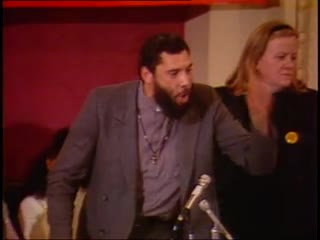
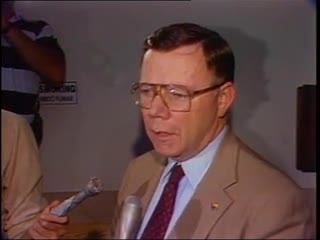
Description: Mike McGuire, a homeless man who lives in the Long Island Shelter, serves as a representative on Boston's shelter commission. Exterior & interior of shelter.
Collection: Ten O'Clock News
Date Created: 12/30/1988
Description: Hotel and restaurant workers rally at Arlington Street Church to take strike vote. Rev. Graylan Ellis-Hagler. Domenic Bozzotto. Local 26.
Collection: Ten O'Clock News
Date Created: 11/16/1988
Description: Judge rules Boston School Committee cannot order school closings. Parents rejoice over injunction but still have questions about assignments.
Collection: Ten O'Clock News
Date Created: 08/22/1989
Description: Auto insurance reform bill goes to Senate where it is faulted for rolling reconciliation provision. Rep. Frank Woodward, Sen. John Houston. Senate door.
Collection: Ten O'Clock News
Date Created: 09/21/1988
Description: Emerson College will be moving from downtown Boston to Lawrence in 1992. Interview with a representative of Emerson on the reasons for the move. Interview with Lawrence Mayor Kevin Sullivan on the urban renewal project that will help improve the city. Sullivan, Gov. Dukakis, and Sen. Patricia McGovern speak at a ceremony held at the site along the Merrimack River. Construction in progress on site. Interview with William Callaghee, publisher of the Lawrence News, who speaks against the project. Interviews with Lawrence residents on the benefits they predict will come from the relocation of Emerson into their city.
Collection: Ten O'Clock News
Date Created: 12/27/1988
Description: Farmers rally at State House to protest Question 3, livestock protection referendum proposed by animal rights activists. Photo of mistreated calves. State House interiors, empty House chamber.
Collection: Ten O'Clock News
Date Created: 09/06/1988
Description: Boston City Councillor Robert Travaglini opposes incumbent state Sen. Michael LoPresti, a race in which the candidates have similar positions and backgrounds.
Collection: Ten O'Clock News
Date Created: 09/13/1988
Description: Deborah Wang reports on a labor dispute concerning the Boston Harbor Cleanup project. Wang notes that labor have signed an agreement with the Massachusetts Water Resources Authority (MWRA), in which the unions have promised not to strike if the MWRA agrees to hire only union workers for the project. Interview with John Cruz of J.B. Cruz Construction, who says that many minority businesses would like to bid on the project. Cruz can afford union wages but cannot afford union rules. He says that his business is more efficient because his workers are not unionized. Interview with Richard Fox of the MWRA), who says that the MWRA wants to avoid a work stoppage during the project. Interview with Joe Nigro of the Building Trades Council, who says that unions give workers good healthcare and pensions. Wang reports that Cruz and other non-union contractors may challenge the agreement in court. Following the edited story is additional b-roll footage of construction workers and construction sites.
1:00:08: Visual: Shots of two African American men moving a heavy object from the basement of a building; of a truck belonging to the J.B. Cruz Company; of rowhouses being renovated in Roxbury. Deborah Wang reports that the J.B. Cruz Company has been building and renovating homes in Roxbury since 1948. V: Shots of two African American men lifting a heavy object onto the back of a truck. Wang reports that the J.B. Cruz Company hopes to bid on the Boston Harbor Cleanup project; that the Boston Harbor Cleanup project is the largest public works project to date. V: Shot of an African American man working on the wiring of a home. Footage of John Cruz (J.B. Cruz Construction) being interviewed by Wang. Cruz says that he hopes the project will have a 30% minority set-aside; that minority businesses see the program as a great opportunity. Shots of an African American man operating a tractor; of rubble being transported out of a building on a conveyor belt. Wang reports that the J.B. Cruz Company may not be able to bid on work for the Harbor Cleanup project because the J.B. Cruz Company runs an "open shop" using non-union labor. Wang reports that the city's unions do not want non-union workers to participate in the project. V: Shots of two African American construction workers examining a document; of a construction worker measuring a pipe. Footage of Cruz saying that the union policy is discriminatory. Cruz says that he has been fighting discrimination all of his life. Shots of a construction worker operating a backhoe; of a construction worker using a welding torch. Wang reports that the unions are in control of the Boston Harbor Cleanup project; that the unions have signed a labor agreement with the Massachusetts Water Resources Authority (MWRA). Wang notes that the unions have promised not to strike during the ten-year project. Wang adds that the unions consider the no-strike clause as a major concession. V: Shots of a construction site; of a worker descending stairs on a piece of scaffolding; of a construction worker using a mallot. Footage of Richard Fox (MWRA) saying that a work stoppage during the project could cost millions of dollars. Fox says that the MWRA wanted an agreement which guaranteed good relations with labor and construction workers. Shot of two construction workers walking on a job site; of a construction worker working in a subterranean structure; of a construction worker operating a backhoe. Wang reports that the unions fought for a clause stating that all workers on the project must be union members. Wang notes that Cruz must enroll all of his workers in a union if he wants to bid on the Harbor Cleanup Project. Wang reports that Cruz says that he can afford union wages but cannot afford union rules. V: Shots of construction workers working at a construction site; of Cruz being interviewed by Wang. Shots of a gravel truck at a construction site; of the driver of the gravel truck. Footage of Cruz saying that his business runs more efficiently because his business is not subject to union work restrictions. Shots of workers shoveling rocks down a chute into a building. Footage of Joe Nigro (Building Trades Council) saying that unions try to give workers good healthcare and a healthy pension. Nigro says that Cruz pays his workers low wages; that Cruz does not offer health and welfare benefits. Wang stands at a construction site. Wang reports that unions have a highly skilled work force; that unions get most of the jobs on big construction projects. Wang notes that unions can often dictate the labor terms on big construction projects. V: Footage of Cruz being interviewed by Wang. Cruz says that the unions are threatened by open-shop contractors because they are more efficient. Shots of a construction site near Boston Harbor. A worker climbs on a half-built structure. Another worker stands on a large piece of equipment. Wang reports that other non-union contractors are unhappy about the labor agreement for the Boston Harbor Cleanup project. Wang notes that a trade group may challenge the agreement in court; that the lawsuit could signal further delays for the Harbor Cleanup Project. V: Shots of construction workers at a site near Boston Harbor; of the Boston skyline; of large equipment operating in the harbor.
Collection: Ten O'Clock News
Date Created: 06/26/1989
Description: Deborah Wang reports that the city of Boston's minority set-aside program is facing a court challenge. This program allows minority-owned businesses to break into their industries by inviting them to participate in municipal projects. Interview with Robert McCoy pf McCoy Landscaping, who says that his business could not have survived without the program. The Consortium of Minority Business Enterprises has been formed to protect set-aside laws in Massachusetts. Interview with Walter Williams of the Contractors' Association of Boston, about the set-aside programs. The Consortium gave a hostile reception to Sen. John Kerry at a recent meeting, where he says that public opinion is not in favor of set-aside programs. Wang notes that Consortium members seem to be united in support of set-aside programs. This edition of the Ten O'Clock News also included the following item: Press conference to celebrate the positive findings of a study on the state's Healthy Start Program
1:00:08: Visual: Footage of construction workers digging holes for the construction of a new park in Roxbury. Deborah Wang reports that the new Roxbury park is a $400,000 project which has been funded by the city of Boston. Wang reports that the work is being done by McCoy Landscapers; that McCoy Landscapers may not have had an opportunity to do the job five years ago. V: Footage of Robert McCoy (McCoy Landscaping) being interviewed by Wang at the park site. McCoy says that the minority set-aside program has allowed him to build his business; that he could not have survived without the program. Wang reports that McCoy says that minority firms often have a hard time getting their bids accepted by contractors. V: Shots of construction workers digging holes at the Roxbury park site. Footage of McCoy saying that most contractors want to work with firms with which they are familiar. McCoy says that the minority set-aside program has allowed his company to break into the business. Wang reports that the minority set-aside program has been threatened by a Supreme Court decision; that Boston's set-aside program is facing a court challenge. Wang reports that minority business owners say that their businesses will be devastated if the program is shut down. V: Shot of workers digging and measuring holes at the Roxbury site. Footage of a meeting held by the Consortium of Minority Business Enterprises. Shot of a banner for the Contractors' Association of Boston, which hangs on a wall of the meeting room. Shots of the media and audience members at the meeting. Wang reports that the Consortium of Minority Business Enterprises has been formed to protect set-aside laws in Massachusetts. V: Footage of Walter Williams (Contractors' Association of Boston) being interviewed by Wang. Williams says that minority-owned businesses will be fighting with white-owned businesses for opportunities. Wang reports that members of the Consortium of Minority Business Enterprises gave a hostile reception to John Kerry (US Senator). Wang notes that Kerry has been a long-time supporter of set-aside programs. Wang reports that Kerry told the Consortium that public opinion is against them. V: Footage of Kerry at the Consortium meeting. Kerry says that Irish immigrants, Italian immigrants, and immigrants of other nationalities struggled to succeed without affirmative action programs when they arrived in the US. A Consortium member tells Kerry that he does not care if the Consortium offends other groups. Kerry tells the Consortium that he is trying to describe the feelings of other groups toward affirmative action programs; that the Consortium needs to decide whether or not to take these feelings into account. Kerry says that there will be trouble if the Consortium does not care about the feelings of other groups. Shots of Consortium members attending the meeting, including Deval Patrick (attorney). Wang reports that the Consortium needs to decide whether it will compromise; that members took a hard line at today's meeting. V: Footage of McCoy being interviewed by Wang at the Roxbury park site. saying that the Consortium will probably offend some groups with its actions; that the civil rights movement offended some people. McCoy says that the Consortium will not change its position.
Collection: Ten O'Clock News
Date Created: 05/15/1989
Description: Legislators ponder new taxes to reduce the budget deficit. Some say spending cuts must occur first. Door to Speaker's office. Reps. Cerasoli, Flaherty, Havern, Mara, Businger, Woodward.
Collection: Ten O'Clock News
Date Created: 10/30/1989