Description: Hope Kelly reviews the major events and key issues during the tenure of Boston superintendent of schools Laval Wilson. The Boston School Committee has voted to remove him from his post. Kelly adds that there are racial overtones in the vote to dismiss Wilson. Kelly notes that Wilson's opponents are all white. Kelly reviews Wilson's interview and selection, his record and the school bus drivers' strike. Kelly also discusses the school consolidation controversy and his contract renewal in 1989. The Boston Public Schools experienced a rise in achievement test scores and a decrease in the dropout rate under Wilson. Kelly's report is accompanied by footage illustrating these events during Wilson's tenure. This edition of the Ten O'Clock News also included the following items: Controversy surrounds the Boston School Committee's decision to fire Laval Wilson and Meg Vaillancourt interviews Nthabiseng Mabuza about the release of Nelson Mandela
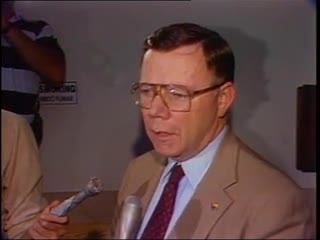
1:00:04: Visual: Footage of Dr. Laval Wilson (Superintendent, Boston Public Schools) being interviewed by Eileen Jones (WGBH reporter) on July 19, 1985. Wilson says that he wants to convince the Boston Public School community that he is the best person for the job of superintendent. Shots of posters prepared by Wilson for his presentation to the Boston School Committee; of Wilson adjusting the position of the charts. Hope Kelly reports that Wilson interviewed for the position of superintendent in July of 1985. Kelly notes that Wilson showed little charisma; that he was well prepared for the interview. V: Footage of Wilson being interviewed by the Boston School Committee in the School Committee chambers on July 19, 1985. Wilson says that his planning skills are excellent. Shots of Wilson and the members of the School Committee. Kelly reports that Wilson stressed his planning skills; that Wilson was self-confident and stubborn. Kelly notes that Wilson did not mention his people skills or his passion. V: Footage of Wilson being interviewed by Jones on July 19, 1985. Wilson repeats that he classified himself "as a school superintendent." Shot of Wilson during his interview with the School Committee. Kelly reports that Wilson never made any reflections on race. V: Footage of Wilson being interviewed by the School Committee on July 19, 1985. Wilson says that he is an educator who happens to be African American. Footage of the members of the School Committee as they cast their votes for the position of superintendent on July 31, 1985. Jean McGuire (Boston School Committee) votes for Dr. Peter Negroni (candidate for superintendent of schools). School Committee members John O'Bryant and Thomas O'Reilly vote for Wilson. Kelly notes that Wilson had held the position of superintendent of schools in Rochester, New York, and Berkeley, California. Kelly reports that the Boston School Committee voted nine-to-four in favor of hiring Wilson. Kelly reports that Wilson became Boston's first African American superintendent of schools. Kelly adds that the Boston Public School System was rife with poverty and patronage in 1985. V: Footage from August 21, 1985. Wilson walks on Devonshire Street with a group of school officials, including John Nucci (President, Boston School Committee), Ellen Guiney (Citywide Education Coalition), John Grady (Boston School Committee), and Julio Henriquez (aide to School Committee member Daniel Burke). Footage of Wilson at a press conference of May 12, 1987. Wilson says that 20% of first-graders did not pass first grade last year. Kelly reports that a bus strike paralyzed the school system in Wilson's fourth month on the job. Kelly notes that students and parents became enraged at Wilson's plan to consolidate schools. V: Shot of buses parked outside of South Boston High School. African American students walk among the buses. Shot of a group of angry protesters. Shots of students and parents protesting outside of the Boston School Committee headquarters on Court Street. The students and parents hold signs. Shot of a jacket being held up in the air. Writing on the jacket reads, "Save our school." Kelly reports that Wilson threatened to resign over the school consolidation issue; that Wilson pursued a job offer from the New York City Public School System in 1987. Kelly notes that Wilson receives a salary of nearly $100,000 per year. Kelly adds that there were questions about his performance. V: Shot of Wilson at a press conference. Footage from a Boston School Committee meeting on October 11, 1988. Shot of Daniel Burke (Boston School Committee). Shot of Wilson saying that progress is being made. Shot of the audience at the meeting. Kelly reports that progress is being made in the school system; that achievement scores are rising. Kelly notes that the drop-out rate has declined to its lowest level in eleven years. V: Shots of Wilson in an elementary school classroom; of Wilson and school officials walking through a high school corridor. Footage from a Boston School Committee on April 11, 1989. Don Muhammad (Muhammad's Mosque) addressing the members of the School Committee. Muhammad says that Wilson's contract should be renewed; that Wilson has begun to turn the school system around. Shots of audience members crowded into the School Committee chambers; of the School Commitee members in the School Committee chambers. Kelly reports that Wilson's contract was renewed in 1989; that Wilson survived by one vote. Kelly reports that Wilson did not receive a ringing endorsement from the Boston School Committee; that Wilson had wanted a four-year contract in 1989; that he did not receive one. Kelly notes that Ray Flynn (Mayor of Boston) suggested abolishing the Boston School Committee during the summer of 1989. V: Footage of Flynn at a press conference in May of 1989. Flynn says that the present system fails the schoolchildren and parents of Boston. Shot of the members of the School Committee seated at the front of the School Committee chambers. Kelly reports that Flynn wanted to replace the elected school committee with an appointed school committee. V: Footage from July of 1985. Wilson sits at a press conference with Flynn, Edward Doherty (President, Boston Teachers Union), Peggy Davis-Mullen (Boston School Committee), Rita Walsh-Tomasini (Boston School Committee) and other school officials. The officials stand up and raise their linked hands. Kelly reports that the debate over the schools has become divisive and political. Kelly reports that Flynn took no questions about Wilson today; that Flynn released a short statement. V: Footage of Wilson being interviewed by the School Committee on July 19, 1985. Wilson says that issues are more important than skin color. Kelly stands outside of the headquarters of the Boston School Committee. Kelly notes that the situation has racial overtones. Kelly reports that an all-white majority on the School Committee has voted to remove an African American superintendent from a school system with a 75% non-white student population.
Collection: Ten O'Clock News
Date Created: 02/14/1990
Description: Judge rules Boston School Committee cannot order school closings. Parents rejoice over injunction but still have questions about assignments.
Collection: Ten O'Clock News
Date Created: 08/22/1989
Description: William Sullivan holds press conference in his Jamaica Plain home to announce the Boston School Committee candidacy of his daughter Jean Sullivan McKeigue. He talks about educational attainment of wife Mary Malone Sullivan and their six children. Introduces daughter Kathleen Sullivan Alioto who introduces her sister Jean. Joseph Alioto sits behind smiling. Much press attention is focused on the Aliotos' respective political plans; they decline to be specific. William Sullivan turns away questions about the Patriots.
Collection: Ten O'Clock News
Date Created: 03/19/1979
Description: Kathleen Sullivan complains that her chief role as School Committee member is helping constituents obtain patronage jobs, rather than focusing on public education issues.
Collection: Ten O'Clock News
Date Created: 09/28/1976
Description: Kathleen Sullivan complains that the School Committee is too much a 'political' organization rather than a guardian of educational interests of the city. Patronage.
Collection: Ten O'Clock News
Date Created: 09/28/1976
Description: School Committee member Kathleen Sullivan talks about evening centers (night classes in vocations for adults) run by Boston Public Schools. She says they are underenrolled and should be closed.
Collection: Ten O'Clock News
Date Created: 10/04/1976
Description: Silent b-roll of Kerrigan in his office. Cuts from an interview with Boston School Committee Chairman John Kerrigan. He discusses the invasion of Girls Latin School and English High School, where literature from the Students for a Democratic Society was passed out. He says that the 1968 they sent 100% of Girls Latin student to college. Close-ups on the SDS literature. Reporter reasks questions for editing purposes.
Collection: WHDH
Date Created: 09/18/1969
Description: Compilation of footage on the Martin Luther King, Jr. Middle School. Press conference with Mr. Rollins and other people concerned about racist education at the King School, talking about the first day of school, the Boston School Committee's actions, and appropriate learning resources for the students at the King School. Another press conference about Operation Exodus, which is setting up learning centers for students who are assigned to attend the King School. They criticize the racist education of the current curriculum in Boston Schools. Cutaways of reporter asking questions. Press conference with John Bradley, new principal of the King School, answering questions about school problems and his proposed solutions. Interview with Louis Vangel, executive director of the Boston Teachers Union, on the teachers position at the King School. Interview with another man about the School Committee meeting to occur next Monday on the fate of the teachers and reopening of the King School. Interview with Louise Day Hicks on her proposed repeal of the 1965 Racial Imbalance law. Reporter asks her about soon to be Massachusetts Commissioner of Education Neil Sullivan and his busing programs. People walking into a building. Another interview with Mr. Vangel on the BTU's demands for the closing of the King School. Interview with man from the Boston School Committee on relationship between the School Committee and the King-Timility Advisory Council on resolving the problems at the King School. Silent footage of a hearing. Cutaways from Louise Day Hicks interview.
Collection: WHDH
Date Created: 11/1968...12/1968
Description: Theodore Landsmark (attorney) speaks to the media at a press conference. His face is in bandages. Landsmark gives an account of the attack he sustained on City Hall Plaza, perpetrated by white teenagers attending an anti-busing rally. He commends the actions of Clarence Jones (Deputy Mayor, City of Boston), who came to his aid after the attack. Landsmark talks about the media's coverage of his attack. Landsmark says that he will seek full prosecution of his attackers, and adds that he will bring suit against members of the Boston School Committee and the Boston City Council. He condemns white city leaders who "incite and encourage" racist violence. Landsmark calls for an end to racism and race discrimination in the city. He accuses the white power structure of ignoring the problems of minority citizens.
1:00:04: Visual: A group of African American men greet each other at the entrance of the room where Theodore Landsmark (attorney) will hold a press conference. Landsmark enters the room. His nose and face are bandaged with white tape. An African American woman hands him a note as he enters. Landsmark sits down behind a table with microphones. An African American man sits beside him. A group of African American men and women, and a few white people, stand behind him as he speaks. Reporters sit at the other side of the table and stand around the room. The reporters take notes as Landsmark speaks. 1:02:00: V: Landsmark notes that there has been conflict among the media over coverage of the press conference; that he wants both union and non-union members of the media to cover the press conference; that the media needs to work out the union issues outside of the press conference. Landsmark greets the media and reads a statement. He says that the press conference will be brief because he needs to get some rest; that he lost a lot of blood in the attack. Landsmark says that he is concerned that the publicity generated by the attack may distort some of the crucial issues which need to be discussed. Landsmark runs through the sequence of events on the day of the attack. Landsmark says that he was on his way to an affirmative action committee meeting with the Boston Redevelopment Authority; that he was beaten and kicked by a crowd of young people coming from an anti-busing rally at City Hall. Landsmark refutes rumors that Clarence Jones (Deputy Mayor, City of Boston) had been with him and ran away from the scene. Landsmark says that he regrets the circulation of the false reports regarding Jones; that Jones was the only person who left City Hall to aid him after the attack. Landsmark says that he will seek full prosecution of the youth involved in the attack; that he will take action in civil and criminal court against members of the Boston City Council and the Boston School Committee; that he would like to see an end to the use of City Hall as "a sanctuary for racism and a resource center for those who would incite and encourage racist violence." Landsmark says that some city officials perpetuate discrimination against people of color in Boston on a daily basis. Landsmark expresses gratitude to members of the African American and white communities for the many acts of kindness and courage shown to him after the attack. Landsmark adds that meaningful gestures by the white community before the attack could have prevented the violence. Landsmark says that he is grateful for the support of the Black Caucus, the Board of Directors of the Contractors Association of Boston, and the Massachusetts Black Lawyers Association. Landsmark thanks the newspaper and TV cameramen for capturing the attack on film. He says that he wishes that somebody had come to his aid, but is grateful for the record of the attack provided by the journalists. Landsmark says that without the photos, the attack would have been recorded "as just another scuffle on the street." Landsmark says that racism is to blame for the attack; that racism in the city of Boston has been fueled by selfish politicians; that politicians continue to ignore the social and economic problems of the city. Landsmark says that he will work to solve these problems in the African American community; that solving these problems will benefit all citizens. Landsmark says that the attack lays bare the problems of the city; that the problems go beyond issues of safety in the street or busing. Landsmark notes that the attack has been called "an isolated incident" by J. Stanley Pottinger (Assistant US Attorney General). Landsmark says that he does not agree; that people of color must be allowed to participate on an equal basis in all areas and levels of business and city government. Landsmark says that the issue of racism must not be subordinated; that the white power structure is indifferent to people of color in the city; that businesses and government must work together to improve the economic situation of people of color in Boston. 1:15:29: V: Reporters ask Landsmark questions after his statement. A reporter asks him to specify city officials against whom he will bring suit. Landsmark says that he will not name the officials because he does not want to jeopardize any of the lawsuits. A reporter asks him if he will bring suit against Louise Day Hicks (Boston City Council). Landsmark says that he will not comment except that his attackers were violating truancy laws; that his attackers were marching on City Hall Plaza without a parade permit. Landsmark notes that Hicks invited the protestors into her office to escape from the cold; that police officers were on duty near City Hall Plaza, but did not arrive on the scene until after the attack. Landsmark says that he cannot comment on how the police department should have deployed its personnel to control the unlicensed protest on City Hall Plaza by the students. A reporter asks Landsmark if he agrees with the Black Caucus' decision to call for the resignation of Kevin White (Mayor, City of Boston). Landsmark says that the Black Caucus is looking for better leadership from White on issues of affirmative action, busing, and unemployment. Landsmark says that he has received calls from around the country; that many are appalled by the incident on City Hall Plaza; that the city can take action to prevent more violent incidents.
Collection: Ten O'Clock News
Date Created: 04/07/1976
Description: Marcus Jones reports on proposals by Laval Wilson (Superintendent, Boston Public Schools) to improve educational standards in the Boston Public School System. Jones' report includes footage of Wilson at a press conference. Wilson discusses his goals and agenda for improving the level of education in the school system. Jones reviews Wilson's proposals. Jones' report includes footage from an interview with John Nucci (President, Boston School Committee). Nucci comments on Wilson's proposals and talks about efforts by the Boston School Committee to find funding for the proposals.
0:59:59: Visual: Footage of Dr. Laval Wilson (Superintendent, Boston Public Schools) at a press conference, talking about his goal to improve the level of education in the Boston Public School System. Marcus Jones reports that Wilson has proposed a comprehensive education improvement plan for the schools; that the plan is now under review by the Boston School Committee. V: Footage of Wilson saying that 20% of first graders did not pass first grade last year; that Boston students do not read well; that students do not perform well on standardized tests. Jones reports that the average senior graduating from Boston Public Schools read at a seventh grade level; that Wilson wants to raise that level. V: Shots of students in a classroom; of male high school students in the hallway of a high school. Footage of Wilson saying that graduating seniors should be able to read at the eighth grade level at least; that eighth graders should be able to read at a sixth grade level. Shot of a school hallway. On-screen text lists Wilson's proposals for stricter promotion standards, for more reading assignments, for programs to retain dropouts and for an increase in writing and math course work. Shots of a teacher teaching reading to elementary school students; of students in the classroom. Jones reports that budget cuts may force the layoff of forty teachers. V: Footage of Wilson saying that some positions and programs can be cut from the budget. Footage of John Nucci (President, Boston School Committee) saying that the School Committee needs to find ways to fund Wilson's initiatives; that the School Committee is already cutting the school budget by $10 million. Nucci says that Wilson's proposals are valuable; that the School Committee will cut the budget to fund the proposals. Jones stands outside the offices of the Boston School Committee. Jones reports that Wilson's initiatives will address sixteen areas of concern in the school system; that Wilson submitted thirteen proposals to the School Committee today.
Collection: Ten O'Clock News
Date Created: 05/12/1987