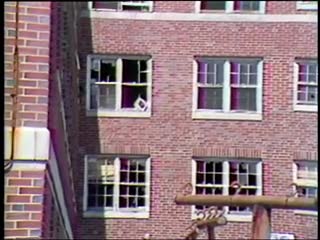
Description: Boston Housing Authority subsidized projects. Faneuil Street three-story brick development. Fidelis Way three- and six-story bricks with many broken, boarded up windows. Laundry hanging outside. Bromley-Heath project. People gardening outside teen center.
Collection: Ten O'Clock News
Date Created: 08/07/1980
Description: Christy George interviews Maria LeBron about her experiences as a tenant in Boston's public housing, specifically in the Mission Hill Housing Project. George notes that LeBron is one of 370 tenants who have been compensated for the discriminatory policies of the Boston Housing Authority (BHA). The Department of Housing and Urban Development (HUD) and a federal court found the BHA policies to be discriminatory. The Lawyers Committee for Civil Rights filed a lawsuit on behalf on tenants. LeBron talks about how she was placed on a waiting list for an apartment even though there were empty apartments in housing projects in South Boston and Charlestown. She talks about the discriminatory policies of the BHA. LeBron says that it is very difficult to be homeless. She adds that people of color should not be afraid to challenge government agencies. George reports that nearly 1,000 people are eligible for settlement money from the BHA.
1:00:11: Visual: Footage of Maria LeBron (public housing tenant) calling to her children in the courtyard of the Mission Hill Housing Project. LeBron takes one of her children by the hand. She walks with along with them toward one of the buildings in the development. Christy George reports that the Boston Housing Authority (BHA) placed LeBron in the Mission Hill Public Housing Project three years ago. George notes that LeBron is Puerto Rican; that LeBron's neighbors are Puerto Rican and African American. George reports that the BHA used to assign tenants by race; that LeBron was forced to wait for a long time to be placed in an apartment. George adds that LeBron signed up for public housing after the city condemned the building in which she was living; that LeBron was six months pregnant. V: Footage of LeBron sitting in her apartment with her two sons. LeBron says that she wondered why the BHA took so long to place her in an apartment. LeBron says that she knew that there were empty apartments. LeBron says that she waited three months before being placed in an apartment. Shots of LeBron working in the kitchen of her apartment. George reports that LeBron spent three months shuttling between a homeless shelter and the Milner Hotel. George notes that BHA apartments in Charlestown and South Boston sat empty while LeBron waited for an apartment. V: Shot of one of LeBron's sons sitting on the floor of the apartment. A toy car is in the foreground of the shot. George reports that LeBron was assigned to an apartment in Mission Hill two weeks before her baby was born. V: Shot of LeBron's two sons in the kitchen with her while she works. Footage of LeBron being interviewed by George. LeBron says that she noticed that there were no white families in the housing project where she was placed. LeBron says that a neighbor told her that the BHA only places white families in Charlestown and South Boston; that there are no white people outside of those two areas. LeBron says that she thinks that is wrong. Shots of LeBron in the kitchen with her sons. LeBron gets some chocolate milk for one of her sons. Shot of the boy drinking from a small bottle of chocolate milk. George reports that the Department of Housing and Urban Development (HUD) and a federal court ruled that the BHA housing policies were discriminatory. George reports that the Lawyers Committee for Civil Rights filed suit on behalf of the NAACP and tenants. V: Shots of Lebron giving her other son a cup of milk. Shot of an $500 invoice made out to LeBron from the BHA. George reports that LeBron received $500 from the BHA yesterday; that LeBron will receive a total of three checks as compensation for the discriminatory practices of the BHA. George notes that she will receive two more checks for $250. V: Shot of LeBron and her two sons on the couch. Footage of LeBron being interviewed by George. LeBron says that the BHA learned an expensive lesson. LeBron says that there are many people who do not have homes. LeBron says that it is hard to be homeless; that homeless people do not know where they will go for their next meal or for shelter. LeBron says that she wanted a home. Shot of the housing development from a window in LeBron's apartment. George reports that LeBron is one of 370 people who have been compensated for the BHA's discriminatory policies. George notes that nearly 1,000 more people are eligible for settlement money. George notes that these people will be hard to find; that some do not speak English; that others may be afraid to collect. V: Shot of three people standing at the entrance to one of the development buildings. Footage of LeBron being interviewed by George. LeBron says that many people of color are intimidated by large government bureaucracies like the BHA. LeBron says that people should not be intimidated, especially if they are in the right. Shot of LeBron handing each of her sons a coin. LeBron stands near a bureau. George reports that LeBron will use her first check to bring her sons to Puerto Rico for a visit to their grandparents. George notes that LeBron would like to attend college in the future to study law. George adds that LeBron has already won her first case. V: Shot of LeBron following her sons out of a room in the apartment.
Collection: Ten O'Clock News
Date Created: 08/02/1990
Description: Hope Kelly reports that Barbara Arnwine, the Executive Director of the Lawyers' Committee for Civil Rights, is filing a lawsuit against the city of Boston, the Boston Housing Authority (BHA), and the department of Housing and Urban Development (HUD) on behalf of public housing tenants in Boston. Mayor Ray Flynn has announced an agreement aimed at eradicating discriminatory housing practices, but Arnwine considers the agreement inadequate because it does not acknowledge that African American families were "victims" of discrimination. Arnwine says that the city of Boston and the BHA lied to African American families and that the BHA worked to keep housing projects segregated. Press conference held by Flynn, Doris Bunte (BHA), and Robert LaPlante (HUD). Interview with Arnwine in her office at the Lawyers' Committee for Civil Rights. She says that the city of Boston, the BHA, and HUD do not want to accept responsibility for the harm done to African American tenants and that, despite the difficulty of the struggle, racial equality is worth fighting for. Kelly reviews Arnwine's career as an activist and lawyer. Kelly's report also features footage of African American and white children playing outside of public housing projects and footage of African American students entering a Boston high school. This edition of the Ten O'Clock News also included the following item: Carmen Fields reports on nomination papers for Bill Owens and Royal Bolling, Sr.
1:00:16: Visual: Shot of the exterior of the offices of the Lawyers' Committee for Civil Rights. An African American woman sits at a desk at the front of the offices. The woman answers the phone. Footage of Barbara Arnwine (Executive Director, Lawyers' Committee for Civil Rights) being interviewed by Hope Kelly. Arnwine says that the city of Boston, the Boston Housing Authority (BHA), and the Department of Housing and Urban Development (HUD) do not want to face up to the harm they have caused to African American residents of public housing in Boston. Shot of Arnwine signing a business letter. Kelly reports that Arnwine is bringing a lawsuit against the city of Boston, the BHA, and HUD on behalf of tenants of public housing in Boston. Kelly reports that Ray Flynn (Mayor of Boston) has announced an agreement aimed at correcting the discriminatory housing practices of the past; that Arnwine believes the agreement to be inadequate. V: Shot of Flynn, Doris Bunte (BHA), and Robert LaPlante (HUD) entering a press conference in June of 1988. Footage of Arnwine in her office, being interviewed by Kelly. Arnwine says that the agreement does not acknowledge that African American families were the "victims" of discrimination; that the agreement calls the families "disadvantaged." Arnwine says that the African American families were injured by the discriminatory housing policy. Arnwine says that African American families were misled and lied to by the city and the BHA. Arnwine says that African American families were not placed in white housing projects because of their race. Shots of African American children outside of a housing project building; of white children playing with a garden hose outside of a housing project building in South Boston. Footage of Arnwine saying that some white families were also victims of discrimination; that white families were discouraged from living in primarily African American housing projects. Arnwine says that the BHA was engaged in an effort to keep public housing projects segregated. Shot of the name plaque on the door of Arnwine's office. Shots of Arnwine working in her office. Kelly reports that Arnwine grew up in a segregated housing project in Detroit. Kelly reports that the Lawyers' Committee for Civil Rights was involved in the struggles to desegregate the fire department, the police department, and the schools in Boston. V: Shots of a poster in the Lawyers' Committee offices. The poster has a caption reading, "I have a dream. . . ." Shots of Arnwine talking on the telephone in her office. Kelly notes that the Lawyers' Committee for Civil Rights filed the original school desegregation suit against the Boston School Committee in 1972. V: Shots of African American students entering a high school in Boston. Footage of Arnwine being interviewed by Kelly. Kelly asks if the housing discrimination suit can be compared to the school desegregation suit. Arnwine says that housing integration means that people of different races become neighbors. Arnwine says that housing integration represents change; that change is often met by resistance; that some people might get hurt in the resulting struggle. Arnwine says that it was difficult for the African Americans who first integrated the police department and the schools; that integration has a price. Arnwine says that racial equality is worth fighting for. Shots of Boston police officer taking an oath; of African American students entering Charlestown High School.
Collection: Ten O'Clock News
Date Created: 06/21/1988
Description: Retrospective of fifty years of the Boston Housing Authority, the largest landlord in the city, and one of the largest such agencies in the country. 50th anniversary ball at Park Plaza Hotel; guests include Doris Bunte, Edward Brooke, Byron Rushing, Michael Dukakis, Mel King, Ray Flynn, Bruce Bolling, William Bulger, Harry Spence. Interviews on BHA history include Lewis Weinstein, Joseph Slavet, Paul Garrity, Peter Dreier. Scenes of squalor inside housing projects. Many families remain residents for generations. Tenants' class action suit led by Armando Perez. On the need for racial integration, Doris Bunte says “separate always means separate and unequal.” Scenes of the city's subsidized developments in varying degrees of neglect or renovation. Examples of the breadth and density of the projects. Archival film and stills. Compiled from five-part series from 11/1986. ,Harris
Collection: Ten O'Clock News
Date Created: 01/01/1987
Description: BHA 50th anniversary ball at Park Plaza, Doris Bunte, exteriors of public housing projects.
Collection: Ten O'Clock News
Date Created: 11/10/1986
Description: Tenants sue BHA for better housing conditions. Kevin White vs BHA. Judge Paul Garrity. Harry Spence.
Collection: Ten O'Clock News
Date Created: 11/12/1986
Description: Profile of BHA executive director Doris Bunte. Progress in public housing conditions and occupancy.
Collection: Ten O'Clock News
Date Created: 11/13/1986
Description: Ray Flynn's public housing advocacy. National direction of public housing. BHA.
Collection: Ten O'Clock News
Date Created: 11/14/1986
Description: Through home rule, Boston regains control of BHA from receivership. Public housing tenants will form monitoring committee. Doris Bunte justifies small percentage of over-income families. Raymond Flynn.
Collection: Ten O'Clock News
Date Created: 04/26/1988
Description: Christy George reports that a lawsuit has been filed against the Boston Housing Authority (BHA) to protest its discriminatory housing policies. It charges that the BHA has discouraged minorities from moving into all-white housing projects. The city is planning to voluntarily integrate its housing projects by next year. Interview with Tanya Boman and Annie Hailey, who are among the plaintiffs in the lawsuit. Boman and Hailey talk about their experience with the BHA. Both women were told that their families would be unsafe in white housing projects and that the BHA would not provide them with protection. Interview with Doris Bunte of the BHA, who denies any discriminatory practices on the part of BHA employees. Interview with City Councilor James Kelly, who defends the BHA and denounces public housing integration. Kelly has proposed an alternative public housing integration plan that eliminates preferences for minority families applying for apartments in white housing projects. Interview with Dianne Wilkerson of the NAACP. Wilkerson criticizes the city's record on public housing integration and the slow pace of change. This edition of the Ten O'Clock News also included the following item: David Boeri reports that midwives at Boston City Hospital have been locked out by the hospital administration in a dispute over hospital policy
1:00:19: Visual: Footage of Tanya Boman (plaintiff) sitting with her children. Boman says that people should have the right to live wherever they want to live. Christy George reports that Boman applied for public housing in 1985; that she was told to apply for an apartment in Charlestown or South Boston because the city would give preference to minorities requesting apartments in white housing projects. V: Shots of parochial school students walking toward a public housing project; of white residents in front of a housing project in South Boston. Footage of Boman saying that she asked the Boston Housing Authority (BHA) if they would provide protection for her family if they moved to a white housing project. Boman says that she was told that she would need to call the Boston Police Department if she ran into any problems. Boman says that she was told that she would be moved to the bottom of the waiting list if she moved out of the apartment for a "racial reason." George reports that a discrimination suit has been filed against the BHA on behalf of Boman, Annie Hailey (plaintiff), and unnamed parties. V: Footage of Hailey saying that she applied for an apartment in the McCormack Housing Development in 1987. Hailey says that the BHA told her that she would need to see the Civil Rights Board before she could move into the project. Hailey says that the BHA told her that the project would be unsafe for her teenage son. Footage of Doris Bunte (BHA) saying that the situation needs to be examined. Bunte says that she will not tolerate employees of the BHA who discourage minorities from living in white housing developments. George reports that the city is planning to voluntarily integrate its public housing projects. V: Shots of a broken-down wall near a housing project in South Boston; of parochial school students walking toward the housing project. George reports that African Americans may be the victims of harassment and violence when they move into white housing projects. V: Footage of Bunte saying that BHA employees can tell the truth; that BHA employees cannot use tactics designed to discourage African American families from moving to white housing projects. Footage of James Kelly (Boston City Council) in his office. Kelly says that people in private housing call the police for protection; that the BHA did not discriminate by telling an African American family to call the police for protection. George reports that Kelly has proposed a plan to integrate public housing in Boston very slowly; that Kelly's proposal eliminates minority preference. George says that Kelly believes that reverse discrimination causes racial hostility. V: Shots of a white woman looking out of a window of a project apartment; of a white woman and children in front of a project building in South Boston. Footage of Kelly being interviewed by George. Kelly says that there are South Boston residents who have been on the waiting list for years; that those residents are not being treated fairly. George reports that the suit suggests that many of Boston's housing projects are still segregated. George notes that Ray Flynn (Mayor of Boston) has been praised for his efforts to integrate the public housing projects in Charlestown. V: Footage of Dianne Wilkerson (NAACP) saying that there were 200 vacancies open in Charlestown; that over 600 African American families had requested apartments in Charlestown; that the BHA actively recruited white families to fill the vacancies in the Charlestown projects. Shot of housing project buildings in Charlestown. George reports that there are only six African American families in Charlestown; that Flynn has announced plans to integrate the housing projects in South Boston. V: Shots of signs for the Old Colony Housing Project and the Mary Ellen McCormack Housing Development. Shots of a white female resident standing at the entrance to a housing project in South Boston. Footage of Bunte saying that the mayor and the BHA want to move forward with integration. Bunte says that she hopes that the lawsuit does not hold back plans for integration.
Collection: Ten O'Clock News
Date Created: 05/17/1988