Description: Democratic and Republican presidential candidates debate in Washington, DC. Tom Brokaw moderates. Babbitt, Dukakis, Gephardt, Gore, Jackson, Simon, du Pont, Bush, Dole, Haig, Kemp, Robertson. reel 2 of 2
Collection: Ten O'Clock News
Date Created: 12/01/1987
Description: Dan Quayle addresses newspaper editors' convention. Takes questions about Persian Gulf war, Kurdish refugees, Bush advocating overthrow of Hussein.
Collection: Ten O'Clock News
Date Created: 04/11/1991
Description: Steve Grossman of Democratic State Committee and Republican counterpart Leon Lombardi comment on Dan Quayle's fitness as vice president in light of George Bush's hospitalization for heart problem.
Collection: Ten O'Clock News
Date Created: 05/06/1991
Description: Meg Vaillancourt opens report with person on the street interviews on quotas, affirmative action, and civil rights. Vaillancourt interviews Avi Nelson (radio talk show host) and Dianne Wilkerson (attorney) about the debate concerning minority hiring quotas as a part of civil rights policy. Vaillancourt notes that George Bush vetoed a Civil Rights Bill last year because he said the bill would encourage the use of quotas by employers. Nelson opposes affirmative action programs and quotas. Nelson says that the Civil Rights Bill compromises the rights of some in order to benefit others. Wilkerson says that quotas were never a part of the Civil Rights Bill as it was written. Wilkerson says that the Civil Rights Bill would allow women and people of color to file lawsuits in cases of discrimination. Wilkerson accuses the Republican Party of bringing up quotas in order to undermine the passage of the Civil Rights Bill. Vaillancourt reports that the future of the bill remains uncertain. Vaillancourt's report includes footage of George Bush speaking in October of 1990 and footage of construction workers at a construction site. Vaillancourt's report also features footage from interviews with people on the street about minority hiring quotas. This tape includes additional footage from From Montgomery to Memphis. This edition of the Ten O'Clock News also included the following items: Controversy surrounds David Duke's visit to Boston and Carmen Fields reports on the history and present activities of the Ku Klux Klan
1:00:06: Visual: Footage of a white man being interviewed on the street. The man says that African Americans claim to have been discriminated against for many years. The man says that now it is "every man for himself." Footage of a white woman being interviewed at Downtown Crossing. The woman says that businesses should not be required to hire a certain number of minorities; that equal rights are important. Footage of an African American woman being interviewed on the street. The woman says that there is a assumption that people of color and women cannot compete with white men; that this assumption gives quotas a bad name. Shots of people walking through Downtown Crossing. Meg Vaillancourt reports that the majority of people interviewed today at Downtown Crossing opposed job quotas. Vaillancourt asks if job quotas are the issue when it comes to civil rights. V: Footage of Avi Nelson (radio talk show host) being interviewed. Nelson says that quotas are not part of civil rights. Nelson says that people who get jobs because of quotas keep out other people who are more qualified to do the job. Footage of Dianne Wilkerson (attorney) being interviewed by Vaillancourt. Wilkerson says that she does not understand all of the controversy surrounding job quotas. Wilkerson that no one has publicly admitted being forced to hire people of color or women. Vaillancourt reports that Wilkerson believes that Republicans use the term quotas because they know that the word has a negative connotation. Vaillancourt reports that Wilkerson prefers the term "remedy." V: Footage of Wilkerson being interviewed by Vaillancourt. Wilkerson says that there is no "quota bill." Wilkerson says that there is a bill to restore the civil rights of women and people of color. Wilkerson says that Supreme Court decisions of the late 1980s had a devastating impact on the ability of women and people of colors to file lawsuits in cases of discrimination. Vaillancourt reports that Nelson is a republican; that Nelson opposes the ideas of affirmative action. V: Footage of Nelson being interviewed. Nelson says that the grievances of history can never be fully redressed; that it is impossible to achieve a state of equality for all people. Nelson says that the government should commit itself to granting equal opportunity for all in the structure of the laws from this day forward. Nelson says that the government cannot remedy the disadvantaged backgrounds of certain individuals. Footage of George Bush (US President) speaking on October 22, 1990. Bush says that he has long been committed to affirmative action. Vaillancourt reports that Bush vetoed a Civil Rights Bill last year. Vaillancourt notes that Bush said that the bill would encourage the use of quotas by employers. Vaillancourt reports that the word "quota" never appeared in the Civil Rights Bill vetoed by Bush. Vaillancourt notes that the bill shifted the burden of proof onto employers; that employers would need to show that they did not discriminate. Vaillancourt adds that an Congressional effort to override Bush's veto failed by a handful of votes. V: Footage of workers at a construction site. Shot of a worker moving dirt in a wheelbarrow. The worker dumps the dirt outside of a building. Shots of workers digging holes at a construction site. The workers are of diverse races. Footage of Wilkerson being interviewed by Vaillancourt. Wilkerson says that supporters of the Civil Rights Bill were not advocating quotas; that quotas were never mentioned in the legislation. Vaillancourt remarks that some people call job quotas the "Willie Horton" of civil rights. Wilkerson agrees with Vaillancourt's remark. Wilkerson says that Bush and David Duke (Louisiana state representative) are in agreement. Wilkerson says that the Republican Party is trying to distance itself from Duke; that the Republican Party and Duke are in agreement on this issue. Footage of Nelson being interviewed by Vaillancourt. Nelson says that the Republican Party has a problem with Duke; that the Democratic Party has a problem with Louis Farrakhan (leader, Nation of Islam). Nelson says that he occasionally agrees with Duke; that he does not embrace Duke as fellow traveler. Nelson says that opponents of the bill do not want to deny civil rights of US citizens. Nelson says that the bill would compromise the civil rights of some in order to give benefits to others. Vaillancourt reports that Democrats in the US House of Representatives have tried to rename the bill this year in order to change the tone of debate; that House Democrats are emphasizing its benefits for white women. Vaillancourt reports that Democrats fear that they will again be accused of promoting quotas. Vaillancourt reports that Senate Democrats have not yet proposed a new bill; that Senate Democrats fear a repeat of last year's debate and Republican victory.
Collection: Ten O'Clock News
Date Created: 03/28/1991
Description: Christy George reports that critics have charged George Bush's presidential campaign with exploiting racial fears among white voters. George notes that there is controversy over the Bush campaign's Willie Horton advertisement, which criticizes Democratic nominee Michael Dukakis's furlough program in Massachusetts. George's report includes footage of the Horton advertisement and footage of Jesse Jackson criticizing the advertisement. George interviews Dr. Alvin Poussaint (psychiatrist) about racism in the campaign and in Bush's political advertisements. Poussaint says that white voters see Horton as the "universal" African American criminal and that African Americans are associated with crime in the minds of whites. George reports that the Bush campaign advertisement does not use the face of William Horton (furloughed prisioner), but that campaign advertising by Bush supporters has used Horton's face. George notes that Bush has disassociated himself from the groups producing these ads. George's report includes footage from a political advertisement produced by "Americans for Bush." Poussaint says that the "Americans for Bush" advertisement is racist. He adds that Dukakis may lose white votes if he complains too much about racism because Americans do not like to be called racist. George notes that Poussaint believes that Horton's face triggers associations with other negative images of African Americans. Poussaint goes on to analyze race in US pop culture and in US politics. George's report is accompanied by images of African American figures in US politics, sports, and culture and by footage from Saturday Night Live of a satirical campaign advertisement. George's report is also accompanied by footage of Dukakis at a campaign rally.
1:00:12: Visual: Footage from WBZ-TV of Jesse Jackson (African American political leader) speaking from a podium. Jackson says that the Willie Horton advertisement has been used to conjure up "psycho-sexual fears" of African American men among whites voters. Shot of a black and white photo of William Horton (furloughed prisoner). Christy George reports that critics have charged George Bush's presidential campaign with exploiting racial fears among white voters. V: Footage of Dr. Alvin Poussaint (psychiatrist) being interviewed by George. Poussaint says that white voters see Horton as the "universal" African American criminal. George reports that Poussaint had supported Jackson for president; that Poussaint now supports Michael Dukakis (Democratic US presidential nominee). V: Footage of Poussaint saying that African Americans have long been associated with crime in the minds of whites. Poussaint notes that the rape of white women by African American men has always been a sensitive issue. Footage of the Bush campaign's Willie Horton advertisement. George notes that Horton's face is not shown in the Bush campaign advertisement about Dukakis's furlough program in Massachusetts. George notes that many of the prisoners shown in the Bush campaign ad are white. George adds that the Bush campaign is asking a legitimate questions about the Massachusetts' furlough program. V: Footage of Poussaint saying that Bush would have raised the issue of the furlough program even if Horton were white. Shots of George Bush (Republican US presidential nominee) speaking from a podium. George reports that Bush supporters have not been cautious about using Horton's face in their campaign literature. V: Footage of Dukakis addressing a crowd at a campaign rally on October 19, 1988. Dukakis holds up a piece of Bush campaign literature. Dukakis says that the campaign literature is "garbage." The crowd applauds for Dukakis. George reports that Dukakis has attacked the race-baiting campaign literature of a group of Bush supporters from Illinois. George notes that Bush has disassociated himself from the group's literature. V: Footage of Poussaint being interviewed by George. Poussaint says that Dukakis may gain minority votes by complaining about the subliminal racism of the Bush campaign; that Dukakis may lose white votes if he complains. Poussaint says that Americans do not like to be called racist. George talks about a campaign ad paid for by a group called "Americans for Bush." George notes that many have called the advertisement racist; that the advertisement has been running for months in key states. V: Footage of the "Americans for Bush" campaign advertisement. Footage of Poussaint saying that the Horton case can be used to exploit the association of African Americans with crime and drugs. George notes that the campaign's subliminal racial messages have become the subject of satire. V: Footage of a satirical campaign advertisement from Saturday Night Live. George reports that Poussaint believes that Horton's face triggers other negative associations with African Americans. V: Shot of a black and white photo of an African-American man in the custody of white police officers. Shots of the Reverend Louis Farrakhan (leader of the Nation of Islam) and Tawana Brawley (New York State resident); of the Reverend Al Sharpton (African American community figure); of a group of white people moving through a crowd; of Bernard Goetz (New York City resident) walking down a street. George reports that Poussaint is a consultant to the Cosby Show; that Poussaint advocates positive images of African Americans. V: Footage from The Cosby Show. George reports that The Cosby Show is the most popular show among white South Africans. George adds that Poussaint does not believe that an abundance of positive African American role models will change white attitudes. V: Shots of the Los Angeles Dodgers celebrating a win; of Stevie Wonder (pop singer); of Colin Powell (National Security Advisor to Ronald Reagan); of Magic Johnson (basketball player); of Bishop Desmond Tutu (Black South African leader) with Dukakis. Shot of the floor of the Republican Political Convention. George reports that Poussaint believes that whites do not find African American heroes and leaders threatening. George adds that Poussaint believes that whites transfer their fears to African Americans in their proximity. V: Footage of Poussaint saying that white women react to the color of his skin when they meet him on the street at night.
Collection: Ten O'Clock News
Date Created: 10/25/1988
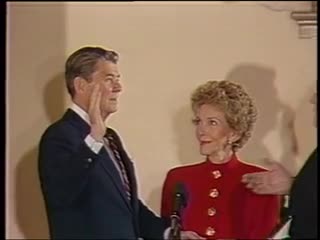
Description: GEORGE BUSH & RONALD REAGAN SWORN IN FOR SECOND TERM. BARBARA BUSH, NANCY REAGAN.
Collection: Ten O'Clock News
Date Created: 01/20/1985
Description: Ronald Reagan and George Bush before New Hampshire primaries. Reagan speaks about inflation, military, and energy conservation. He states that government should be taken out of the energy industry, that it belongs in the free market. He speaks about his successes as governor of California.
Collection: Ten O'Clock News
Date Created: 02/18/1980
Description: Attempt is made to track down source and veracity of rumor being circulated about George Bush's alleged affair with Jennifer Fitzgerald. British newspaper mastheads and gossip headlines. scandal.
Collection: Ten O'Clock News
Date Created: 10/20/1988
Description: Scenes from the Republican National Convention including Bob Hope performing at Billianare Bunker Hunt's Little Clam Bake, people chanting "Four more years" and "USA" at the convention, the Republican Platform Committee, interview with former RNC Chairperson Mary Louise Smith who is disappointed with the radical changes to the platform, overview of the new platform, interview with Vice President George Bush about how the majority of Americans are conservative, excerpts from Reagan's speech, and balloons falling from the ceiling. Reporter voice-over throughout. Sound.
Collection: WCVB Collection
Date Created: 08/24/1984
Description: Republican candidates speak in NH day after Iowa caucuses. Bush looks ahead; Dole looks thankful.
Collection: Ten O'Clock News
Date Created: 02/09/1988