Description: Array of political buttons from 1976 presidential campaign mounted on black background: Reagan, Carter/Mondale, Harris, Shriver, Bayh, Ford/Dole, Udall, Wallace. Visuals of politicians: Biden, Kemp, Connally, Hart, Ford, Dole, Carter, Reagan, Bush. Sample of New Hampshire Republican primary ballot.
Collection: Ten O'Clock News
Date Created: 04/13/1978
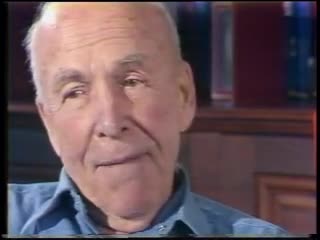
Description: Interview with Li'l Abner cartoonist and political satirist Al Capp in his Cambridge home. He talks about evading his father's creditors, and scheming to take semesters at various arts schools around the city. He says he likes the Boston view of the world, and talks about the influence Boston has had on his work. He talks about turning conservative. He criticizes American presidents, calling Gerald Ford ‘clumsy’ and Jimmy Carter ‘weak.’ He talks about working on Li'l Abner with a team of men.
Collection: Ten O'Clock News
Date Created: 11/04/1977
Description: Andrew Young, Ambassador to the United Nations, speaks at the John F. Kennedy School of Government at Harvard University. He takes questions about the UN, divestment from South Africa, the Middle East peace process and the Carter Administration. He also discusses his transition from the civil rights movement to politics. Young has a good rapport with the students in the audience.
0:00:44: Visual: Andrew Young (Ambassador to the United Nations) speaks at the John F. Kennedy School of Government at Harvard University. A representative from the school sits on stage while Young speaks. Young talks about the Trilateral Commission. He says that the Trilateral Commission "is the rich people of the world getting together to talk." Young says that UN has been criticized for being a part of the "Western Bloc"; that five members of the UN Security Council are western nations; that the UN must make policy with all nations in mind. Young describes UN efforts to initiate an arms embargo against South Africa; that the UN resolution on South Africa was not as strong as many would have liked; that the resolution is effective because all of South Africa's trading partners have agreed on it. Young mentions the "North-South dialogue." He says that it is important for nations to deal with issues like trade, debt relief and foreign aid as a group; that the Trilateral Commission is a negotiating group. Young says that there are competition and adversarial relationships among members of the Trilateral Commission; that the members of the Trilateral Commission are competing with each other, not with the Third World. 0:04:12: V: Young responds to an audience member's question about the UN Security Council. Young says that the US, France and England are permanent members of the Security Council; that France and Canada hold two of the rotating seats. Young has a good rapport with the crowd. The crowd laughs at his jokes. An audience member asks about UN policy in Africa. Young says that he does not think pressure should be put on US corporations to divest from South Africa. Young adds that companies would continue to invest in South Africa through complicated transactions using foreign subsidiaries. Young notes that the students at Harvard should be learning all about the complicated finances of multi-national corporations. Young says that nothing would change through divestment; that US corporations are complicit with the government of South Africa; that change can be wrought through the guilt felt by these corporations. He notes that the students should continue to put pressure on Harvard's Board of Directors to divest from South Africa. He says that students should be idealistic, while administrators like him must be realistic. An audience member asks about the Carter Administration's policy in the Middle East. Young says that Jimmy Carter (US President) has been willing to expend political capital pushing for a peace settlement in the Middle East. Young says that Carter has never tried to impose peace on the parties involved in the conflict. Young says that Anwar Sadat (President of Egypt) has moved boldly to move the peace process forward; that the Carter Administration must work with Sadat; that the USSR must be forced to participate in the peace process; that the USSR will undermine the peace process if they are not involved. Young notes that Sadat and the Soviets have had a difficult relationship. 0:12:55: V: An audience member asks how he can remain morally conscious when the policy he conducts for the US is not always morally conscious. Young says that protest movements in the 1960s have led to a reawakening of the nation's moral conscience; that the Carter Administration was voted into office by morally conscious voters. Young notes that it is easier to protest than it is to govern; that the Carter Administration is staffed with idealistic, moral people of all races and ethnicities. Young notes that he chose to enter politics to put his ideals into action; that effective change can be made through politics as well as protest. Young talks about his experiences in the civil rights movement and the movement against the Vietnam War. Young says that there was a logical progression from the protest movements of the 1960s to the politics of change in the 1970s. Young says that he took his post in order to effect change in foreign policy; that foreign policy issues and domestic policy are closely related; that he has not compromised his ideals in performing his job. Young jokes that he tries to stand up for what is right while doing his job; that he might be looking for a new job someday because of that; that perhaps Harvard will hire him if he ever needs a job. The audience laughs at the joke. 0:18:30: V: An audience member asks Young if he has seen an increase in "television diplomacy." Young says that he has seen an increase in "television diplomacy." Young responds to another audience question. Young says that the Carter Administration is staffed with people who are advocating change; that these people were outside of politics before. Young notes that Ernie Green (Assistant Secretary for Manpower) was one of the students who integrated Little Rock High School in 1958; that Green is working hard to create jobs within the African American communities; that he has been working on the problem for only six months. Young notes that an African American lawyer from Harvard helped prepare the brief for the Bakke court case. Young notes that Patricia Harris is Carter's Secretary for Housing and Urban Development. Young says that African American organizations needs to work within the structure of the government; that the activists in the civil rights movement were working with the Kennedy Administration in the early 1960s.
Collection: Ten O'Clock News
Date Created: 12/06/1977
Description: Bernadette Devlin McAliskey (Irish Republican activist) holds a press conference in Boston as part of a 13-city tour of the United States. Devlin speaks about her recent candidacy for the European parliament and says that her speaking tour is intended to help defray debts incurred during her campaign. Devlin's campaign was organized around a human rights platform. Devlin notes that international organizations have condemned the human rights abuses in Northern Ireland but that the United Nations and western countries will not speak out against Great Britain. Devlin expresses cynicism towards politicians and doubts about an American political response to the situation in Northern Ireland. She equates the oppression in Northern Ireland to the inequalities that exist in the United States and notes that Irish Americans engage in oppression of African Americans in Boston. Devlin compares the dearth of Protestant support for her cause in Northern Ireland to the lack of white working class support for busing in Boston; recounts the history of the Irish conflict from the Irish elections in 1918; and discusses changes that must be made by Great Britain in Northern Ireland. Devlin discusses her activities in the years since she left parliament; the use of violence by Catholics in Northern Ireland; the death of Lord Louis Mountbatten (British official). She accuses the international press of hypocrisy; answers questions about her speaking schedule and her life in Ireland.
0:58:09: Visual: Bernadette Devlin McAliskey (Irish Republican activist) prepares for a press conference as part of a 13-city tour of the United States. She sits at a small table in front of a microphone and takes questions from reporters. The press conference takes place in an informally furnished room; the walls are covered with handmade political posters. A reporter asks Devlin if she is doing the speaking tour to pay off debt accumulated during her recent campaign for a seat in the European parliament. Devlin says that her candidacy focused on human rights issues; that her candidacy was announced only three weeks before the election; that she ran on behalf of the H-Block political prisoners. Devlin says that her political party still has a debt of $10,000 after the elections; that she has come to the US to raise money through speaking engagements and from contributions. Devlin says that she has raised about $3,000 so far. A reporter asks Devlin's opinion on US involvement in Northern Ireland. Devlin says that Amnesty International, the International Red Cross and the European Court of Human Rights have all condemned the human rights abuses in Northern Ireland; that Jimmy Carter (US President) condemns human rights abuses all over the world, but ignores the deprivation of human rights in Northern Ireland. Devlin questions Carter's sincerity on human rights issues. Devlin says that the United Nations and western countries will not speak out against Great Britain; that she is trying to raise awareness of the situation among the white population of the US. The reporter asks Devlin if she expects a response from Irish Americans and Irish American politicians. Devlin says that she has a cynical view of politicians; that Edward Kennedy (US Senator) and Carter might speak out against the situation in Northern Ireland if they thought it would win them some votes; that she is not sure if Irish American politicians will take any action. Devlin says that the Irish American community has been made to feel guilty about giving money to Ireland; that they are made to feel like they are supporting violence. Devlin says that US politicians do not want Irish Americans to take interest in the situation in Northern Ireland. Devlin says that there are enough Irish Americans in the US to pressure the US government to take some firm action about Northern Ireland; that Irish Americans might become aware of the inequalities in US society if they started to think about the oppression in Northern Ireland. Devlin says that it saddens her to see Irish Americans involved in the oppression of African Americans in Boston. Devlin says that Irish Americans would get themselves on the "right side" of the civil rights struggle in the US if they understood the situation in Northern Ireland. Devlin says that Catholics in Northern Ireland were inspired by the civil rights movement in the US; that they identify with the struggles of African Americans. Devlin says that Irish Americans appear to be actively involved in the oppression of African Americans. Devlin says that she could probably raise money more easily if she avoided discussing the role of Irish Americans in the oppression of African Americans; that she is not willing to keep silent for money. Devlin says that she hopes Irish Americans will become more aware of their contradictory behavior; that many fled oppression in Ireland only to become oppressors in the US. 1:07:11: V: Devlin says that there is little Protestant support for her cause in Northern Ireland. She compares the amount of Protestant support for her cause in Northern Ireland to the amount of white working class support for busing in Boston. Devlin says that Great Britain needs to withdraw the undemocratic veto given to Protestants in Northern Ireland in 1921; that Great Britain needs to support change in Northern Ireland. Devlin reviews the history of the Irish conflict from the Irish elections in 1918 to the partition of the country by Great Britain. Devlin accuses Great Britain of partitioning the country in order to create a Protestant majority where there was none before. A reporter asks Devlin what she did during the years before the most recent election. The reporter comments that Devlin had not been visible on the political scene. Devlin responds that she has never stopped working for her cause; that the media ignored her activities because she was no longer a member of the British Parliament. Devlin says that the world took no notice of the violence used by Great Britain to oppress Catholics in Northern Ireland before 1969; that the oppressed Catholics are adopting the methods of violence used by Great Britain. Devlin questions why the Catholics are condemned for using violence, when they are only reacting to the violence used to oppress them. Devlin says that the international media have portrayed Lord Louis Mountbatten (British official) as a brave soldier and an aristocrat; that the oppressed peoples of the British Empire see Lord Mountbatten as a symbol of oppression. Devlin adds that public figures who represent the oppression of the British Empire will inevitably become targets of the oppressed. Devlin questions why the life of Mountbatten is worth more than the lives of all the Irish people who have died at the hands of the British; that the Irish victims fought for their country as Mountbatten did; that they were portrayed as terrorists by the international press. Devlin accuses the international press of hypocrisy. She says that the Irish people will not be "chastened" by the press coverage of Mountbatten's death. Devlin adds that if Great Britain was not occupying Northern Ireland, Mountbatten would be alive today. A reporter asks Devlin about Princess Margaret of England's comment that the Irish are "pigs." Devlin responds with a translation of an old Irish saying that "a pig thinks the whole world is pigs." Devlin answers questions about her speaking schedule and her life in Ireland. Devlin says that she has three children; that she does not have a regular job; that she works in the resistance movement. Devlin adds that she works with Catholics whose welfare benefits have been taken away by the British government. Devlin says that the money she raises will pay off her party's campaign debt. She adds that if the debt is paid, the rest of the money will go to a fund to benefit Irish prisoners.
Collection: Ten O'Clock News
Date Created: 10/19/1979
Description: JIMMY CARTER BEING NOMINATED AT THE 1980 DEMOCRATIC CONVENTION
Collection: Ten O'Clock News
Date Created: 08/15/1980
Description: FIRST 100 DAYS OF JIMMY CARTER'S PRESIDENCY,
Collection: Ten O'Clock News
Date Created: 05/03/1977
Description: Presidential candidate Jimmy Carter enters North End Post 144, Veterans of Foreign Wars hall, shakes hands. A man introduces Carter; he also points out local politicians in attendance. Carter addresses a small crowd. He calls himself a 'Washington outsider' and appeals to them as same. Carter takes questions from the audience. He lays out his plans for national defense. He talks about the nuclear positions of the United States and the Soviet Union. Exteriors of the VFW.
Collection: Ten O'Clock News
Date Created: 02/17/1976
Description: Press conference at Americana Hotel in New York by Democratic presidential candidate Jimmy Carter to announce Walter Mondale as vice presidential running mate. On podium with wives Rosalynn and Joan respectively. Carter acknowledges Mondale's hypertension (high blood pressure), which is under medical control and not a prohibitive concern about his fitness. They agree VP role will not be just ceremonial. Carter admits Mondale was not original choice, but well prepared and compatible.
Collection: Ten O'Clock News
Date Created: 07/12/1976
Description: Sampler of Christopher Lydon commentaries on the first 100 days of Jimmy Carter's presidency.
Collection: Ten O'Clock News
Date Created: 04/15/1977
Description: Christopher Lydon commentaries on first hundred days of Jimmy Carter's presidency.
Collection: Ten O'Clock News
Date Created: 02/10/1977