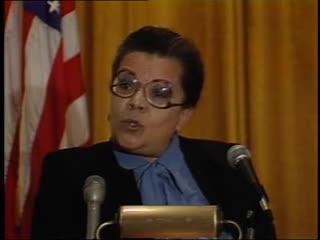
Description: Demand for homeless shelter exceeds supply despite recently added emergency beds at Armory and expanded Pine Street Inn. Ray Flynn, Ed Koch. NYC starts involuntary hospitalization of street people.
Collection: Ten O'Clock News
Date Created: 11/13/1987
Description: Meg Vaillancourt reports that the city of Boston is experimenting with a parcel-to-parcel linkage program to promote development in both the downtown area and in the outlying neighborhoods of the city. A new development project has linked a development in Chinatown to the development of Parcel 18 near the Ruggles MBTA station in Roxbury; the developers had to agree to develop both parcels of land. Vaillancourt reviews the details of the proposed development in each neighborhood. Interview with Stephen Coyle of the Boston Redevelopment Authority about the linkage project. Coyle says that the city is linking desirable downtown sites to sites in other neighborhoods in an attempt to bring jobs and services to the neighborhoods. Mayor Ray Flynn, Governor Michael Dukakis, and City Councilor Bruce Bolling at a press conference in Roxbury talk about the benefits of the linkage project. The Columbia Plaza Associates are a group of minority developers who will most likely develop the sites in Chinatown and Roxbury. Vaillancourt reviews the city's criteria for the development project. The project may bring more jobs and better housing to the Roxbury neighborhood. Following the edited story is b-roll of the area near the Ruggles MBTA station. This edition of the Ten O'Clock News also included the following item: Jesse Jackson campaigns for president in New Hampshire
1:00:06: Visual: Footage of Stephen Coyle (Boston Redevelopment Authority) saying that public land is being used to create "community equity." Shots of a street in Chinatown.<br /><br />Meg Vaillancourt reports that a new development project will affect two communities; that a parking garage and another lot on Essex Street will be developed into office space, retail space, a hotel, and moderate-income housing. Vaillancourt adds that land near the Ruggles MBTA station in Roxbury will be developed into a commercial center with two office buildings, a cultural center, and mixed-income housing for over 150 families. <br /><br />: V: Shots of a parking garage in Chinatown; of the area near the Ruggles Street MBTA station in Roxbury.<br /><br />Vaillancourt notes that developers who wanted the land in Chinatown had to agree to develop the land in Roxbury. <br /><br />: V: Shot of shoppers on a street in Chinatown; of African American commuters entering the Ruggles MBTA station. Shot of a sign reading, "Parcel-to-parcel linkage program project #1. Kingston-Bedford/Parcel 18."<br /><br />Vaillancourt reports that the parcel-to-parcel linkage program is the first program of its kind in the nation. <br /><br />V: Footage of Coyle saying that the downtown sites are desirable to developers; that the city is linking downtown sites with sites in other neighborhoods; that the city would like to bring the service economy into other neighborhoods. Coyle says that Roxbury can benefit from a service economy, especially with the new MBTA orange line trains. Footage of Ray Flynn (Mayor of Boston) addressing a crowd seated outside of the Ruggles MBTA station. Flynn talks about the necessity of good jobs, affordable housing, and neighborhood revitalization. The crowd applauds. The crowd is mostly African American. Shots of an older African American woman in the crowd.<br /><br />Vaillancourt reports that the $400 million project will provide benefits to both communities; that the projects will create more than 2,000 jobs in construction; that the projects will provide more than 8,000 permanent jobs when complete. <br /><br />V: Shots of construction workers working on building sites. Footage of Michael Dukakis (Governor of Massachusetts) saying that these projects will prove to students that there are opportunities for them if they stay in school to be trained. Shot of the audience members. Footage of Bruce Bolling (President, Boston City Council) says that the projects are about the "economic mainstreaming" of those who had been factored out of the process. Shots of an African American woman and her child in the audience; of an African American man at the podium.<br /><br />Vaillancourt reports that Roxbury and Chinatown residents met with the Columbia Plaza Associates; that Columbia Plaza Associates are the minority developers of the projects. Vaillancourt notes that the Columbia group must satisfy five criteria before being officially designated as the developer of the projects. Vaillancourt reports that the group must expand minority and community participation in the project beyond 30%; that the group must develop a plan with clear community benefits; that the plan must get maximum benefit from the $6.6 million in linkage funds; that the project plans must be sensitive in scale and design; that the group must find private investors who promote community ownership and who will insure the projects. <br /><br />V: Shot of the Boston skyline from area near the Ruggles MBTA station. Text on screen lists the city's criteria for development. Footage of Coyle being interviewed by Vaillancourt. Coyle says that the plan requires that the land be put to use for the community. Shot of an African American woman holding her child.<br /><br />Vaillancourt stands in front of the Ruggles MBTA station. Vaillancourt reports that Roxbury community activists blocked a 1970 plan to extend an interstate highway; that the plan would have destroyed several area neighborhoods; that the activists argued for more jobs, more housing and better transportation. Vaillancourt notes that the project looks like it will fulfill the wishes of those community activists.:
Collection: Ten O'Clock News
Date Created: 10/12/1987
Description: Flynn's year in review - triumphs & shortcomings. Developer Jerome Rappaport. Brimmer Street Garage car condominiums. Mandela,Mass proposal discussed on Phil Donahue show.
Collection: Ten O'Clock News
Date Created: 01/06/1987
Description: Hope Kelly reports on charges of racism against the Boston Irish Rowing Club. Larry Otway, President of St. Brendan's Rowing Club of New York said that he was discouraged from bringing African American rowers to compete against the Boston Irish Rowing Club in South Boston. Otway later rescinded his accusations. Mayor Ray Flynn holds a press conference to cite progress in fighting racism across the city. Flynn, William Geary, the Commissioner of the Metropolitan District Commission, City Councilor Bruce Bolling, John Joyce, the President of Boston Irish Rowing Club, and Otway speak at the press conference. Joyce denies any discriminatory practices on the part of the Boston Irish Rowing Club. Andrew Jones and Curtis David of the Greater Roxbury Incorporation Project hold a rival press conference in front of the L Street Bath House in South Boston, spekaing out against racism Jerry Cullitary (South Boston resident) defends South Boston against charges of racism. Interview with Susan Moir, a South Boston resident, about racism in South Boston. People rowing in curraghs on Pleasure Bay.
1:00:00: Visual: Footage of Andrew Jones (Greater Roxbury Incorporation Project) and Curtis Davis (Greater Roxbury Incorporation Project) at a press conference in front of the L Street Bathhouse in South Boston. Jones reads a prepared statement. The statement reads that Ray Flynn (Mayor of Boston) should not invite New York residents to Boston; that African Americans from New York and Boston are not welcome in Flynn's neighborhood. Footage of Flynn at a press conference. Flynn says that acts of discrimination in the city will not be tolerated. Shots of Davis and Jones at their press conference; of Bruce Bolling (Boston City Council) speaking at Flynn's press conference. Footage of Jones saying that African Americans were stoned when they tried to visit Carson Beach in 1974. Footage of William Geary (Commissioner, Metropolitan District Commission) at Flynn's press conference. Geary says that Carson Beach is open to all citizens. Shots of Flynn speaking at his press conference. White and African American city officials stand behind him. Hope Kelly says that Flynn's press conference included a full array of testimony about the city's progress in fighting racism; that it is rare for African American community leaders to hold press conferences in South Boston. V: Shot of the press conference in front of the L Street Bathhouse. The sign over the entrance to the bathhouse reads, "James Michael Curley Recreation Center." A crowd of white residents and media stand in front of the entrance. Shot of a white man standing at the entrance of the bathhouse. Footage of Jones saying that Flynn is doing nothing to combat racism in his own neighborhood. Footage of Flynn saying that a number of minority youngsters have participated in events in South Boston. Footage of John Joyce (President, Boston Irish Rowing Club) saying that the rowing club does not discriminate; that their activities are open to all. Kelly reports that Joyce directs a group of rowers who row on Pleasure Bay in curraghs; that curraghs are boats which are native to Ireland. Kelly notes that the club competes against other curragh clubs; that the club will host a New York curragh club on Sunday. V: Shot of Joyce in a curragh; of rowers in curraghs on Pleasure Bay; of white male members of the club on shore; of a white male getting into a boat with two other white rowers. Shots of curragh races. Kelly reports that Larry Otway (President, St. Brendan Rowing Club of New York) filed a complaint against the Boston club; that the Otway contends that Joyce told the New York club not to come to Boston with African American rowers. V: Shot of Joyce at Flynn's press conference. Kelly notes that Joyce apologized; that Otway has now exonerated Joyce. V: Footage of Otway at Flynn's press conference. Otway says that Joyce is not a racist; that Joyce has always welcomed all of the members of the New York Club; that Joyce has been mistakenly targeted as a racist. Kelly reports that some people agree that the rowing club has been unfairly targeted as racist. Footage of Jerry Cullitary (L Street bather) saying that the residents of South Boston are hard-working, working-class people; that racism is more of a problem in the white suburbs than it is in South Boston. Kelly reports that South Boston has become synonymous with racism. V: Shot of a front page headline in the Boston Herald. The headline reads, "Southie rowing club beached by racial uproar." Footage of a white man addressing Jones and Davis at the press conference at the bathhouse. The man says that "good news in South Boston is no news; that bad news is big news." Davis says that he has not heard anyone utter a racial slur at the press conference. The man says that he would like Davis and Boyce to talk about "good news" in South Boston. Kelly says that the press conferences pointed up the stereotypes which still exist on both sides of the race issue in Boston; that the "sunny side-up" tone of Flynn's press conference only reinforced skepticism about the issue. V: Shot of Flynn leaving his press conference. Hope Kelly stands in the room where Flynn's press conference was held. Kelly said that she wanted to ask Flynn if Carson Beach was presently open to everyone; that Flynn did not answer the question. V: Footage of Susan Moir (white South Boston resident) in South Boston. Moir says that her son is white; that he gets insulted at Carson Beach because he has dark skin. Moir adds that she has brought African American children to the beach with her; that the children have been hassled by white beachgoers. Moyer says that non-white people cannot use the beach.
Collection: Ten O'Clock News
Date Created: 05/22/1987
Description: WILLIAM BULGER'S BARBS FOR RAY FLYNN AND CHRIS LYDON AT ST. PATRICK'S DAY BENEFIT
Collection: Ten O'Clock News
Date Created: 03/12/1987
Description: OFFICIALS SUGGEST RESTRUCTURING OF SCHOOL COMMITTEE FOR BETTER EDUCATION. RAY FLYNN, EDWARD DOHERTY.
Collection: Ten O'Clock News
Date Created: 04/21/1987
Description: History of Boston incinerator siting issue. Controversy erupts when Senate president William Bulger makes known his opposition to South Bay location. Ray Flynn, Ray Dooley, Gov. Michael Dukakis.
Collection: Ten O'Clock News
Date Created: 07/16/1987
Description: Meg Vaillancourt reports that Mayor Ray Flynn has pledged to integrate public housing projects in South Boston by next year. Currently there are no African American families among the 2400 families living in the Old Colony Housing Project in South Boston. Interviews with South Boston housing project residents talking about their opposition to integration. Residents say that the quality of life will decline if African American families move into the project. Other residents say that violence will erupt if the projects are integrated. Interview with Flynn, who says that the housing projects will be integrated in a responsible manner. He talks about integration of public housing projects in Charlestown. Civil rights advocates accuse the Boston Housing Authority (BHA) of ignoring non-white families on the waiting list for apartments in South Boston projects. Interview with Alex Rodriguez of the Massachusetts Commission Against Discrimination, who says that the BHA's housing policies are illegal. Rodriguez threatens to take action against the city. Vaillancourt reports that the pace of integration in the housing projects has been slow. Interview with an African American laborer who says that he would not mind moving into a housing project in South Boston. This edition of the Ten O'Clock News also included the following item: Hope Kelly reviews the history of public housing in Boston
1:00:05: Visual: Footage of a white male South Boston resident saying that violence resulted from forced busing and "forced beaching." Footage of a white female South Boston resident speaking from the window of her project apartment. She says that she would prefer the neighborhood to remain white; that a racial war may erupt if non-whites move in. Shots of the Old Colony Housing Project in South Boston; of a sign reading, "Old Colony Public Housing Development." Meg Vaillancourt reports that there are close to 2400 families living in the Old Colony Housing Project; that 39 families are Latino, Asian or Native American; that there are no African American families in the project. George reports that Ray Flynn (Mayor of Boston) has said that there are African American families on the waiting list for public housing; that the Boston Housing Authority (BHA) will place those families in the Old Colony Project next year. V: Shot of Flynn speaking to a reporter. Footage of a white female South Boston resident saying that the Mission Hill Housing Project was once a nice place to live; that housing projects decline when African American families move in. Footage of a white female resident saying that there will be fights and riots if African American families move into the projects; of another white female resident saying that the neighborhood will decline if it is integrated. Footage of Flynn being interviewed by Vaillancourt. Flynn says that the integration of the housing project will take place in a responsible and professional manner; that there will be no community disruption; that housing projects were integrated in Charlestown. Flynn says that members of the community must participate in the planning for integration. Vaillancourt reports that 900 families live in the housing projects in Charlestown; that 45 of those families are non-white. V: Shot of the exterior of the Boston Housing Authority building in Charlestown. Vaillancourt notes that civil rights advocates say that the BHA and the mayor have done little to promote integration of the projects in South Boston. V: Footage of Alex Rodriguez (Massachusetts Commission Against Discrimination) being interviewed by Vaillancourt. Rodriguez says that he will recommend that the city receive no money unless desegregatory action is taken within 30 or 40 days. Rodriguez says that the city stands to lose millions of dollars. Vaillancourt reports that the pace of integration in the South Boston projects has been slow. V: Shots of the housing projects in South Boston. Vaillancourt notes that a spokesperson for the BHA says that there were more white families on the waiting lists for the South Boston projects. Vaillancourt reports that critics accuse the BHA of ignoring non-white families on the waiting list for the South Boston projects. V: Footage of Rodriguez saying that the BHA is denying entrance to the projects for non-white families. Rodriguez says that the BHA policy is illegal. Footage of a white female South Boston resident saying that she does not understand why African American families would want to move into the housing project. Vaillancourt notes that an African American man was working at the Old Colony Housing Project this afternoon. V: Footage of the African American worker saying that he would have no problem living in this project. Footage of a white male resident saying that Flynn will lose votes if he pushes for integration of the South Boston housing projects. Shot of a white woman and her children in front of a project building.
Collection: Ten O'Clock News
Date Created: 10/29/1987
Description: Hope Kelly reviews the history of public housing in Boston. The first public housing project was built in South Boston in the 1930s. The tenants were all white. The public housing projects in South Boston remained white even as the non-white tenant population grew in the rest of the city. Shots of photographs of white and African American public housing tenants in the 1940s and 1960s. Kelly reviews statistics concerning the numbers of white and non-white families on the waiting list for public housing. The waiting list for public housing in Boston is currently 80% non-white. The waiting list for white families is shrinking while the waiting list for non-white families is growing. There are no African American families living in the housing projects in South Boston in 1987. The Boston Housing Authority (BHA) went into receivership in 1979 due to mismanagement. Mayor Ray Flynn was named receiver of the BHA in 1984. Flynn must integrate the housing projects, but is likely to meet opposition from South Boston residents. Kelly's report is accompanied by footage of Flynn from the 1983 mayoral campaign and by footage of African American and white public housing tenants. This edition of the Ten O'Clock News also included the following item: Meg Vaillancourt reports that Ray Flynn has pledged to integrate public housing projects in South Boston by next year
1:00:04: Visual: Footage of Ray Flynn (Mayor of Boston) at the D Street Housing Project in South Boston in 1983. Flynn talks to project residents. Hope Kelly reports that Flynn announced his candidacy for mayor at a South Boston Housing Project in 1983; that there were no African American families in any South Boston housing projects in 1983; that there are still no African American families in South Boston projects in 1987. V: Shots of a white woman standing at the entrance to a project building; of a white woman looking out of the window of a project apartment. Aerial shot of a housing project in South Boston; of an African American children outside of a housing project building. Shot of a white child scrambling under a fence near a housing project. Kelly notes that the Boston Housing Authority (BHA) is responsible for 69 housing projects in Boston; that 10% of the city's population lives in the projects. Kelly notes that many projects have been integrated for years; that South Boston has not been integrated. Kelly notes that William Bulger (President, Massachusetts Senate) grew up in the Mary Ellen McCormack Housing Project in South Boston. V: Shots of Bulger speaking to a reporter; of a sign for the Mary Ellen McCormack Development; of white women and children sitting on a park bench. Kelly notes that the McCormack Development was the first housing project in all of New England; that the project tenants were white when the project was built in the 1930s. V: Shots of black and white photos of white families and children; of white families in apartments. Kelly notes that people of color began to move into the city; that they became tenants of public housing. V: Shot of a black and white photo of an African American student among white students at the Bromley Heath Housing Project in the 1940s; of a black and white photo of a racially diverse group of children outside of the Cathedral Project in the South End in the 1960s. Kelly notes that the minority population in Boston's public housing doubled in the 1960s. V: Shots of African American students walking home from school; of an African American woman walking her dog on a sidewalk. Kelly notes that the housing projects in South Boston remained white through the 1960s and 1970s; that the BHA waiting list for public housing is 80% minority. V: Shots of a white residents at the entrance to a project building; of an African American girl outside of a housing project. On-screen text lists statistics about the BHA waiting list for public housing. Kelly notes that the BHA waiting list for public housing had 1,455 white families and 9,633 minority families in September of 1987; that the BHA waiting list had 1,688 white families and 9,408 minority families in September of 1986. Kelly notes that there are fewer white families on the waiting list in 1987; that there are more minority families on the waiting list. V: Shots of African American adults and children outside of a housing project. On-screen text lists statistics from the BHA waiting list for public housing. The statistics show the numbers of white, African American, Latino and Asian families on the BHA waiting list. Kelly notes that the numbers of non-white families waiting for public housing have increased dramatically; that the numbers of white families waiting for public housing have increased by less than 100 families. V: Shots of African American children playing outside of a housing project. WCVB-TV footage of Flynn on election night in November of 1983. Flynn says that the city has overcome its racial divisions. Kelly notes that BHA went into receivership in 1979 due to gross mismanagement and poor conditions. V: Shots of a courtroom hearing; of trash accumulated around and inside of public housing project buildings. Kelly reports that racial segregation remains an issue for public housing in Boston; that Flynn was named as receiver of the BHA in 1984. V: Shot of an African American girl looking out of a window of a project apartment. Footage of Flynn saying that people cannot be told where to live or where not to live. Shots of an elderly white woman on a park bench; of a white man wearing a Southie sweatshirt, sitting outside of a housing project. Kelly notes that South Boston residents are being asked to integrate the housing projects one week before the mayoral elections.
Collection: Ten O'Clock News
Date Created: 10/29/1987
Description: Boston Mayor Ray Flynn gives State of the City address at Faneuil Hall.
Collection: Ten O'Clock News
Date Created: 01/06/1987