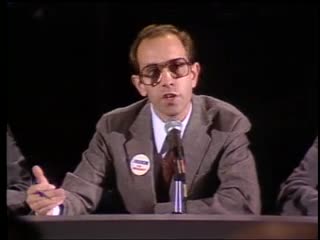
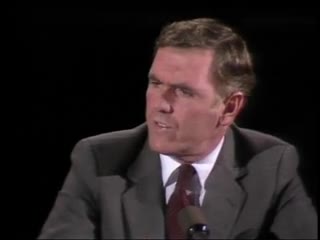
Description: Reel 1 of 1983 Boston Mayoral Debate, held at Simmons College. Candidates are Larry DiCara, Ray Flynn, Robert Kiley, Dennis Kearney, David Finnegan and Mel King. The moderator is professor Carroll Miles. Journalists on the panel are Andy Hiller, Michael Rezendes, William Robinson, and J. Jordan. DiCara, Finnegan, Flynn, and Kearney make their opening remarks. Robert Kiley begins his opening remarks.
Collection: Ten O'Clock News
Date Created: 04/25/1983
Description: Reel 2 of 1983 Boston Mayoral Debate, held at Simmons College. Candidates are Larry DiCara, Ray Flynn, Robert Kiley, Dennis Kearney, David Finnegan and Mel King. The moderator is professor Carroll Miles. Journalists on the panel are Andy Hiller, Michael Rezendes, William Robinson, J. Jordan. Robert Kiley finishes his opening remarks. Mel King, Fred Langone and Eloise Linger maker their opening remarks. Robert Kiley talks about restoring the faith of residents in city government and making the city government work efficiently. He talks about the need to eliminate corruption, the need to establish sound fiscal management and the need to reduce crime. Kiley says that the Boston Public School System must be reformed. Mel King discusses his professional experience and long history of work within the community. King talks about the importance of crime prevention and the need to work with community youth. King states his intention to change the climate of fear in the city. King mentions his proposals for addressing unemployment in the city, including the "Boston jobs for Boston people" program. Fred Langone talks about his years of service to the city and his experience in dealing with the city's finances. Langone condemns the fiscal mismanagement of the present administration. Linger addresses US government foreign policy, school desegregation and racism, women's rights and the anti-abortion referendum. Linger talks about the housing shortage and other social problems. She advocates less spending on defense and more spending on housing and other social issues.
0:59:20: Robert Kiley (candidate for mayor) speaks at a mayoral debate at Simmons College. Kiley talks about restoring the faith of residents in city government; about making city government work efficiently. Kiley says that corrupt practices must be eliminated from city government; that sound fiscal management must be established. Kiley notes that crime must be reduced; that the school system needs reform; that the Boston Public School System has the highest dropout rate and absentee rate of any urban school system in the nation. Kiley says that he has the background, skills and experience to govern the city; that he has proven experience in government; that he has tackled difficult problems in the city like school desegregation and reform of the MBTA. Kiley says that the next mayor must adopt a system of government based on merit and professionalism. Kiley proposes that all candidates make a voluntary pledge not to accept contributions from city or county employees. Kiley notes that he has made a financial disclosure statement. He proposes that all candidates do the same. Kiley adds that the city needs a mayor with a sense of integrity, decency and a commitment to justice. The audience applauds. 1:03:55: Carroll Miles (professor, Simmons College) introduces Mel King (candidate for mayor). King says that he has been working in the Boston community for thirty years; that he is currently teaching at MIT (Massachusetts Institute of Technology); that he served as a state representative for ten years. King says that crime prevention is important; that he would put people on the streets to work with community youth; that he wants to change the climate of fear in the city. King says that he campaigned for mayor in 1979; that he advocated a "Boston jobs for Boston people program during that campaign; that the program guaranteed 50% of Boston jobs for Boston residents. King notes the high unemployment rates in East Boston, Charlestown, South Boston, Roxbury. King says that 85% of the jobs in Boston are now held by non-residents; that the Occupational Resource Center should serve as a training center for unskilled Boston workers; that this program would make a difference in the lives of city residents. The audience applauds. 1:08:55: Miles introduces Frederick Langone (candidate for mayor). Langone says that the present administration has had deficits exceeding $25 million per year; that the deficits persisted despite relief from the state government; that the state government has assumed welfare costs, half of the MBTA budget and the full costs of running the Suffolk County Court. Langone reminds voters that he was able to expose the fiscal mismanagement and extravagances of the present administration. Langone talks about his knowledge and experience in dealing with the city finances. Langone decries the sale of the Soren Water Commission. Langone talked about his involvement in resolving disputes about the Tregor Bill. Langone says that he was the first to speak out against the present proposal to defer tax breaks for real estate owners. Langone says that he has served the city for twenty years; that he has the courage to defend his positions. Langone notes that there is a movement to depress the Central Artery. He reminds voters that he made a suggestion to depress the Central Artery thirty years ago. Langone closes by saying that he has a strong record of service to the city. The audience applauds. Visual: Shot of Langone and Eloise Linger (mayoral candidate, Socialist Workers Party). 1:14:10: Miles introduces Linger. Linger says that she is familiar with the problems of working people; that she is a working mother employed as a stitcher in the garment industry; that she recently went off unemployment. Linger addresses US government foreign policy. She accuses the federal government of dragging the nation into a "new Vietnam" in Central America. She says that the "war machine" of the federal government puts a drain on resources; that these resources could be used to remedy social problems. Linger says that racism exists in Boston at the highest levels; that she is opposed to attempts to roll back gains made in school desegregation. Linger proposes to extend busing for school integration and to hire more teachers for the schools. Linger says that the present city administration has encouraged racist violence through its failure to publicly condemn the killers of William Atkinson. Linger says that there is growing opposition to women's rights at the highest levels; that she is opposed to the pending anti-abortion referendum; that opposition to women's rights at the highest levels encourages rapists and other violent attacks on women. Linger says that a government of working people could solve the problem of unemployment; that "the rich rule and rob Boston." Linger advocates less spending on defense and more spending on housing and other social issues. Linger advocates putting people to work to build affordable housing, public transportation, public health care clinics and new schools. Linger says that the elimination of the Pentagon budget could pay for needed programs. Linger says that banks, corporations and insurance companies in Boston enjoy huge tax breaks at the expense of working people; that the working people of the city have a right to know where the money is. Linger closes by urging everyone to attend the demonstration against US policy in Central American on May 14, and to attend her campaign rally on May 7 in Kenmore Square. Linger holds up a flyer for the campaign rally. The audience applauds.
Collection: Ten O'Clock News
Date Created: 04/25/1983
Description: DEBATE AMONG 8 BOSTON MAYORAL CANDIDATES (REEL 1). Ray Flynn, David Finnegan, Michael Gelber, Lawrence DiCara, Fred Langone, Eloise Linger, Dennis Kearney, Mel King.
Collection: Ten O'Clock News
Date Created: 10/02/1983
Description: DEBATE AMONG 8 BOSTON MAYORAL CANDIDATES (REEL 2). Ray Flynn, David Finnegan, Michael Gelber, Lawrence DiCara, Fred Langone, Eloise Linger, Dennis Kearney, Mel King.
Collection: Ten O'Clock News
Date Created: 10/02/1983
Description: Mel King (candidate for mayor of Boston) attends a meeting of the Tent City Corporation, chaired by Joan Tighe (chairwoman, Tent City Corporation), regarding the development of the Tent City site. Tighe says that the group will work to maintain affordable housing units at the site and to scale down a proposed plan for a parking garage on the site. Crowd sings happy birthday to Tinghe. Christy George interviews King about his position on housing issues and those of his opponents Ray Flynn (candidate for mayor of Boston) and David Finnegan (candidate for mayor of Boston). King criticizes condominium conversions and talks about the need for a strong rent control program. King discusses the link between employment and housing, and says that the community needs more low- and moderate-income housing units. King notes that the federal government is not aware of the housing crisis across the nation; he adds that the federal government needs a better housing policy.
1:00:04: Visual: Mel King (candidate for mayor of Boston) enters a room where a meeting about the Tent City Development is being held. White and African American attendees sit on either side of a long table. King greets a few of the attendees, then sits down near a window at the side of the room. Joan Tighe (chairwoman, Tent City Corporation) reviews the goals of the Tent City Corporation. Tighe says that the Tent City Corporation aims to be the sole developer of the Tent City site; that they will work with the mayor to maintain affordable housing units at the site; that they will work to scale down a proposed plan for a parking garage. The meeting is adjourned. Meeting members tidy up the room. King greets the attendees. Meeting members and King sing "Happy Birthday" to Tighe. King continues to greet attendees. 1:05:22: V: Christy George interviews King. She asks him about his position on housing and about the positions of his opponents Ray Flynn (candidate for mayor of Boston) and David Finnegan (candidate for mayor of Boston). King talks about the need for a strong rent control program and criticizes condominium conversions. King says that new public housing must be built. King says that there is a link between jobs and housing; that people need employment in order to afford housing. King says that the city and the voters must lobby the federal government for a better housing policy. George asks about the differences between King's position and the positions of Flynn and Finnegan. King says that housing must be community-based; that the community needs low- and moderate-income housing. King says that there are other housing issues besides rent control and condominium conversion; that public housing must be protected and improved; that the city must work to provide more housing. King says that he would like to investigate the possibility of a city-wide housing and finance program. King adds that the federal government needs to be aware of the housing crisis across the nation; that the nation needs a good federal housing program. George comments that there are differences between King's position and Finnegan's position. She asks about the differences between King's position and Flynn's position. King says that he has been involved with groups like the Tent City Corporation, who have worked to provide housing. King notes that Flynn has not advocated for a federal approach to the housing crisis. King talks about the need for a tenant equity program in Boston. George thanks King and closes the interview. The crew takes cutaway shots of George and King. George and King speak informally.
Collection: Ten O'Clock News
Date Created: 09/19/1983
Description: Christopher Lydon interviews Mel King (Boston mayoral candidate) in his home. Lydon asks King about his experiences and strengths as a social worker. King says that he believes in empowering people and encouraging them to solve their own problems. King answers questions about similarities between his background and the background of Ray Flynn (Boston mayoral candidate). King says that Flynn has adopted a "me, too" approach to politics. King emphasizes his own commitment to diversity and says that he has taken the lead on many issues. Lydon asks King whether Flynn has learned from him. Lydon also asks King about his silent nature. King says that there is thought and reflection behind his silences. Some sound interference at the end of the interview. Tape 2 of 2 Editor's note: Content given off the record was edited out of this footage.
1:00:30: Visual: Christopher Lydon interviews Mel King (candidate for mayor of Boston) in his home. Lydon asks King to describe his experiences and strengths as a social worker. King says that it is important to help people in need; that it is important to feel good about yourself in order to feel good about other people; that people feel good when they can solve their own problems. King talks about his work with the Symphony Tenants Organizing Project. King says that he encouraged the tenants to use their skills to solve problems. King says that it takes a lot of people to effect change. King says that he is inspired by the actions of Rosa Parks (African American civil rights activist); that the civil rights movement required the participation of many. King says that he believes in empowering people to solve their own problems. 1:04:57: V: Lydon asks King about similarities between his background and the background of Ray Flynn (candidate for mayor of Boston). King says that he has never remarked on similarities between him and Flynn; that Flynn has adopted a "me, too" approach to politics which leads people to see similarities between them. King says that their experiences and worldviews are vastly different; that Flynn's positions are narrower and more parochial. King notes that Flynn does not live in a diverse community; that his legislative achievements are different than Flynn's legislative achievements; that Flynn has not pushed for the same kind of programs. Lydon asks if Flynn has learned from King. King says that people are aware of his successes. King notes that he is usually out in front on the issues; that Flynn has not been out in front on the issues. King adds that he filed the first bills dealing with housing displacement and condominium conversion; that Flynn lagged behind him on this issue. King says that his politics have been informed by the issue of oppression. King says that he and Flynn come from different places in respect to the issue of oppression. 1:12:05: V: Lydon asks King what is behind King's silence. King says that there is thought and reflection behind his silence; that he expresses his anger at oppression through action. King says that he likes to think about the causes of problems and the solutions to problems. The crew takes cutaway shots of Lydon and King. Lydon says that King should consider Flynn as a student; that Flynn needs to learn from King, even if he wins the election. King and Lydon speak informally about the staffing of Flynn's administration in the event of a Flynn victory. Lydon asks King if he would consider working for a Flynn administration.
Collection: Ten O'Clock News
Date Created: 11/03/1983
Description: Marcus Jones reports that a group of minority developers will work with Mayor Ray Flynn and the Boston Redevelopment Authority (BRA) to develop a multi-million dollar complex including office, retail, and residential space in downtown Boston. The complex will replace a downtown parking garage. Jones reports that Flynn's "parcel to parcel linkage program" will link downtown development to development in minority neighborhoods. Jones adds that this project will be linked to a parcel of land in Roxbury. Flynn and the developers, called the Columbia Plaza Associates, hold a press conference to announce plans for the development. Interviews with President of City Council Bruce Bolling and Davis Woo of the Chinese Investment Group about the need for development in minority neighborhoods. Interview with Stephen Coyle, the BRA Commissioner, about opportunities for minority involvement in development. This edition of the Ten O'Clock News also included the following items: Community leaders talk about the significance of the African Meeting House and Renovation of the African Meeting House
1:00:30: Visual: Shots of downtown Boston; of construction in downtown Boston. Marcus Jones reports that $7 billion has been invested in construction in dowtown Boston over the past nine years. V: Shot of Ray Flynn (Mayor of Boston) and a group of minority developers. Jones reports that a group of minority developers are working with Flynn through his "parcel to parcel linkage program"; that the developers will work with the Flynn administraton on a multi-million dollar development which will replace a downtown parking garage. V: Shot of the downtown parking garage. Footage of Flynn saying that a united partnership has been created with members of the Asian, African American, and Hispanic communities. Jones reports that the developers have called themselves the Columbia Plaza Associates; that the developers have raised $2.5 million of their $5.7 million goal. V: Shot of an African American developer standing among the group. Jones notes that the developers represent an important part of Flynn's plan to link downtown development to development in minority neighborhoods such as Chinatown and Roxbury. V: Footage of Bruce Bolling (President, Boston City Council) saying that "those who have been factored out will now be factored in." Footage of Davis Woo (Chinese Investment Group) saying that the developers will work toward buiding new housing in Chinatown; that there is not enough housing in Chinatown. Jones reports that city officials expect to see a development with office, retail, and housing space built to replace the parking garage; that the project is valued at $400 million; that $100 million is earmarked for the minority developers who have won the right to co-develop the project. V: Shot of the parking garage; of a relief of the seal of the city of Boston set into the wall of the garage. Footage of Stephen Coyle (Commissioner, Boston Redevelopment Authority) saying that the minority developers have the "inside track" to develop the project; that this project marks the beginning of a "new era" in the city. Jones reports that up to $15 million spent to purchase the land from the city will be spent by the minority developers to create jobs and to build offices, stores and housing on a 5-acre parcel of land near the Ruggles MBTA Station in Roxbury. V: Overhead shot of the parcel of land in Roxbury. Footage of Coyle saying that the Boston economy will remain strong for the next decade; that teams of minority developers will be able to take advantage of new economic opportunities. Footage of Bolling saying that the work of minority developers will ensure future minority participation in the city. Jones reports that city officials will designate a formal development team for the linkage project in the winter; that construction is slated to start in the spring of 1988. V: Shot of the parking garage.
Collection: Ten O'Clock News
Date Created: 09/19/1986
Description: Mission Church in Roxbury holds service to heal Mission Hill community after false accusations in Stuart murder case. Ray Flynn.
Collection: Ten O'Clock News
Date Created: 01/09/1990
Description: Interview with Boston city councilor Ray Flynn about affordable, safe and decent housing. In front of Mission Hill housing project on Smith Street. Interior of apartment renovated by tenant. Interview with Alan Root of Tenants Policy Council on how to use public funds and sweat equity to optimize rehabilitation effort. Looks for improved racial climate through integrating the several cultures and languages predominant in public housing. Calls for better security and lighting so residents can be comfortable in and around their homes. Is dismayed that public housing has been excluded from CDBG entitlements.
Collection: Ten O'Clock News
Date Created: 05/23/1980
Description: Mixed reviews for Ray Flynn's 1986 performance from city councillors and others.
Collection: Ten O'Clock News
Date Created: 01/06/1987