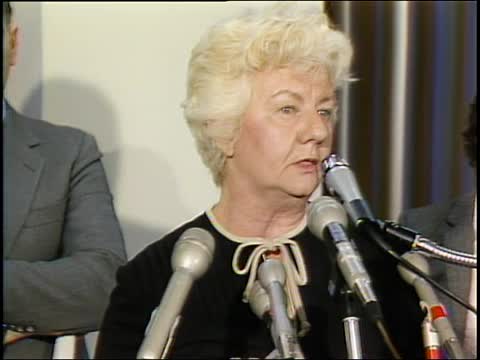
Description: REEL 1 OF MICHAEL DUKAKIS PC ABOUT NEW HOUSING FOR MISSION HILL. Raymond Flynn, Kevin Fitzgerald, William Edgerly. Huntington Avenue.
Collection: Ten O'Clock News
Date Created: 01/21/1985
Description: Ray Flynn and Michael Dukakis speak at dedication of shelter for homeless veterans. Rows of empty beds with pillows, lounge area, dining area.
Collection: Ten O'Clock News
Date Created: 02/05/1990
Description: DEMOCRATIC UNITY BREAKFAST AFTER PRIMARY. RAY FLYNN, JAMES SHANNON, PAUL TSONGAS, DAVID BARTLEY, JOHN KERRY, CHESTER ATKINS
Collection: Ten O'Clock News
Date Created: 09/18/1984
Description: Ray Flynn wants Boston State Hospital site to be used for light industry and affordable housing. Dukakis also supports this, but bill is held up in House Ways & Means. Pat McGovern, Angelo Scaccia.
Collection: Ten O'Clock News
Date Created: 11/24/1987
Description: Neighborhood activists demonstrate inside Boston Public Facilities Department for affordable housing to be a priority when development proposals are considered for Bowditch School, district 13 police station, and Jamaica Plain High School sites. Ray Flynn cuts ribbon at new condos in Hyde Square.
Collection: Ten O'Clock News
Date Created: 07/13/1984
Description: Hope Kelly reports on a legislative hearing in Boston on alleged redlining practices by Boston banks. Kelly reports that the Federal Reserve Bank released a study finding evidence of redlining practices. Kelly notes that the banking industry reacted strongly to the accusations. Kelly's report includes footage from the legislative hearings. Barney Frank (US Congressman) and Benjamin Hooks (Executive Director, NAACP) condemn redlining practices. Richard Pollard (Chairman, Massachusetts Banking Association) and Richard Syron (President, Federal Reserve Bank) say that they do not believe that the banks are engaged in redlining. Kelly reviews the findings of the study. She adds that the study does not conclude if the findings reflect redlining or discrimination on the part of lenders. Kelly quotes Ray Flynn (Mayor of Boston), Michael Dukakis (Governor of Massachusetts), and Joseph Kennedy (US Congressman) as saying the redlining practices cannot be tolerated. Kelly interviews Pollard. Pollard says that banks are not engaged in redlining. He adds that banks need to better serve the needs of minority communities. Kelly notes that the legislative hearing addressed solutions to the problem of redlining, but did not talk about the problem of racism. This tape includes additional footage of the legislative hearing, with various speakers both in agreement and disagreement with the study.
1:00:05: Visual: Footage of Barney Frank (US Congressman) at a congressional hearing in Boston. Franks says that people of color are being denied their rights because of their skin color. Hope Kelly reports that Frank and other officials said that there is irrefutable evidence showing that Boston banks are engaged in discriminatory lending practices. V: Footage of Benjamin Hooks (Executive Director, NAACP) saying that banks across the nation are engaged in discriminatory lending practices. Kelly reports that the banking industry reacted strongly to the comments. V: Footage of Richard Pollard (Chairman, Massachusetts Banking Association) saying that he does not think that Hooks read the study. Kelly reports that the Federal Reserve Bank issued a study on August 31, 1988. Kelly quotes the study as finding that "the number of mortgage loans. . .is 24% lower in black neighborhoods than in white, even after taking into account economic and other non-racial neighborhood characteristics that might contribute to such disparities." V: Shot of Hooks, Michael Dukakis (Governor of Massachusetts), Richard Syron (President, Federal Reserve Bank), and Ray Flynn (Mayor of Boston) at the congressional hearing. Shot of Syron speaking. On-screen text and visuals detail the study findings. Kelly notes that the study does not conclude whether the findings reflect redlining or discrimination on the part of lenders. V: Footage of Syron speaking at the hearing. Syron says that he does not believe that Boston banks are engaged in redlining or discriminatory practices. Footage of Hooks saying that the African American community often knows through experience what the white community must find out through studies. Kelly reports that city and state officials were sympathetic to Hooks's viewpoint. Kelly quotes Flynn as saying that the findings are disturbing; that discriminatory practices cannot be tolerated. Kelly quotes Joseph Kennedy (US Congressman) as saying that "there is a serious problem of racially discriminatory lending in this city." Kelly quotes Dukakis as saying that "racial bias in any form is contrary to the very principles upon which this nation and Commonwealth were founded." V: Shot of Flynn, Syron, and Dukakis at the hearing. Quotes by Flynn, Kennedy and Dukakis appear written in text on-screen. Kelly reports that the bankers disagreed with the officials. V: Footage of Pollard being interviewed by Kelly. Pollard says that the study contains no evidence showing that banks are involved in the practice of redlining. Pollard admits that people in disadvantaged neighborhoods are ill-served by the financial community. Pollard says that bankers are part of the larger financial community; that bankers will be part of the solution to the problem. Shots of the congressional hearing; of Kennedy at the congressional hearing. Shots of Kweisi Mfume (State Representative) at the hearing; of attendees at the hearing; of Bruce Bolling (Boston City Council) at the hearing. Kelly reports that speakers at the hearing focused on solutions to the problem; that few talked about the larger issue of racism at the heart of the problem. V: Shots of Flynn; of attendees at the hearing.
Collection: Ten O'Clock News
Date Created: 09/29/1989
Description: Ray Flynn interview on opening Division of Employment Security office in Uphams Corner. DES exterior with signs: Job Matching, Job Insurance. Uphams Corner environs from moving car in rain. jobs.
Collection: Ten O'Clock News
Date Created: 02/15/1984
Description: Dorchester District Court justices, Mayor Flynn & Boston Public Facilities Department named as defendants in SJC lawsuit against severe overcrowding & hazardous conditions in courthouse.
Collection: Ten O'Clock News
Date Created: 01/27/1988
Description: David Boeri reports on a legislative hearing about urban issues in the Roxbury neighborhood, where city and state officials addressed the panel. Mayor Ray Flynn, District Attorney Newman Flanagan, and Judge Julian Houston of the Roxbury District Court address the panel. Boeri reports that the congressmen were interested in the Dorchester Youth Collaborative (DYC) program. Emmit Folgert of the DYC, along with Dorchester teens Lawrence McKinley and Andrew Young address the panel. They talk about gang activity in the neighborhood. Boeri reports that many teen counselors believe that drug education and prevention should focus on the after-school hours. DYC offers entertainment, music, sports, and a safe place for teenagers. Interview with Al McClain of DYC, and Dorchester teens William Woods, Abigail Santana, and Mickey McBride about the DYC. The teens dance and hang out at DYC. Boeri reports that the congressmen are being urged to fund community centers like the DYC. This edition of the Ten O'Clock News also included the following item: Carmen Fields interviews Shirley Caesar
1:00:13: Visual: Footage of speakers addressing a congressional hearing in Roxbury. The congressional panel includes Congressman Joseph Moakley and Charles Rangel. Shots of Ray Flynn (Mayor of Boston) addressing the panel; of Newman Flanagan (District Attorney) addressing the panel; of Julian Houston (judge, Roxbury District Court). Shots of the panel. Shot of William Celester (Deputy Superintendent, Boston Police Department). David Boeri reports that legislators on the panel at the congressional hearing wanted to hear from residents of Roxbury and Dorchester; that the panel first heard from Michael Dukakis (Governor of Massachusetts), Flynn and other officials. V: Shots of African American attendees at the meeting. Shot of Georgette Watson (Roxbury resident) at the hearing. Audio of Emmet Folgert (Dorchester Youth Collaborative). Folgert says that the US has given up on poor urban teens; that poor urban teens have given up on America. Shots of audience members. Footage of Lawrence McKinney (Dorchester teen) describing the gang culture in his neighborhood. Footage of Andrew Young (Dorchester teen) talking about dangerous gang members in his neighborhood. Shots of the exterior of the Dorchester Youth Collaborative (DYC); of a sign for the DYC. Shots of teenagers entering the DYC. Boeri reports that the DYC is a safe haven for many teens; that Congressman are interested in the DYC program. V: Shots of a white girl and an African American girl dancing to music in a room at the DYC; of other teens in the room with the girls. Boeri reports that drug activity takes place after school. Boeri notes that counselors think that drug education and prevention should be focused on after-school hours. V: Footage of Al McClain (DYC) being interviewed by Boeri at the DYC. Boeri asks McClain what the teens would be doing if they were not at the DYC. McClain says that the teens would probably be out on the streets; that they might get into drugs. Footage of William Woods (Dorchester teen) saying that he does not want to get into trouble. Boeri reports that the DYC offers entertainment, music, and sports; that some kids go to the DYC to do their homework. V: Shots of teens at the DYC; of a two boys dancing to music in a room at the DYC. Footage of Abigail Santana (Dorchester teen) and Mickey McBride (Dorchester teen) being interviewed by Boeri at the DYC. Boeri asks about the activity on the streets. Santana says that people are drinking alcohol on the streets. McBride says that people are selling drugs and shooting each other. McBride says that she likes being at the DYC. Boeri stands outside of the entrance to the DYC. Boeri reports that DYC counselors complain that President George Bush's drug program directs funding to jails, schools, and treatment centers; that the drug program does not fund community centers like the DYC. V: Footage of McClain saying that the teens at the DYC are like a big family; that the teens try to reach out to others who are on the streets. Shots of two boys dancing to music at the DYC. The boys are wearing WGBH T-shirts. Boeri reports that Congressmen are being urged to take a closer look at DYC. V: Footage of Emmet Folgert (DYC) speaking at the congressional hearing. Folgert says that community centers should be funded; that community centers provide positive adult role models. Shot of the two boys dancing at the DYC.
Collection: Ten O'Clock News
Date Created: 10/06/1989
Description: Story on the Drop-a-Dime Program started by Roxbury residents Georgette Watson and Rev. Bruce Wall. Pedestrians on the streets of Roxbury and Roxbury neighborhood in the evening. Watson points out a drug dealer and a building out of which the drug trade operates. Interview with Watson about the drug problem in the city and the effectiveness of the Drop-a-Dime Program. She talks about the role of neighborhood youth in the drug trade. Representatives from the Drop-a-Dime Program were not included in the mayor's newly formed council on drug abuse. Mayor Ray Flynn holds press conference announcing the formation of the council. Ben Thompson, Chairman of the council, says that the council intends to work with anti-crime and drug prevention groups across the city. William Weld, US Attorney for Massachusetts, and Derek Sanderson, former player for the Boston Bruins, stand with the other members of the council at the press conference. Interview with Bruce Wall about how community groups have not been included on the council. He adds that members of community groups understand how the drug trade functions in their neighborhoods. Flynn will go to the Boston City Council to obtain funding to combat drug abuse in the city.
1:00:05: Visual: Shots through the windshield of a traveling car of Boston streets; of Washington Street; of youth gathered in front of a building. Audio of Georgette Watson (Roxbury community leader) talking about drug trafficking in her neighborhood. Watson points out a well-known drug dealer as he walks across the street. Watson talks about the role of neighborhood youth in the drug trade. Meg Vaillancourt reports that Watson is familiar with the drug trade in her neighborhood; that Watson and Reverend Bruce Wall (Roxbury community leader) started the Drop-a-Dime program. Vaillancourt reports that the Drop-a-Dime program encourages residents to phone in tips and information about the drug trade to police; that South Boston and Roxbury police have found the tips to be mostly accurate. V: Shots of Watson and Wall; of a tape recorder. Footage of a hand pressing the play button on the tape recorder. Audiocassette is heard playing in the background of the report. Shots from a traveling car of Washington Street in the evening. Vaillancourt reports that Watson wants to expand Drop-a-Dime program into a city-wide service; that representatives from the program were not included in the mayor's council on drug abuse. V: Footage of Watson saying that Drop-a-Dime deserves more support from the mayor and the city. Vaillancourt reports that the Ray Flynn (Mayor of the City of Boston) held a press conference today to announce his new drug abuse council; that Flynn did not answer questions regarding the absence of Drop-a-Dime representatives from the council. V: Shots of Flynn and his council at a press conference. Footage of Ben Thompson (Chairman of the Council), saying that the council intends to be "inclusive"; that the council intends to work with other anti-crime and drug prevention groups across the city. Footage of Wall saying that community groups need to be included on the mayor's council; that community groups understand how the drug trade functions on the streets of the city. Shots of members of the drug abuse council, including William Weld (US Attorney for Massachusetts) and Derek Sanderson (former player for the Boston Bruins). Footage of Flynn explaining that Sanderson will be paid by the city of Boston; that the rest of the committee is made up of volunteers. Shots of the council preparing to leave the press conference. Vaillancourt notes that the council is made up of local and state officials. Vaillancourt notes that the council will prepare a report on how the city can combat drug abuse; that Flynn will take the report to the Boston City Council in order to obtain funding; that it will be difficult for Flynn to obtain extra funds because of the economic crisis faced by the city.
Collection: Ten O'Clock News
Date Created: 12/07/1984