Description: Harvard graduate student Marjorie Damon whose Marine son is in Persian Gulf mulls over dichotomy of elite education vs. military service. Students in Harvard Yard with umbrellas.
Collection: Ten O'Clock News
Date Created: 02/14/1991
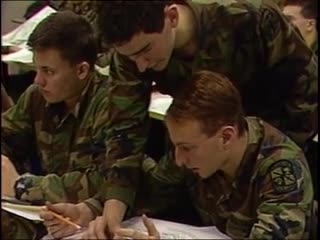
Description: Four Harvard ROTC students talk about what duty means to them, and possible service in Persian Gulf war. They attend training classes at MIT in army camouflage uniforms.
Collection: Ten O'Clock News
Date Created: 02/14/1991
Description: RUSSIAN CONVERSATION CLASS AT HARVARD, émigré
Collection: Ten O'Clock News
Date Created: 08/01/1984
Description: Ralph Nader criticizes Harvard University for allowing its faculty to become beholden to business through research, findings of which professors do not disclose. Corporatization. Harvard Watch.
Collection: Ten O'Clock News
Date Created: 11/16/1988
Description: Rep. Bernard Sanders, formerly Socialist mayor of Burlington, Vermont, is now the only independent in Congress. He attends Kennedy School orientation for new Congress members. Maxine Waters, Scott Klug.
Collection: Ten O'Clock News
Date Created: 12/07/1990
Description: Harvard study indicates federal efforts in drug war are misdirected; more money should be spent at local and state levels. Marijuana being cut in field, smoking joint.
Collection: Ten O'Clock News
Date Created: 08/21/1989
Description: Christy George reports that the Reverend Allan Boesak, an anti-apartheid activist, received an award at Harvard University. He gives a speech at the university in which he urges western countries to place economic sanctions on the South African government. He criticizes Ronald Reagan and other western leaders for supporting the South African government. Boesak, at a press conference after the awards ceremony, praises Dukakis for imposing sanction and and urges George Bush to impose sanctions on South Africa. Boesak talks about the effectiveness of sanctions. George's report includes footage of Bush talking about South Africa and footage of apartheid South Africa. Following the edited story is additional footage of Boesak's press conference at Harvard.
1:00:00: Visual: Footage of Dr. Allan Boesak (anti-apartheid activist) preaching at Memorial Church at Harvard University. Boesak says that the lives of many South African blacks could have been saved if Ronald Reagan (US President) and other Western leaders had divested from South Africa in 1985. Footage of South African police brutally arresting South African blacks. Christy George reports that Boesak is one of the few South African church leaders who would dare to blame Reagan for the deaths of South African children. V: Footage of Boesak at Harvard. Boesak accuses Reagan, Margaret Thatcher (Prime Minister of Great Britain), and Helmut Kohl (Chancellor of Germany) of supporting the South African government. Boesak says that these leaders refused to impose sanctions on the apartheid government. George reports that Boesak is outspoken; that Boesak received an award from Harvard University today; that Boesak chided Harvard for investing in South Africa. V: Shots of Memorial Church at Harvard University; of Boesak receiving an award from a Harvard official. George notes that Boesak praised Michael Dukakis (Governor of Massachusetts) for imposing sanctions against South Africa; that Boesak begged George Bush (US President-elect) to do the same. V: Footage of Bush on October 25, 1988. Bush says that the South African government is racist; that the US needs to stay engaged; that the US needs to use its "moral influence" to change the South African government. Footage of Boesak at a press conference at Harvard University. Boesak says that he hopes Bush will follow the example of Massachusetts; that the US should divest from South Africa. Boesak says that he wishes Dukakis had been elected president. Boesak says that Bush has talked about his commitment to civil rights; that Bush needs to act on his commitment. Footage of South African blacks running from police on January 10, 1988. George reports that Boesak says that the South African government is redoubling its efforts to enforce apartheid laws. V: Footage of Boesak saying that he his tired of lame excuses from western governments. Boesak says that western leaders are lying when they talk about their concern for South African blacks. Boesak talks about the US government's commitment to sanctions against Cuba, Libya, Argentina and Nicaragua. George reports that Boesak says that sanctions are effective; that war has become too expensive for the South African government. George reports that Boesak points to the end of wars in Namibia and Angola as proof of the effectiveness of sanctions. V: Footage of Africans celebrating in the streets; of Africans marching in the street; of African soldiers watching a plane taxi on a runway. Footage of Boesak at a press conference. Boesak talks about sanctions. Boesak says that the South African government should be cut off from oil and from access to the international money market. Boesak says that no South African blacks would be hurt if air links to and from South African were cut off. Boesak says that he and Desmond Tutu (South African anti-apartheid leader) are the only two South African blacks who fly anywhere.
Collection: Ten O'Clock News
Date Created: 01/17/1989
Description: Kris Rondeau speaks at a rally, intercut with shots of attendees. She talks about the success of the Harvard Union of Clerical and Technical Workers and their disputes with Harvard administration. She ends by introducing Jesse Jackson. Jackson leads a chant of “Keep Hope Alive!” for a couple of seconds. He speaks about worker pay, the economy, and Harvard. He speaks about workers at Harvard and claims that they cannot pay Harvard tuition. He speaks about hospital workers who cannot afford healthcare and states the need for a national healthcare plan. He speaks about equal pay for women, benefits for workers, and other problems in America. He speaks about the need for coalition and the need to push for change. He speaks about his plan to meet with Harvard’s president and what he will discuss. He speaks about Harvard’s endowment and its character. He speaks again about the need for coalition. He speaks about mistreatment of minorities in World War II, links this to current situations in Haiti, Somalia, Bosnia, and South Africa, and to current situations in the U.S. He speaks about the L.A. Riots and racism. He ends the speech with calls to action and takes a press question about his plan to meet with Harvard’s president. Credits over shot of statue and protest sign, over audio of man and chorus singing.
Collection: CCTV
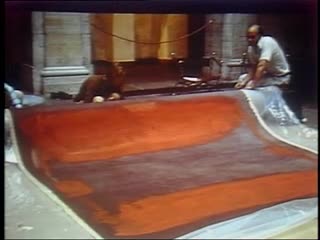
Description: Suite of paintings done by Mark Rothko for Harvard faded severely in sun because of fugitive pigments. The murals are on display for final time at Sackler Museum.
Collection: Ten O'Clock News
Date Created: 08/01/1988
Description: Charles Ray, the Headmaster of Roxbury High School, talking to students, parents and faculty members in the offices of Roxbury High School. Pam Bullard interviews Ray in the administrative offices of the school. Ray talks about how the school has changed since the beginning of school desegregation in 1974. He notes that white attendance is still low, but that it is improving. Ray describes the school's bilingual program, and the academic programs set up at the school in conjunction with Harvard University. He says that many students from Roxbury High School received college scholarships last year, and discusses their college opportunities. Ray talks about the atmosphere at the school, and the close relationships between the students and the faculty. He notes that very few students transfer out of the school. He adds that most students feel comfortable at Roxbury High School. Ray says that he tries to learn the names of every student in the school. Ray talks about the challenges of urban education. He says that he encourages pregnant students to remain in school as long as possible. Ray says that he would like to see a program set up to allow students to bring their children to school with them. Ray describes the school's building and facilities. Ray tells Bullard that it is important to treat each student with respect.
1:00:05: Visual: Charles Ray (Headmaster, Roxbury High School) speaks to an African American female student in the office of Roxbury High School. He tells the student what she needs to do in order to change school assignments. 1:01:37: V: Pam Bullard sets up an interview with Ray. Ray talks about some of the photographs in the school office. He notes that the photos were taken by students from the school. Ray talks to a student who has entered the office. The student asks Ray about the television crew in the school office. Bullard notes that the Boston Public Schools are beginning their fifth year of desegregation. Bullard asks Ray how things have changed in five years. Ray notes that Roxbury High School was paired with South Boston High School during the first year of desegregation. Ray notes that only a small percentage of students from South Boston attended Roxbury High School during the first year of school desegregation. Ray says that Roxbury High School was placed in the same district as Charlestown High School during the second year of school desegregation; that Roxbury High School has remained in that district. Bullard asks Ray about white attendance at Roxbury High School. Ray says that the school has more white students now than it had during the first year of school desegregation. He notes that sixty-three white students have been assigned to the school this year; that twenty-five white students are in attendance. Ray says that he would like the Boston School Department to assign more white students to the school. Ray says that Roxbury High School has a bilingual program for Asian and Spanish-speaking students. Bullard asks Ray about Roxbury High School's programs in conjuction with Harvard University. Ray explains that Roxbury High School has been paired with Harvard University by the federal court order governing school desegregation in Boston. Ray talks about a tutoring program in which Harvard students tutor Roxbury High School students. Ray talks about the Harvard Upward Bound Program. He adds that Harvard and Roxbury High School have set up programs for students in advanced math and sciences, reading, and art. Ray explains that teachers and advanced students can take courses at Harvard University. 1:06:46: V: Bullard notes that students who attend Roxbury High School tend to stay at the school and do not transfer out. Ray agrees that not many students transfer out of the school. He adds that most students like the school and the faculty. Bullard asks Ray if many students from Roxbury High School attend college. Ray says that 74 students graduated from Roxbury High School in 1978; that 37 of those students went on to college. He adds that many of the students received scholarships last year. Ray adds that the Girls High Alumni Association has contributed to a scholarship fund for the students. Ray notes that many Roxbury High School students have done well in their college careers. Bullard asks why Roxbury High School has been a successful school. Ray says that the teachers get to know the students and their families very well. Ray notes that the faculty know most of the students by name; that the students feel comfortable at the school. Ray adds that these close relationships are the key to the school's success. Bullard asks Ray if he knows the name of every student at the school. Ray says that he is learning the names of all of the incoming freshmen; that he makes an effort to talk to the students in the hallways. Ray adds that he knows the names of all of the returning students. Bullard notes that all of the students like Ray and speak highly of him. Ray talks about the importance of knowing the name of each student. He adds that the students know that the teachers and other faculty members care about them. 1:11:43: V: Bullard asks how urban education has changed in the past decade. Ray says that programs for special needs students have changed; that pregnant students now stay in school. Ray says that he encourages pregnant students to stay in school for as long as they can. He says that he encourages them to return to school as soon as possible. Ray adds that he would like to start a program that would allow students to bring their children to school with them. He says that it might be difficult for Roxbury High School to meet the safety requirements for such a program. Bullard asks Ray if he would have chosen to be assigned to Roxbury High School. Ray says that he likes Roxbury High School. He adds that the school is structurally sound and has good facilities; that he likes the layout of the building. Ray says that the faculty at the school have a good relationship with the community and with the parents. Ray adds that he likes the atmosphere at small high schools. He says that each student gets personal attention at Roxbury High School. Bullard asks Ray what he has learned over the course of his career. Ray says that he has learned the importance of treating each student with respect. He says that the students treat him respectfully in return. Bullard closes the interview. 1:16:38: V: Ray stands behind the counter of the office at Roxbury High School. He answers questions from a student about her school schedule. Ray confers with a teacher about two problem students. Ray tells the teacher that he will speak to the students. Ray talks to two more students about their school schedules. Ray confers with another teacher in the office.
Collection: Ten O'Clock News
Date Created: 09/13/1978