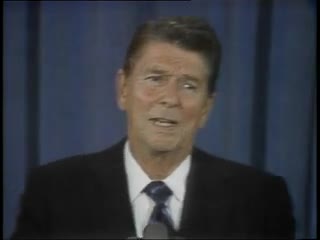
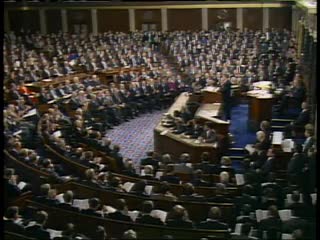
Description: Comparison of Reagan and F.D. Roosevelt in context of respective stock market crashes; how Reagan reassured the nation about the state of the economy.
Collection: Ten O'Clock News
Date Created: 10/21/1987
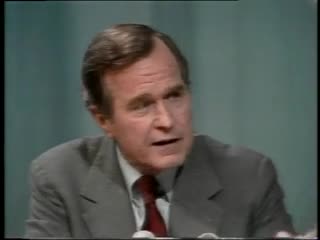
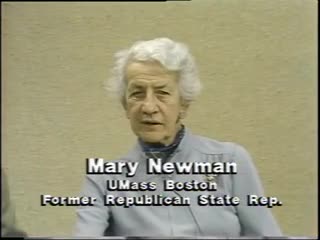
Description: Scenes from the Republican National Convention including Bob Hope performing at Billianare Bunker Hunt's Little Clam Bake, people chanting "Four more years" and "USA" at the convention, the Republican Platform Committee, interview with former RNC Chairperson Mary Louise Smith who is disappointed with the radical changes to the platform, overview of the new platform, interview with Vice President George Bush about how the majority of Americans are conservative, excerpts from Reagan's speech, and balloons falling from the ceiling. Reporter voice-over throughout. Sound.
Collection: WCVB Collection
Date Created: 08/24/1984
Description: New Hampshire debate among 7 Republican presidential candidates. Philip Crane, George Bush, Ronald Reagan, John Anderson, Howard Baker, Robert Dole, John Connally. Howard K. Smith, moderator. Eileen Shanahan and Joseph Kraft, panelists.
Collection: Ten O'Clock News
Date Created: 02/20/1980
Description: New Hampshire debate among seven Republican presidential candidates. Philip Crane, George Bush, Ronald Reagan, John Anderson, Howard Baker, Robert Dole, John Connally. Howard K. Smith, moderator.
Collection: Ten O'Clock News
Date Created: 02/20/1980
Description: Christy George reports that the Reverend Allan Boesak, an anti-apartheid activist, received an award at Harvard University. He gives a speech at the university in which he urges western countries to place economic sanctions on the South African government. He criticizes Ronald Reagan and other western leaders for supporting the South African government. Boesak, at a press conference after the awards ceremony, praises Dukakis for imposing sanction and and urges George Bush to impose sanctions on South Africa. Boesak talks about the effectiveness of sanctions. George's report includes footage of Bush talking about South Africa and footage of apartheid South Africa. Following the edited story is additional footage of Boesak's press conference at Harvard.
1:00:00: Visual: Footage of Dr. Allan Boesak (anti-apartheid activist) preaching at Memorial Church at Harvard University. Boesak says that the lives of many South African blacks could have been saved if Ronald Reagan (US President) and other Western leaders had divested from South Africa in 1985. Footage of South African police brutally arresting South African blacks. Christy George reports that Boesak is one of the few South African church leaders who would dare to blame Reagan for the deaths of South African children. V: Footage of Boesak at Harvard. Boesak accuses Reagan, Margaret Thatcher (Prime Minister of Great Britain), and Helmut Kohl (Chancellor of Germany) of supporting the South African government. Boesak says that these leaders refused to impose sanctions on the apartheid government. George reports that Boesak is outspoken; that Boesak received an award from Harvard University today; that Boesak chided Harvard for investing in South Africa. V: Shots of Memorial Church at Harvard University; of Boesak receiving an award from a Harvard official. George notes that Boesak praised Michael Dukakis (Governor of Massachusetts) for imposing sanctions against South Africa; that Boesak begged George Bush (US President-elect) to do the same. V: Footage of Bush on October 25, 1988. Bush says that the South African government is racist; that the US needs to stay engaged; that the US needs to use its "moral influence" to change the South African government. Footage of Boesak at a press conference at Harvard University. Boesak says that he hopes Bush will follow the example of Massachusetts; that the US should divest from South Africa. Boesak says that he wishes Dukakis had been elected president. Boesak says that Bush has talked about his commitment to civil rights; that Bush needs to act on his commitment. Footage of South African blacks running from police on January 10, 1988. George reports that Boesak says that the South African government is redoubling its efforts to enforce apartheid laws. V: Footage of Boesak saying that he his tired of lame excuses from western governments. Boesak says that western leaders are lying when they talk about their concern for South African blacks. Boesak talks about the US government's commitment to sanctions against Cuba, Libya, Argentina and Nicaragua. George reports that Boesak says that sanctions are effective; that war has become too expensive for the South African government. George reports that Boesak points to the end of wars in Namibia and Angola as proof of the effectiveness of sanctions. V: Footage of Africans celebrating in the streets; of Africans marching in the street; of African soldiers watching a plane taxi on a runway. Footage of Boesak at a press conference. Boesak talks about sanctions. Boesak says that the South African government should be cut off from oil and from access to the international money market. Boesak says that no South African blacks would be hurt if air links to and from South African were cut off. Boesak says that he and Desmond Tutu (South African anti-apartheid leader) are the only two South African blacks who fly anywhere.
Collection: Ten O'Clock News
Date Created: 01/17/1989
Description: President Ronald Reagan press conference 10/1/1981.
Collection: Ten O'Clock News
Date Created: 10/01/1981
Description: Gary Griffith story on "handicapping the race" for Ronald Reagan Administration Staff Positions.
Collection: Ten O'Clock News
Date Created: 11/13/1980
Description: Ronald Reagan's final State of the Union address. Edward and Joe Kennedy together in Congressional audience. Exterior of Capitol dramatically lit against night sky. Supreme Court justices seated together. Democratic response by House Speaker Jim Wright.
Collection: Ten O'Clock News
Date Created: 01/27/1987
Description: Marcus Jones reports on Congressional debate over a bill that would impose sanctions on the apartheid regime in South Africa. Jones notes that Ronald Reagan is opposed to sanctions, but did impose a limited one-year trade embargo on South Africa last September. Jones' report includes footage of Reagan giving a speech. Jones reports that Reagan and his supporters believe that sanctions would hurt black South Africans more than they would help them. Jones adds that supporters of sanctions call Reagan's position hypocritical and illogical. Jones' report is accompanied by footage of the members of US Congress addressing the legislature about the sanctions issue. The congressmen include Stephen Solarz, Silvio Conte, Dan Burton, Edward Kennedy, and Bob Dole. George Bush is shown presiding over the US Senate. Jones reports that anti-apartheid leaders believe that the US must set an example for other nations by imposing sanctions on the South African government. Jones' report is accompanied by footage of laborers in South Africa and by footage of black South Africans. This tape contains additional footage of Prince Andrew of Great Britain and Sarah Ferguson (Andrew's fiance). This edition of the Ten O'Clock News also included the following item: David Boeri reports on drug activity in the Grove Hall area of Roxbury
0:59:59: Visual: Footage of Stephen Solarz (US Representative from New York) speaking to legislators on June 18, 1986. Solarz says that sanctions are a form of "political shock therapy." Solarz says that it is better to deliver a stronger shock than a weaker one. Marcus Jones reports that Ronald Reagan (US President) gave a speech today; that Reagan's speech was supposed to quiet Congressional debate over sanctions against South Africa. Jones reports that Reagan's speech did little to quiet the debate. Jones notes that the Senate is debating a bill which would divest US business interests in South Africa; that the bill would ban US companies from trading with, investing in, or opening subsidiaries in South Africa. V: Shots of Reagan giving a speech; of the audience listening to Reagan. Shots of the Senate chambers; of Bob Dole (US Senator) speaking on the floor of the Senate chambers. Shot of George Bush (US Vice-President) presiding over the Senate. Bush confers with an official as he sits in his seat. Footage of Silvio Conte (US Representative from Massachusetts) addressing legislators. Conte says that the US should not be timid; that the US needs to provoke the South African government to act before civil war erupts. Footage of Dan Burton (US Representative from Indiana) addressing legislators. Burton says that legislators should give Reagan's measures time to work before enacting sanctions. Shot of Reagan speaking. Jones reports that Reagan tried in vain to cut off debate about sanctions last September; that Reagan issued a five-point executive order. Jones notes that Reagan's order included a limited one-year trade embargo on South Africa. Jones reports that critics believe that the executive order has failed to promote change in South Africa. Jones notes that US anti-apartheid leaders said that Reagan's position on South Africa is inadequate, hypocritical, and illogical. V: Shot of a US Congressman addressing legislators on June 18, 1986. Jones reports that Reagan's position states that US sanctions would hurt black South Africans more than they would help them. Jones reports that critics note that Reagan supported sanctions against the governments of Poland and Nicaragua. Jones reports that Reagan's policy states that the US would be put at a strategic disadvantage if the import of certain minerals from South Africa was outlawed. Jones notes that the current Congressional bill would allow exceptions for minerals imported for the military. V: Shots of an industrial plant in South Africa; of two black South African men walking in a commercial district in South Africa. Shots of Reagan giving a speech. Shot of Bush presiding over the Senate chambers. Shot of Edward Kennedy (US Senator) addressing members of the Senate. Jones reports that Reagan's critics acknowledge that strong sanctions will not remedy the situation in South Africa. Jones notes that there are only a few hundred US firms operating in South Africa; that US firms employ less than 1% of the South African work force. Jones reports that anti-apartheid leaders believe that change will come to South African only if other nations follow the example of the US in imposing sanctions. V: Shots of traders on the floor of a stock exchange; of a black South African miner. Shot of a sign on a building. The sign reads "Mine Labour Organisations" Shot of black South African women waiting at the Mine Labour Organisation building. Shot of black South African men carrying a coffin in a funeral procession. Shot of a black fist raised in the air.
Collection: Ten O'Clock News
Date Created: 07/22/1986
Description: Ronald Reagan's State of the Union address on his 74th birthday. In chamber: George Bush, Tip O'Neill, Donald Regan, Howard Baker, George Shultz, David Stockman, Caspar Weinberger, Robert Michel. Joint session sings Happy Birthday to Reagan.
Collection: Ten O'Clock News
Date Created: 02/06/1985