Description: Visit to Scotch Market in Quincy where haggis is made from sheep's organs mixed with onions and oatmeal.
Collection: Ten O'Clock News
Date Created: 01/27/1989
Description: Conversation and jokes with Irish comedian Hal Roach.
Collection: Ten O'Clock News
Date Created: 03/17/1989
Description: Hammond Street bridge in Newton is closed for inspection failure. Deteriorating steel trusses, potholes, Jersey barriers. Weight limit signs. Chestnut Hill T sign.
Collection: Ten O'Clock News
Date Created: 11/15/1989
Description: Dukakis commends police officers for their bravery at State House ceremony to present the annual Hanna Awards.
Collection: Ten O'Clock News
Date Created: 10/26/1989
Description: 20 years after Harvard student strike, radicals reunite in the Yard to recall their activism and proclaim continued commitment to ideals. Harvard Medical School exteriors. Mission Park apartments.
Collection: Ten O'Clock News
Date Created: 04/07/1989
Description: Harvard University radicals from the 1960s reunite for a rally in the Yard and speak from the steps of Widener Library, proclaiming their current causes.
Collection: Ten O'Clock News
Date Created: 04/07/1989
Description: Hope Kelly reports on the incidence of hate crimes in Boston. Kelly explains that hate crimes are defined as incidents of racial violence; she cites statistics that illustrate how hate crimes have affected various racial and ethnic groups. Kelly's report includes footage of Jack McDevitt (Center for Applied Research, Northeastern University) giving a seminar on hate crimes in Boston. The small audience includes uniformed police officers. McDevitt says that most hate crimes are not initially categorized as such by police officers. McDevitt talks about the seriousness of hate crimes. He notes that all racial and ethnic groups are affected. Kelly's report includes shots of Boston residents on the streets and shots from a moving car of downtown Boston in the evening.
1:00:13: Visual: Shots from a moving car of downtown Boston at night. Hope Kelly reports that hate crimes are defined as incidents of racial violence; that Boston has had 452 hate crimes over the past four years. Kelly notes that hate crimes are rarely recognized for what they are. V: Footage of Jack McDevitt (Center for Applied Research, Northeastern University) addressing a small audience. McDevitt says that his research looks at how Boston's 452 hate crimes were initially categorized by the responding officer. McDevitt says that 19 of the 452 incidents were initially categorized as racially motivated. Shots of the audience listening to McDevitt. Shots of police officers in uniform as they listen to McDevitt. Kelly reports that one of the goals of the study is to teach police officers and citizens to recognize these crimes for what they are. V: Footage of McDevitt saying that Boston's hate crimes were more serious than statistics show them to be. Kelly reports that half of Boston's 452 hate crimes involved assaults; that thirty percent of the assaults were serious enough to require hospitalization. Kelly reports that national statistics show only 7% of assaults as serious enough to require hospitalization. V: Shots from a moving car of residents on the streets of Boston at night. Audio of McDevitt saying that many of Boston's hate crimes involve multiple offenders attacking a single victim. Shots of Washington Street in Roxbury during the day. Elevated train tracks are visible. Shots of African American men gathered outside of Joe's sub shop on Washington Street. Kelly reports that McDevitt found turf issues to be the motivation of many hate crimes in Boston. V: Footage of McDevitt saying that members of every racial and ethnic group were victims of hate crimes. Kelly reports that the study found that Africans Americans and whites were equally apt to be victims of hate crimes; that the perpetrators were usually of another race than their victim. V: Shots of residents walking on the streets of Boston in the daylight. On-screen text and visuals detail hate crime statistics. Kelly reports that 118 African Americans were victims of hate crimes; that 92% of those victims were attacked by whites. Kelly reports that 111 whites were victims of hate crimes; that 78% of those victims were attacked by African Americans. Kelly reports that whites and African Americans accounted for 2/3 of all victims. Kelly reports that 6% of victims were Latino; that the rest of the victims were Asian. Kelly notes that Vietnamese residents were victimized at a rate far out of proportion to their population. V: Shot of a white business man walking and an African American business man walking in the financial district. Shots of Latino residents walking on a street; of two Asian men conversing on a sidewalk. Kelly reports that the perpetrators were unknown in 25% of Boston's hate crimes. V: Shots of a police car traveling slowly through a parking lot. On-screen text and visuals detail statistics about perpetrators of hate crimes. Kelly reports that 63% of known offenders are white; that 33 % of known offenders are African American; that 4% of known offenders are Latino and Asian. Kelly notes that victims are often reluctant to report hate crimes. V: Shots of McDevitt talking about his study; of police officers and officials in the audience, including Francis "Mickey" Roache (Commissioner, Boston Police Department). Shot from a car of a street in downtown Boston.
Collection: Ten O'Clock News
Date Created: 03/27/1989
Description: Mother of ill child is thankful for universal health care plan because she could not afford her son's huge medical bills without its help. Cheryl Gresek.
Collection: Ten O'Clock News
Date Created: 01/05/1989
Description: Marcus Jones reports that top officials from the Department of Public Health held a press conference to celebrate the positive findings of a study on the state's Healthy Start Program. The program provides prenatal, birth, and post-partum care to poor and uninsured women. Deborah Prothrow-Stith, the Commissioner of the Department of Public Health and Howard Spivak, the Deputy Commissioner of the Department of Public Health speak at the press conference. Spivak says that high-risk women in the program had excellent results. Prothrow-Stith talks about the importance of prenatal care. Jones reviews the findings of the study of the program. Interview with Spivak about continued state funding for the program. The program's preventative medicine saves money in the long-run. Jones' report includes footage of infants, mothers, and health care workers in a hospital nursery. This edition of the Ten O'Clock News also included the following item: The Consortium of Minority Business Enterprises promotes minority set-aside programs.
1:00:05: Visual: Footage of Deborah Prothrow-Stith (Commissioner, Department of Public Health) and another public health official handing out an award to a woman at a small press conference. Shots of the audience applauding at the press conference. Marcus Jones reports that a small gathering of people gathered to celebrate the state's Healthy Start program. Jones reports that top officials from the Department of Public Health announced the findings of a study done on the first group of women and infants assisted by the Healthy Start Program. V: Footage of Howard Spivak (Deputy Commissioner, Department of Public Health) speaking at the press conference. Spivak says that minority women, teenage girls, and other high-risk populations were among those aided by the Healthy Start program. Shots of the audience at the press conference. Shot of a poster for the Healthy Start program. Jones reports that the Healthy Start program began in the mid-1980s; that the program is funded by state and federal money. Jones notes that the program provides pre-natal, birth, and post-partum care to poor, uninsured and under-insured women. V: Shot of a pregnant African American woman being examined by a health care worker. Shot of an African American woman with her child, sitting in the waiting area of a health clinic. Shot of an African American woman and child talking about paperwork with a health care worker. Footage of Spivak at the press conference. Spivak says that high-risk women in the Healthy Start program had better birth outcomes than high-risk women in any other sectors. Spivak says that the success of the Healthy Start program proves that a broad-based approach is effective; that the program succeeds because it tries to serve all of the needs of pregnant women. Shots of audience members at the press conference; of Jones at the press conference. Jones reports that teenagers and minorities in the Healthy Start Program gave birth to fewer low-weight babies than any other group in the state from July to December of 1986; that teenagers and minority women in the Healthy Start Program saw medical professionals more frequently; that teenagers and minority women in the Healthy Start program had fewer premature births. V: Shots of a nurse rocking and feeding an infant in the nursery of a hospital; of hospital workers at an administration desk; of an African American infant surrounded by medical equipment in a hospital nursery. Shot of a health care worker examining an African American infant in a hospital nursery. Jones reports that health officials would like the Healthy Start Program to continue to receive state funding. V: Shots of infants sleeping in a hospital nursery; of a woman in a hospital bed with her baby sleeping next to her. Footage of Spivak being interviewed by Jones. Spivak says that the Healthy Start Program is still in the state budget; that officials expect to be able to maintain the program at its present level. Shots of an African American woman holding her child in a hospital nursery. The woman speaks to a white health care worker. Shot of a child in an incubator being wheeled through a hospital corridor. Jones reports that the Healthy Start Program saves on hospital costs related to the birth of unhealthy and low-weight babies. Jones notes that the Healthy Start Program saves four to six dollars on hospital expenses for each dollar it spends. V: Footage of Prothrow-Stith at the press conference. Prothrow-Stith says that the Healthy Start Program saves lives, prevents human tragedy, and saves money. Shots of the audience at the press conference.
Collection: Ten O'Clock News
Date Created: 05/15/1989
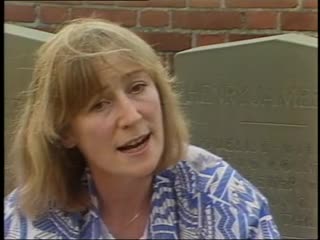
Description: Interview with Miranda Seymour, biographer of Henry James, while sitting by his gravestone in Cambridge.
Collection: Ten O'Clock News
Date Created: 09/01/1989